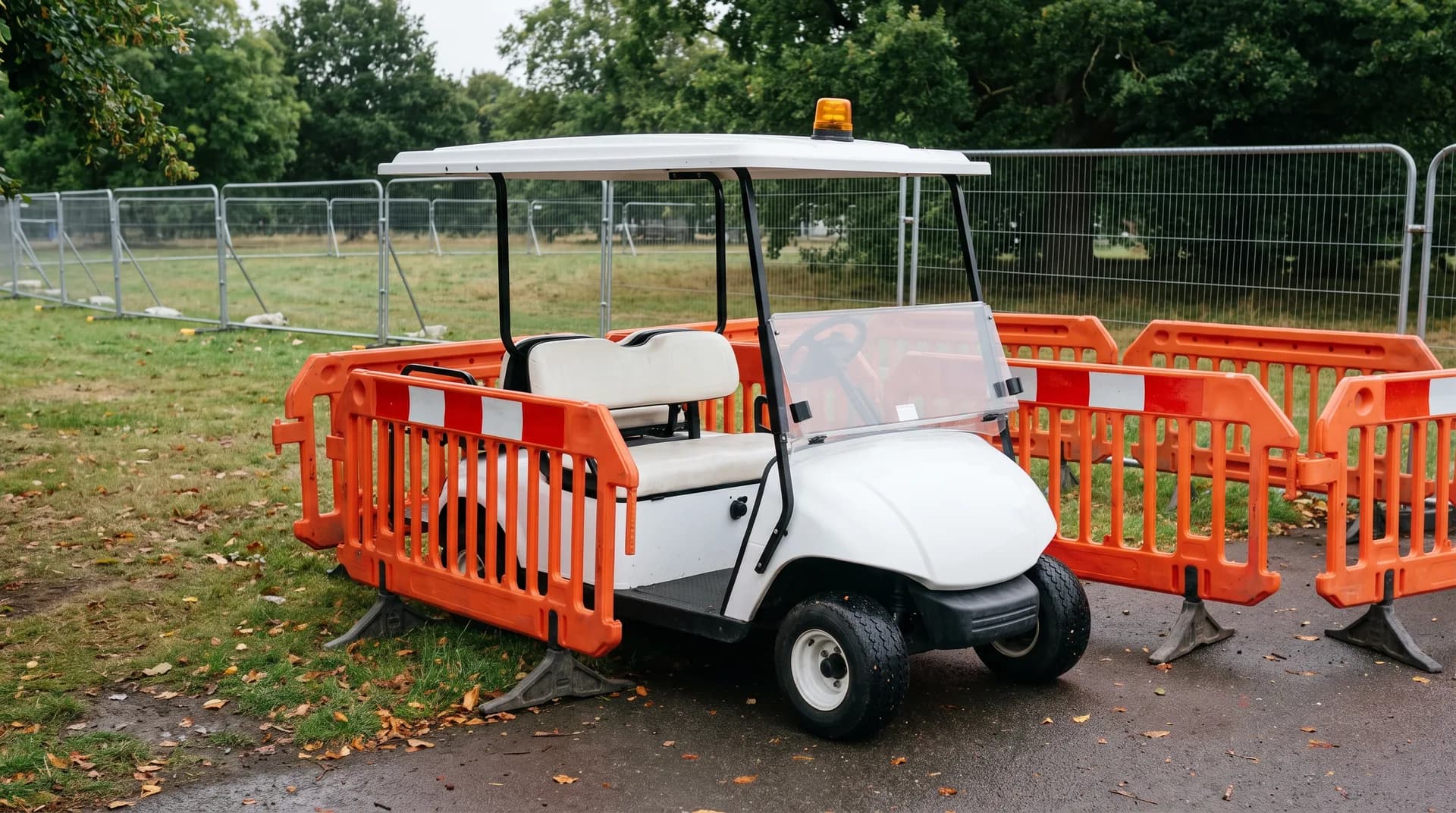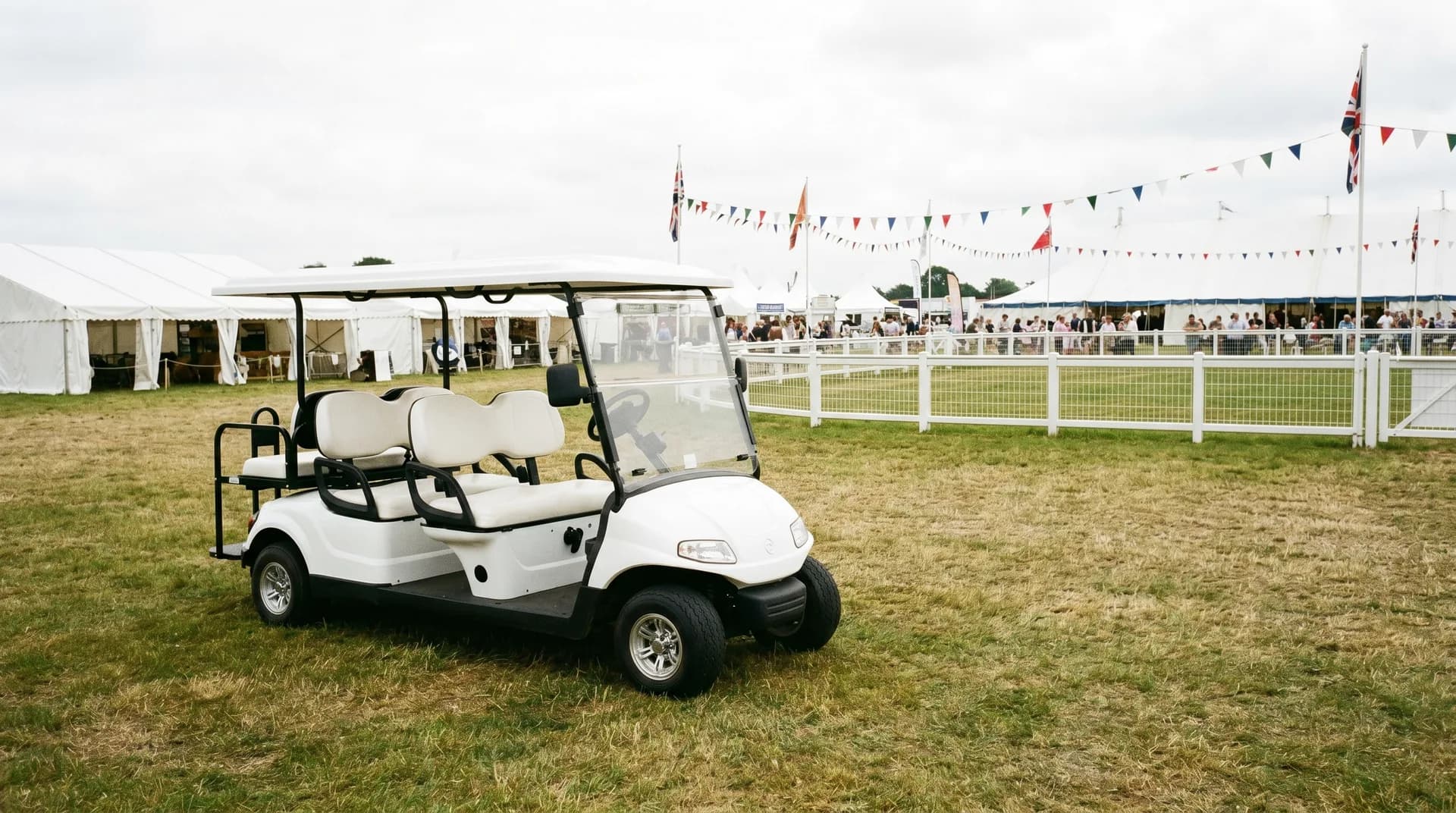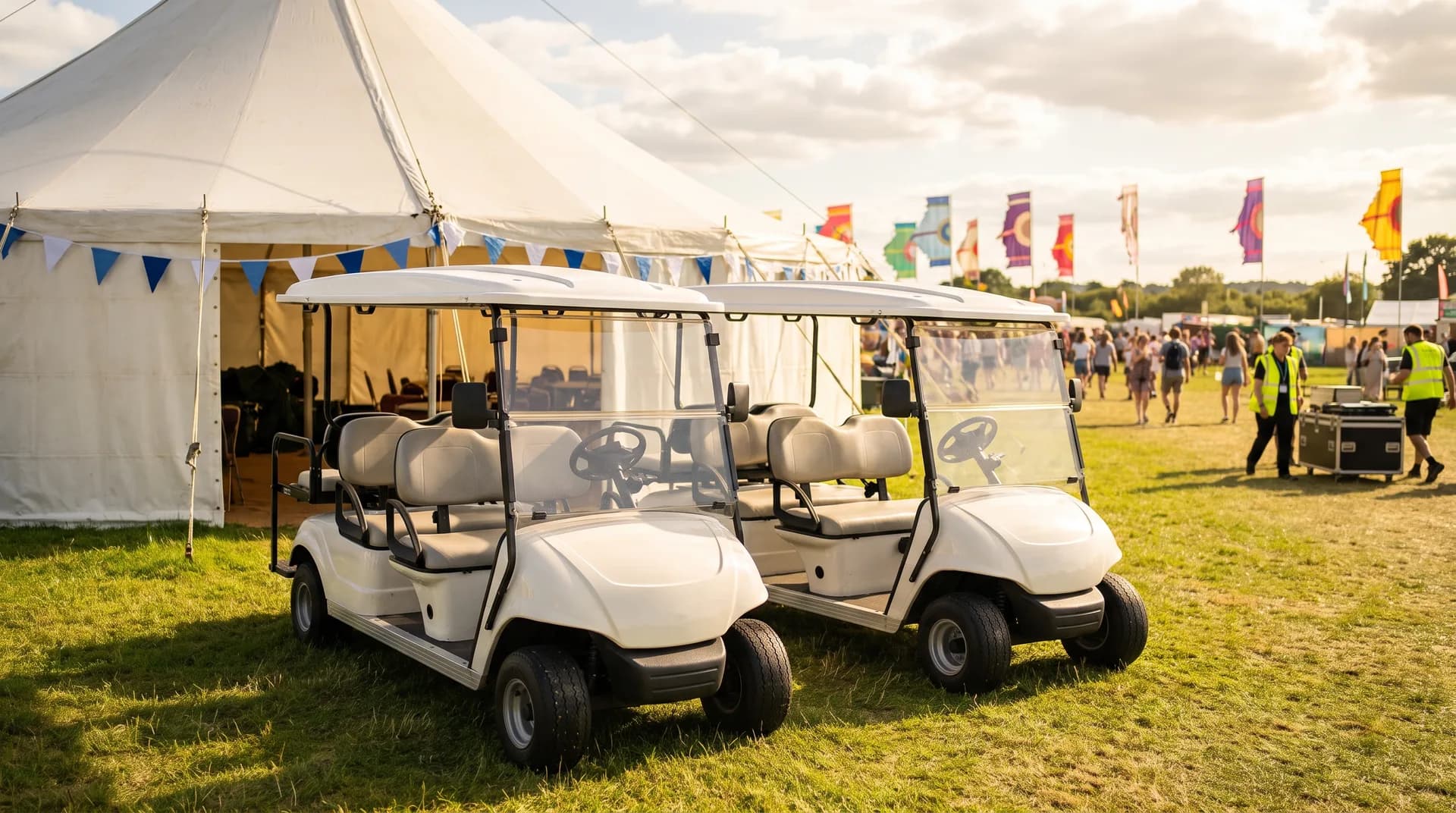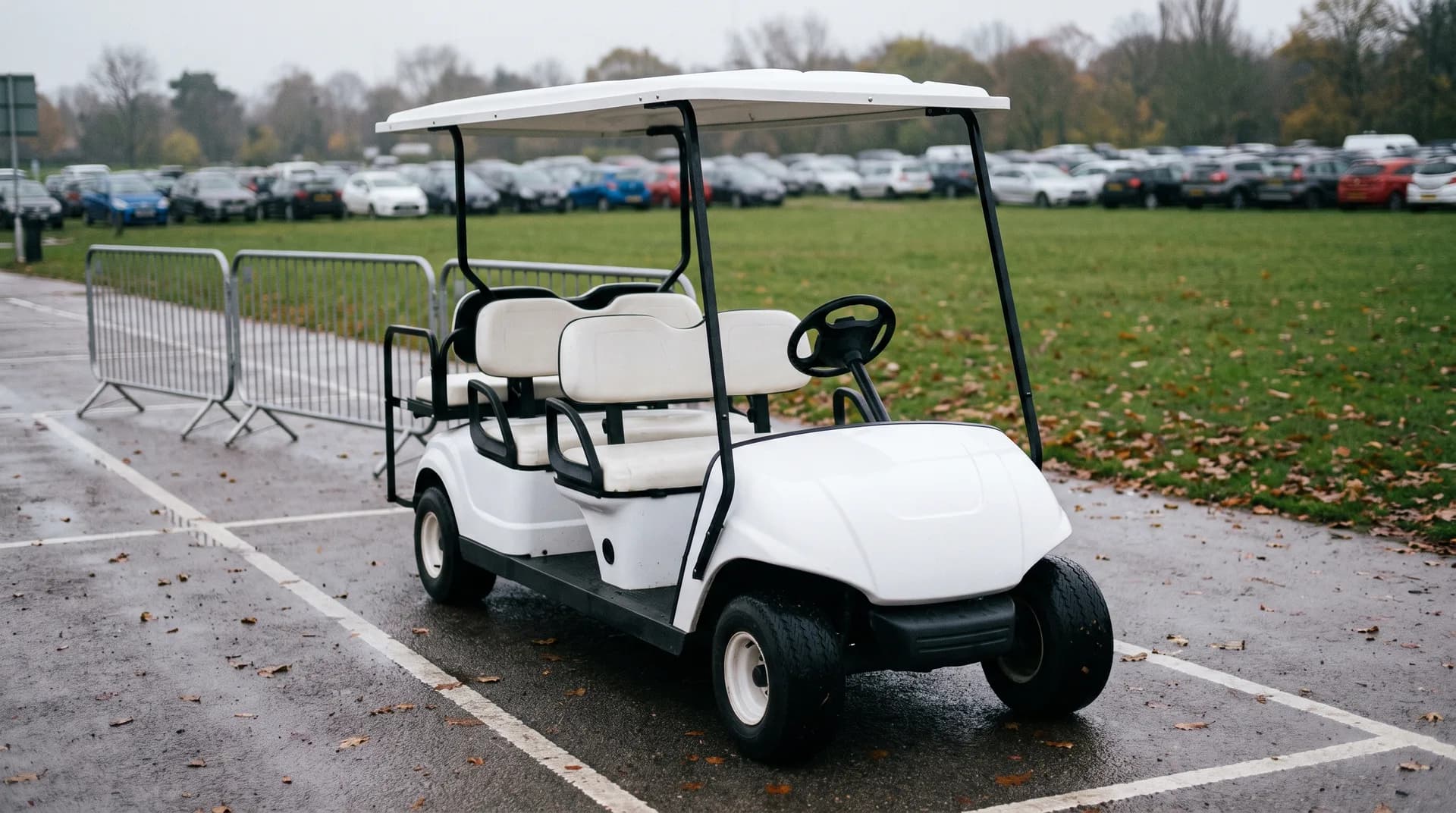
Most event buggy operations that disappoint were not under-resourced, they were badly routed. The fleet was the right size, the drivers were willing, and the whole thing still crawled, because the route crossed the main pedestrian flow four times, reversed in a dead end, and shared a gate with the caterers. Routing is the cheapest lever in event transport and the least used. Get it right and three buggies do the work of five; get it wrong and five do the work of two while generating complaints. This guide covers how to plan buggy routes on a UK event site: how to segregate from pedestrians, why loops beat out-and-back, where the pinch points always are, and how to turn the plan into something a driver can follow at eight on a wet Saturday evening.
- Separate vehicles from pedestrians wherever you can; cross at defined, marshalled points where you cannot.
- One-way loops almost always outperform out-and-back routes: no reversing, no passing conflicts, predictable timings.
- Design out reversing entirely; it is the single most avoidable hazard on an event site.
- Time the route before you size the fleet, because round-trip time decides capacity more than seat count does.
- Publish one site map with routes, stops, crossings and no-go areas, and brief every driver from it.
Start with segregation, not with the map
The first question is not where the buggies go, it is where the people go. Map your pedestrian flows first: the walk from the car parks, the route from the gate to the main arena, the paths between food, toilets and stages, and the surges that happen when something starts or finishes. Only then draw vehicle routes, and draw them where those flows are not. On most sites there is more separated space available than organisers assume: service roads, perimeter tracks, the back of house route the traders use, the edge of a car park field. Using them costs nothing but a slightly longer distance, and it removes the dominant hazard in your risk assessment at a stroke. Where a crossing is genuinely unavoidable, make it one place rather than five, mark it, and marshal it at peak times.
Loops beat out-and-back, almost always
A one-way loop is the single best structural decision in event buggy routing. It eliminates reversing, which is the most avoidable hazard on any site. It removes passing conflicts on narrow tracks, which is what actually slows an out-and-back route to a crawl. It makes journey times predictable, because every trip is the same distance. And it makes the service legible to the public, who can be told the buggy comes past every few minutes rather than having to flag one down. Where a site simply will not support a loop, the fallback is a wide out-and-back with defined passing places and a rule about who yields. Design your turning circles at both ends of the route at the planning stage; a beautifully drawn route that ends in a three-point turn between two marquee guy lines will not survive its first hour.
- Typical use
- Continuous shuttle around a site
- Strengths
- No reversing, no passing conflict, predictable timings
- Watch out for
- Longer distance, needs a full circuit of usable ground
- Typical use
- Car park to gate, single link
- Strengths
- Shortest distance, simple to brief
- Watch out for
- Passing conflict, reversing at each end, unpredictable timings
- Typical use
- One interchange serving several destinations
- Strengths
- Efficient use of a small fleet, easy to marshal
- Watch out for
- The hub becomes a queue and needs managing
- Typical use
- VIP, artist liaison, site management
- Strengths
- Flexible, responsive
- Watch out for
- Impossible to schedule, easily consumed by low-value trips
| Typical use | Strengths | Watch out for | |
|---|---|---|---|
| One-way loop | Continuous shuttle around a site | No reversing, no passing conflict, predictable timings | Longer distance, needs a full circuit of usable ground |
| Out-and-back | Car park to gate, single link | Shortest distance, simple to brief | Passing conflict, reversing at each end, unpredictable timings |
| Hub and spoke | One interchange serving several destinations | Efficient use of a small fleet, easy to marshal | The hub becomes a queue and needs managing |
| On-demand roaming | VIP, artist liaison, site management | Flexible, responsive | Impossible to schedule, easily consumed by low-value trips |
Time the route before you size the fleet
Fleet size follows from round-trip time, not the other way round, and the most common planning error is to guess a number of buggies before anyone has walked the route with a stopwatch. Walk it, or better, drive it at the speed you will actually permit, with the loading and unloading time included, because loading is where the minutes go. A five-minute round trip and a fifteen-minute round trip on the same site demand completely different fleets for the same passenger numbers. Once you have that figure, the arithmetic in our guide on how many buggies your event needs does the rest, and the event buggy hire calculator will turn it into an indicative cost. Time the route in the conditions you expect, too: a route that takes six minutes on dry ground can take ten when it is wet and the crowd has doubled.
Pinch points: where every event site goes wrong
They are remarkably consistent from event to event. Gates and entrances, where vehicles, pedestrians and deliveries all want the same three metres. The area immediately outside the main arena or marquee, where people stop to look at their phones. Toilet blocks, which generate unpredictable pedestrian movement all day. Bar and food areas after dark. Contractor and trader routes, which run to their own timetable and cross yours. Car park exits at the end, which is the single worst ten minutes of most events. Identify yours on the map, then apply the cheapest control that works: reroute around it, marshal it, or simply schedule vehicles not to be there at the known peak. Scheduling is underused and remarkably effective, because a buggy that is parked during the surge is a hazard that does not exist.
Accessibility routes deserve protection
If your buggy operation includes an accessibility service, and on most public events it should, protect its route from everything else. It needs the most reliable surface, the shortest realistic distance, the fewest crossings, and priority when the fleet is under pressure, because the people relying on it have the fewest alternatives. The failure mode is predictable: the accessibility shuttle gets absorbed into general VIP ferrying by mid-afternoon and the people it was specified for are left waiting. Ring-fence the vehicles, ring-fence the route, and brief the drivers that this run does not get reassigned. Our guide to running an accessible shuttle covers the operation in full.
The one map that makes it work
- The route itself, with direction of travel marked on a one-way loop
- Stops and pick-up points, named the way the public will hear them announced
- Crossing points, marked and identified as marshalled or unmarshalled
- No-go areas: pedestrian-only zones, structures, cabling runs, ground you must not cross
- The charging and parking compound, and the route to it
- Pinch points and the times vehicles should avoid them
- The accessibility route, marked distinctly and protected
- Contractor and delivery routes, so drivers know where they will meet other vehicles
- Emergency vehicle routes and keep-clear areas
- A named contact and number for the transport lead
Brief it, then walk it with the drivers
A map that lives in a folder controls nothing. Print it, put a copy in every vehicle, and walk or drive the route with your drivers before the site opens, pointing at the crossings, the pinch points and the no-go ground as you go. Ten minutes of that is worth more than any amount of written procedure, and it surfaces the practical problems, the gate that is actually padlocked, the cable ramp that was not there yesterday, while there is still time to fix them. Then keep the plan alive during the event: sites change, marquees appear, a route that worked on Friday may be blocked by Saturday lunchtime, and the transport lead needs the authority to reroute and the means to tell every driver at once. If you tell us your site layout and the routes you are planning, we will specify vehicles that suit the ground and the distances in your hire quote. Routing matters most on the biggest sites, which is why it shapes every racecourse and county show fleet we quote.
Frequently asked questions
How do you plan buggy routes at an event?+
Map pedestrian flows first, then draw vehicle routes where those flows are not. Prefer a one-way loop, design out reversing, define and marshal any unavoidable crossings, and time the round trip before deciding how many vehicles you need.
Should event buggies use one-way routes?+
Wherever the site allows it, yes. One-way loops remove reversing and passing conflicts, make journey times predictable, and make the service easy to explain to the public. Out-and-back routes need defined passing places and a clear rule about who yields.
How do you separate buggies from pedestrians at an event?+
Use service roads, perimeter tracks and back-of-house routes rather than main pedestrian arteries, and concentrate any unavoidable interaction at one or two marked crossing points that are marshalled at peak times. Scheduling vehicles not to move during crowd surges is the cheapest control of all.
What is a site traffic management plan?+
A document showing how vehicles and pedestrians move around your site safely: routes, direction of travel, crossings, speed rules, no-go areas, loading arrangements and emergency access. Your buggy routes should form part of it rather than sitting separately.
How do I work out how long a buggy route takes?+
Walk or drive it at the speed you will actually permit, including loading and unloading time, and do it in the conditions you expect on the day. Round-trip time, not seat count, is what determines how many people your fleet can move in the peak hour.
Send us your site plan
Tell us the routes, distances and ground and we will specify a fleet sized to your round-trip time rather than to a guess.
Related solutions
Ready to explore what we build?
See the vehicles and the setting this applies to, or get a tailored quote built around your site.

Ready to find the right buggy?
Tell us how and where it will work and we will specify a vehicle and a tailored quote built around you. Every build comes with a 3-year warranty and a 24-hour priority call-out.
Our guides are written and reviewed by the Hawke Electric Vehicles team, the people who specify, build, deliver and support the vehicles. We focus on honest, practical advice and flag where a figure depends on the build rather than guessing.
More guides by Hawke