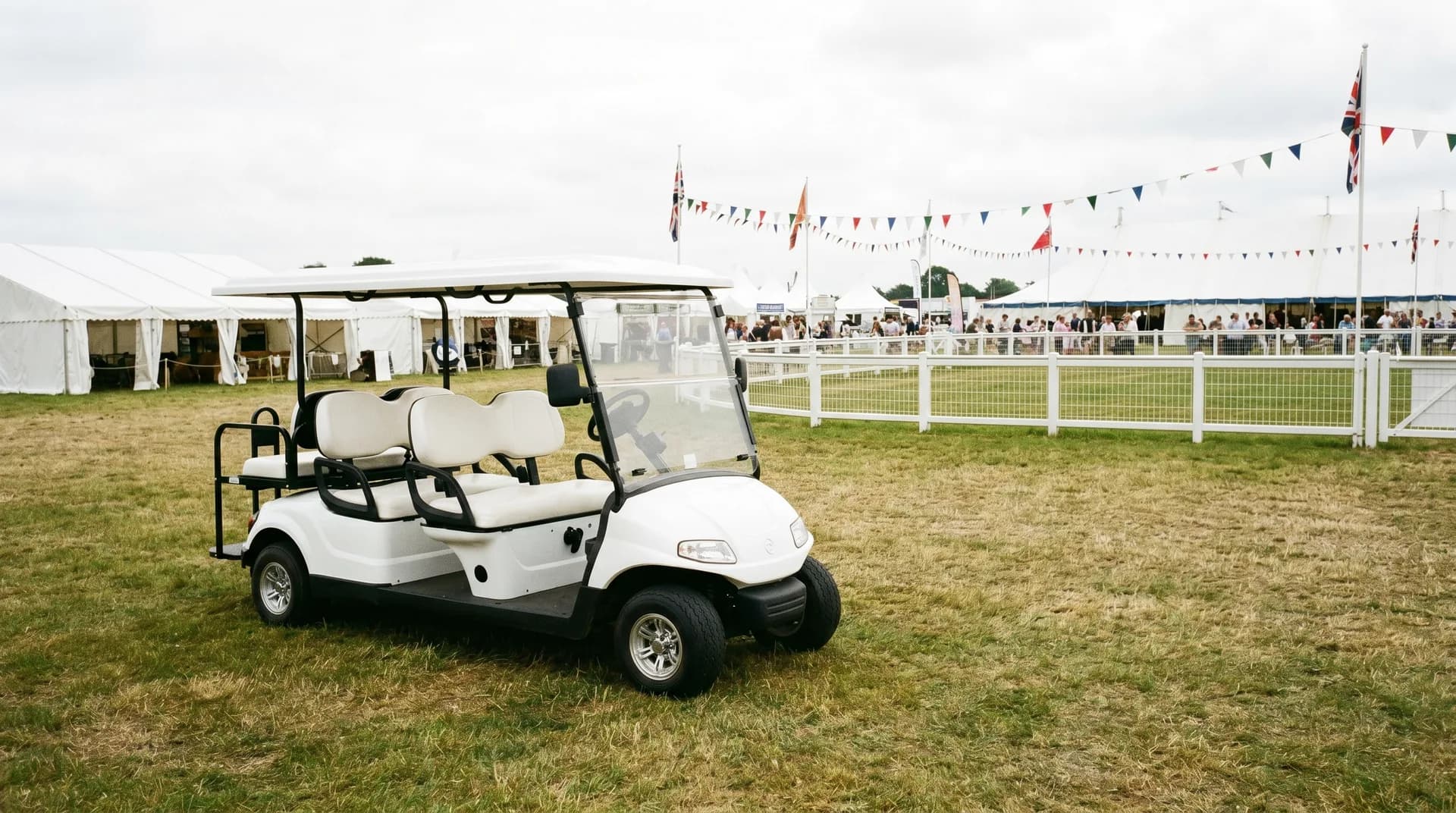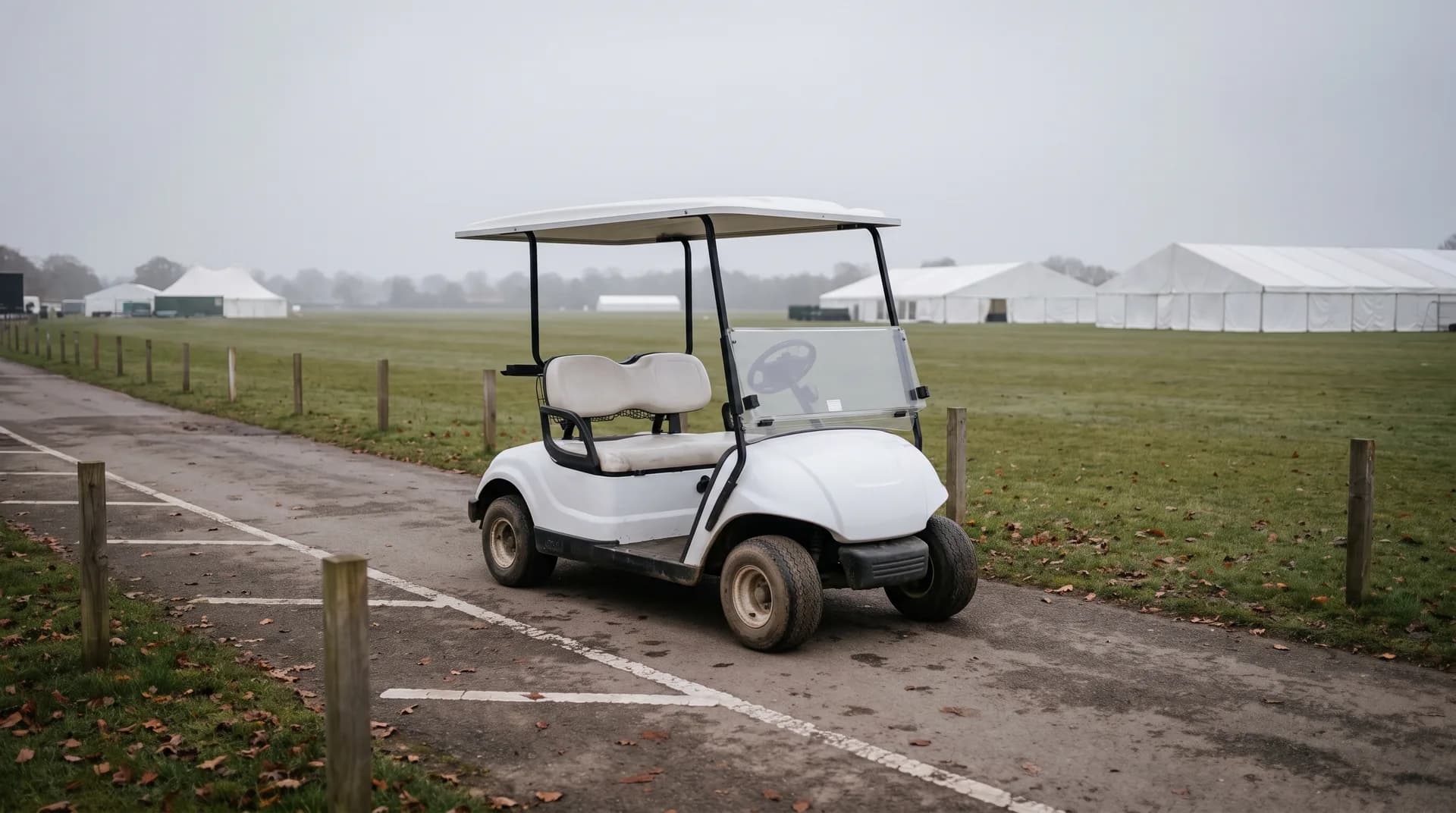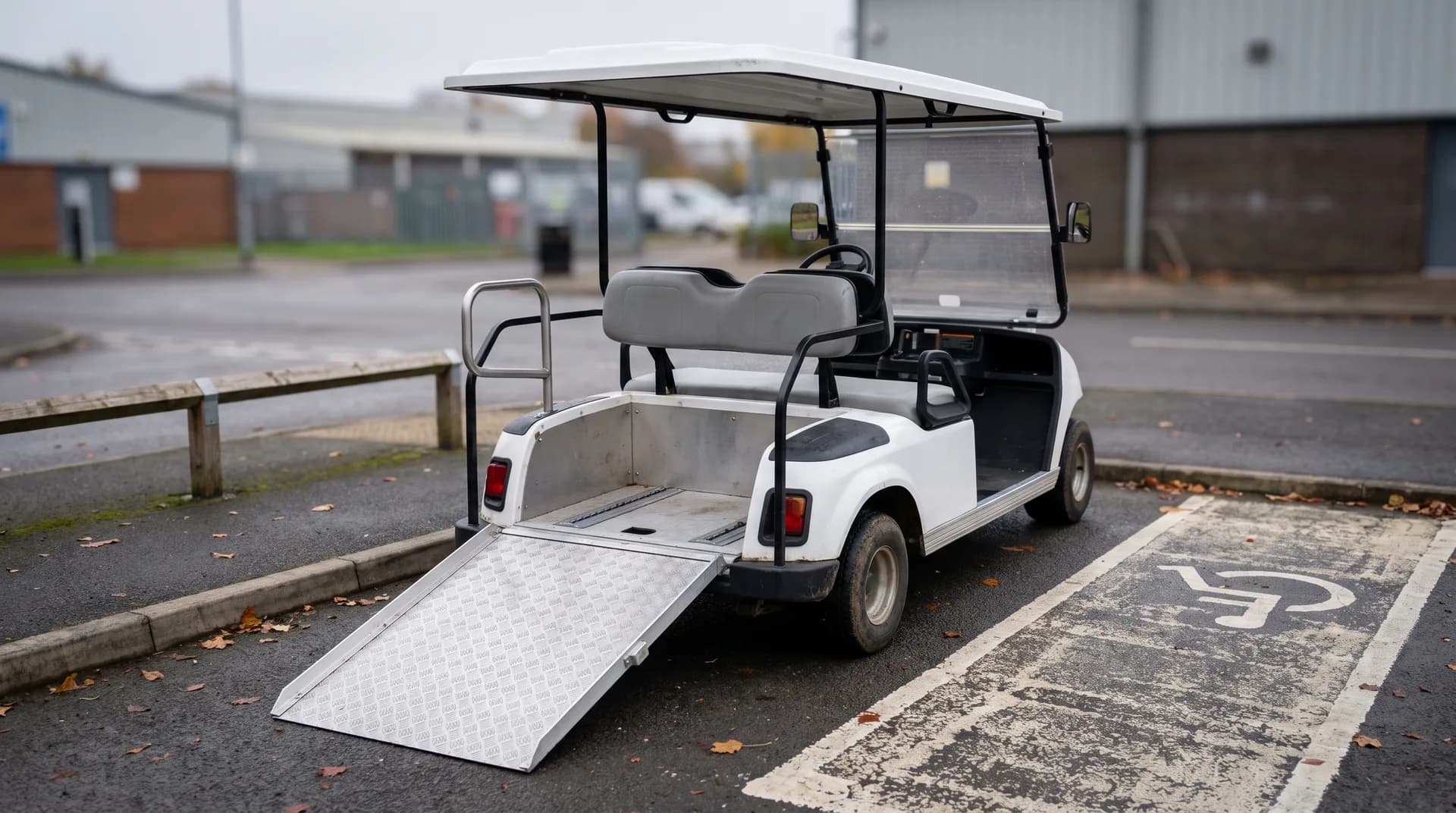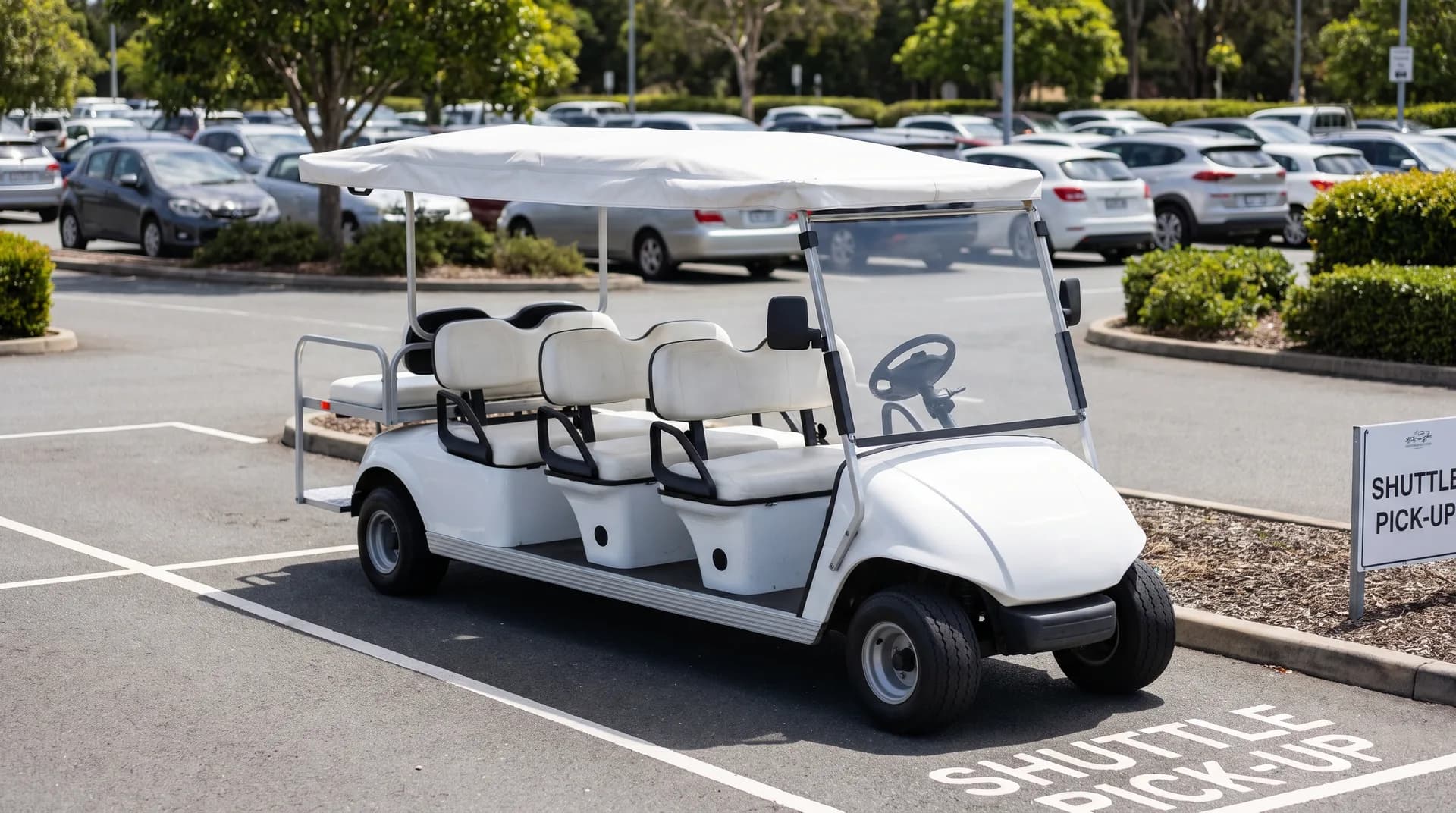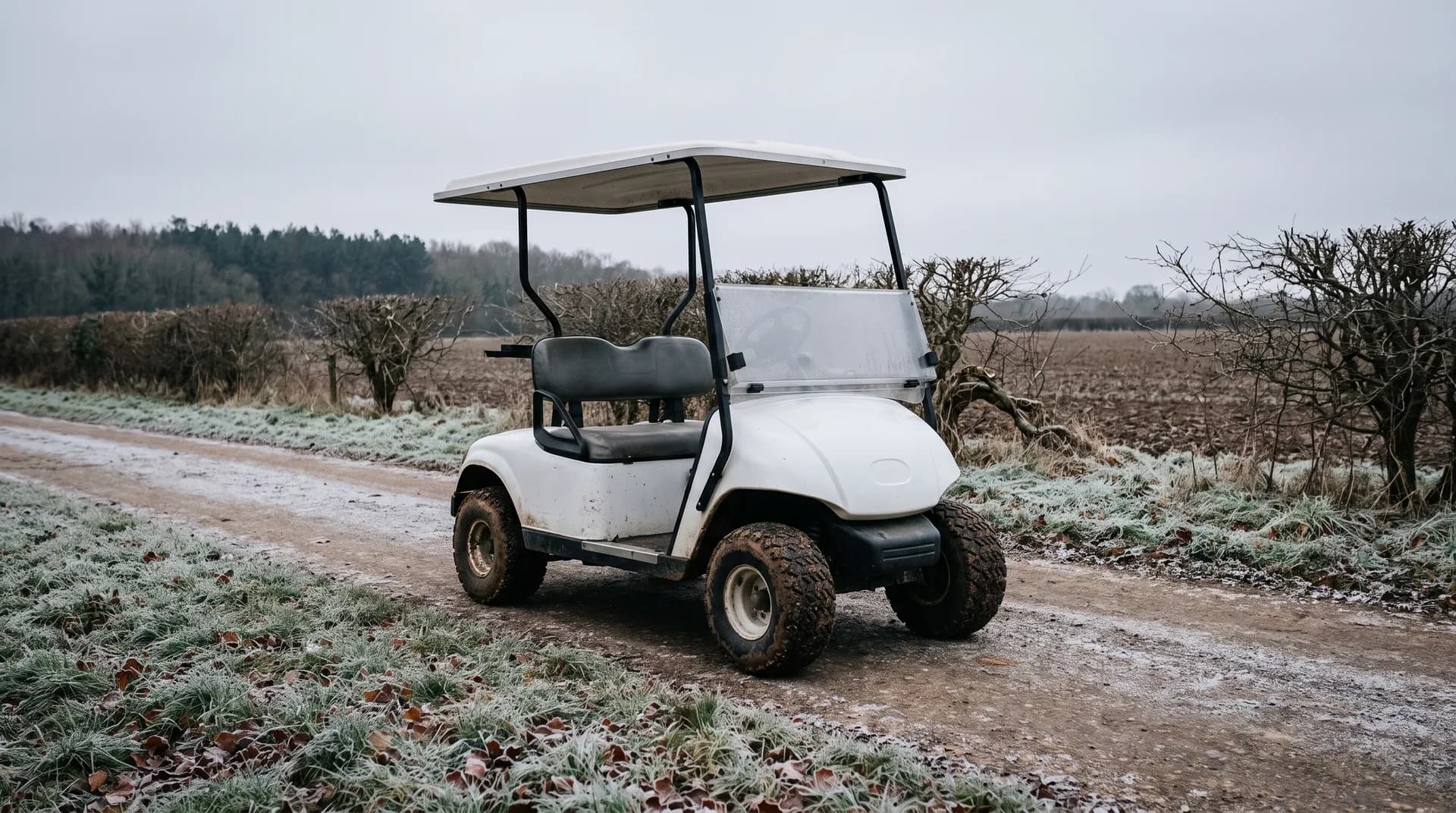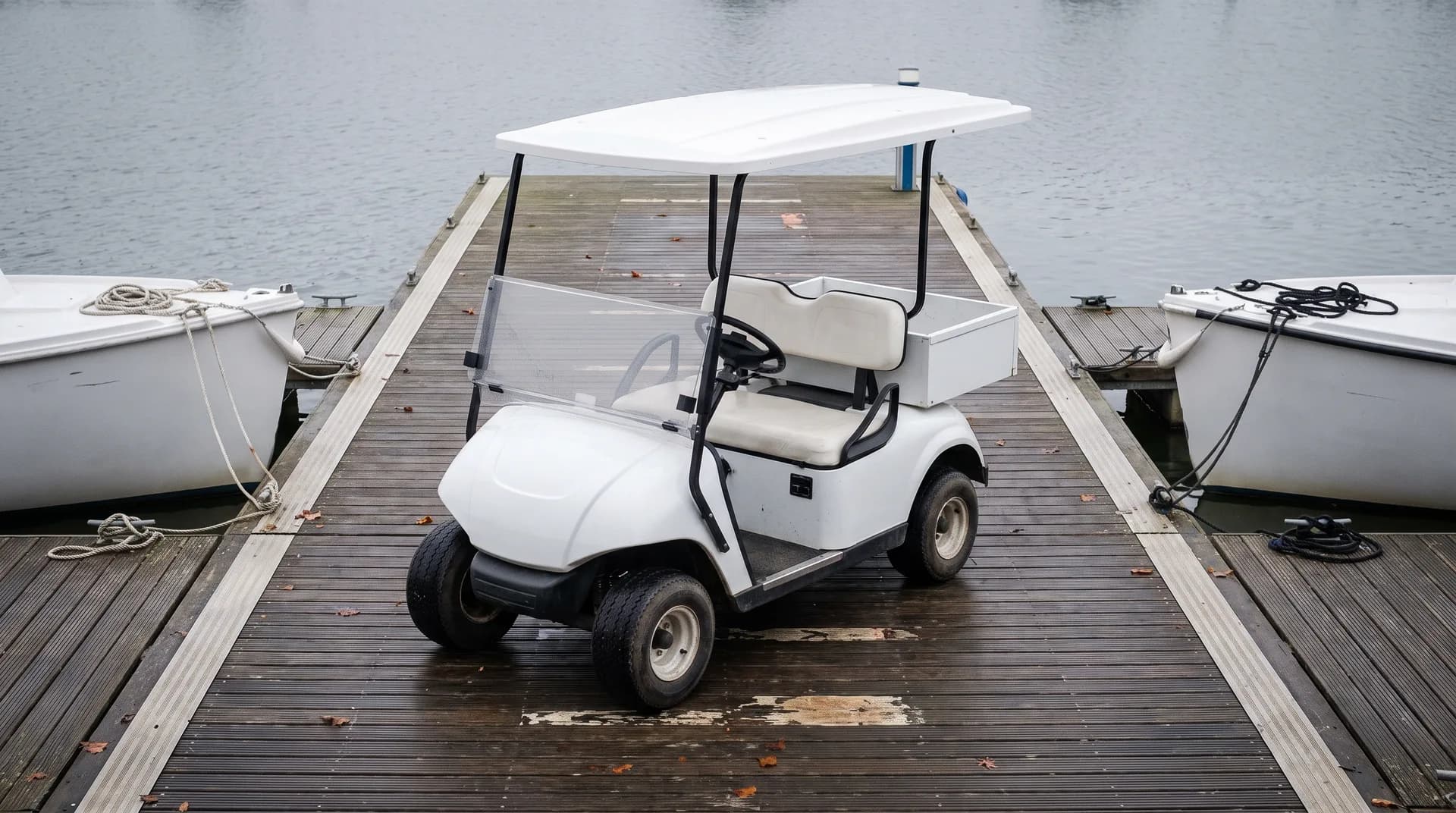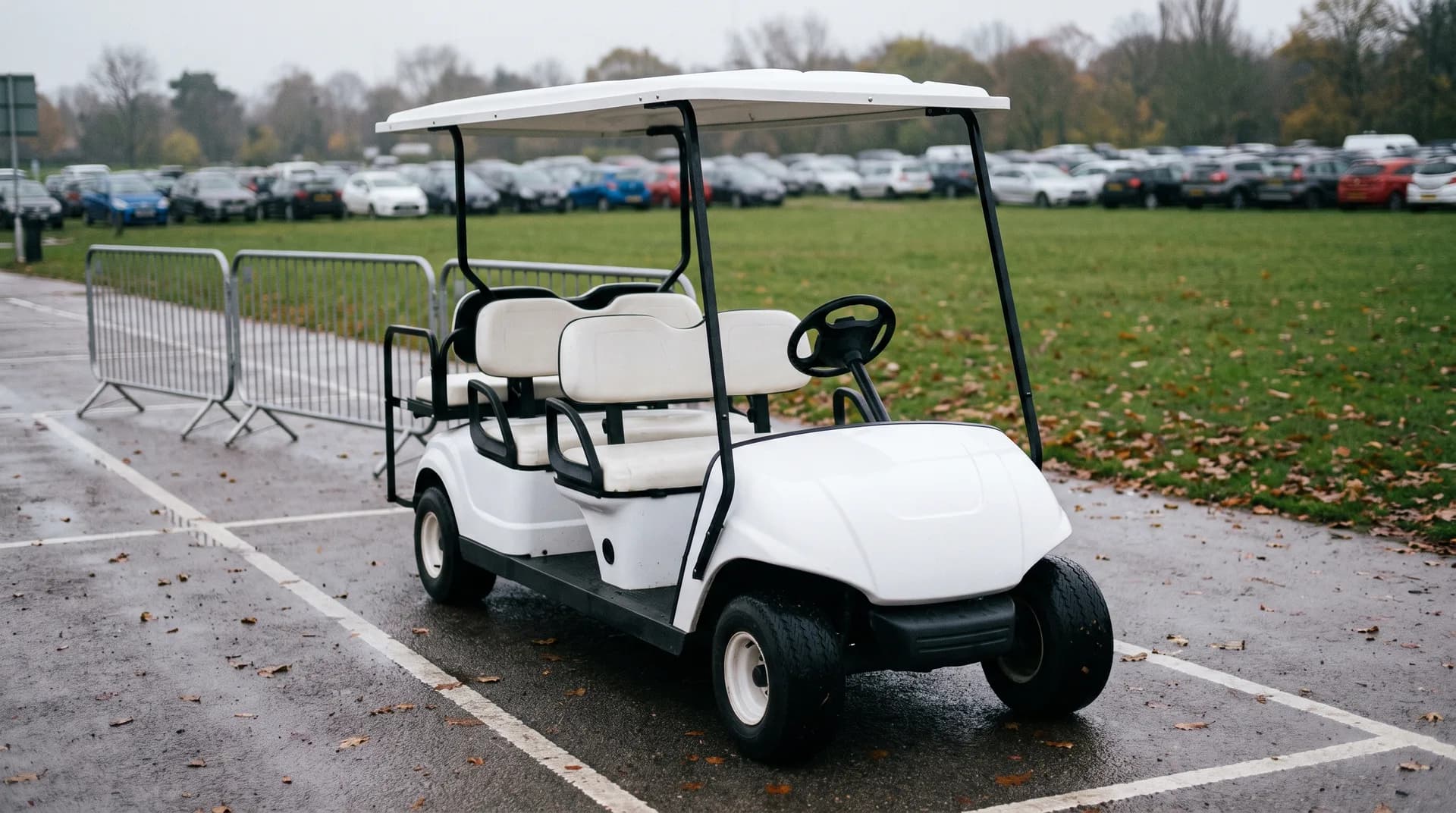
The walk from the car park to the gate is the first thing your visitors experience and the last, and it is the one part of the event you did not design, because the overflow field was a farmer's decision and the entrance was where the entrance has always been. That walk sets the mood on arrival and defines the memory on departure, particularly for anyone carrying a child, pushing a pushchair, wearing unsuitable shoes or managing a distance they find difficult. An event park and ride buggy shuttle is the highest-value single job a hired fleet does at most UK events, and it is also the one most often under-resourced at exactly the moment it matters. This guide covers how to run one properly: sizing it, handling the two peaks, managing queues, and where to put the stops.
- Arrival and departure are two different problems, and departure is always the harder one.
- Size the service from round-trip time at the peak, not from total attendance.
- Departure demand arrives all at once and does not spread; plan the fleet around that, not the average.
- Loading points need space, a queue system and somewhere to stand out of the weather.
- Signage and staff at both ends matter as much as the vehicles; an unmarked shuttle is an unused shuttle.
Arrival and departure are different problems
Arrival is the easy peak. People turn up across a window, often an hour or two, they are cheerful, and if there is a short wait they accept it because the event is ahead of them. Departure is the hard peak, and it is hard in a specific way: when the headline act finishes or the show closes, everyone leaves at once, the demand arrives in a single block that cannot be spread, and the people waiting are tired, often cold, sometimes wet, and want to be in their car. A shuttle sized for the arrival profile will be visibly overwhelmed at departure, and that is the experience people remember and describe to others. Plan the fleet, the staffing and the queue arrangements around departure, and arrival looks after itself.
Sizing an event park and ride buggy shuttle
Use round-trip time, not attendance. Walk or drive the route at the speed you will permit, including loading and unloading, and get an honest figure; loading is where the minutes disappear, especially with luggage, children and chairs. A vehicle making a six-minute round trip completes ten trips an hour; a six-seater carrying five passengers therefore moves around fifty people an hour on that route. Divide your peak demand by that figure and you have your fleet. Then apply two corrections. Add for departure, because that peak is compressed. And be honest about who actually rides: at a family event on a wet day it can be most of the car park, while at a fine-weather event with a short walk it may be a small minority. Our guide on how many buggies your event needs works through the arithmetic, and the event buggy hire calculator will price it.
- What it needs
- Space for a queue clear of moving traffic, clear signage, a marshal
- Common failure
- Queue forms in a live traffic lane
- What it needs
- A drop-off clear of the entrance flow, and a separate pick-up point
- Common failure
- Drop-off and pick-up in the same place, blocking both
- What it needs
- Continuous running, visible signage from the parking bays
- Common failure
- Service starts late, after the first arrivals have walked
- What it needs
- Full fleet, extra marshals, a queue that people can see the end of
- Common failure
- Fleet sized for arrival, so departure overwhelms it
- What it needs
- A protected vehicle and a clear priority rule
- Common failure
- Priority quietly disappears once the queue builds
| What it needs | Common failure | |
|---|---|---|
| Car park stop | Space for a queue clear of moving traffic, clear signage, a marshal | Queue forms in a live traffic lane |
| Gate stop | A drop-off clear of the entrance flow, and a separate pick-up point | Drop-off and pick-up in the same place, blocking both |
| Arrival peak | Continuous running, visible signage from the parking bays | Service starts late, after the first arrivals have walked |
| Departure peak | Full fleet, extra marshals, a queue that people can see the end of | Fleet sized for arrival, so departure overwhelms it |
| Accessibility priority | A protected vehicle and a clear priority rule | Priority quietly disappears once the queue builds |
Queue management is most of the job
A shuttle queue is a queue of people who chose not to walk, which usually means they had a reason, and it is a queue that behaves badly if it is not managed. Three things make it work. Make the queue visible and finite: people tolerate a wait they can see the end of and lose patience with one that disappears around a corner, so use a barriered lane rather than a crowd. Put a marshal at the front to load vehicles quickly and fairly, because loading speed determines throughput more than vehicle speed does, and an unmanaged queue loads slowly and argues. And communicate: a marshal saying the next buggy is two minutes away transforms the mood of a queue in bad weather. Add somewhere to sit or shelter if you can, and enforce your accessibility priority rule visibly, because priority that is not visible is not real.
Where to put the stops
The two stops are more important than the route between them. At the car park end, put the stop where people naturally arrive rather than where it is tidy on a plan, keep the waiting area clear of moving vehicles, and sign it from the parking bays themselves, because a shuttle nobody can see is a shuttle nobody uses. At the gate end, separate the drop-off from the pick-up: using one point for both is the single most common design error, and it produces a knot of vehicles, arriving guests and departing guests in exactly the place your entrance flow needs to be clear. Keep both stops off the main pedestrian desire line, and make sure a vehicle can turn or loop without reversing, which our traffic management guide covers.
Signage, staffing and telling people it exists
A well-run shuttle with no signage carries almost nobody, and the organiser concludes that the service was not needed. Sign it from the parking bays, at the stop, at the gate, and in the pre-event information, and describe it in plain terms, where it runs from and to, how frequently, whether there is a priority arrangement. Staff both ends, because a shuttle with a driver but no marshals loads slowly, queues badly and cannot enforce priority. And publish it in advance alongside your accessibility information, because people deciding whether the event is manageable for them will be looking for exactly this, as our guide to running an accessible shuttle explains.
Getting the shuttle right
Almost every park and ride shuttle that disappointed did so for one of three reasons: it was sized for arrival rather than departure, the stops were badly placed, or nobody knew it existed. All three are fixed in planning, none of them costs much, and together they turn a service people complain about into the thing they mention in the feedback form. Send us the two distances, the surfaces, your expected peaks and how long the route takes to drive, and we will specify a fleet sized for the departure surge rather than the average, and price it in a hire quote. Park and ride is a fixture at racecourses, marathons and mass-participation events and county shows.
Frequently asked questions
How many buggies do you need for an event car park shuttle?+
Size it from the round-trip time on your actual route rather than from attendance. A six-minute round trip means about ten trips an hour per vehicle, so a six-seater moves roughly fifty people an hour. Divide peak demand by that figure, then add capacity for the departure surge.
Why is departure harder than arrival for an event shuttle?+
Because arrival spreads across a window while departure happens all at once when the event ends, and the people waiting are tired, often cold and want to be in their car. A fleet sized for the arrival profile will be visibly overwhelmed at departure, which is the experience people remember.
Where should the shuttle stops be at an event?+
At the car park end, where people naturally arrive, clear of moving traffic and signed from the parking bays. At the gate end, with the drop-off and pick-up in separate places, because combining them is the most common design error and blocks the entrance flow for everyone.
How do you manage the queue for an event shuttle?+
Make it visible and finite with a barriered lane rather than a crowd, staff the front so loading is fast and fair, and communicate waiting times. Loading speed determines throughput more than vehicle speed does, and an unmanaged queue loads slowly and argues about priority.
Do you need to advertise an event shuttle in advance?+
Yes. A shuttle nobody knows about carries almost nobody, and organisers then conclude it was not needed. Publish it in the pre-event information and alongside your accessibility information, and sign it clearly at the parking bays, the stop and the gate.
Running a park and ride?
Send us the distances, the surfaces and your expected peaks and we will size a shuttle fleet for the departure surge, not the average.
Related solutions
Ready to explore what we build?
See the vehicles and the setting this applies to, or get a tailored quote built around your site.

Ready to find the right buggy?
Tell us how and where it will work and we will specify a vehicle and a tailored quote built around you. Every build comes with a 3-year warranty and a 24-hour priority call-out.
Our guides are written and reviewed by the Hawke Electric Vehicles team, the people who specify, build, deliver and support the vehicles. We focus on honest, practical advice and flag where a figure depends on the build rather than guessing.
More guides by Hawke