Ask most hire companies how many buggies your event needs and the answer is "call us". That is fair enough, every event is different, but it is not much help when you are building a budget at 10pm with a spreadsheet open. So here is the working. The honest answer is that fleet size is not driven by how many people attend your event. It is driven by how many journeys the buggies must make in your busiest hour, and how long each journey takes. Get those two numbers roughly right and the fleet sizes itself.
- Size the fleet from peak-hour journeys, not total attendance.
- Work out how many round trips one buggy can make per hour on your site, then divide.
- A six-seater moving guests on a 5-minute route can shift roughly 30 to 40 people an hour.
- Crew, site ops and accessibility each need their own vehicles, not leftover seats.
- Our [event calculator](/event-buggy-hire-calculator) does this arithmetic for you and returns an instant estimate.
The framework: peak-hour person-moves
Start with three questions. First, who actually rides? At most events it is a fraction of attendance: guests with a long walk, VIPs, artists, crew, judges, and anyone with limited mobility. Second, when is the crunch? There is almost always one, arrival, the headline act, carriages at midnight. Third, how long is the round trip, there and back, including loading? On a compact site that might be 5 minutes; across a large showground with gates and crowds it can be 15 or more.
Then the arithmetic. A buggy making a 10-minute round trip completes about 6 trips an hour. A six-seater carrying a driver and 5 passengers therefore moves roughly 30 people an hour on that route. If your crunch hour needs 90 people moved, that is 3 six-seaters, or 2 if you can stretch the peak over two hours. That is the whole method: peak people to move, divided by what one vehicle can realistically shift.
Worked example: a wedding with 100 guests
Picture a marquee wedding where the car park sits a long, muddy 600 metres from the ceremony. Not all 100 guests will want a lift, but grandparents, anyone in heels on grass, and everyone once the drinks have flowed will. Assume half ride at the arrival peak, 50 people across about 45 minutes. A six-seater on a 5-minute round trip moves 5 guests every 6 minutes or so, call it 35 to 40 in that window. One six-seater covers it with a little queuing; two makes it feel effortless and gives you cover for photos, elderly guests and the end-of-night run. For most weddings of this size, 1 to 2 six-seaters is the honest answer.
Worked example: a regional festival
A festival is not one transport job, it is several, and they do not share well. Artist liaison needs a smart people-mover on standby, which means it cannot also be hauling water to a bar. A sensible mixed fleet for a regional festival is built by role: a 6-seater or two dedicated to artists and VIPs, a couple of 4-seaters for site management and stewards who need to be anywhere fast, and utility or 4x4 vehicles for the site crew moving kit, waste and stock. That might land at 5 to 8 vehicles for a multi-stage regional event, more for a long build and break, when the crew fleet often works harder than it does during the show itself.
Worked example: a county show
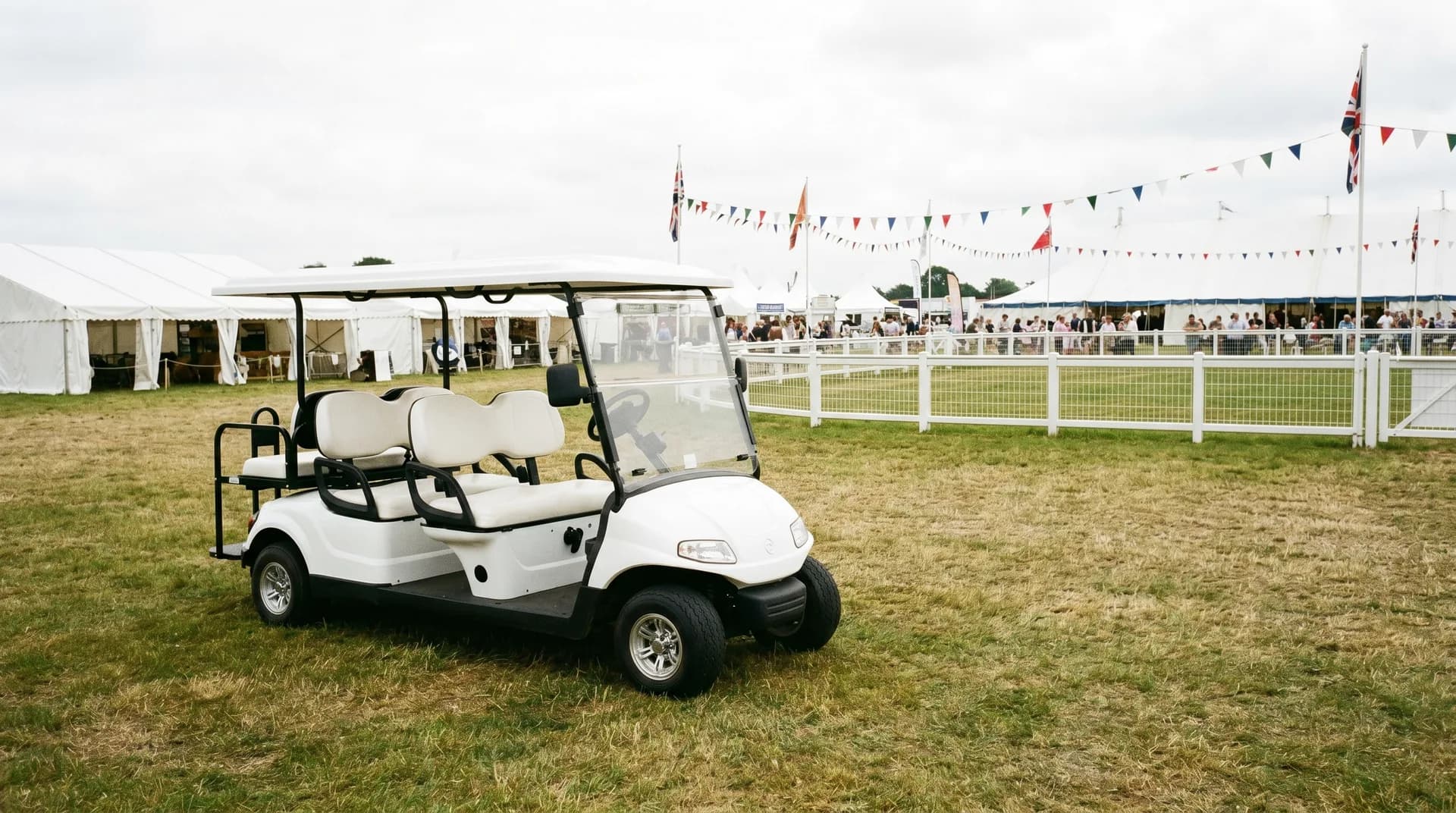
A county show adds two jobs festivals do not have: judges and stewards on a timetable, and a real accessibility duty across a large ground. Judging rings run to the clock, so the vehicles serving them cannot be shared with ad-hoc requests, one or two dedicated buggies with drivers keep the schedule honest. On top of that, an accessibility shuttle from the car parks, looping continuously rather than on demand, is often the single most appreciated service on site. A typical medium county show runs 3 to 6 vehicles: judges and stewards, an accessibility loop, and one for the site team.
- Typical fleet
- 1 to 2 six-seaters
- Sized by
- Arrival peak and end of night
- Typical fleet
- 2 to 4 people-movers
- Sized by
- Session changeovers
- Typical fleet
- 3 to 6 mixed vehicles
- Sized by
- Judging timetable + accessibility loop
- Typical fleet
- 5 to 8 mixed vehicles
- Sized by
- Roles: artists, stewards, site crew
- Typical fleet
- 10 plus
- Sized by
- Per department, build and break included
| Typical fleet | Sized by | |
|---|---|---|
| Wedding, up to ~120 guests, long walk | 1 to 2 six-seaters | Arrival peak and end of night |
| Corporate day or conference campus | 2 to 4 people-movers | Session changeovers |
| County or agricultural show | 3 to 6 mixed vehicles | Judging timetable + accessibility loop |
| Regional festival, multi-stage | 5 to 8 mixed vehicles | Roles: artists, stewards, site crew |
| Major festival or large site build | 10 plus | Per department, build and break included |
What changes the number
- Site size and terrain: a hilly, rutted or spread-out site slows every round trip, which cuts each buggy's hourly capacity.
- Operating hours: a 12-hour day is fine on one charge for most jobs; around-the-clock operation needs a charging rota or extra vehicles.
- Drivers: provided drivers keep vehicles working constantly; self-drive fleets idle between errands, so you sometimes need one more.
- Overnight charging: with mains power on site, the fleet resets every night. Without it, plan generator charging or petrol and diesel options.
- Weather: rain doubles demand for lifts and softens the ground at the same time. If in doubt, round up.
Get your number in two minutes
This framework gets you to a defensible fleet size on the back of an envelope, and our event buggy hire calculator does the same arithmetic interactively: tell it your event type, dates and site, and it returns an instant estimate you can put in a budget. For what drives the price itself, see our guide to event buggy hire costs, and for how the whole process runs, how event buggy hire works. Two refinements are worth applying to whatever number you land on: size for the departure surge on a car park shuttle rather than the average, and time your route properly, because round-trip time decides capacity far more than seat count does.
Frequently asked questions
How many buggies do I need per 100 event guests?+
There is no fixed ratio, because it depends on how many guests actually ride and how long the route is. As a starting point, one six-seater on a short route moves 30 to 40 people an hour, so a 100-guest wedding with a long walk typically needs 1 to 2 six-seaters. Size from your peak hour, not total attendance.
How many people can one buggy move per hour?+
Take the round-trip time including loading and divide it into 60, then multiply by the passenger seats. A six-seater (driver plus 5 passengers) on a 10-minute round trip moves roughly 30 people an hour; on a 5-minute route, roughly double that.
Should crew and guests share buggies?+
Usually not. Guest transport, artist liaison, site operations and accessibility are different jobs with different peaks, and sharing means the vehicle is always in the wrong place. Size each role separately, even if the totals are small.
Is it better to have too many or too few?+
Slightly too many. An idle buggy costs a modest day rate; a queue of wet guests or a missed artist stage time costs far more. If your numbers land between two fleet sizes, round up.
Can I get an estimate without calling anyone?+
Yes. Our event buggy hire calculator takes your event type, dates and site details and returns an instant estimate, which you can turn into a formal quote when you are ready.
Size your fleet in two minutes
Answer a few questions about your event and get an instant estimate, then turn it into a quote when you are ready.
Related solutions
Ready to explore what we build?
See the vehicles and the setting this applies to, or get a tailored quote built around your site.
Ready to find the right buggy?
Tell us how and where it will work and we will specify a vehicle and a tailored quote built around you. Every build comes with a 3-year warranty and a 24-hour priority call-out.
Our guides are written and reviewed by the Hawke Electric Vehicles team, the people who specify, build, deliver and support the vehicles. We focus on honest, practical advice and flag where a figure depends on the build rather than guessing.
More guides by Hawke