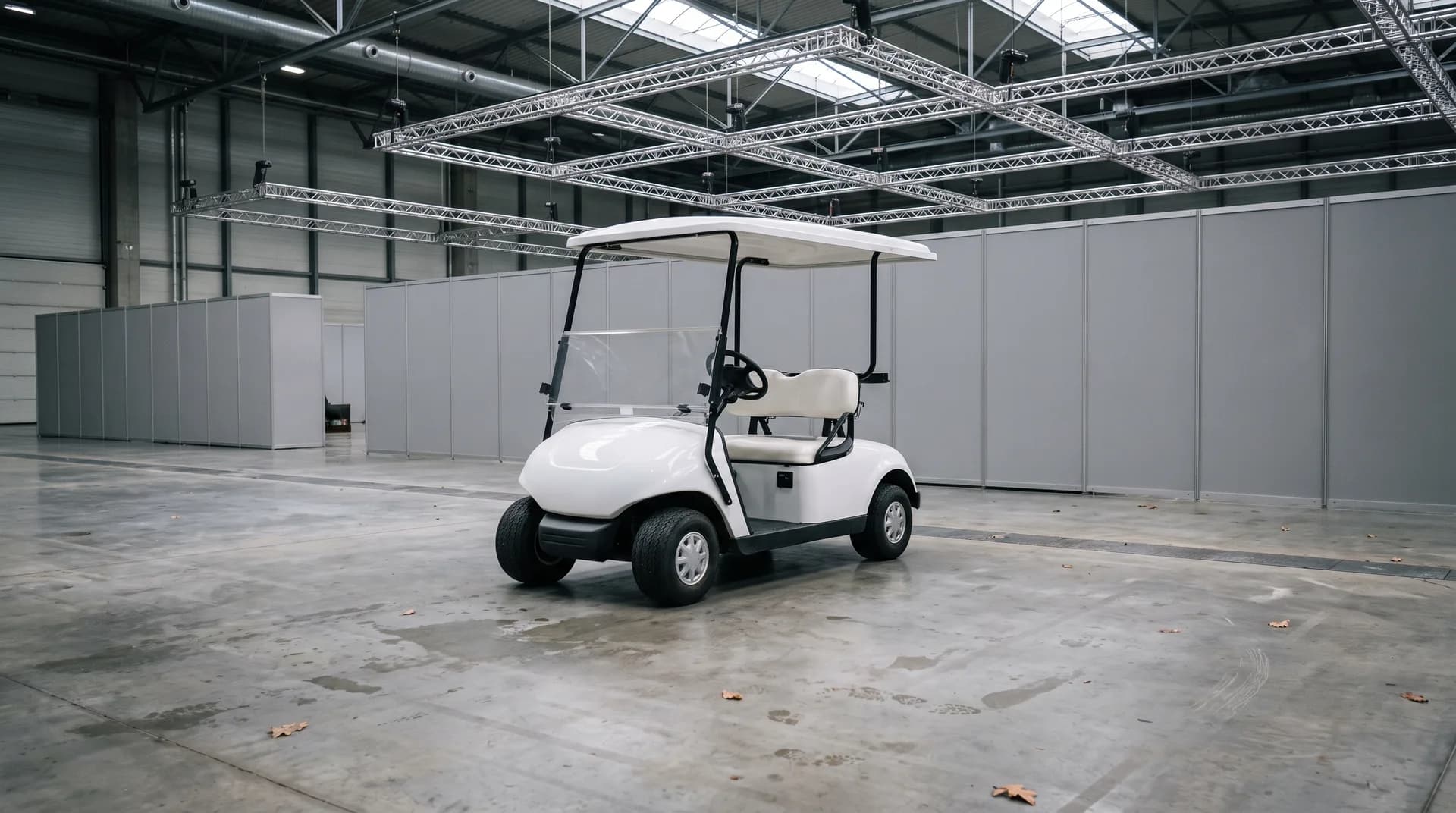
Exhibition venues are deceptively enormous. A hall that looks like a single room on a floor plan is a quarter of a mile end to end, and during build week the route from the loading bay to a stand in the far corner is a serious walk, repeated dozens of times a day by people carrying things. Add multi-hall venues, external car parks, hotel campuses and a build schedule measured in hours rather than days, and internal transport stops being a luxury. This guide covers buggy hire for UK trade shows and exhibitions: what the vehicles do during build, breakdown and the show itself, the indoor operating rules that catch people out, and how to specify a fleet that the venue will actually let you use.
- Build and breakdown are when exhibition buggies work hardest, not show days.
- Indoor operation is where venue rules bite: check floor loading, tyre marking, permitted areas and permits before booking.
- Electric is effectively mandatory indoors; petrol vehicles are unacceptable in enclosed halls on fumes alone.
- Show-day use is mostly organiser mobility, accessibility shuttles between halls, and VIP or press movement.
- Venue rules are set by the venue, not the organiser, so get them in writing early and pass them to your supplier.
Build and breakdown: where the value is
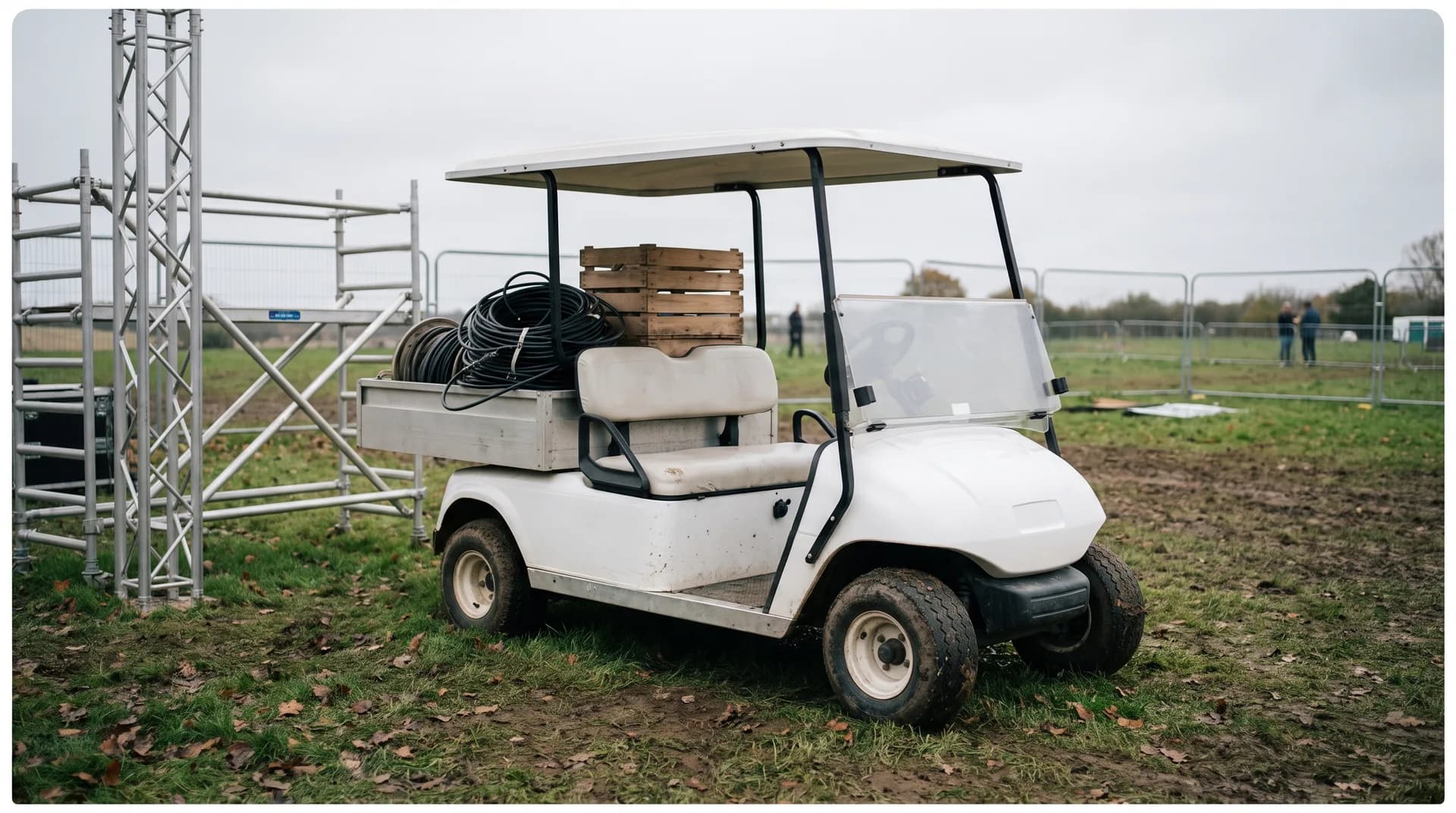
During build week an exhibition is a construction site with a deadline, and the constraint is almost always time rather than labour. Crews move stand components, tools, cable, flooring, graphics and consumables from a loading bay to a specific plot, then do it again for the next stand. Contractors, organisers and venue staff cross the hall constantly to solve problems. Every one of those journeys on foot takes ten minutes that the schedule does not have. A small fleet during build and breakdown recovers hours of skilled contractor time, and it is the same argument as our build and derig guide makes for outdoor events, only compressed. Breakdown is worse, because everything must leave in a fixed window, the venue is charging for overrun, and the temptation to move heavy things quickly by hand is exactly where injuries happen.
Indoor operating rules: what venues actually require
This is the part that catches people out, and the rules belong to the venue rather than the show organiser, so ask the venue directly and early. Expect some combination of the following. Floor loading limits, which govern total vehicle and load weight in some halls. Non-marking tyre requirements, because a hall floor is expensive and rubber marks are chargeable. Restrictions on where vehicles may operate and when, typically prohibiting vehicle movement once visitors are in the hall. Speed limits, often walking pace throughout. Permits and induction, sometimes with a named driver list. And a straightforward prohibition on combustion engines indoors. None of these are unreasonable and all are satisfiable, but they must be confirmed before you book so the right vehicles are specified. Get the venue's contractor manual, find the vehicles section, and send it to your supplier with your enquiry.
- Why it matters
- Almost always prohibited in enclosed halls
- Who to ask
- Venue contractor manual
- Why it matters
- Floor marking is chargeable and avoidable
- Who to ask
- Venue operations team
- Why it matters
- Governs vehicle plus load weight in some halls
- Who to ask
- Venue technical services
- Why it matters
- Vehicle movement usually stops once visitors enter
- Who to ask
- Show organiser and venue
- Why it matters
- A fleet without permits does not get in
- Who to ask
- Venue, at booking
- Why it matters
- Where you may plug in, and at what rating
- Who to ask
- Venue electrical services
| Why it matters | Who to ask | |
|---|---|---|
| Combustion engines indoors | Almost always prohibited in enclosed halls | Venue contractor manual |
| Non-marking tyres | Floor marking is chargeable and avoidable | Venue operations team |
| Floor loading limits | Governs vehicle plus load weight in some halls | Venue technical services |
| Permitted areas and times | Vehicle movement usually stops once visitors enter | Show organiser and venue |
| Permits and driver lists | A fleet without permits does not get in | Venue, at booking |
| Charging locations | Where you may plug in, and at what rating | Venue electrical services |
Why electric is the only realistic option indoors
Fumes settle this before noise does. An enclosed exhibition hall has limited natural ventilation, and combustion exhaust accumulates in a way that is unacceptable to venues, contractors and health and safety alike, which is why almost every major UK venue prohibits it outright. Noise is the secondary argument and still a strong one: during build, halls are loud and communication is difficult, and during show days a quiet vehicle is the only kind that can move without disturbing stands. Electric buggies solve both, which is why they have become the default indoor works vehicle at exhibition venues. The practical consequences to plan for are charging locations, which the venue controls, and battery discipline over a long build day, since a fleet running fourteen-hour shifts needs a proper overnight charge rather than an opportunistic one.
Show days: a different, smaller job
Once visitors arrive, most venues stop vehicle movement in the halls entirely, and the buggy job changes shape. What remains is usually three things. Organiser and venue team mobility, generally on back-of-house routes and service corridors rather than through the halls. Accessibility and inter-hall shuttling, which matters enormously at multi-hall venues and campus sites where the walk between halls is genuinely long, and which our guide to running an accessible shuttle covers. And VIP, press and speaker movement, typically between a car park, an entrance and a suite. That is a much smaller fleet than build week needs, which is why exhibition hires are often specified as a larger build fleet reducing to a small show-day fleet, with the surplus collected mid-hire. Ask your supplier whether a stepped hire like that is possible; it frequently is.
Exhibitors and stand branding
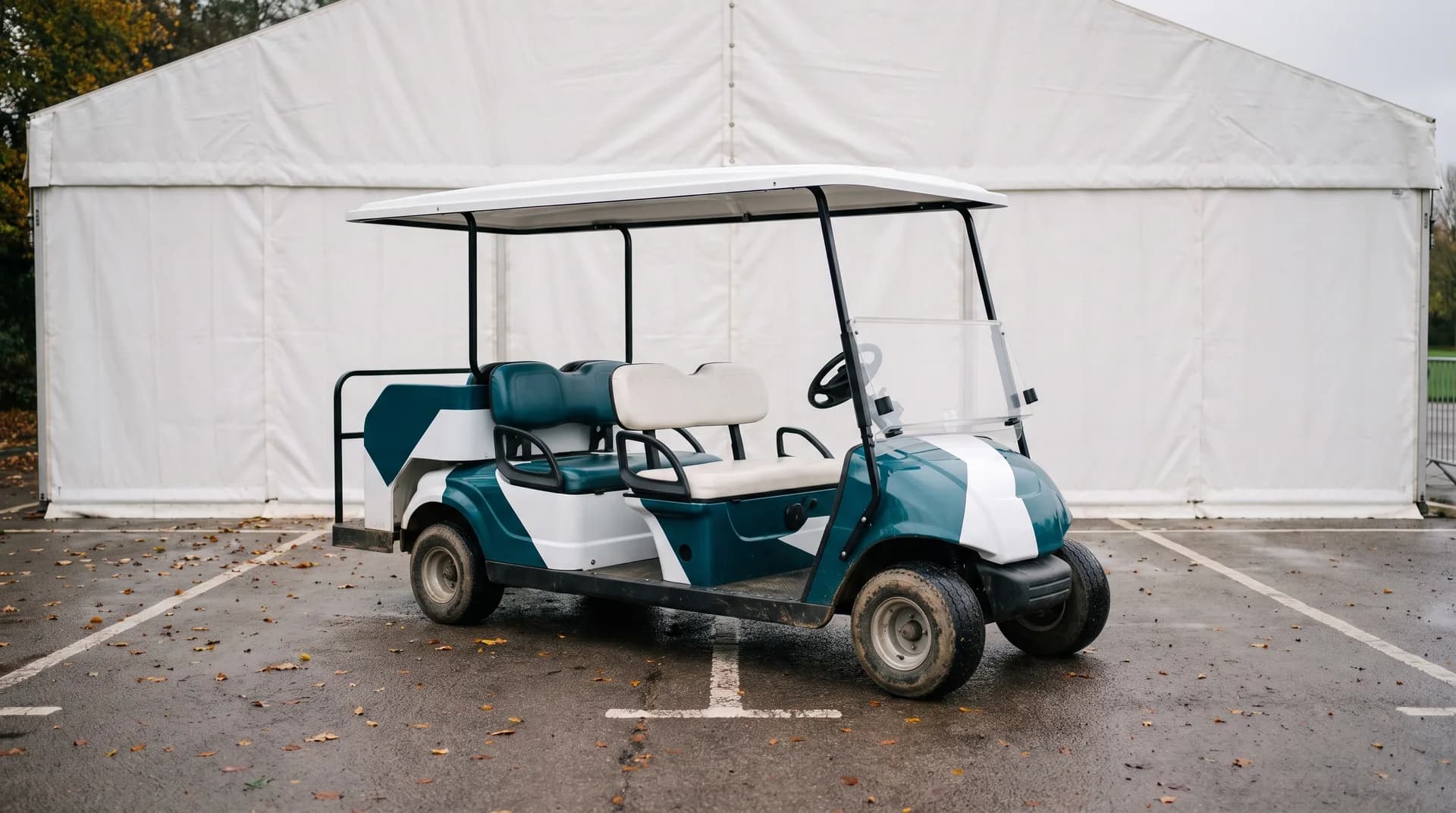
There is a second reason exhibitors hire buggies, and it has nothing to do with logistics: the vehicle is the stand. A branded buggy parked on a plot is a genuine crowd-stopper in a hall of pull-up banners, it photographs well, and it gives visitors somewhere to sit and a reason to approach. For exhibitors selling into golf, hospitality, estates, facilities, events or leisure, it is also a working demonstration of the product category. If that is your reason for hiring, the specification changes: presentation, colour, wrap area and clean lines matter far more than payload, and lead times matter because wrapping takes planning. Our guide to branded and wrapped buggy hire covers the artwork and timing side, and it is worth reading well before your stand design is signed off.
Getting an exhibition buggy hire right
Do three things and this becomes straightforward. Get the venue's vehicle rules in writing at the point you book the stand or the show, not the week before build. Split your requirement into build fleet and show-day fleet, because they are different sizes and often different vehicles. And tell your supplier it is an indoor exhibition hire explicitly, so tyres, charging and presentation are specified for a hall rather than a field. Send us the venue, the hall, the build schedule and the contractor manual, and we will specify a fleet that meets the venue's rules and price the whole build-to-show period in one hire quote.
Frequently asked questions
Can you use golf buggies indoors at an exhibition centre?+
Yes, and electric buggies are the standard works vehicle at most UK exhibition venues. Venues set their own conditions, commonly covering non-marking tyres, floor loading, permitted areas and times, permits and charging locations, so confirm those before booking rather than on arrival.
Are petrol buggies allowed in exhibition halls?+
Almost never. Combustion exhaust accumulates in enclosed halls with limited ventilation, and most major UK venues prohibit combustion engines indoors outright. Electric is the only realistic option, with charging locations agreed with the venue in advance.
When do exhibition buggies actually get used?+
Mostly during build and breakdown, when contractors are moving stand components, tools and graphics against a hard deadline. On show days most venues stop vehicle movement in the halls, so the remaining work is organiser mobility, inter-hall accessibility shuttling and VIP or press movement.
Can you hire fewer buggies for show days than for build?+
Often yes. Exhibition hires are frequently specified as a larger build fleet that steps down to a small show-day fleet, with the surplus collected mid-hire. Ask your supplier whether a stepped hire is possible, because it can make a significant difference to the total.
Can you brand a hire buggy for an exhibition stand?+
Yes, and it is a common reason exhibitors hire one. A branded buggy on a stand attracts attention, photographs well and gives visitors a reason to approach. Wrapping needs lead time and artwork, so raise it early rather than once the stand design is finalised.
Exhibiting or organising a show?
Send us the venue, the hall and the build schedule and we will specify an indoor-ready fleet that meets the venue's rules.
Related solutions
Ready to explore what we build?
See the vehicles and the setting this applies to, or get a tailored quote built around your site.

Ready to find the right buggy?
Tell us how and where it will work and we will specify a vehicle and a tailored quote built around you. Every build comes with a 3-year warranty and a 24-hour priority call-out.
Our guides are written and reviewed by the Hawke Electric Vehicles team, the people who specify, build, deliver and support the vehicles. We focus on honest, practical advice and flag where a figure depends on the build rather than guessing.
More guides by Hawke