Reverse faults come in three flavours: the buggy will not reverse at all, it will only reverse and refuses to go forward, or the two directions run at oddly different speeds. All three sound alarming, but they nearly always trace back to one small area of the buggy: the forward-reverse selector and the switch or contactor behind it, with the controller's settings accounting for the rest. Before you book anything, it helps to know what each symptom means, and which behaviour is actually normal by design.
- One direction working and the other not almost always means the direction switch or contactor.
- The reverse buzzer sounding proves the selector's signal, not that drive will follow.
- Reverse being slower than forward is deliberate on most models, not a fault.
- A selector resting between positions gives no drive either way.
- Direction-switch contacts carry real current and are an engineer repair, not a DIY one.
No reverse, or forward only
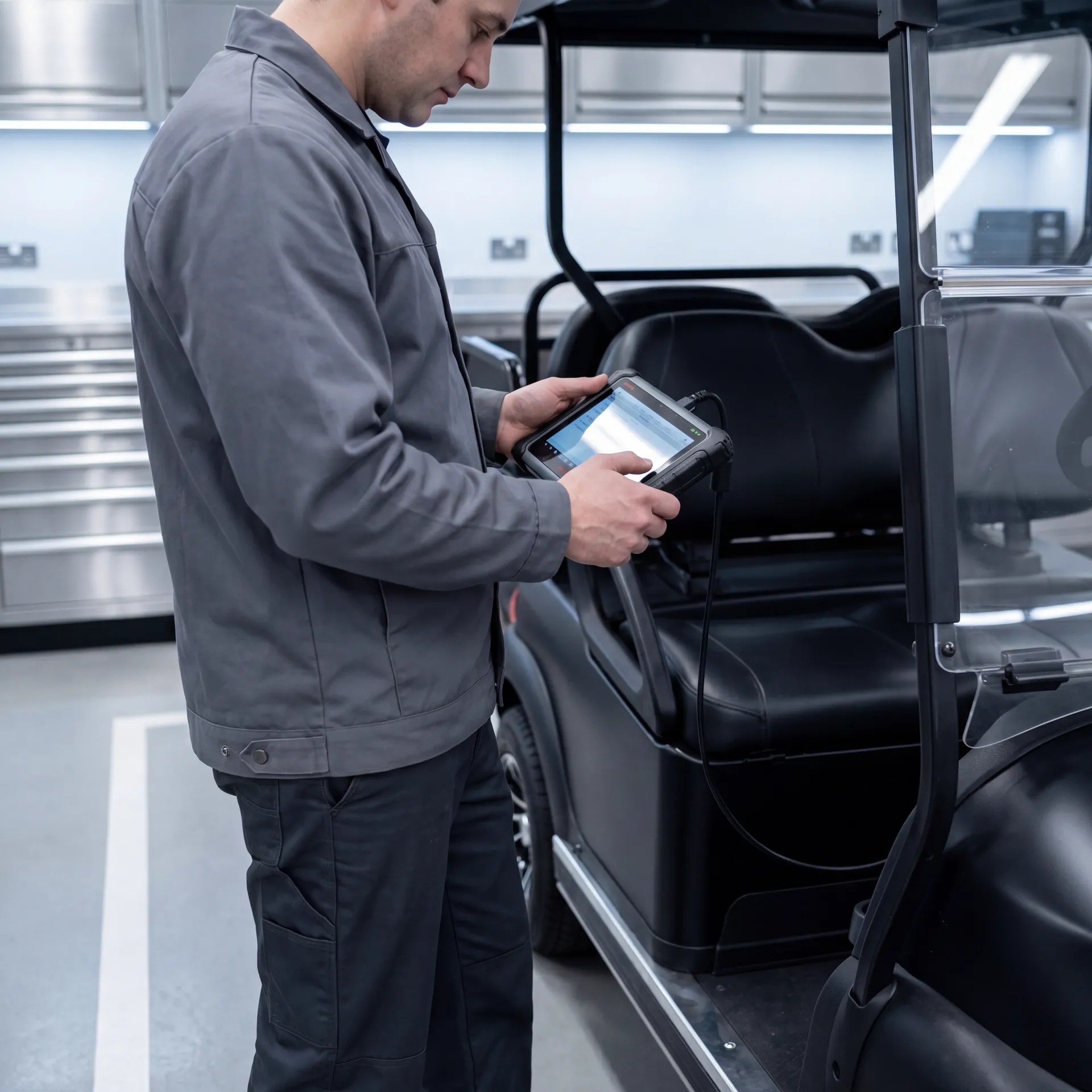
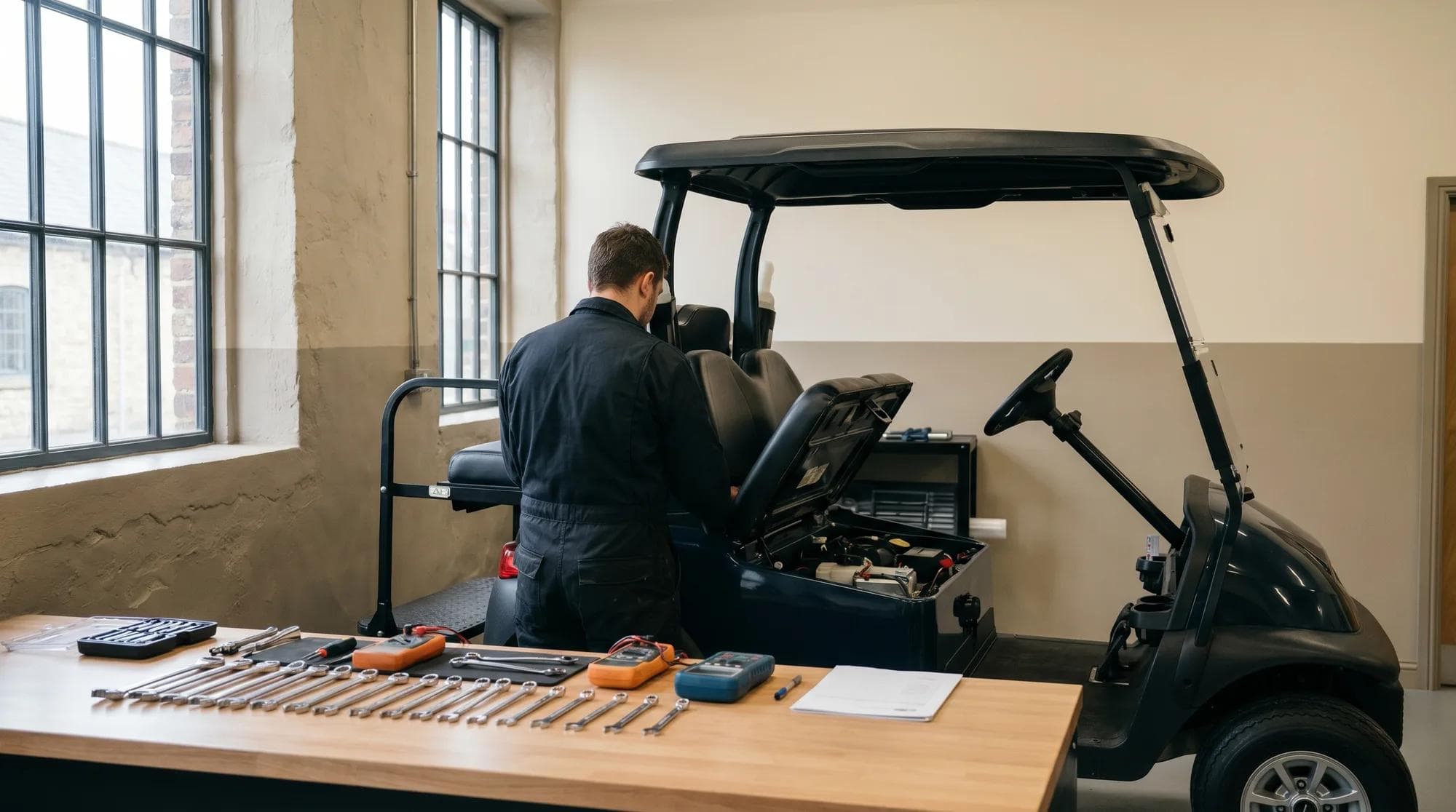
The forward-reverse control, whether it is a lever, a rocker or a dash switch, works through a set of contacts that route power or signal one way for forward and the other for reverse. On many models those contacts carry substantial current, and they wear: they pit, burn and oxidise with years of use. Because forward gets used far more than reverse, wear is uneven, and the result is a buggy that drives happily in one direction and hesitates or does nothing in the other. First, though, check the simple thing: push the selector firmly and fully into position, because a lever resting between detents gives you neutral, which reads as a reverse fault if that is the direction you happened to want. If one direction is consistently dead or intermittent, the switch or contactor needs testing and likely replacing, which is an engineer job.
What the reverse buzzer is telling you
Most buggies sound a warning buzzer in reverse. Diagnostically the buzzer is useful: it is wired from the selector, so if it sounds, the selector is signalling reverse correctly. Buzzer but no movement means the fault is downstream, in the contactor, controller or motor circuit. No buzzer and no movement points at the selector itself or its wiring. It is a thirty-second observation that meaningfully narrows the fault, so note it before you call. Our guide to how electric buggies work covers how the selector, controller and motor connect.
Reverse faster, slower, or 'wrong': design versus fault
Owners sometimes report reverse being much slower than forward as a fault. On most modern buggies it is deliberate: the controller is programmed with a lower speed limit in reverse, because reversing at forward speed is rarely safe. So a buggy that reverses at a fraction of its forward speed is usually behaving exactly as designed. What is worth investigating is change or asymmetry the other way: if reverse has become dramatically weaker than it used to be, or forward has slowed to below reverse, something is wrong, most often worn contacts robbing one direction of full power, or a controller setting that has been altered. Controller direction settings should only ever be adjusted by an engineer within the manufacturer's specification; they interact with braking and stability, and they are not a place to experiment.
Frequently asked questions
Why won't my golf buggy go in reverse?+
Most often the forward-reverse switch or contactor has worn contacts on the reverse side, or the selector is not fully in position. If the reverse buzzer sounds but the buggy does not move, the fault is downstream of the selector. Either way the repair is an engineer job.
Why does my buggy only work in reverse?+
The same fault in mirror image: the forward contacts of the direction switch have worn or burned, which is common because forward does almost all the work. The switch needs testing and usually replacing.
Is it normal that reverse is slower than forward?+
Yes, on most models. Controllers are deliberately programmed with a lower reverse speed limit for safety. A fault is only indicated if the behaviour has changed, for example reverse becoming far weaker than it was, or forward dropping below reverse.
Can the reverse speed be adjusted?+
On many controllers, yes, but only within the manufacturer's specification and only by a competent engineer. Direction and speed settings interact with braking and stability, so they are not something to alter yourself.
Direction playing up? Book an engineer
We test the selector, contactor and controller settings and fit replacements where needed, with everything kept within the maker's spec. Join a plan or call us.
Related solutions
Ready to explore what we build?
See the vehicles and the setting this applies to, or get a tailored quote built around your site.

Ready to find the right buggy?
Tell us how and where it will work and we will specify a vehicle and a tailored quote built around you. Every build comes with a 3-year warranty and a 24-hour priority call-out.
Our guides are written and reviewed by the Hawke Electric Vehicles team, the people who specify, build, deliver and support the vehicles. We focus on honest, practical advice and flag where a figure depends on the build rather than guessing.
More guides by Hawke