A buggy that powers up but refuses to move feels like a serious breakdown, but very often it is a switch rather than a component. Electric buggies have several deliberate ways of stopping themselves from driving, and any one of them left in the wrong position produces exactly this symptom: lights and display on, pedal pressed, nothing. Work through the switches first, then use your ears, because the sound the buggy makes when you press the pedal tells you a surprising amount about where the fault lies.
- Check the tow/run switch, the parking or hill brake and the direction selector before anything else.
- A click with no movement means the solenoid is trying: power is not reaching the motor.
- No click at all points to the pedal switch, the selector or the solenoid itself.
- A snapped drive belt is a petrol-buggy fault: electric buggies drive without one.
- Never bridge the solenoid or work under a buggy supported only by a jack.
Three switches that stop a buggy on purpose
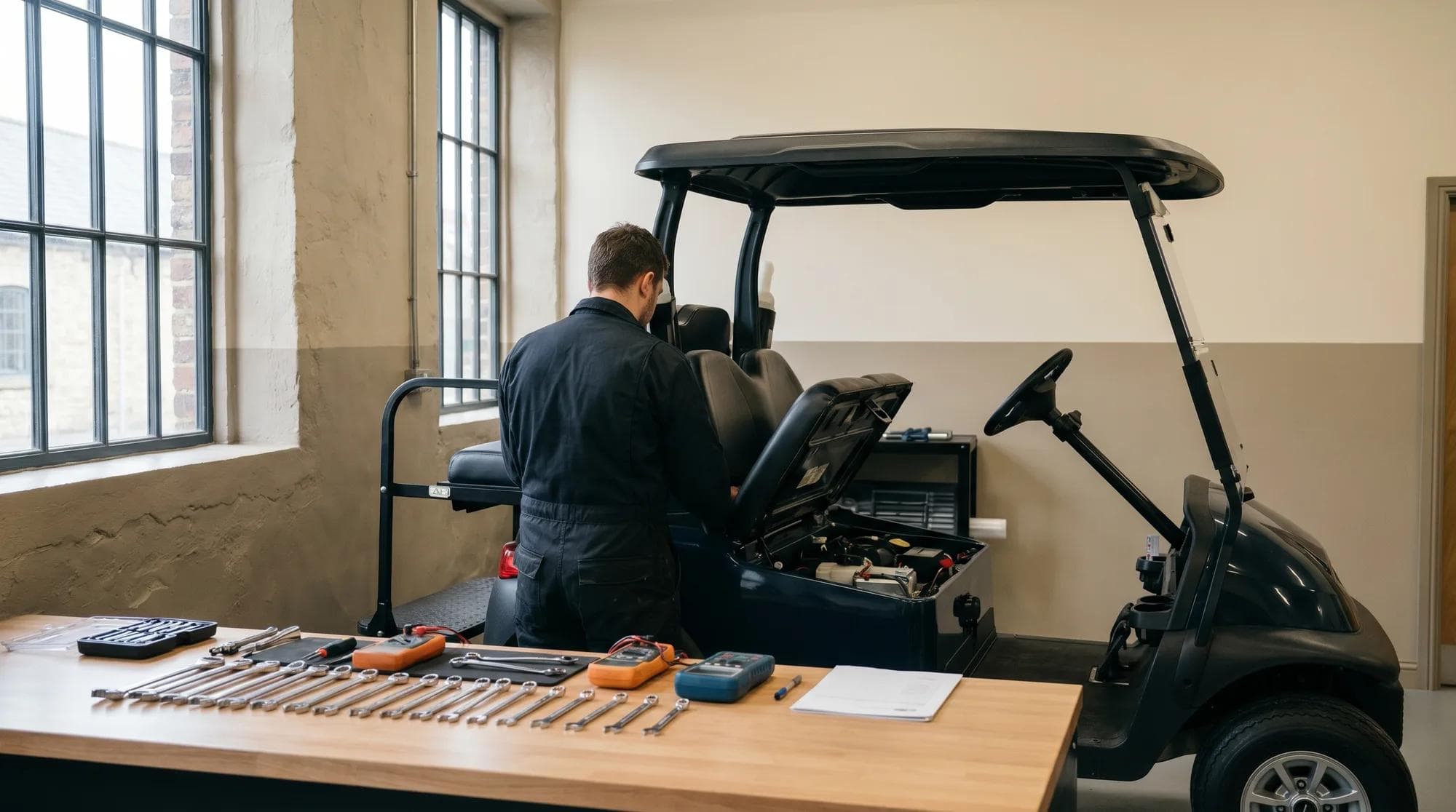
First, find the run/tow switch, usually under the seat, and confirm it is set to RUN. In TOW the buggy is deliberately dead so it can be moved without the motor braking against you, and a buggy put away in TOW is one of the most common no-drive calls we get. Second, make sure the parking brake, or the automatic hill brake on models that have one, is fully released: a hill brake that has stuck on will hold the buggy just as firmly as a fault. Third, check the forward-reverse selector is pushed firmly into gear, because a selector resting between positions leaves the buggy in neutral. Our explainer on how electric buggies work shows how these controls fit together.
Now listen: click or no click?
With the switches confirmed, press the accelerator and listen. A single click from under the seat is the solenoid, the heavy-duty relay that connects the battery to the motor circuit. A click with no movement means the control side is working but power is not getting through to the motor: the usual culprits are burned or pitted solenoid contacts, worn motor brushes on older brushed motors, or a motor fault. No click at all means the request is not reaching the solenoid, which points to the pedal's microswitch, the direction switch or the solenoid coil itself. Either way you have narrowed the fault usefully, and that is where owner diagnosis should stop: everything past this point involves high-current connections and needs an engineer.
What it is not: the snapped belt myth
Owners coming from petrol buggies sometimes assume a buggy that revs its motor but does not move has snapped a drive belt. That is a petrol-buggy fault: petrol models use a belt-driven clutch system, and a failed belt leaves the engine running with no drive. An electric buggy has no drive belt to snap; the motor drives the axle through a sealed gearbox. So on an electric buggy, power without movement is an electrical or brake question, not a belt one.
Frequently asked questions
My golf buggy clicks but won't move. What does that mean?+
The click is the solenoid engaging, so the control side works but power is not reaching the motor. Burned solenoid contacts, worn motor brushes or a motor fault are the usual causes, and all of them need an engineer to test and repair safely.
The buggy powers on but there is no click when I press the pedal. What now?+
Confirm the run/tow switch is on RUN, the parking brake is off and the selector is fully in gear. If there is still no click, the pedal microswitch, direction switch or solenoid coil is the likely fault. Book an engineer rather than probing the circuit yourself.
Could the brake be holding it?+
Yes. A stuck parking brake or hill brake will hold the buggy even though everything else works. Do not attempt to free or adjust a brake yourself: brakes are safety-critical and should only be worked on by an engineer.
Has my electric buggy snapped a drive belt?+
No. Snapped drive belts are a petrol-buggy failure. Electric buggies drive the axle through a sealed gearbox with no belt, so power without movement on an electric buggy points to a switch, the solenoid, the motor or a stuck brake instead.
Still not moving? We'll get it going
Our engineers carry the common parts, from solenoids to brushes, and can usually restore drive in a single visit. Join a service plan or call to book.
Related solutions
Ready to explore what we build?
See the vehicles and the setting this applies to, or get a tailored quote built around your site.

Ready to find the right buggy?
Tell us how and where it will work and we will specify a vehicle and a tailored quote built around you. Every build comes with a 3-year warranty and a 24-hour priority call-out.
Our guides are written and reviewed by the Hawke Electric Vehicles team, the people who specify, build, deliver and support the vehicles. We focus on honest, practical advice and flag where a figure depends on the build rather than guessing.
More guides by Hawke