Ask how far an electric utility vehicle goes on a charge and you will get a brochure number measured in the kindest possible conditions: unladen, on smooth flat ground, at steady speed on a mild day. Real work is nothing like that. A working vehicle carries loads, tows some days, climbs tracks, restarts dozens of times an hour and spends part of its year in the cold, and each of those takes a slice off the quoted figure. The honest measure of electric utility vehicle range is not miles on a spec sheet but hours of your actual shift, and a correctly specified vehicle covers a full working day with margin. This guide explains what moves the number and how to size the battery so you never think about it again.
- Quoted range is measured unladen on flat ground; treat it as a ceiling, not a promise.
- Payload, towing, slopes, soft ground, cold and stop-start duty each cut usable range.
- Size the battery to your longest realistic shift plus margin, not to the brochure figure.
- Opportunity charging at breaks quietly extends a working day without a bigger battery.
- Lithium holds its usable range better than lead-acid as the pack ages and the day wears on.
Quoted range vs working electric utility vehicle range
Manufacturers do not lie about range; they measure it in conditions no working site ever sees. Load the bed, hitch a trailer or turn onto wet grass and the motor draws more current for every metre, so the same battery delivers fewer of them. This is not unique to work vehicles: our guide to electric golf buggy range covers the passenger side of the same physics, where the variables are golfers and hills rather than payloads and trailers, but on a utility vehicle the penalties are larger because carrying and towing is the whole point. Read a quoted range as the best the platform can do, then ask the useful question: what will it do on my site, loaded my way, on my worst day of the year?
What cuts utility vehicle battery range: payload, towing and terrain
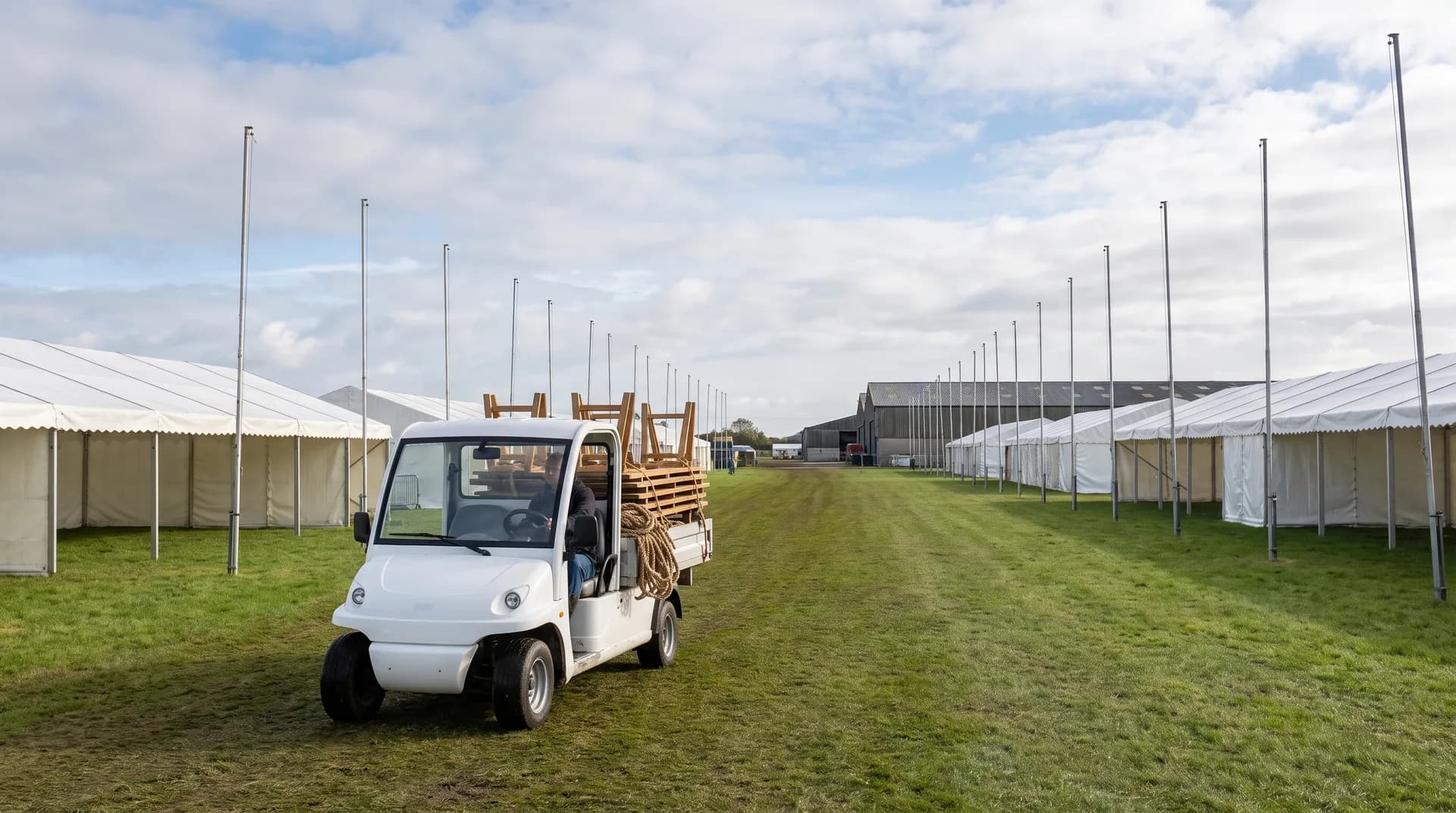
Payload is the steady tax. A bed carrying a typical working load of tools, materials or feed makes the motor work harder on every climb and every pull-away, and the heavier the habitual load the larger the slice. Towing is payload's bigger sibling: a laden trailer can demand more energy than the vehicle's own load bed, especially on grass or gradients, and a vehicle that tows daily should be specified as a tower, not a carrier that occasionally pulls. Terrain compounds both. Smooth tarmac is the friendliest surface a tyre ever meets; wet turf, gravel tracks, mud and long gradients all raise rolling resistance, and a hilly estate can use noticeably more energy than a flat yard covering the same distance. None of this makes electric the wrong choice, the same physics costs a diesel fuel too, but it decides how big a battery you need.
- Effect on range
- Steady reduction, larger with heavier habitual loads
- What to do about it
- Specify the battery for the laden vehicle, not the empty one
- Effect on range
- One of the biggest single draws, worst on grass and slopes
- What to do about it
- Tell your supplier the trailer weight and how often you tow
- Effect on range
- Meaningful reduction on hilly or wet sites
- What to do about it
- Size for your terrain; consider tyres matched to the ground
- Effect on range
- Batteries deliver less in winter, lead-acid worst of all
- What to do about it
- Store and charge under cover; prefer lithium for winter work
- Effect on range
- Constant pull-aways draw more than steady running
- What to do about it
- Opportunity charge at breaks; plan realistic daily mileage
| Effect on range | What to do about it | |
|---|---|---|
| Regular payload in the bed | Steady reduction, larger with heavier habitual loads | Specify the battery for the laden vehicle, not the empty one |
| Towing a trailer | One of the biggest single draws, worst on grass and slopes | Tell your supplier the trailer weight and how often you tow |
| Slopes and soft ground | Meaningful reduction on hilly or wet sites | Size for your terrain; consider tyres matched to the ground |
| Cold weather | Batteries deliver less in winter, lead-acid worst of all | Store and charge under cover; prefer lithium for winter work |
| Stop-start duty | Constant pull-aways draw more than steady running | Opportunity charge at breaks; plan realistic daily mileage |
Cold weather and stop-start duty
Two range thieves get forgotten in a summer demonstration. The first is cold: every battery chemistry delivers less energy on a winter morning than a summer afternoon, and lead-acid suffers most, which is why a pack that managed fine in July can feel tired in January. Storing and charging under cover takes much of the sting out, and lithium keeps more of its usable capacity in the cold. The second is duty cycle. A vehicle doing genuine site work pulls away, stops, loads and pulls away again fifty times a morning, and each restart from standstill is the most expensive metre it covers. If your work is stop-start, and most real site work is, budget range on that basis rather than a continuous-driving figure.
Sizing the battery to the shift, not the brochure
The right way round is to start from the work. Add up an honest day, the miles, the loads, the towing, the ground and the season, then specify a battery that does that day with comfortable margin, on the worst week of the year, with a pack a few years old. That last part matters: every battery loses capacity as it ages, and a vehicle sized with no headroom when new quits early at year four. Lithium ages more gracefully than lead-acid, holding more of its usable range across its life, which is why we fit it as standard across our electric utility vehicle line-up. Whether one charge genuinely covers a full shift, and what to do when the day runs long, is covered in our full working-day guide.
Opportunity charging: the quiet range extender
The habit that transforms electric range on a working site costs nothing: plug in whenever the vehicle stands still. Lunch breaks, loading waits and shift handovers are all charging time if a socket lives where the vehicle naturally parks. Lithium packs accept charge quickly and are happy being topped up in short bursts, so a vehicle that opportunity charges through the day can comfortably outrun its on-paper range without a bigger, heavier, more expensive pack. If you are laying out a yard or compound for an electric fleet, put ordinary outdoor sockets at the two or three places vehicles actually stand, and the range question largely disappears.
Frequently asked questions
How far does an electric utility vehicle go on one charge?+
Quoted figures are measured unladen on flat, smooth ground, so treat them as a ceiling. Working range depends on payload, towing, terrain, temperature and duty cycle. The practical answer is that a correctly specified vehicle covers a full working shift with margin, which is the standard we specify to.
Does towing really reduce range that much?+
Yes. A laden trailer is often the single biggest draw on the battery, particularly on grass or gradients. If the vehicle will tow regularly, say so at specification time so the battery and drivetrain are sized for it.
How much range do you lose in winter?+
Every chemistry delivers less in the cold, with lead-acid affected most and lithium least. Storing and charging under cover reduces the effect considerably. Size the battery for your worst winter week, not a mild spring day.
Is a bigger battery always the answer?+
Not always. A bigger pack costs more and adds weight. Opportunity charging at natural pauses, sensible route planning and matching tyres to the ground often close the gap more cheaply. Start from an honest picture of the shift and specify from there.
Lithium or lead-acid for working range?+
Lithium delivers more usable capacity, charges faster, tolerates opportunity charging well and holds its range better in cold weather and as it ages. For a vehicle worked daily it is usually the better total cost, which is why it is our standard fit.
Size the battery to your shift
Tell us your site, your loads and your longest day, and we will specify a vehicle that covers it with margin, in January as well as July.
Related solutions
Ready to explore what we build?
See the vehicles and the setting this applies to, or get a tailored quote built around your site.

Ready to find the right buggy?
Tell us how and where it will work and we will specify a vehicle and a tailored quote built around you. Every build comes with a 3-year warranty and a 24-hour priority call-out.
Our guides are written and reviewed by the Hawke Electric Vehicles team, the people who specify, build, deliver and support the vehicles. We focus on honest, practical advice and flag where a figure depends on the build rather than guessing.
More guides by Hawke