Battery chemistry is the decision that most affects how an electric buggy performs and what it costs to own. Here's lithium versus lead-acid, without the jargon, covering real-world range, charging, lifespan, weight and maintenance, so you can match the right battery to how you actually use the vehicle.
- Lithium gives more usable range, charges faster and tolerates partial charging; lead-acid is heavier and slower.
- Lithium lasts around 8 to 10 years; lead-acid around 3 to 5, so it's replaced more often.
- Lithium costs more up front but usually less over the life of the vehicle once replacements are counted.
- For regular or daily use, lithium almost always wins. For light, occasional use, lead-acid can still make sense.
Real-world range and weight
Lithium batteries are lighter and deliver more usable range from the same weight, which also improves handling and efficiency. Lead-acid is heavier and gives less usable capacity, and that weight matters: a heavier vehicle works harder on grass and gradients and eats into the range you actually get. Range figures also depend on terrain, load, weather and driving style, so treat any headline number as a guide rather than a promise. The practical difference owners notice is that a lithium buggy tends to hold its useful range across a full day, while an ageing lead-acid pack can fall short of what it managed when new, particularly in the cold.
Charging behaviour and partial charging
Lithium charges faster and, importantly, tolerates partial charging without harm, so you can top it up in a lull between trips and carry on. That suits a buggy in regular service, a resort transfer vehicle, a daily golf buggy, where there is rarely a long window to charge fully. Lead-acid is slower to charge and prefers a full, regular charge cycle; running it down hard and topping it up in snatches shortens its life. The habit that protects either chemistry is to charge after use rather than leaving the pack to stand flat, but lithium is far more forgiving of an irregular routine.
Lifespan and total cost of ownership
This is where the two genuinely diverge over the years. Lead-acid packs typically last three to five years, while lithium typically lasts eight to ten and holds its performance better through that life. Lithium costs more up front, but over the life of a vehicle used regularly it usually works out cheaper once you account for replacement cycles: a lead-acid buggy may need a second or even third pack in the time a single lithium pack serves. Add the value of faster charging (less downtime) and lighter weight (less energy per trip), and the total cost of ownership generally favours lithium for anything beyond light, occasional use.
- Lead-acid
- Lower
- Lithium
- Higher
- Lead-acid
- 3 to 5 years
- Lithium
- 8 to 10 years
- Lead-acid
- Slower, prefers full cycles
- Lithium
- Faster, partial-charge friendly
- Lead-acid
- Heavier
- Lithium
- Lighter
- Lead-acid
- More attention needed
- Lithium
- Largely maintenance-free
- Lead-acid
- Light, occasional use
- Lithium
- Regular daily use
| Lead-acid | Lithium | |
|---|---|---|
| Up-front cost | Lower | Higher |
| Typical lifespan | 3 to 5 years | 8 to 10 years |
| Charging | Slower, prefers full cycles | Faster, partial-charge friendly |
| Weight | Heavier | Lighter |
| Maintenance | More attention needed | Largely maintenance-free |
| Best for | Light, occasional use | Regular daily use |
Maintenance
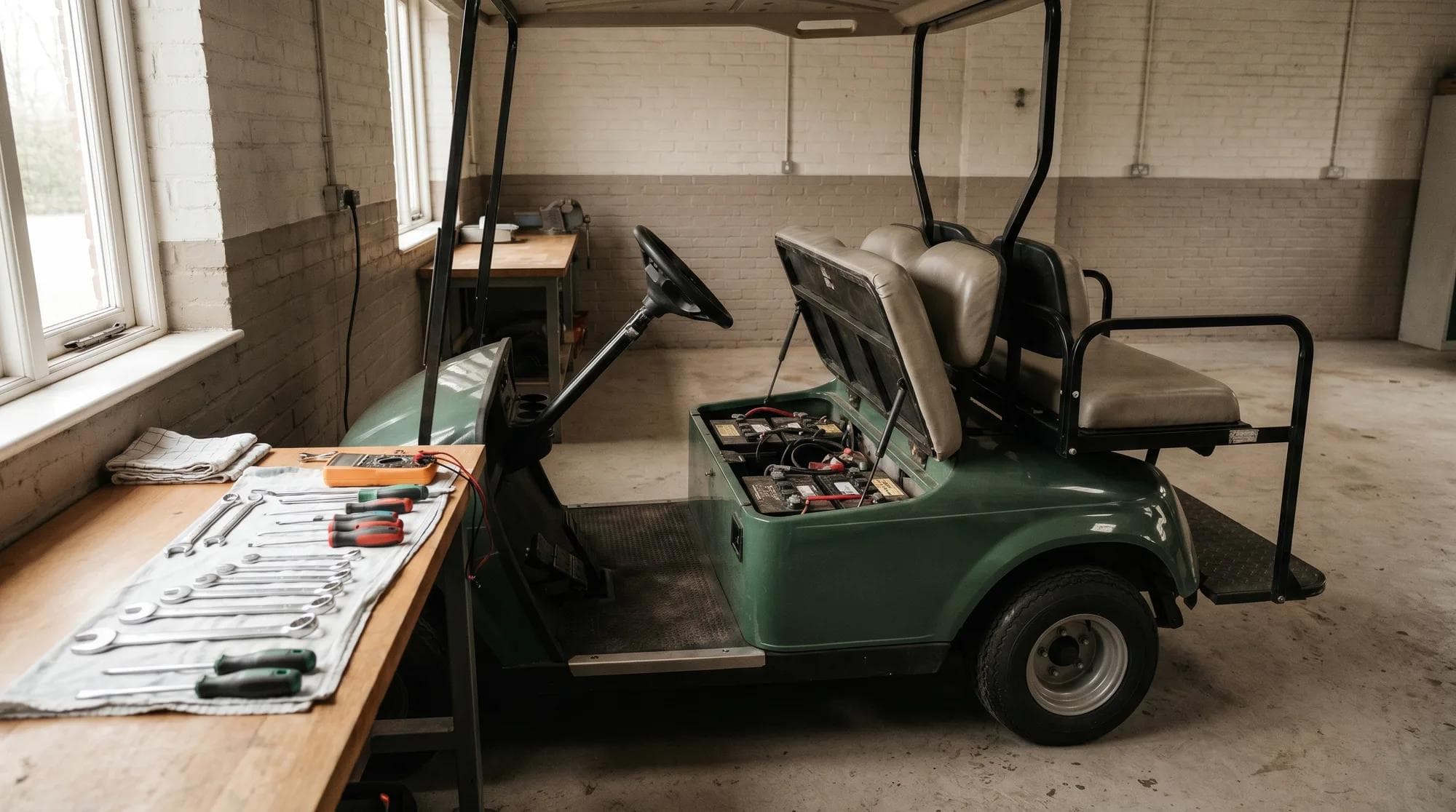
Lead-acid asks more of you: connections need keeping clean, and some packs need their levels checked, so a neglected lead-acid battery fails sooner than it should. Lithium is largely maintenance-free by comparison, which is one reason it suits a fleet where no one has time to nurse individual vehicles. Whichever you run, storing the buggy charged and charging regularly rather than running flat does most of the work of extending the pack's life.
Which suits which use
The honest way to choose is by how hard the vehicle works. A buggy used now and then, a private golf buggy taken out at weekends, can suit lead-acid, where the lower up-front cost matters more than charging speed or pack life. Anything in regular service is a different case: a resort fleet running transfers all day, a working estate vehicle, a daily golf buggy, benefits from lithium's range retention, fast partial charging and long life. For a fleet, the case is stronger still, because lithium's lighter maintenance and longer life reduce both downtime and the cost of replacing packs across many vehicles.
Lithium costs more up front and usually less over the life of the vehicle.
If you are unsure which chemistry suits your use, configure a vehicle and tell us how often it will run, and we will advise honestly on the battery that gives you the best value over the years.
Choose the right battery
Tell us how the vehicle will be used and we will advise on the chemistry that gives the best value. Configure a buggy or request a tailored quote.
Frequently asked questions
Is lithium worth the extra cost?+
For regular or daily use, usually yes. Lithium lasts roughly twice as long as lead-acid, charges faster and weighs less, so over the years it tends to cost less to own despite the higher up-front price. For light, occasional use, lead-acid can still make sense.
Can I partly charge a lithium buggy battery?+
Yes. Lithium tolerates partial charging without harm, so you can top it up between trips. Lead-acid prefers full, regular charge cycles and wears faster if repeatedly run down and topped up.
How long does each battery type last?+
Lead-acid packs typically last three to five years; lithium packs typically last eight to ten and hold their performance better. Charging regularly and storing the vehicle charged extends either chemistry.

Ready to find the right buggy?
Tell us how and where it will work and we will specify a vehicle and a tailored quote built around you. Every build comes with a 3-year warranty and a 24-hour priority call-out.
Our guides are written and reviewed by the Hawke Electric Vehicles team, the people who specify, build, deliver and support the vehicles. We focus on honest, practical advice and flag where a figure depends on the build rather than guessing.
More guides by Hawke