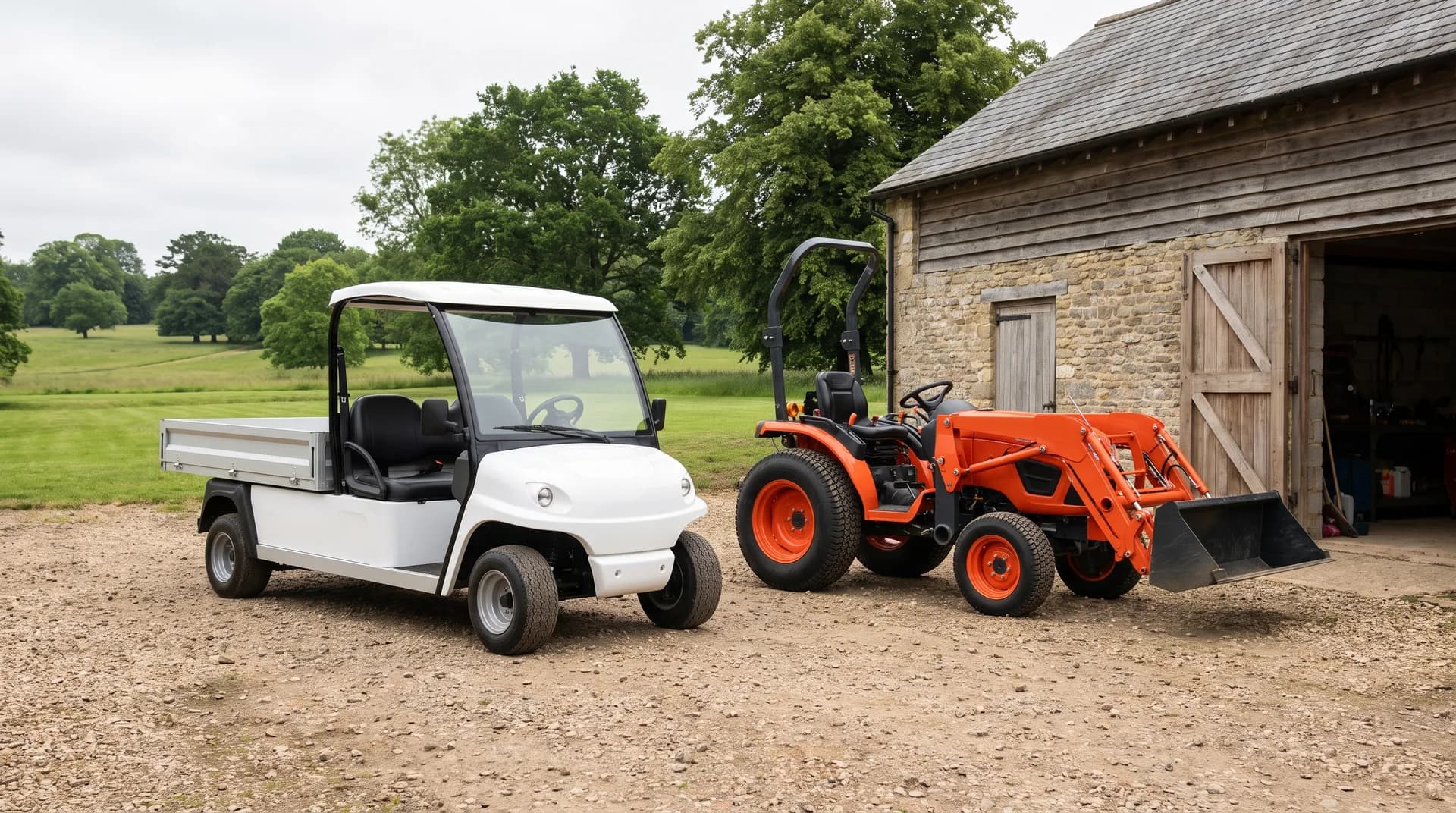
A compact pedestrian tow tug will typically move rolling loads of one to several tonnes on flat, hard ground, and larger ride-on tugs are rated well beyond that. The catch is in the words rolling, flat and hard: a tow tug's headline figure describes wheeled loads on a good surface, not dead weight dragged across gravel or a loaded train hauled up a ramp. Understanding that difference is the whole game when choosing a tug, because a machine that genuinely handles 3,000 kilograms in one building can be overwhelmed by 800 kilograms in another. This guide explains what the ratings mean, why gradient changes everything, where pedestrian and ride-on tugs each fit, and what to tell a supplier so the machine matches the job.
- Tow tug ratings describe rolling, wheeled loads on flat, hard ground, not dead weight.
- Even a gentle gradient multiplies the pulling force needed, so slopes must be declared up front.
- Pedestrian tugs suit indoor, stop-start work at walking pace; ride-on tugs suit longer routes and heavier trains.
- Castors, tyre type and floor surface change real-world capacity as much as the load's weight does.
- The honest route to the right machine is describing the load, route and worst slope, then letting the supplier size it.
What a tow tug's towing capacity really means
When a specification sheet says a tow tug pulls 3,000 kilograms, it means 3,000 kilograms of load sitting on free-rolling wheels, being moved across level, smooth, hard flooring. On good castors on a warehouse floor, the force needed to keep a trolley moving is a small fraction of its weight, which is how a compact machine an operator walks behind can shift loads many times its own mass. Change any part of that picture and the real capacity drops. Small or worn castors, soft tyres, rubber matting, tarmac or grass all increase rolling resistance, sometimes several times over. Dead weight is a different job entirely: a tug is not a winch, and dragging an unwheeled load is outside what any towing rating describes. If your load is not on decent wheels, fix the wheels first. Our guide to what a tow tractor is covers the vehicle category itself in more detail.
Gradient: the number that changes everything
Slopes are where optimistic tug purchases go wrong. On level ground the tug only has to overcome rolling resistance, but on a gradient it must also lift a share of the load's full weight. The physics is simple and unforgiving: on a slope, gravity adds a pulling force roughly equal to the load's weight multiplied by the gradient. A ramp between buildings, a yard with a fall for drainage, or a service corridor that looks flat but is not, can double or triple the force required, which is why manufacturers publish capacity at stated gradients. Measure your worst slope before you talk to anyone; it matters more than almost any other detail, and starting torque matters too, because pulling away uphill from a standstill is the hardest moment in the machine's day.
Pedestrian tow tugs vs ride-on tugs
Pedestrian tugs, where the operator walks behind a tiller head, are the right tool for stop-start work at walking pace: moving roll cages, waste bins, laundry trolleys and equipment carts short distances indoors or between adjacent buildings. They are compact, simple to train on and manoeuvrable in tight corridors. Ride-on tow tractors earn their place when routes get longer, loads get heavier or trains get involved: towing luggage trains, moving multi-trolley waste runs across a large site, or shuttling equipment where walking pace would waste hours of an operator's shift. The trade-off is footprint, cost and the need for more space to turn. Where the load rides on the vehicle rather than behind it, a burden carrier is often the better shape, and our tow tractor vs forklift guide covers why towing beats lifting for horizontal movement.
- Pedestrian tow tug
- Short, stop-start moves indoors
- Ride-on tow tractor
- Longer routes, trailer trains, outdoor runs
- Pedestrian tow tug
- Walking pace
- Ride-on tow tractor
- Faster, suited to site distances
- Pedestrian tow tug
- Roughly 1 to 6 tonnes on the flat
- Ride-on tow tractor
- Several tonnes upwards, model dependent
- Pedestrian tow tug
- Tight corridors and lifts
- Ride-on tow tractor
- Wider aisles and yard space
- Pedestrian tow tug
- Walks with the tiller
- Ride-on tow tractor
- Seated, less fatigue over a shift
- Pedestrian tow tug
- Hospitals, kitchens, back of house
- Ride-on tow tractor
- Airports, warehouses, large estates
| Pedestrian tow tug | Ride-on tow tractor | |
|---|---|---|
| Typical work | Short, stop-start moves indoors | Longer routes, trailer trains, outdoor runs |
| Speed | Walking pace | Faster, suited to site distances |
| Typical rolling-load range | Roughly 1 to 6 tonnes on the flat | Several tonnes upwards, model dependent |
| Space needed | Tight corridors and lifts | Wider aisles and yard space |
| Operator | Walks with the tiller | Seated, less fatigue over a shift |
| Where it shines | Hospitals, kitchens, back of house | Airports, warehouses, large estates |
The jobs tow tugs actually do
The pattern across sites is consistent. Hospitals use tugs for linen, meals, waste and supplies runs along service corridors, where quiet, fume-free operation matters. Facilities teams move commercial waste bins to compactors, often the job that first justifies the purchase, because manually pushing four-wheeled bins is a recognised manual-handling problem. Warehouses and factories tow trains of parts trolleys between zones instead of making dozens of single trips, airports move luggage and equipment trains across large paved areas, and hotels, venues and estates use small electric tow tractors for everything from staging to bin runs. In each case one operator and one machine replace repeated pushing, with less injury risk and faster turnarounds.
How to get an honest capacity match from a supplier
Do not ask a supplier what their tug pulls; tell them what you move and let them size the machine. The list is short: the load and its maximum total weight including the trolley; what it rolls on, meaning wheel size, castor condition and tyre type; the surface along the whole route; the worst gradient, including ramps and thresholds; distance and runs per shift, which size the battery; door widths, lifts and turning space; and whether it works indoors, outdoors or both. A supplier worth buying from will ask these questions anyway, and may recommend a smaller machine than you expected, or a larger one for a slope you had discounted. If the answer you get is a bare headline number with no questions attached, treat it with caution. You can browse the wider line-up on our range page to see where tugs sit alongside carriers and buggies.
Frequently asked questions
How much can a small electric tow tug pull?+
Compact pedestrian tugs are commonly rated to move rolling loads of roughly one to six tonnes on flat, hard ground, model depending. That figure assumes good wheels and a smooth surface; poor castors, soft ground or any gradient reduce it substantially.
Can a tow tug pull a dead weight?+
No. Towing ratings describe wheeled, free-rolling loads. Dragging an unwheeled load is a different task with far higher force requirements, and it is outside what a tug is designed or rated to do. Put the load on decent wheels or a trailer first.
Why does a slope reduce capacity so much?+
On a gradient the tug must lift a share of the load's full weight as well as overcome rolling resistance. The extra force is roughly the load's weight times the gradient, so even a modest ramp can multiply the effort needed and cut usable capacity to a fraction of the flat-ground figure.
Do I need a licence to operate a tow tug?+
On private sites, no driving licence is required, but employers must train operators under workplace equipment rules and keep records. Site inductions and a basic familiarisation are the sensible minimum for pedestrian tugs; ride-on tugs warrant fuller training.
Pedestrian or ride-on: how do I choose?+
Choose pedestrian for short, stop-start indoor moves in tight spaces at walking pace. Choose ride-on when routes are longer, loads are heavier, trailer trains are involved, or an operator would otherwise spend a large part of the shift walking.
Get a tug sized to your site, not a spec sheet
Tell us the load, the route and the worst slope, and we will match a tow tug or tow tractor to the job honestly, including telling you if a smaller machine will do.
Ready to find the right buggy?
Tell us how and where it will work and we will specify a vehicle and a tailored quote built around you. Every build comes with a 3-year warranty and a 24-hour priority call-out.
Our guides are written and reviewed by the Hawke Electric Vehicles team, the people who specify, build, deliver and support the vehicles. We focus on honest, practical advice and flag where a figure depends on the build rather than guessing.
More guides by Hawke