Golf buggy hire delivery and collection is the part of the job nobody pictures when they first enquire. People imagine the buggies; they rarely picture the lorry that brings them, the gate it has to fit through, or the ground it has to reverse onto at seven in the morning. Yet delivery and collection are part of every hire in the UK, they are a real line in every quote, and they are where the overwhelming majority of hire-day friction happens. This guide walks the whole cycle, from the transport that brings the fleet to the handover that signs it over to you, and back again on collection day, so that when a supplier starts asking about gate widths and hard standing you know exactly why.
- Every hire includes delivery and collection; buggies are not collected by the customer and never driven on public roads to site.
- Delivery is quoted as a window, not a moment, and access is the single biggest variable in whether that window holds.
- Tell your supplier the truth about gates, gradients, height barriers, soft ground and long carries before the day, not on it.
- The handover is your evidence: photograph every vehicle, confirm the charge state, and have someone with authority sign for it.
- Collection needs the same planning as delivery: vehicles gathered in one accessible place, keys accounted for, access still open.
How golf buggy hire delivery works in the UK
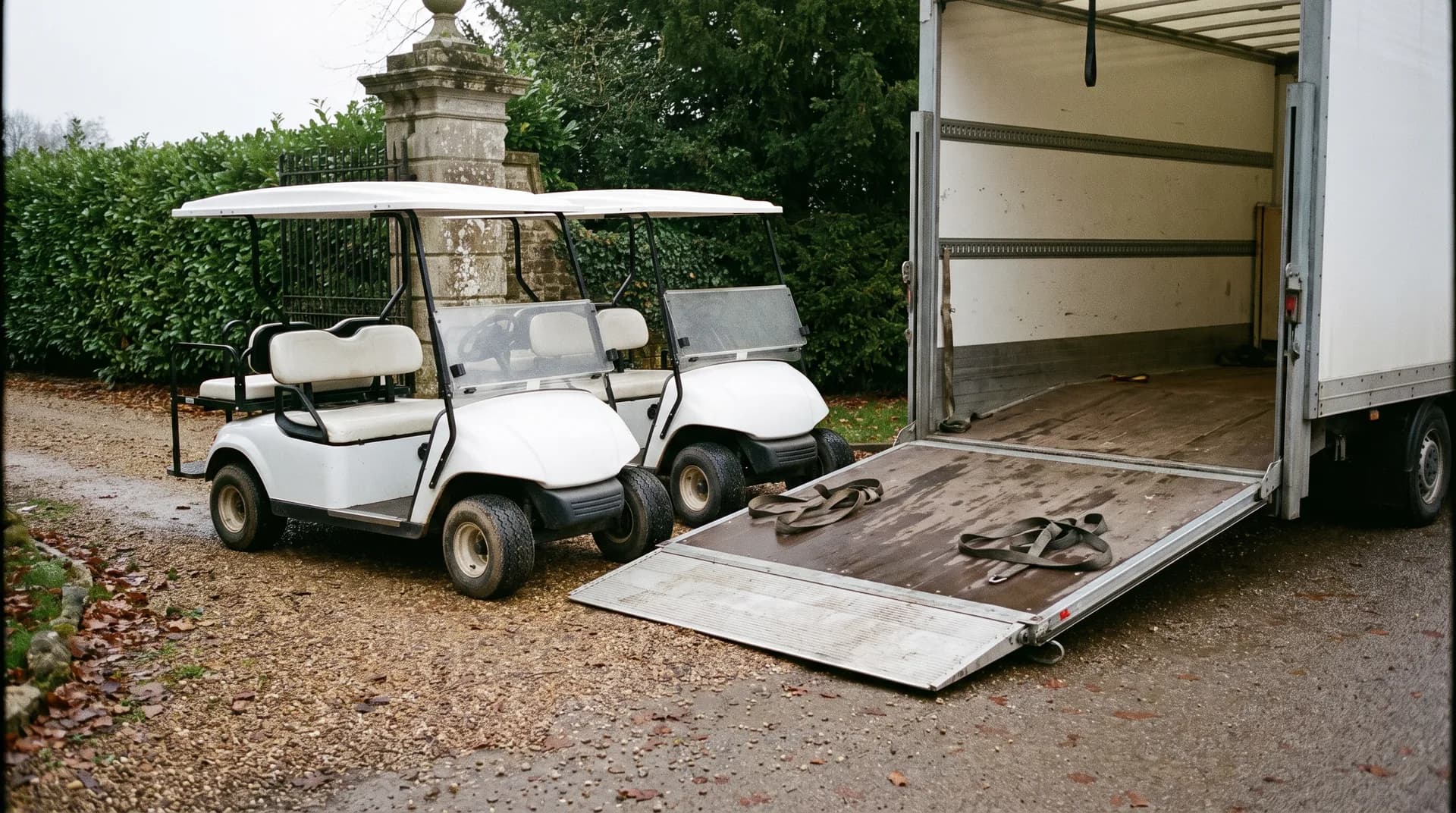
A hire fleet travels on a trailer or a covered transporter, loaded and strapped at the depot, and it arrives on a vehicle far larger than the buggies themselves. That single fact drives most of the planning. The transporter needs somewhere to stop legally and safely, somewhere firm to unload onto, and enough room to turn around afterwards, and none of that is guaranteed on a country estate track or a city centre venue with a loading bay booked by three other suppliers. Buggies are unloaded, checked over, positioned where you have asked for them, and handed to a named person on your side. They are not driven to site on public roads; the vast majority of hire buggies are not road-registered, so the transporter is not a convenience, it is the only lawful way the fleet reaches you. Our guide to how event buggy hire works sets the whole booking cycle in context.
Delivery windows and why suppliers quote a window
Almost every supplier commits to a delivery window rather than a precise time, and that is not evasion, it is honesty about British roads. A driver leaving a depot at dawn to reach a venue three counties away cannot promise 08:15, and a supplier who does is either running one job that day or is about to disappoint you. What you can and should pin down is the outside edge of the window, because that is what your own schedule depends on: the latest time the buggies can arrive and still be useful. If your gates open at ten and you want a briefed, charged fleet ready at half nine, say so explicitly at booking, and expect the supplier to build the run around it. Where a venue imposes its own constraints, a curfew, a one-way system, a delivery slot booked through the venue's own portal, pass those on at the quote stage rather than the week before.
Site access: the questions that decide your delivery
Access is where deliveries succeed or fail, and the awkward truth is that the customer always knows more about their site than the supplier does. Six things matter more than anything else. Gate and entrance width, because a transporter is wider than the van you picture. Height restrictions, because a barrier at the car park entrance can turn a fifteen-minute unload into an hour of reversing. Ground condition at the unloading point, because a laden trailer on soft grass after a wet week is a recovery job waiting to happen. Gradients on the route in. Distance from the unloading point to where the buggies actually need to be. And, on managed venues, the practical politics of shared loading bays. None of these are difficult if they are known; all of them are expensive if they are discovered on the morning. Send a pin, a photo of the entrance and an honest sentence about the ground, and you will have removed most of the risk in your own hire.
- Why it matters
- A transporter is wider and longer than a van
- What to send
- A photo of the entrance and any width or height signage
- Why it matters
- Soft ground bogs a laden trailer
- What to send
- Honest description, plus hard standing options
- Why it matters
- Sets the whole day's schedule
- What to send
- The latest useful arrival time, not just a preferred one
- Why it matters
- Someone must meet, sign and receive
- What to send
- Name and mobile number that will be answered
- Why it matters
- Managed sites control their own access
- What to send
- The venue's delivery policy or slot booking
- Why it matters
- Positioning saves an hour on the day
- What to send
- A marked point on a site plan
| Why it matters | What to send | |
|---|---|---|
| Access route and gate width | A transporter is wider and longer than a van | A photo of the entrance and any width or height signage |
| Ground at the unloading point | Soft ground bogs a laden trailer | Honest description, plus hard standing options |
| Delivery window | Sets the whole day's schedule | The latest useful arrival time, not just a preferred one |
| Named site contact | Someone must meet, sign and receive | Name and mobile number that will be answered |
| Venue rules and curfews | Managed sites control their own access | The venue's delivery policy or slot booking |
| Where the buggies go | Positioning saves an hour on the day | A marked point on a site plan |
The handover: ten minutes that protect you for the whole hire
The handover is the most valuable ten minutes of the entire hire, and it is the one people rush. A proper handover does four things: it records the condition of each vehicle before you take responsibility for it, it confirms the state of charge on arrival, it walks a named person on your side through the controls, the keys, the charging routine and anything site-specific, and it establishes who to ring if something goes wrong. Do your own version alongside it. Photograph every vehicle from all four corners on your own phone, timestamped, before anyone drives it, because those photographs are your evidence if condition is queried at collection. Make sure the person receiving the fleet has the authority to sign for it and will still be on site later. Our guides to hire terms and what happens if you damage a hire buggy explain why that photo set matters.
What golf buggy hire delivery costs, and why it varies
Delivery is priced on the job rather than from a list, and three things move it. Distance is the obvious one, because a transporter run is a driver's day as much as it is fuel. Fleet size is the second, since a handful of buggies may share one load while a larger fleet needs a bigger vehicle or a second run. Timing is the third, and it is the one customers underestimate: a delivery that must land inside a narrow overnight window, or a collection at eleven on a Sunday night after a festival closes, is a different job from a delivery at ten on a Tuesday. The useful move is to book delivery once for the venue rather than piecemeal per vehicle, and to give the supplier as much flexibility on timing as your event genuinely allows. Our hire cost guide sets out the full picture of what shapes a hire quote.
Collection day: the half of the job people forget
Collection is delivery in reverse, and it goes wrong more often, because by then everyone is tired and the site is being dismantled around the buggies. Three things make it painless. First, gather the vehicles at one agreed, accessible point before the collection window opens, not scattered across a hundred acres where four of them ran flat. Second, account for every key, charger and accessory; a missing charger is a chargeable item and a genuinely annoying one. Third, keep the access route open. Sites have a habit of closing their good entrance the moment the public leave, and a transporter that cannot get back in becomes an aborted collection with a cost attached. If your event overruns, tell the supplier as early as you know, because most agreements provide for additional charges when vehicles are not ready when agreed, and a phone call the night before is far cheaper than a wasted run.
Booking delivery and collection that actually work
The pattern behind every smooth hire is the same: the customer told the truth about their site early, agreed a realistic window, put a named person on the handover, and planned collection with the same care as delivery. None of that costs anything. Tell us your venue postcode, the ground and access, and the two windows that matter to you, and we will build the transport around them and price it in the hire quote rather than surprising you with it. If you are still shaping the event, the event buggy hire calculator gives you an instant indication to budget against, and our organiser's checklist covers everything else that needs deciding before the fleet arrives.
Frequently asked questions
Do golf buggy hire companies deliver?+
Yes. Delivery and collection are part of every hire in the UK, because hire buggies are generally not road-registered and cannot lawfully be driven to site. The fleet arrives on a trailer or transporter, is unloaded, positioned and formally handed over to a named person on your side.
Can I collect a hire golf buggy myself?+
In almost all cases no. A buggy needs a suitable trailer, correct load restraint and a vehicle rated to tow it, and the hire agreement will normally place transport with the supplier for exactly that reason. Ask before you assume; self-collection is the exception, not the norm.
How much does golf buggy hire delivery cost?+
It is quoted rather than listed, and it moves with distance, fleet size and how tight the delivery and collection windows are. Book delivery once for the venue rather than per vehicle, and give the supplier honest flexibility on timing where your event allows it.
What time will the buggies arrive?+
Suppliers commit to a window rather than a fixed time, because traffic and earlier drops are unpredictable. Agree the latest useful arrival time at booking, not the ideal one, and make sure a named contact will be on site and answering their phone throughout that window.
What do I need to tell the supplier about my site?+
Gate and entrance width, any height barriers, the ground at the unloading point, gradients on the route, the distance from unloading to where the buggies are needed, and any venue delivery rules or curfews. A photo of the entrance answers most of it in one go.
What happens at the handover?+
The condition and charge state of each vehicle are recorded, a named person on your side is walked through controls, keys and charging, and responsibility passes to you. Take your own timestamped photographs of every vehicle at the same time; they are your evidence if condition is queried at collection.
Planning a hire? Start with the site
Send us the venue postcode, the access and the windows that matter, and we will build the delivery and collection around them and price it properly in the quote.
Related solutions
Ready to explore what we build?
See the vehicles and the setting this applies to, or get a tailored quote built around your site.

Ready to find the right buggy?
Tell us how and where it will work and we will specify a vehicle and a tailored quote built around you. Every build comes with a 3-year warranty and a 24-hour priority call-out.
Our guides are written and reviewed by the Hawke Electric Vehicles team, the people who specify, build, deliver and support the vehicles. We focus on honest, practical advice and flag where a figure depends on the build rather than guessing.
More guides by Hawke