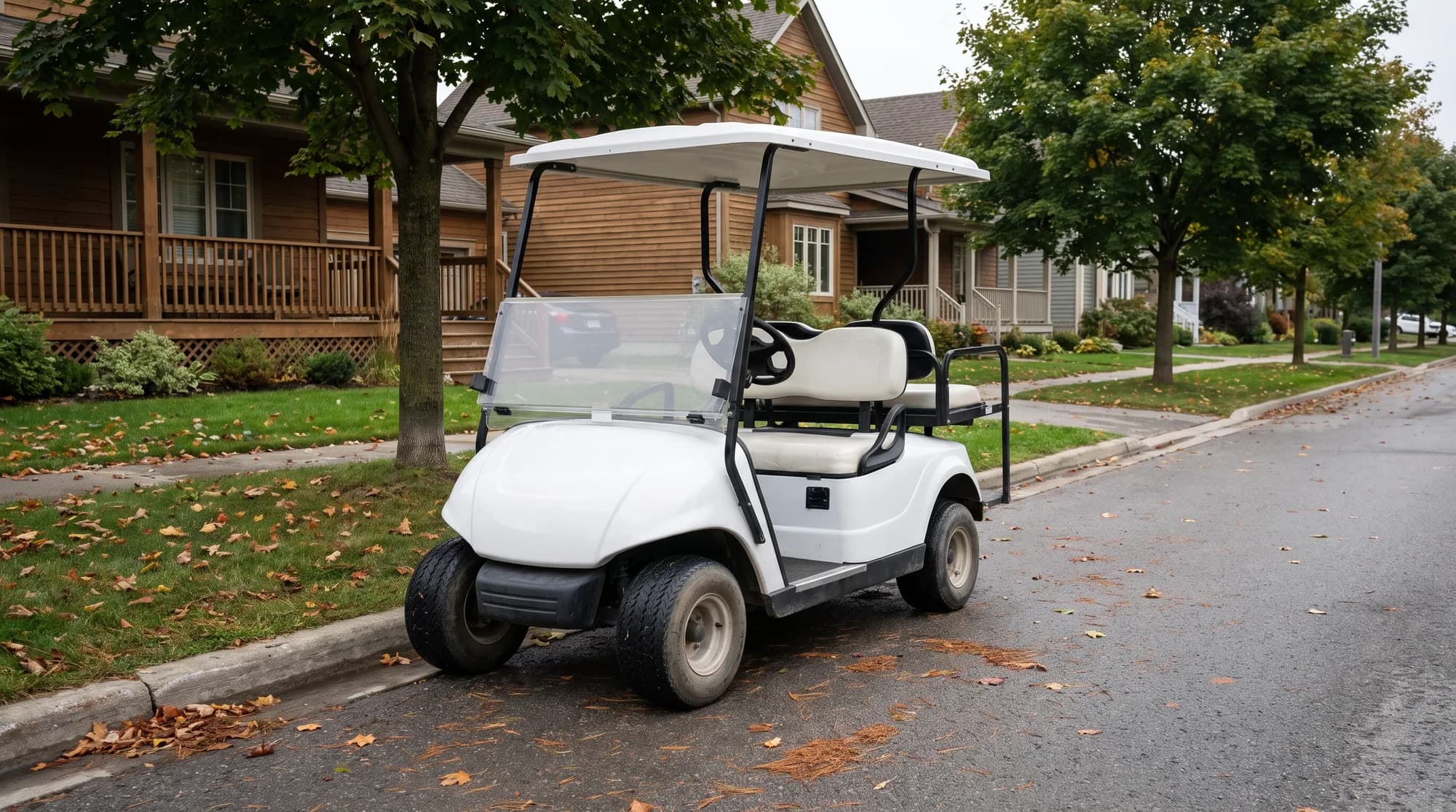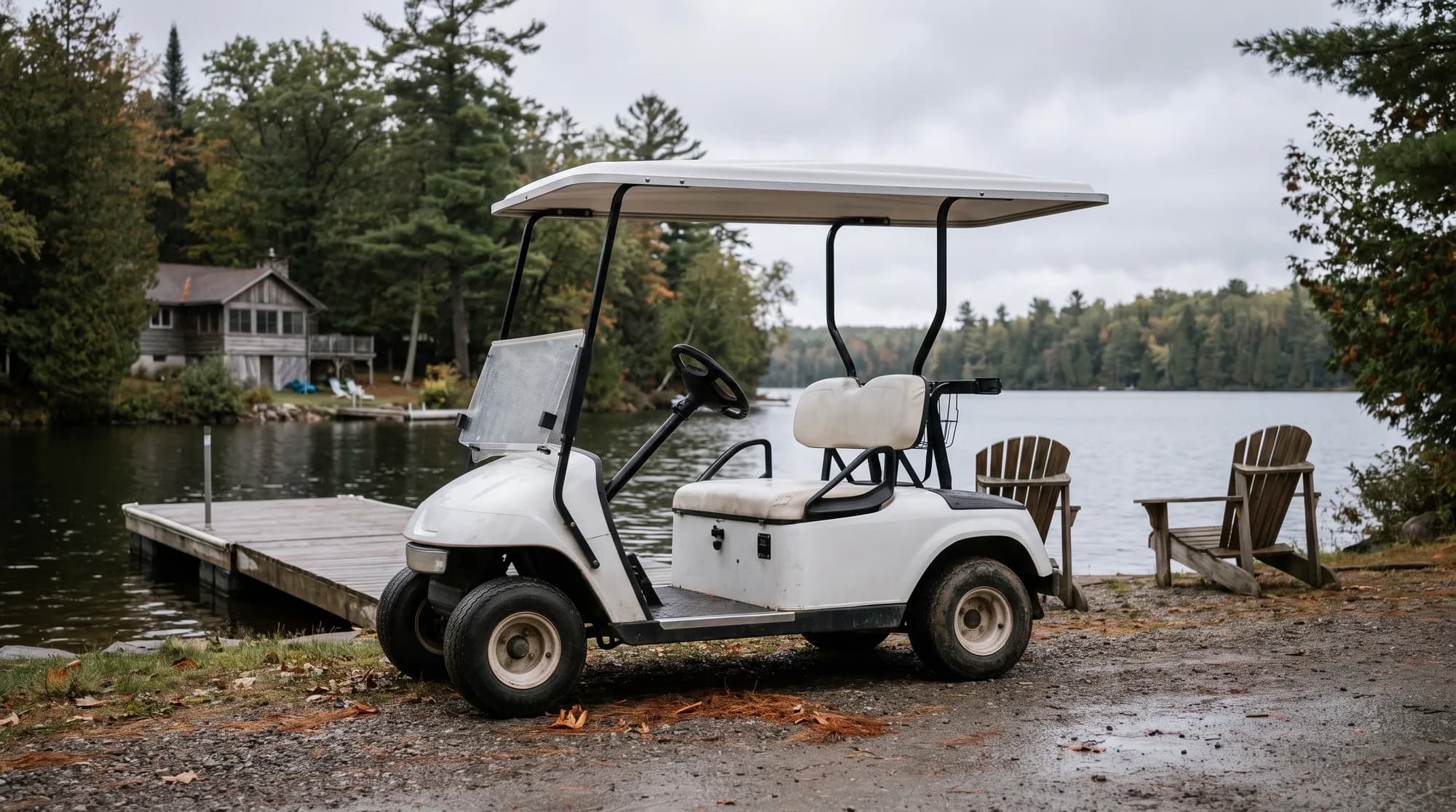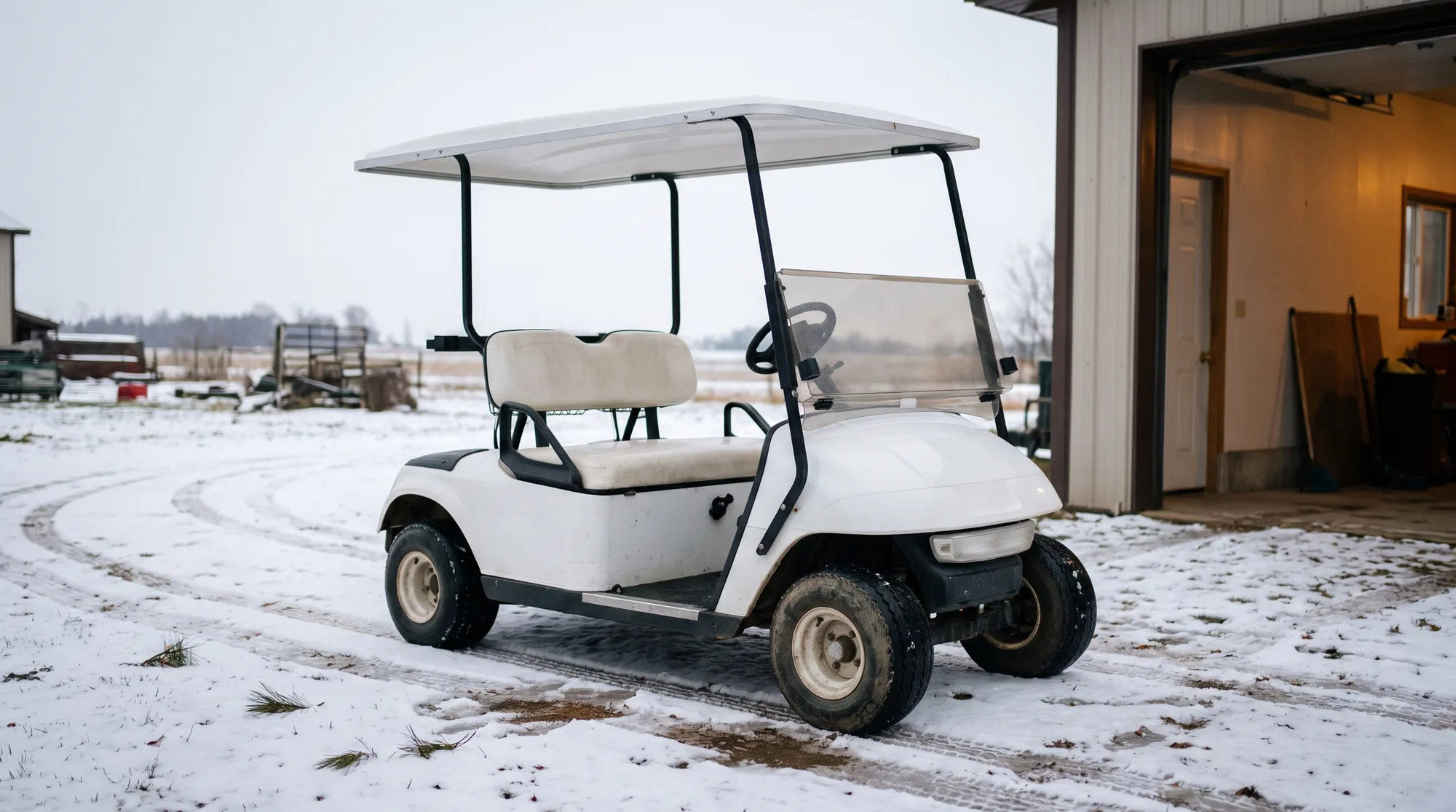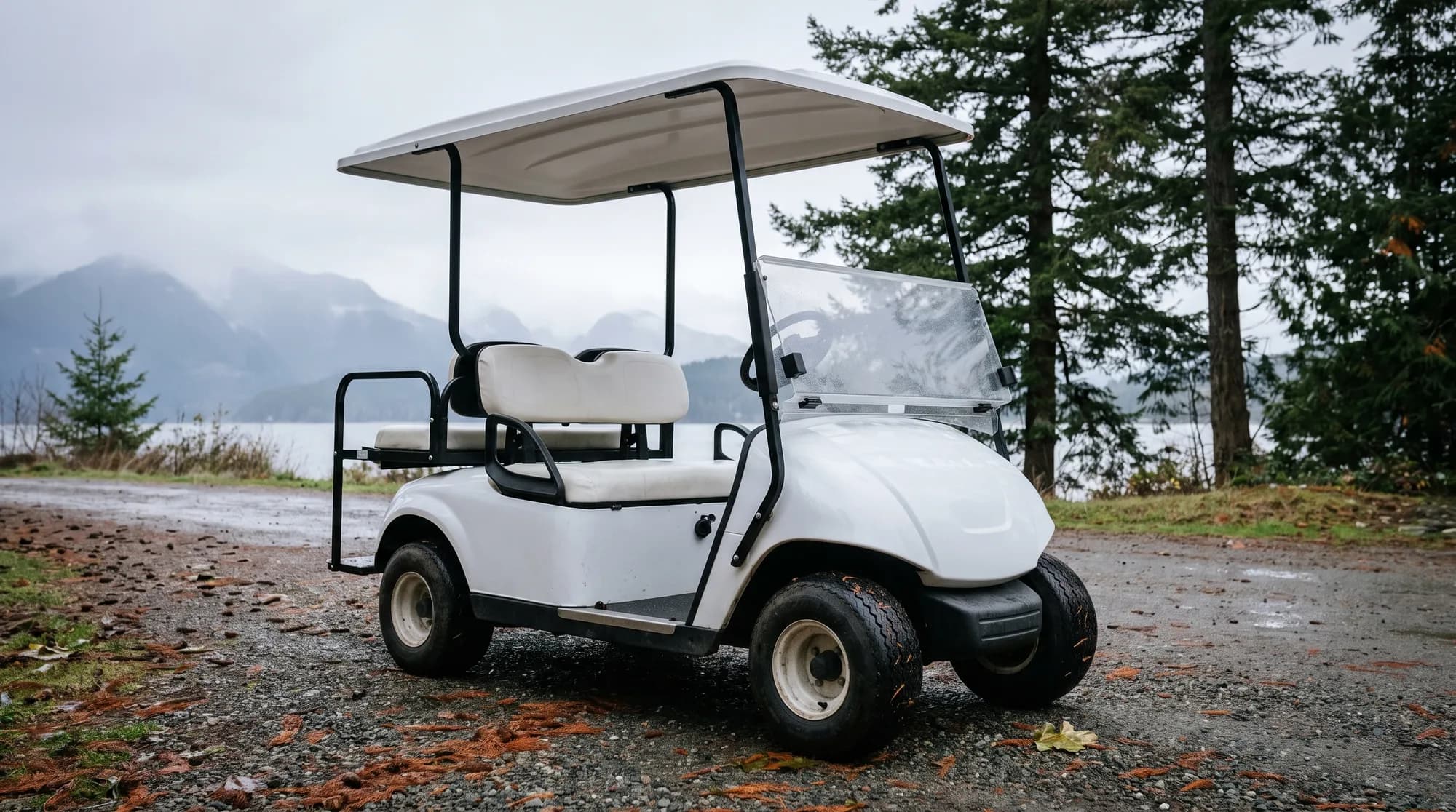
Ask whether golf carts are legal on Ontario roads and the honest answer is: almost everywhere, no, and in a handful of named communities, yes, under strict conditions. Ontario runs a formal Golf Car Pilot Project under Ontario Regulation 407/21, made under the Highway Traffic Act, and outside that pilot a golf cart has no place on a public road. On private property the picture is completely different, and there is also a separate route for federally certified low-speed vehicles. This guide walks through all three, as they stand in 2026.
- Golf carts are not road legal in Ontario except within the provincial Golf Car Pilot Project (O. Reg. 407/21), a ten-year pilot that began in 2021.
- The pilot only applies in a handful of named communities, including Pelee Island, Huron-Kinloss, Lighthouse Cove (Lakeshore), Bois Blanc Island (Amherstburg) and Erieau (Chatham-Kent), and only where the municipality has passed a by-law.
- Pilot rules include a full-class driver's licence, roads posted at 50 km/h or less, a cart that cannot exceed 32 km/h, and a seasonal window of April 1 to November 30.
- Licence plates, vehicle registration and car insurance are not required under the provincial pilot rules, though municipalities can add their own conditions.
- On private property, including golf courses, farms and cottage land, golf carts remain legal to use without a licence.
- Street-legal low-speed vehicles (LSVs) are a separate category with their own Ontario pilot and much stricter requirements.
The default rule: no golf carts on Ontario roads
Under the Highway Traffic Act, a golf cart does not meet the equipment and certification standards required of a motor vehicle, so it cannot be plated, registered or driven on a public highway in the normal way. That word highway is broader than it sounds: in Ontario law it covers essentially any public road, from a rural township lane to a city street. Driving a cart along the shoulder to the local store is an offence in most of the province, and if anything goes wrong you would be dealing with it as the uninsured driver of an unlicensed vehicle.
That is the baseline. The interesting part is the exception Ontario carved out for communities where a golf cart genuinely makes sense as local transport.
The Golf Car Pilot Project (O. Reg. 407/21)
In 2021 Ontario created a ten-year pilot framework that lets specific municipalities permit golf carts (the regulation calls them golf cars) on local roads by passing a by-law. The pilot grew out of Pelee Island's long-running experiment, where carts had already proven themselves as sensible island transport. As of 2026 the communities named under the programme include the Township of Pelee Island, the Municipality of Huron-Kinloss, the community of Lighthouse Cove in Lakeshore, Bois Blanc Island in Amherstburg and the Village of Erieau in Chatham-Kent. Crucially, the pilot only takes effect in a community once its council actually passes a by-law, and the by-law can add local conditions on top of the provincial minimums.
The core pilot rules
- Drivers need a valid full-class Ontario driver's licence (Class G or another full class), so learner permits do not qualify.
- Carts may only use roads with a posted speed limit of 50 km/h or less, and must keep to the right-most lane except when turning left.
- The cart must not be capable of more than 32 km/h on a level surface.
- Operation is seasonal, from April 1 to November 30 each year, which conveniently matches the months when a cart battery is happiest anyway.
- Carts must carry working equipment such as brakes, a horn, a rear-view mirror, reflectors and lights, and lights are mandatory if operating in the low-light window around dusk and dawn.
- Seat belts must be worn where the manufacturer fitted them, and children under 8 cannot be carried.
- All normal rules of the road apply, and so do the Criminal Code impaired driving provisions.
What about everywhere else in Ontario?
If you live outside the pilot communities, the road is off limits, but that still leaves a lot of legal ground. Private property is entirely yours to use: golf courses, farms, campgrounds, large rural lots and cottage properties are where most Ontario carts spend their lives. No licence, registration or minimum age applies on private land under the Highway Traffic Act, although owners are responsible for who they let drive, and impaired driving law still applies to motor vehicles on private property. Many cottage associations with private road networks also allow carts under their own rules, which is worth confirming in writing before you buy.
Golf carts versus low-speed vehicles: two different pilots
Ontario also runs a separate pilot for low-speed vehicles under O. Reg. 215/17. An LSV is not a golf cart: it is a federally certified vehicle class defined by Transport Canada, electric, four-wheeled, capable of between 32 and 40 km/h, and built with road equipment such as seat belts, lights, mirrors and a windshield. Under the Ontario LSV pilot these vehicles can be plated and driven on roads posted at 50 km/h or less, but only where a municipal by-law permits it, and the requirements are much stiffer than the golf cart pilot: a full Class G licence or higher, registration, and at least CA$1 million in third-party liability insurance. The LSV pilot was set to run to mid-2027, so check the current status with the Ministry of Transportation before building plans around it.
- Golf cart pilot (O. Reg. 407/21)
- Named pilot communities with a by-law
- LSV pilot (O. Reg. 215/17)
- Any municipality that passes an LSV by-law
- Golf cart pilot (O. Reg. 407/21)
- Full-class driver's licence
- LSV pilot (O. Reg. 215/17)
- Full Class G or higher
- Golf cart pilot (O. Reg. 407/21)
- Not required
- LSV pilot (O. Reg. 215/17)
- Required
- Golf cart pilot (O. Reg. 407/21)
- Not required provincially
- LSV pilot (O. Reg. 215/17)
- CA$1M+ liability required
- Golf cart pilot (O. Reg. 407/21)
- Standard cart, max 32 km/h
- LSV pilot (O. Reg. 215/17)
- Federally certified LSV, 32 to 40 km/h
| Golf cart pilot (O. Reg. 407/21) | LSV pilot (O. Reg. 215/17) | |
|---|---|---|
| Where allowed | Named pilot communities with a by-law | Any municipality that passes an LSV by-law |
| Licence | Full-class driver's licence | Full Class G or higher |
| Plates and registration | Not required | Required |
| Insurance | Not required provincially | CA$1M+ liability required |
| Vehicle | Standard cart, max 32 km/h | Federally certified LSV, 32 to 40 km/h |
Practical advice for Ontario buyers
First, be honest about where the cart will actually drive. If the answer is your own land, a golf course or a private cottage road, Ontario law barely touches you and your real decisions are about build quality and batteries. Ontario's climate makes battery chemistry the big one: lithium packs handle cottage-country duty well but should not be charged below freezing, so a heated or insulated storage spot matters for the shoulder seasons. If you are in a pilot community, read the municipal by-law itself rather than a summary, because local conditions such as permits or extra equipment vary. And if you genuinely need daily on-road transport, look at a certified LSV rather than trying to make a golf cart into something the law says it is not.
- Confirm whether your community is in the O. Reg. 407/21 pilot and has passed a by-law
- Read the municipal by-law for local permit, equipment or route conditions
- Check your cart cannot exceed 32 km/h and its lights, brakes, horn and mirror work
- Carry your full-class licence and keep to roads posted 50 km/h or under
- Remember the season runs April 1 to November 30
- Arrange liability cover even where insurance is not mandatory
Frequently asked questions
Can I drive a golf cart on the road in Ontario?+
Only within the provincial Golf Car Pilot Project communities, and only where the municipality has passed a by-law permitting it. Everywhere else in Ontario, golf carts are not permitted on public roads, though private property use is legal.
Which Ontario communities allow golf carts on roads?+
The pilot names a small group including Pelee Island, Huron-Kinloss, Lighthouse Cove in Lakeshore, Bois Blanc Island in Amherstburg and Erieau in Chatham-Kent. The list can change, so confirm with your municipality before driving.
Do I need insurance for a golf cart in Ontario?+
Not under the provincial pilot rules, which also waive plates and registration. Municipal by-laws can add conditions, and liability cover is strongly advisable. Low-speed vehicles are different and require at least CA$1 million in liability insurance.
What licence do I need under the Ontario golf cart pilot?+
A valid full-class Ontario driver's licence, such as a full Class G. Graduated learner licences do not qualify, and no licence is needed for purely private property use.
Can I drive a golf cart at night in Ontario?+
Within the pilot, carts need working lights to operate in the period from 30 minutes before sunset to 30 minutes after sunrise, and municipalities may restrict hours further. Outside the pilot, road use is not permitted at any hour.
Thinking about a cart for Ontario?
Tell us how and where you will use it, on the course, the cottage lot or a pilot community, and we will spec a build that suits Ontario conditions, with honest pricing in CAD.
Related solutions
Ready to explore what we build?
See the vehicles and the setting this applies to, or get a tailored quote built around your site.
Ready to find the right buggy?
Tell us how and where it will work and we will specify a vehicle and a tailored quote built around you. Every build comes with a 3-year warranty and a 24-hour priority call-out.
Our guides are written and reviewed by the Hawke Electric Vehicles team, the people who specify, build, deliver and support the vehicles. We focus on honest, practical advice and flag where a figure depends on the build rather than guessing.
More guides by Hawke