For decades the position in Alberta was simple: golf carts had no legal place on a public road, full stop. That changed in October 2024, when the province announced a five-year pilot project, backed by the Pilot Project (Golf Carts) Regulation (Alta Reg 114/2024), letting municipalities apply to allow carts on designated local roads. It is a genuinely permissive scheme by Canadian standards, with no driver's licence requirement and a minimum operator age of just 14, but it only applies where a municipality has been approved and has passed the right bylaw. Here is the full picture for 2026.
- Golf carts remain illegal on Alberta public roads by default under the Traffic Safety Act.
- A five-year provincial pilot, launched in October 2024, lets municipalities apply to permit carts on designated roads posted at 50 km/h or less.
- The first approved communities included Coaldale, Lacombe County, Linden, Whispering Hills, Delburne, Acme and Half Moon Bay, and more municipalities can apply.
- Under the provincial rules, operators must be 14 or older; no driver's licence, registration or plates are required, though municipal bylaws can add permit systems and conditions.
- Night driving is not allowed, carts must be unmodified and in good working order, and towing is prohibited.
- Commercial operators such as resorts and rental businesses need liability insurance; private users should carry cover even where it is not mandated.
The default rule outside the pilot
The Traffic Safety Act requires vehicles on Alberta highways to be registered, insured and equipped to motor vehicle standards, and a golf cart cannot meet those requirements. So outside an approved pilot community, driving a cart on any public road, including quiet hamlet streets and rural range roads, remains an offence. Private property is a different world: farms, acreages, golf courses and campgrounds can run carts freely, which is where the majority of Alberta's carts have always worked.
How the Alberta pilot works
The pilot flips the usual model. Rather than naming communities in the regulation, Alberta invites any interested municipality to apply. Once approved, the municipality must pass a bylaw that designates exactly which roads carts may use and sets up a permit or registration system for the carts themselves. The bylaw can add safety conditions on top of the provincial minimums, so two neighbouring towns can end up with noticeably different regimes. The seven communities approved at launch were the Town of Coaldale, Lacombe County, the Village of Linden, the Summer Village of Whispering Hills, the Town of Delburne, the Village of Acme and the Summer Village of Half Moon Bay, and the list has been open to growth since.
- 01
The municipality applies to the province
Alberta Transportation and Economic Corridors assesses the application under the five-year pilot framework.
- 02
Council passes a bylaw
The bylaw must designate permitted roads and create a permit or registration system, and may add local safety requirements.
- 03
Owners register or get a permit locally
Cart owners follow the municipal process, which may include fees, decals or equipment checks.
- 04
Carts drive under the pilot conditions
Daytime only, designated roads posted 50 km/h or less, unmodified carts in good working order.
The provincial minimum rules
- Operators must be at least 14 years old; a driver's licence is not required under the provincial regulation.
- Carts may only use roads designated by the bylaw, and never roads with a speed limit above 50 km/h.
- No operation at night.
- Carts must be manufacturer-standard: home-built or modified carts are excluded, and towing other vehicles or equipment is not allowed.
- Commercial operators, such as rental businesses, hotels and resorts, must carry liability insurance where bylaws permit their operation.
- Normal traffic rules and Criminal Code impaired driving law apply in full.
Insurance in a province with no public auto insurer
Unlike BC, Saskatchewan, Manitoba and Quebec, Alberta's auto insurance is private, so there is no public insurer gatekeeping cart coverage. The pilot only mandates liability insurance for commercial operators, but going without cover as a private owner is a false economy. A cart on a public street can injure a pedestrian or damage a parked vehicle exactly like a car can, and without insurance that liability is personal. Options include specialty recreational vehicle policies and riders on home or farm policies; a proper policy for a cart typically costs a few hundred dollars a year, which is cheap against the exposure.
Alberta realities: winter, distance and the used market
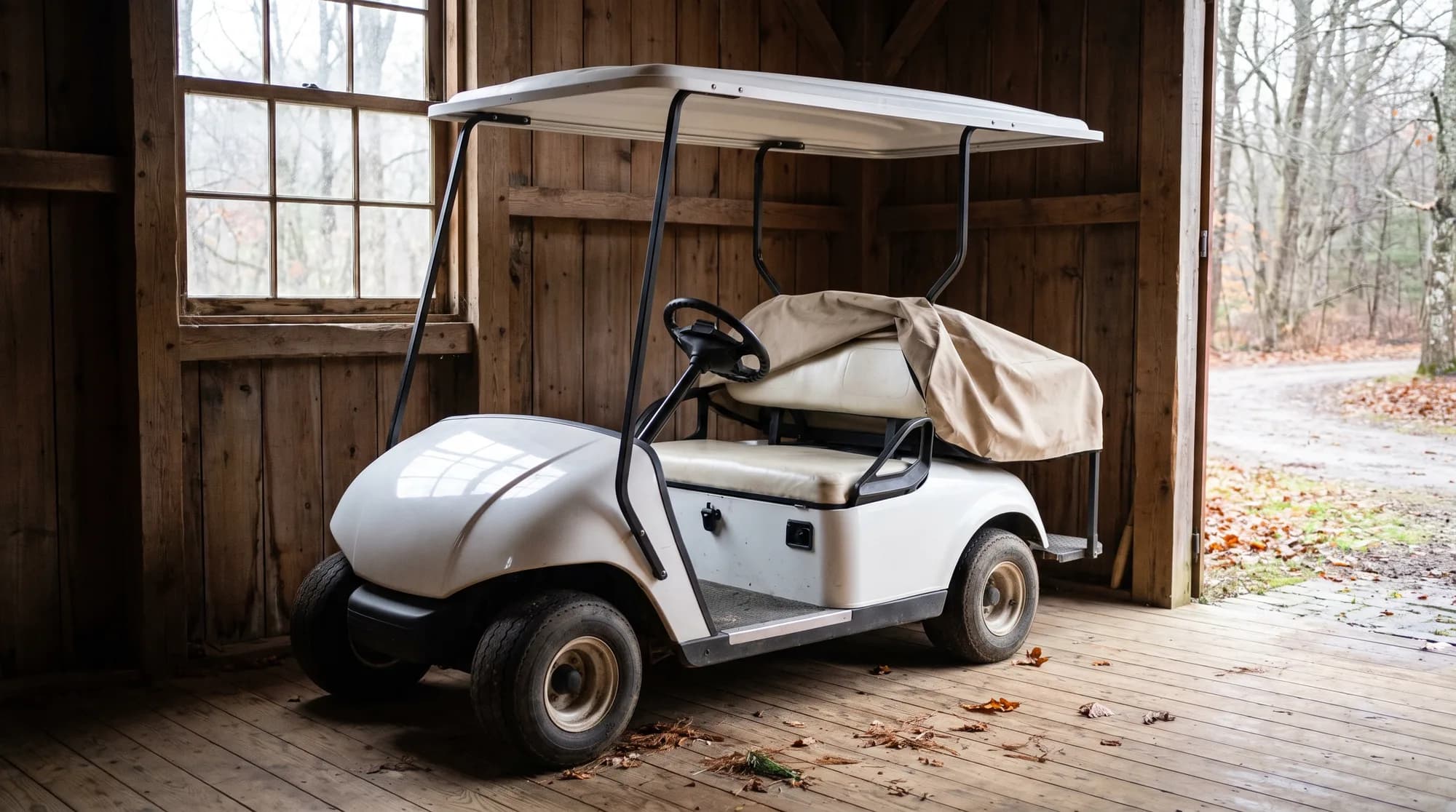
Alberta's pilot has no formal seasonal window, but the prairie winter imposes its own. Most cart use runs May to October, and the storage months are where carts are won or lost mechanically. Lead-acid batteries left discharged in a minus 30 Celsius shed will freeze and be ruined; lithium packs tolerate cold storage far better but must never be charged below zero, so charge indoors or wait for the pack to warm. If you are buying used from a course sell-off, ask when the batteries last wintered properly, because in Alberta that answer is often the true price of the cart.
How Alberta compares with its neighbours
Alberta arrived at golf cart legalisation later than Ontario and Saskatchewan, but it landed on the most permissive driver rules in the country. Ontario requires a full-class driver's licence for its pilot communities; Saskatchewan requires at least a Class 7 learner licence and CA$200,000 in liability insurance; Alberta requires neither, just a 14-year age floor and whatever the local bylaw adds. The trade-off is that Alberta leans harder on municipalities: the bylaw must designate specific roads and create a permit or registration system, so in practice an Alberta pilot town knows exactly which carts are on its streets. For residents the lesson is that the provincial regulation is only half the rulebook. The bylaw is the half that decides whether you need a decal on the cowl, which streets connect to the campground, and whether your teenager can drive to the rink.
It is also worth watching how the pilot evolves. Five-year pilots exist to gather evidence, and municipalities report their experience back to the province. If the early communities generate few incidents, expect the approved list to lengthen and the case for a permanent framework to build, which is broadly what happened with Ontario's island communities before its pilot. If you want your own town added, a note to your councillor citing the approved communities is the practical first step.
Frequently asked questions
Are golf carts legal on Alberta roads in 2026?+
Only in municipalities approved under the five-year pilot that have passed a bylaw designating cart roads. Everywhere else, public road use remains illegal, while private property use is unrestricted.
Do I need a driver's licence for a golf cart in Alberta?+
Not under the provincial pilot regulation, which sets a minimum operator age of 14 instead. Municipal bylaws can add stricter conditions, so check locally.
Which Alberta communities allow golf carts on the road?+
The first approved group included Coaldale, Lacombe County, Linden, Whispering Hills, Delburne, Acme and Half Moon Bay. The pilot is open to further applications, so ask your municipality about its current status.
Is insurance required for a golf cart in Alberta?+
The pilot requires liability insurance for commercial operators. Private users are not required to insure under the provincial rules, but bylaws may differ and liability cover is strongly advisable on any public road.
Can I drive a golf cart at night in Alberta?+
No. The pilot prohibits night operation, and carts must stick to designated roads posted at 50 km/h or less during the day.
Can my town join the Alberta golf cart pilot?+
Yes, interested municipalities can apply to the province during the five-year pilot. The route for residents is to raise it with the municipal council, which must apply, be approved and pass the required bylaw.
Get a cart built for Alberta
Cold-ready batteries, honest specifications and CAD pricing. Tell us whether the cart is for the acreage, the course or a pilot community street, and we will quote accordingly.
Related solutions
Ready to explore what we build?
See the vehicles and the setting this applies to, or get a tailored quote built around your site.
Ready to find the right buggy?
Tell us how and where it will work and we will specify a vehicle and a tailored quote built around you. Every build comes with a 3-year warranty and a 24-hour priority call-out.
Our guides are written and reviewed by the Hawke Electric Vehicles team, the people who specify, build, deliver and support the vehicles. We focus on honest, practical advice and flag where a figure depends on the build rather than guessing.
More guides by Hawke