A Canadian winter is the hardest thing most golf carts will ever face, and the cart is usually parked while it happens. From roughly November to April the vehicle sits still, the temperature swings from mild to minus thirty, and the battery quietly decides whether it will survive to spring. Get the storage routine right and a cart will shrug off a dozen winters. Get it wrong and you can destroy a CA$1,500 to CA$4,000 battery pack in a single season without ever turning the key. This guide covers the full routine, with separate instructions for lead-acid and lithium, because the two chemistries want almost opposite treatment.
- Lead-acid batteries must be stored fully charged. A full pack resists freezing to around minus 50 degrees Celsius, but a deeply discharged one can freeze just a few degrees below zero.
- Lithium packs prefer partial charge for storage, roughly 50 to 60 percent, and should never be charged while below freezing.
- Unheated storage is fine for lead-acid if the pack is full and topped up monthly. Lithium is happiest stored somewhere that stays above freezing.
- Disconnect the battery or use the storage switch. Parasitic drain over five months can flatten a pack on its own.
- Clean the cart, inflate the tires, block against rodents and cover it with a breathable cover, not plastic sheet.
- Spring recommissioning takes an hour and catches problems while they are still cheap.
Why winter storage decides battery life
Two things happen to a parked golf cart in a Canadian winter. First, every battery self-discharges. Lead-acid loses charge steadily month by month, and although cold actually slows the chemistry down, five months is a long time. Second, and far more seriously, a discharged lead-acid battery can freeze. The electrolyte in a fully charged battery is a strong acid solution with a freezing point around minus 50 degrees Celsius or lower, so a full pack is safe almost anywhere in Canada. As the battery discharges, the electrolyte turns progressively more watery, and a deeply discharged battery can freeze only a few degrees below zero. When it freezes, the ice expands, the plates buckle and the case can crack. That battery is scrap, and in a six-battery or eight-battery pack, one frozen unit usually means replacing the set.
This is why the single most important sentence in this guide is short: never let a lead-acid golf cart battery sit discharged in the cold. Everything else, the cleaning, the tires, the cover, is secondary to charge management.
Storing a lead-acid cart: the routine
- 01
Charge the pack fully
Run a complete charge cycle the day you park the cart, and let the charger finish on its own. A full charge protects against freezing and slows sulphation, the crystal build-up that permanently steals capacity from batteries left partly discharged.
- 02
Check and top up the water
After charging, check the electrolyte level in each cell and top up with distilled water so the plates are covered. Only ever water after charging, not before, or the cells can overflow.
- 03
Clean the terminals
Corroded terminals leak current. Clean any white or green crust with a baking soda solution, rinse, dry, and coat the terminals with dielectric grease or terminal protector.
- 04
Cut the drain
Flip the tow/run or storage switch if the cart has one, or disconnect the main negative cable. Modern carts have controllers, meters and accessories that draw a trickle even when off.
- 05
Top up monthly, or use a maintainer
Either recharge the pack once a month through the winter, or leave it on a proper automatic battery maintainer designed for the pack voltage. A maintainer is the better answer for anyone who will not reliably visit a cold shed in January.
Storing a lithium cart: almost the opposite
Lithium packs, usually lithium iron phosphate in modern golf carts, break most of the lead-acid rules. They barely self-discharge, they do not sulphate, and they do not want to sit at 100 percent for months. The widely accepted storage target is roughly 50 to 60 percent charge, which minimizes stress on the cells. Charge or discharge to that level, switch the pack off using its disconnect if fitted, and leave it.
The one hard rule with lithium is temperature. Charging a lithium battery below 0 degrees Celsius causes lithium plating, a permanent internal change that steals capacity and can create safety risks later. A quality battery management system will simply refuse to charge below its low-temperature cutoff, which is exactly what you want, but cheaper packs without that protection will accept a charge and quietly damage themselves. So the winter rule is simple: if the pack is below freezing, warm it indoors for a day before connecting a charger. Storage itself in the cold is less of a problem, since discharge and rest tolerate low temperatures far better than charging, but a spot that stays above freezing, a basement corner or heated garage, is the kinder option and keeps spring simple.
Heated or unheated storage: what actually matters
- Lead-acid pack
- Ideal. Full charge plus a maintainer, nothing to worry about
- Lithium pack
- Ideal. Store at half charge, charging allowed any time
- Lead-acid pack
- Fine if stored fully charged and topped up monthly
- Lithium pack
- Acceptable. Never charge until the pack warms above freezing
- Lead-acid pack
- Risky. Moisture and neglect are the killers, not cold itself
- Lithium pack
- Not recommended. Condensation and extreme cold soak the pack
- Lead-acid pack
- Good option for smaller packs, store on wood, keep charged
- Lithium pack
- Best of all worlds if the pack is removable
| Lead-acid pack | Lithium pack | |
|---|---|---|
| Heated garage or barn | Ideal. Full charge plus a maintainer, nothing to worry about | Ideal. Store at half charge, charging allowed any time |
| Unheated shed or barn | Fine if stored fully charged and topped up monthly | Acceptable. Never charge until the pack warms above freezing |
| Outdoors under cover | Risky. Moisture and neglect are the killers, not cold itself | Not recommended. Condensation and extreme cold soak the pack |
| Battery removed indoors | Good option for smaller packs, store on wood, keep charged | Best of all worlds if the pack is removable |
The rest of the cart: a 30-minute prep
- Wash and dry the cart, including the underside, to remove summer grime and any road salt picked up in late autumn.
- Inflate the tires slightly above normal pressure. Cold air contraction and five months of sitting will otherwise leave them soft and flat-spotted.
- Chock the wheels and leave the park brake off where the design allows, so the brake cannot seize in place.
- Block rodent entry points. Mice nest in seat foam and chew wiring looms, and a chewed loom can cost more than a battery. Steel wool in openings and traps nearby work.
- Leave the seat propped open a crack for airflow if storing indoors with lead-acid batteries, which vent small amounts of hydrogen during charging.
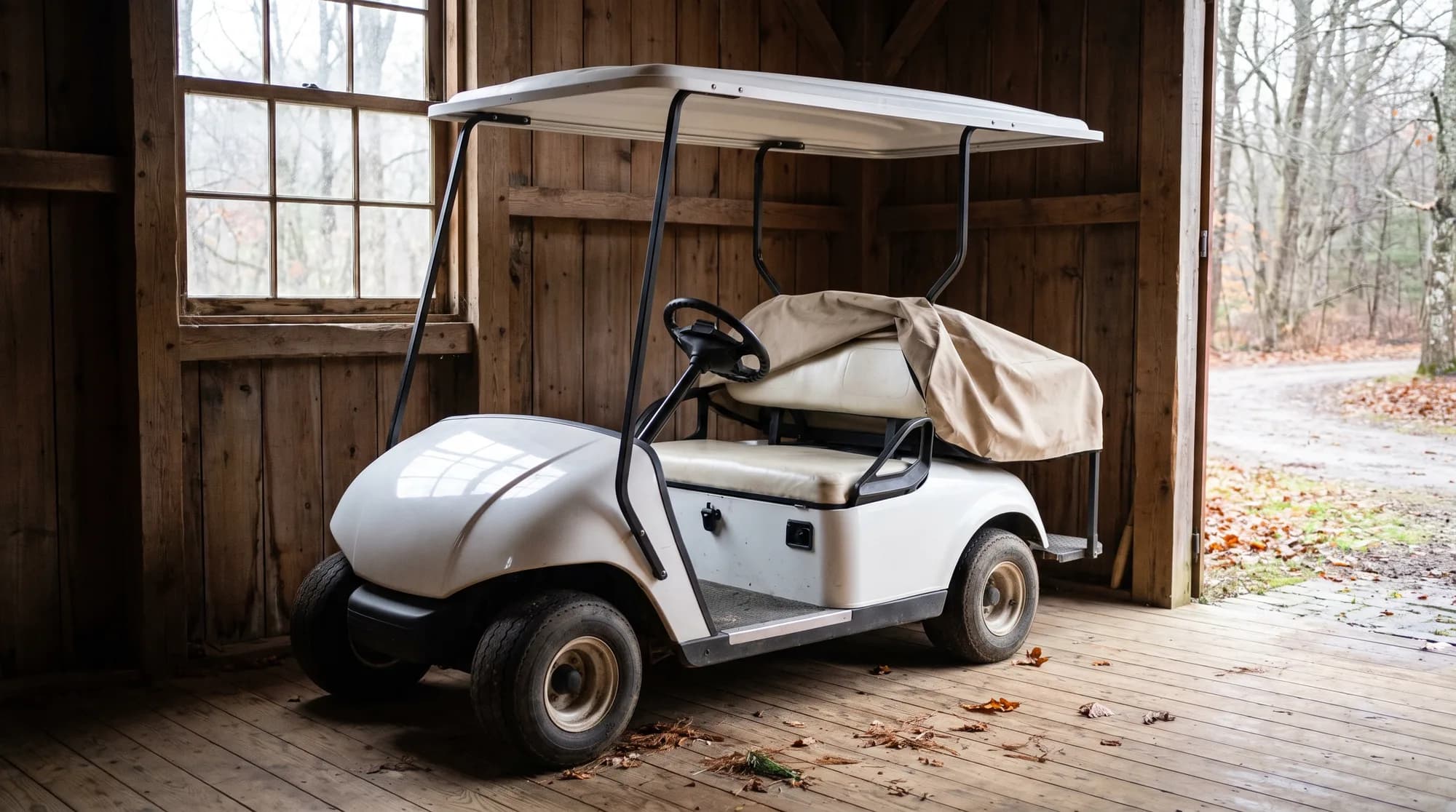
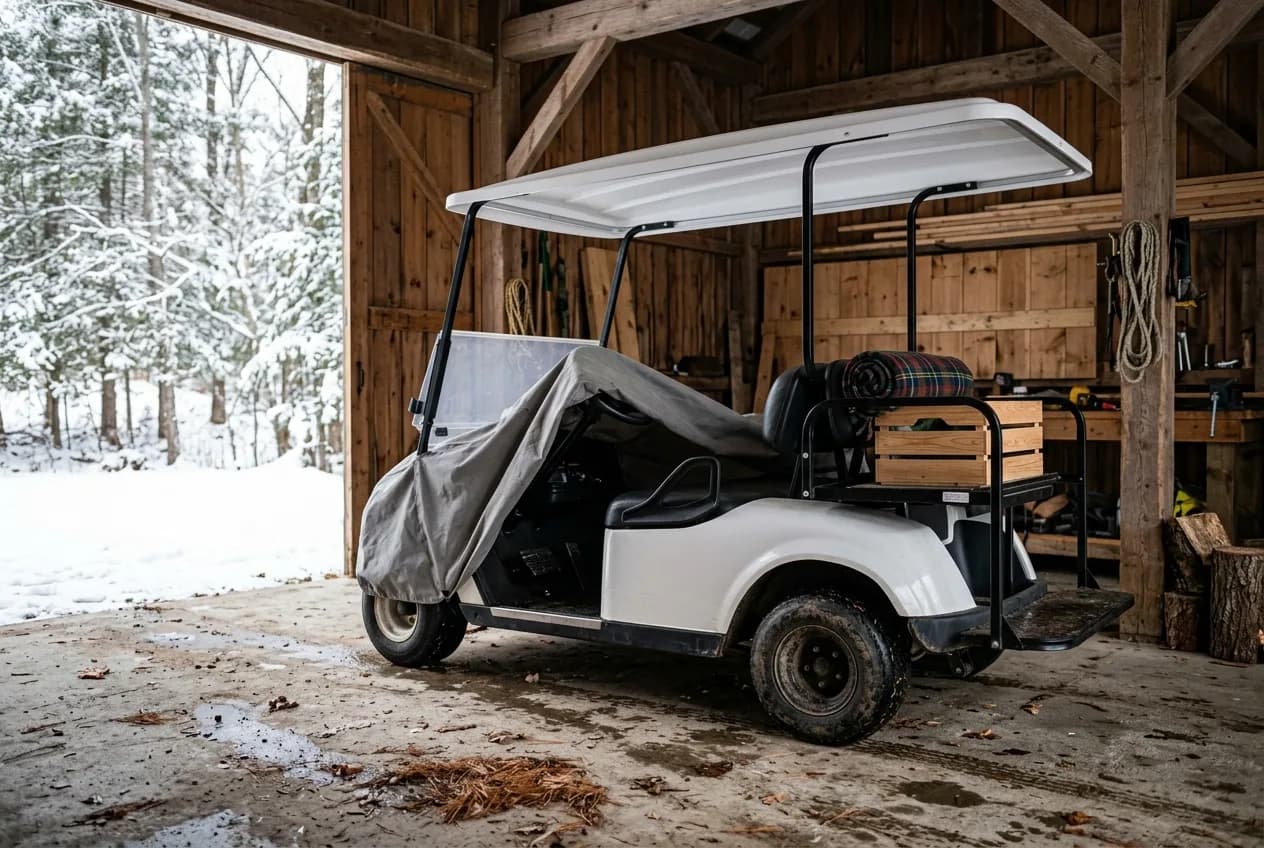
- Use a breathable fabric cover. Plastic sheet traps condensation against the bodywork and terminals all winter.
- For gas carts, stabilize the fuel or run the carburetor dry, per the engine manual.
Bringing it back in spring
Recommissioning is the mirror image of storage and takes about an hour. Reconnect the battery, give lead-acid a full charge and a water check, and let lithium warm fully before its first charge. Set tire pressures back to specification, work the brakes gently a few times before trusting them, and take a slow first lap listening for anything that squeaks, binds or smells hot. If the cart cranks or drives noticeably worse than it did in November, the battery is the first suspect, and our guide to golf cart batteries in cold weather covers how to test a pack properly.
One honest note on economics. If a lead-acid pack is already three or four seasons old going into winter, storage will not save it, and spring is when the weakness shows. Plenty of owners in cottage country treat autumn as the time to decide: winterize the current pack, or budget for a replacement, or step up to lithium, which turns almost this entire article into a single paragraph. As a premium brand serving Canada and building to order, we spec batteries around exactly this kind of climate conversation.
Want a cart built for Canadian winters?
Tell us where the cart will live and how it will be stored, and we will recommend the battery and spec that suit the climate, with honest numbers.
Frequently asked questions
Should I leave my golf cart plugged in all winter in Canada?+
Only if the charger is a genuine automatic maintainer designed for storage. Older chargers that hold a constant charge can overcharge lead-acid and boil off water. If in doubt, charge fully, disconnect, and top up once a month.
Will my golf cart batteries freeze in an unheated garage?+
Fully charged lead-acid batteries will not freeze in any normal Canadian winter, since a full pack resists freezing to around minus 50 degrees Celsius. Discharged batteries can freeze only a few degrees below zero, which is why charge level is everything.
What charge level should a lithium golf cart battery be stored at?+
Roughly 50 to 60 percent is the widely recommended storage level. Avoid storing at 100 percent for months, and never connect a charger while the pack is below freezing.
Should I take the batteries out of the cart for winter?+
It is not required, but removing them to a cool indoor space makes maintenance easier and removes the freezing question entirely. Store them on a wooden surface, keep lead-acid charged, and keep lithium at partial charge.
Do I need to do anything different for a gas golf cart?+
Yes. Add fuel stabilizer or run the carburetor dry, and still maintain the starter battery, which is a lead-acid unit with the same freezing risk as a drive pack.
Related solutions
Ready to explore what we build?
See the vehicles and the setting this applies to, or get a tailored quote built around your site.

Ready to find the right buggy?
Tell us how and where it will work and we will specify a vehicle and a tailored quote built around you. Every build comes with a 3-year warranty and a 24-hour priority call-out.
Our guides are written and reviewed by the Hawke Electric Vehicles team, the people who specify, build, deliver and support the vehicles. We focus on honest, practical advice and flag where a figure depends on the build rather than guessing.
More guides by Hawke