A professional golf buggy service works through seven areas: the battery pack and its connections, the brakes, the steering and suspension, the tyres, the motor controller and its diagnostics, the charger, and lubrication of the moving parts, finishing with a road test and a written report. An electric buggy has far fewer service items than a petrol machine, no oil, no filters, no spark plugs, but the items it does have are the ones that keep it safe and keep its most expensive component, the battery, alive. This guide walks through what actually happens at each stage, why mobile servicing suits buggies particularly well, and how often a service makes sense.
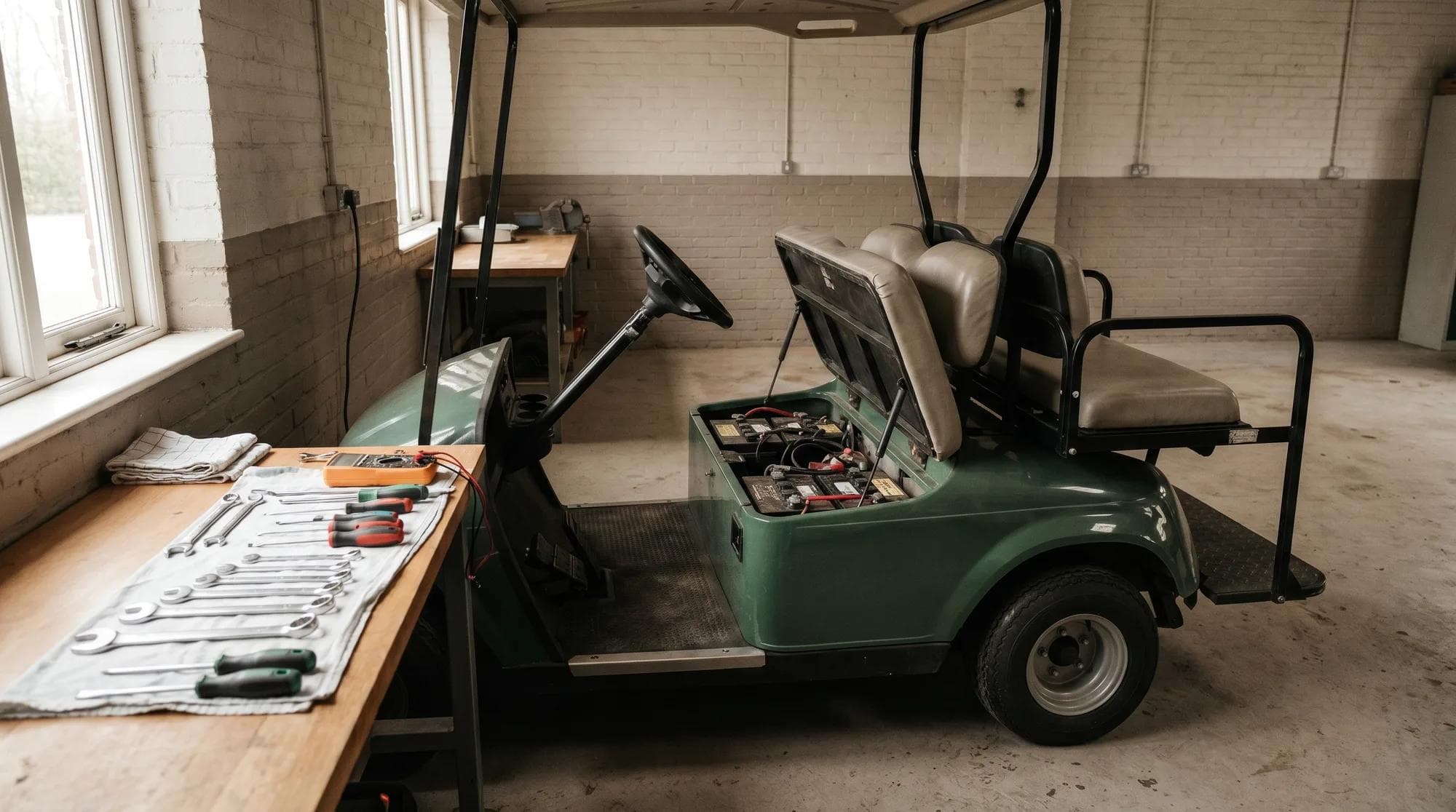
- The battery pack and its connections get the most attention: they are the priciest part and the commonest failure point.
- Brakes, steering and tyres are the safety core of the visit, checked and adjusted, not just glanced at.
- Controller diagnostics read fault codes you would never know were logged.
- The charger is serviced too, because a failing charger quietly kills good batteries.
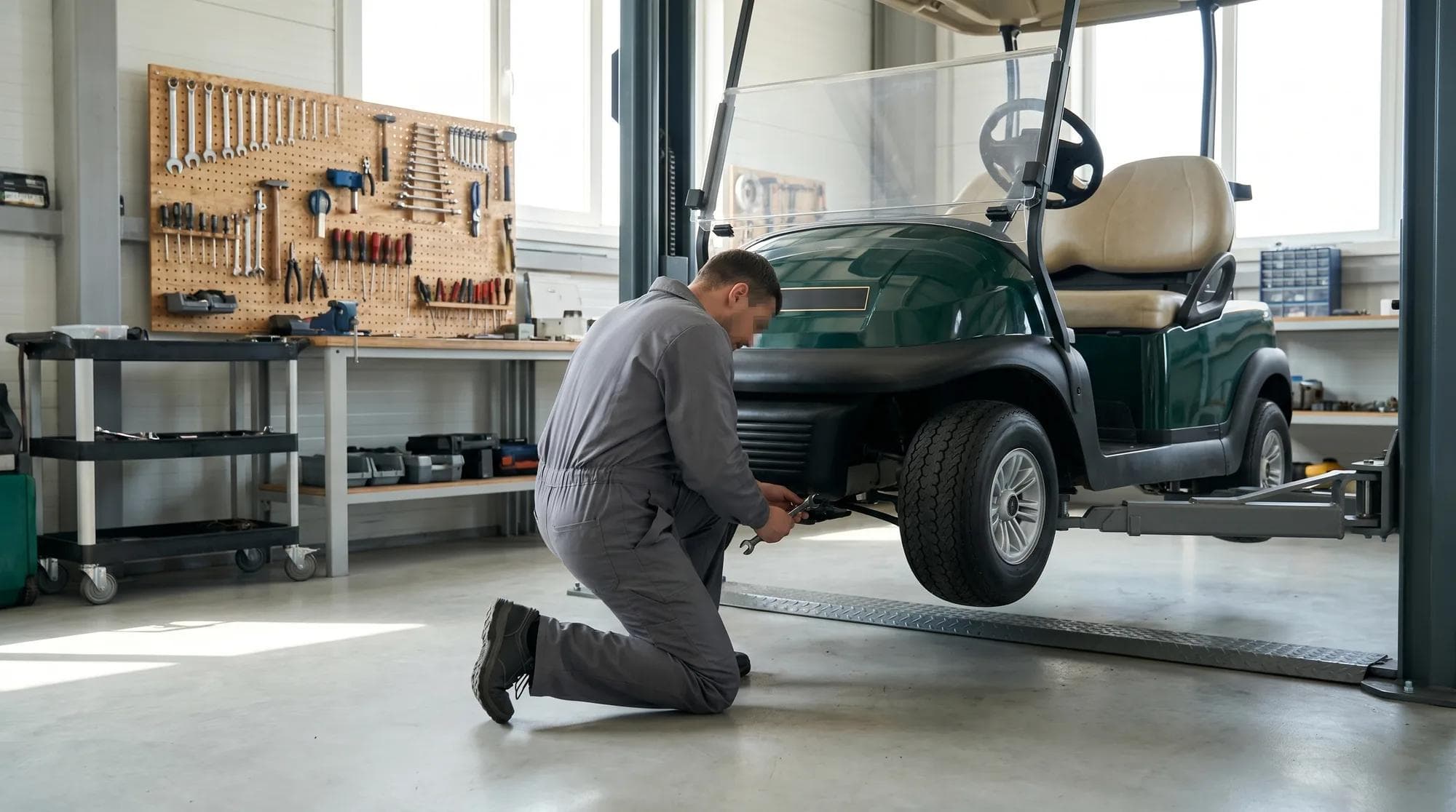
- Mobile servicing suits buggies: the engineer comes to the machine, so no transport costs or downtime hauling it away.
The golf buggy service, stage by stage
The visit starts with the batteries, because everything else depends on them. The engineer inspects the pack for damage and swelling, tests voltage across the pack and per battery to find weak units hiding in a healthy-looking set, and checks every terminal and interconnect for corrosion and tightness, since a loose or corroded connection creates resistance, heat and eventually a stranded vehicle. On lead-acid packs, electrolyte levels are checked and topped with de-ionised water; on lithium, the battery management system is interrogated for cell balance and logged warnings. Next come the safety systems. Brakes are inspected for wear, adjusted for even bite, and the parking brake or hill-hold is tested on a gradient. Steering joints and wheel bearings are checked for play, suspension bushes for wear, and tyres for pressure, tread and sidewall damage.
Then the electrical brain. The engineer connects to the motor controller and reads its diagnostics, most modern controllers log fault codes and event histories that reveal intermittent problems long before they strand anyone, and checks the throttle input, solenoid or contactor, and the drive motor's condition. The charger gets its own check: output voltage and charge profile are verified, because a drifting charger will quietly undercharge or overcharge a pack until the batteries fail early through no fault of their own. The visit closes with lubrication of steering, suspension and pedal linkages, a check of lights, horn and the reverse beeper where fitted, a road test, and a written report listing anything advisory, so you can plan rather than react.
Why mobile servicing suits golf buggy owners
Buggies are awkward to transport: most owners have no trailer, and hauling a machine to a workshop and back can cost as much as the service itself. Mobile servicing solves that, the engineer comes to the club, estate, site or home, works on the machine where it lives, and the vehicle is out of action for hours rather than days. For fleets the case is stronger still, since one visit can service several machines in rotation without the operation losing them all at once. It also means the engineer sees the ground the vehicle actually works on, which often explains wear patterns a workshop would misread. Hawke services and repairs buggies of all brands this way, details are on our golf buggy repairs page, and our servicing, warranty and call-out guide explains how servicing and warranty fit together, including our 24-hour priority call-out for covered customers.
- What the engineer does
- Voltage tests, terminal and connection checks, levels or BMS read
- Why it matters
- Priciest component; early faults are cheap, late ones are not
- What the engineer does
- Inspect, adjust, test parking brake on a slope
- Why it matters
- The core safety system on any gradient
- What the engineer does
- Check joints, bearings and bushes for play
- Why it matters
- Wear here becomes wander, shudder and tyre wear
- What the engineer does
- Pressures, tread, sidewall condition
- Why it matters
- Underinflation eats range and grip
- What the engineer does
- Read fault codes, test throttle and solenoid
- Why it matters
- Finds intermittent faults before they strand you
- What the engineer does
- Verify output and charge profile
- Why it matters
- A drifting charger kills good batteries early
| Area | What the engineer does | Why it matters |
|---|---|---|
| Batteries | Voltage tests, terminal and connection checks, levels or BMS read | Priciest component; early faults are cheap, late ones are not |
| Brakes | Inspect, adjust, test parking brake on a slope | The core safety system on any gradient |
| Steering & suspension | Check joints, bearings and bushes for play | Wear here becomes wander, shudder and tyre wear |
| Tyres | Pressures, tread, sidewall condition | Underinflation eats range and grip |
| Controller | Read fault codes, test throttle and solenoid | Finds intermittent faults before they strand you |
| Charger | Verify output and charge profile | A drifting charger kills good batteries early |
How often does a golf buggy service make sense?
As a general rule, an annual service suits a privately owned buggy in regular but light use, while hard-worked machines, fleet buggies at clubs, hotels and venues, or vehicles working daily on sites and estates, justify a visit every six months or at set operating-hour intervals. Seasonal timing helps too: a service before spring recommissioning catches winter's damage, and a pre-winter check sets the batteries up for storage. Between visits, the routine in our maintenance checklist keeps the machine healthy, and it is worth knowing the warning signs of battery trouble so a failing pack never catches you out. Servicing little and often is cheap; recovering a neglected machine is not.
Frequently asked questions
What is included in a golf buggy service?+
Battery pack tests and connection checks, brake inspection and adjustment, steering and suspension checks, tyre condition and pressures, controller diagnostics, a charger check, lubrication of moving parts, a road test and a written report. Electric buggies have no oil, filters or plugs to change.
How long does a golf buggy service take?+
Typically a couple of hours per machine for a full service, longer if the report turns up work that you approve on the spot. A mobile engineer servicing a small fleet will usually work through the machines in rotation across a day so the operation keeps running.
How often should a golf buggy be serviced?+
Annually for a privately owned machine in light regular use; every six months, or at set operating-hour intervals, for fleet and daily-duty vehicles. A pre-season service in spring and a battery-focused check before winter storage are the two most valuable timings.
Can any machine be serviced, or only ones you sold?+
Independent and dealer engineers, including Hawke, routinely service buggies of all brands. What matters is access to parts and diagnostic knowledge for your controller and battery system, so ask when booking. Servicing history also supports resale value whatever the badge.
Does servicing affect my warranty?+
Keeping to the service schedule is normally a condition of any warranty, and a documented history protects you if a claim is ever questioned. Every new Hawke vehicle carries a 3-year warranty, and covered customers have a 24-hour priority call-out line.
Book servicing that comes to you
Tell us what you run and where it lives, and we will arrange mobile servicing for a single buggy or a whole fleet, any brand.
Related solutions
Ready to explore what we build?
See the vehicles and the setting this applies to, or get a tailored quote built around your site.

Ready to find the right buggy?
Tell us how and where it will work and we will specify a vehicle and a tailored quote built around you. Every build comes with a 3-year warranty and a 24-hour priority call-out.
Our guides are written and reviewed by the Hawke Electric Vehicles team, the people who specify, build, deliver and support the vehicles. We focus on honest, practical advice and flag where a figure depends on the build rather than guessing.
More guides by Hawke