There is one insight that changes how you run buggies after dark, and it is counter-intuitive: the difficulty is not the driver seeing the route. Headlights handle that, and event sites are rarely genuinely dark. The difficulty is the crowd seeing the buggy. A low, quiet, unlit electric vehicle moving at walking pace through a lit area full of people looking at their phones is very easy to miss, and the near-misses that happen at events after dark almost all share that shape. Once you understand the problem as a conspicuity problem rather than an illumination one, the controls become obvious. This guide covers specifying lighting for hire buggies, making vehicles visible, how routes should change at night, and what to brief your drivers before the light goes.
- The risk after dark is the vehicle not being seen, not the driver not seeing.
- Specify lighting at booking; it is easy to add to a hire order and impossible to improvise on site.
- Reflective markings, a beacon and high-visibility clothing do more for conspicuity than brighter headlights.
- Shorten and simplify routes at night, and stop movement altogether during exit surges.
- In the UK, plan for early darkness from autumn onwards, including on events that finish in the afternoon.
Conspicuity: the problem after dark
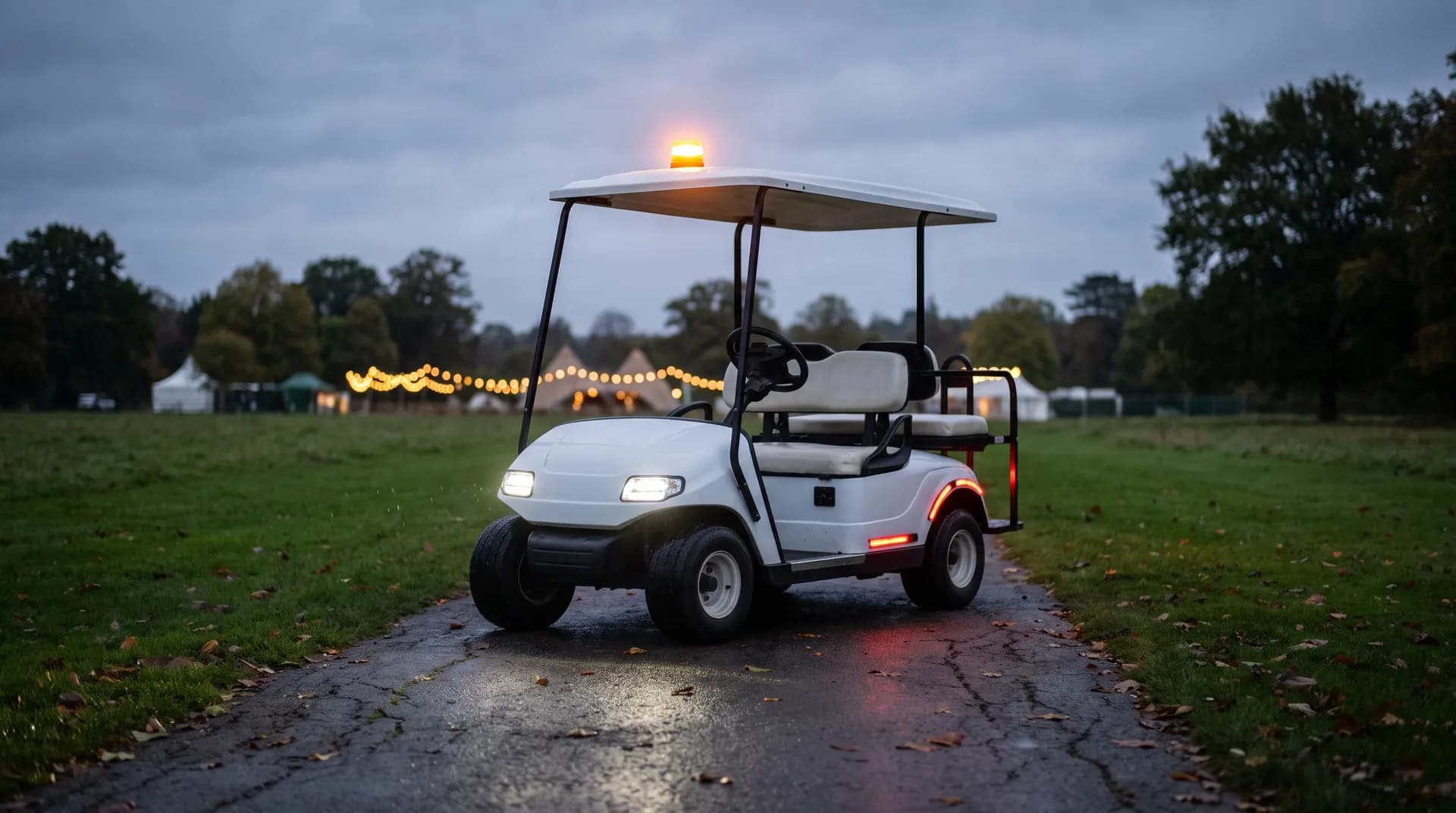
Think about what your buggy looks like to a pedestrian at nine on a November evening. It is low, so it sits below the eye-line of people scanning a crowd. It is quiet, so it removes the audio cue people unconsciously rely on. It is often dark-coloured, in an environment with bright competing light from stages, food stalls and strings of festoon. And the people around it are frequently distracted, sometimes have been drinking, and are not expecting a vehicle in a pedestrian area. Every one of those factors is about the vehicle being noticed, not about the driver's vision. That is why the controls that matter most are the ones that make the buggy conspicuous: a beacon that catches the eye above the crowd, reflective markings that pick up other people's lights, marker lighting that outlines the vehicle's width, and drivers in high-visibility clothing so a person is visible even when the vehicle is partly obscured.
Event buggy lights: what to specify on the hire order
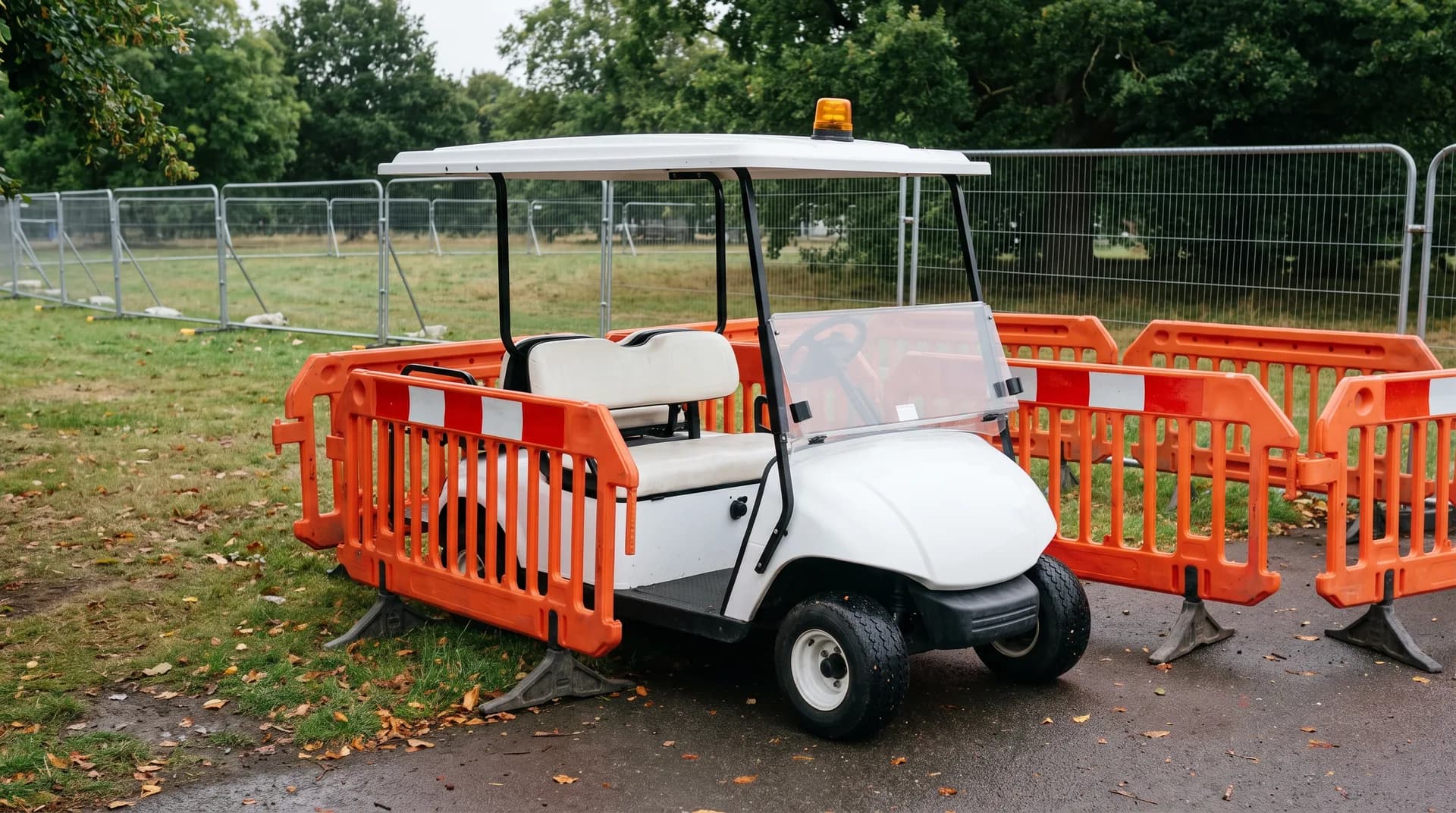
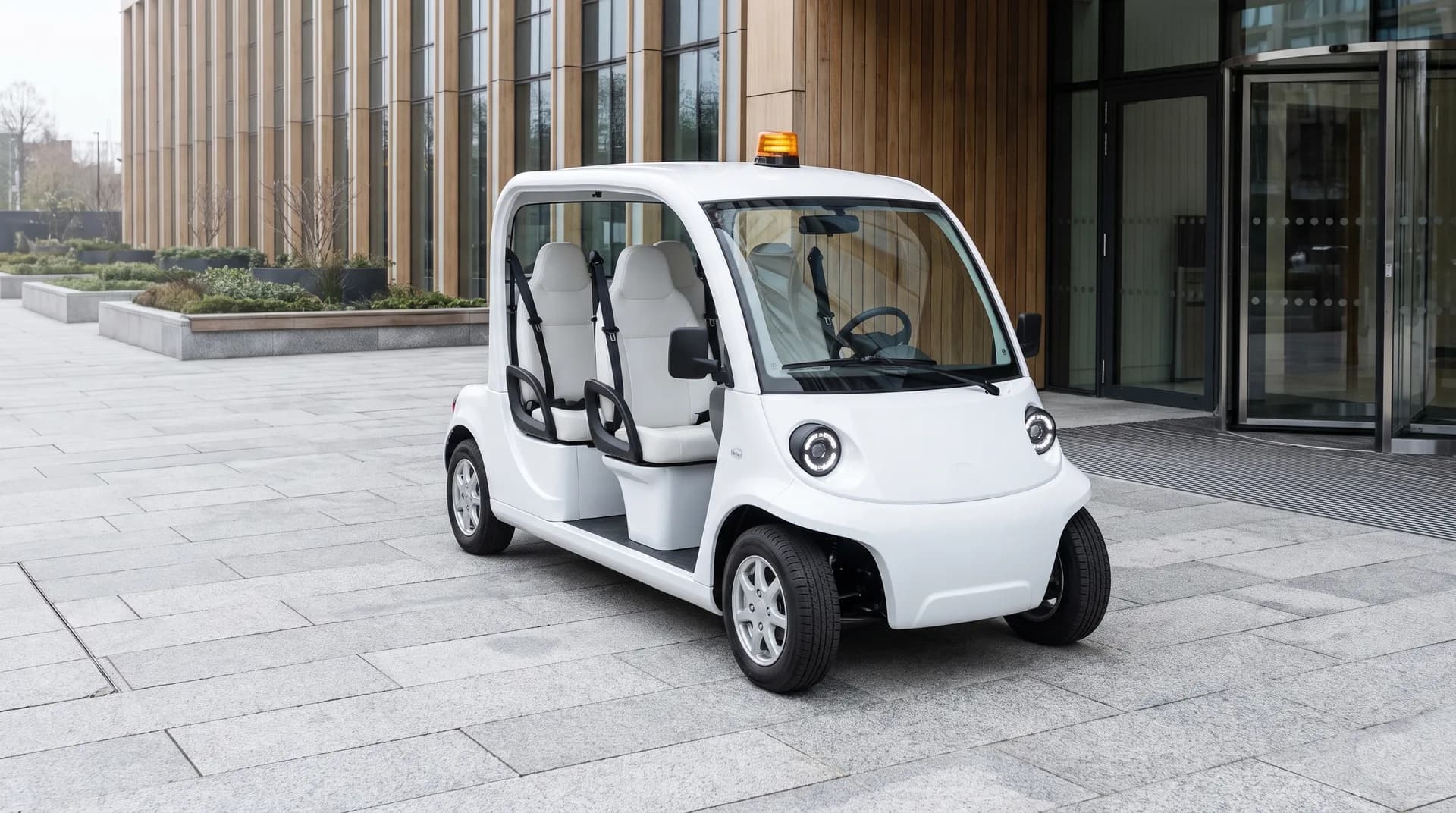
Lighting is one of the easiest things to add at booking and one of the hardest to sort out on site, so decide it early. Working headlights and rear lights are the baseline for any vehicle operating after dark. An amber beacon is the single most effective addition on a crowded site, because it is visible above head height and from behind other structures. Reflective tape or markings on the rear and sides work with other people's light sources rather than needing their own. Interior or canopy lighting helps passengers board safely and makes the vehicle read as an occupied vehicle rather than a shape. And a reversing light or audible reversing alert deserves consideration if reversing cannot be designed out of your routes, though as our traffic management guide argues, designing it out is better than warning about it.
- What it fixes
- Seen above the crowd and around obstructions
- Priority
- Highest for crowded sites
- What it fixes
- Works with other people's light sources
- Priority
- High, and very low cost
- What it fixes
- Baseline legality and basic visibility
- Priority
- Essential, assume it is present
- What it fixes
- The person is seen even if the vehicle is not
- Priority
- High, and free
- What it fixes
- Outlines the vehicle's actual width
- Priority
- Useful on wider vehicles
- What it fixes
- Warns of the least visible manoeuvre
- Priority
- Only if reversing cannot be designed out
| What it fixes | Priority | |
|---|---|---|
| Amber beacon | Seen above the crowd and around obstructions | Highest for crowded sites |
| Reflective markings | Works with other people's light sources | High, and very low cost |
| Head and rear lights | Baseline legality and basic visibility | Essential, assume it is present |
| High-visibility for drivers | The person is seen even if the vehicle is not | High, and free |
| Marker or canopy lighting | Outlines the vehicle's actual width | Useful on wider vehicles |
| Reversing alert | Warns of the least visible manoeuvre | Only if reversing cannot be designed out |
How routes should change after dark
The route that worked in daylight is rarely the right route at night, and the changes are mostly subtractive. Shorten it, because a long dark run through unlit ground has more hazards than value. Simplify it, so drivers are not navigating by memory in the dark. Keep it on lit and hard-surfaced sections where possible, because unlit grass hides ruts, cables and stakes that were obvious at four in the afternoon. Reduce crossings, and marshal the ones that remain, since pedestrians judge vehicle speed and distance far less accurately in the dark. And stop movement entirely during the exit surge at the end of the night, which is both the busiest and the least predictable ten minutes of any event. A buggy parked during that window is a hazard that does not exist, and the journeys it would have made were not worth the risk.
Briefing drivers for night operation
Brief separately for the night shift, and do it before the light goes rather than during it. Cover five things. Speed: slower than daytime, and walking pace anywhere near people, without exception. Assumption: assume you have not been seen, and drive as if nobody knows you are there. Route: the specific night route, the sections now out of bounds, and the crossings that are marshalled. Passengers: no standing, no sitting on load beds, no overloading, all of which get quietly worse as an evening goes on. And fatigue: night shifts follow long days, and a tired driver at eleven is a different proposition from the same person at ten in the morning, which is a scheduling issue as much as a briefing one. Record the briefing alongside your risk assessment; it takes minutes and it is the evidence that matters.
The British darkness problem
One planning point specific to the UK: from autumn onwards, darkness arrives while your event is still busy, not at the end of it. A firework display, a Christmas market, a late-season county show or a rugby fixture can be operating in full darkness at half past four in the afternoon, with a crowd that has not yet thinned and a site that was designed and briefed in daylight. Plan for that explicitly. Decide the time at which night rules take effect, brief it, and make the switch a positive act rather than something that happens gradually while nobody notices. Our guides to fireworks and bonfire events and Christmas markets cover the wider planning for events that run mainly after dark.
Specify for the dark before you need to
Night-time operation is not difficult, it is simply different, and everything that makes it safe is decided in advance: lighting on the hire order, reflective markings fitted, a shorter night route drawn, a briefing written, and a rule about when vehicles stop moving. None of it costs much and all of it is impossible to arrange at nine on a Saturday evening. Tell us your event runs after dark, and we will specify lighting and visibility to match and set it out in the hire quote, so the fleet arrives ready for the hours it will actually work. Our fireworks and bonfire and Christmas market pages cover the events that run almost entirely after dark.
Frequently asked questions
Do hire golf buggies have lights?+
Vehicles specified for after-dark operation will have working head and rear lights, and beacons, marker lighting and reflective markings can be specified on the hire order. Confirm it at booking rather than assuming, because lighting is easy to add in advance and impossible to improvise on site.
What is the main risk of using buggies at night?+
The vehicle not being seen, rather than the driver not seeing. A low, quiet buggy among distracted pedestrians in an environment with bright competing lighting is easy to miss, which is why beacons, reflective markings and high-visibility clothing matter more than brighter headlights.
Should event buggy routes change after dark?+
Yes. Shorten and simplify the route, keep it on lit and hard-surfaced sections, reduce and marshal crossings, and stop vehicle movement entirely during the exit surge at the end of the night, which is the busiest and least predictable window of any event.
Do you need a beacon on an event buggy?+
On a crowded site after dark it is the single most effective addition, because it is visible above head height and around obstructions. It is inexpensive to specify at booking and it does more for safety than almost any other single item on the order.
When does it get dark enough to need night rules in the UK?+
From autumn onwards, darkness frequently arrives while the event is still busy, sometimes by mid-afternoon. Decide in advance the time at which night rules take effect, brief it, and make the switch a positive act rather than something that drifts in unnoticed.
Running after dark?
Tell us the hours your event actually works and we will specify lighting, beacons and visibility on the hire order so the fleet arrives ready.
Related solutions
Ready to explore what we build?
See the vehicles and the setting this applies to, or get a tailored quote built around your site.
Ready to find the right buggy?
Tell us how and where it will work and we will specify a vehicle and a tailored quote built around you. Every build comes with a 3-year warranty and a 24-hour priority call-out.
Our guides are written and reviewed by the Hawke Electric Vehicles team, the people who specify, build, deliver and support the vehicles. We focus on honest, practical advice and flag where a figure depends on the build rather than guessing.
More guides by Hawke