When a lead-acid pack finally gives up, every owner faces the same fork in the road: put a lithium conversion into the buggy you have, or put that money towards a new machine. The honest answer is that the battery is only half the question. A lithium pack transforms range, charging and weight, our guide to converting a golf buggy to lithium covers the how, but it cannot transform the chassis it sits in, the motor that drives it or the controller that manages it. So the real decision is an audit of the machine around the battery. If that machine is sound and still suits your life, conversion is one of the best-value moves in buggy ownership. If it is tired, conversion is throwing good money after old. This guide is the whether.
- Judge the machine, not the battery: chassis, motor, controller and brakes decide whether conversion makes sense.
- Conversion is the smart move on a sound, reasonably modern buggy you would happily keep for years.
- It is the wrong move on a corroded chassis, a tired motor or an obsolete controller, the pack will outlive the buggy.
- Compare total conversion cost against the from-price of new, not against doing nothing.
- A converted buggy still has an old machine's warranty position: usually none beyond the pack itself.
The real decision: the machine around the battery
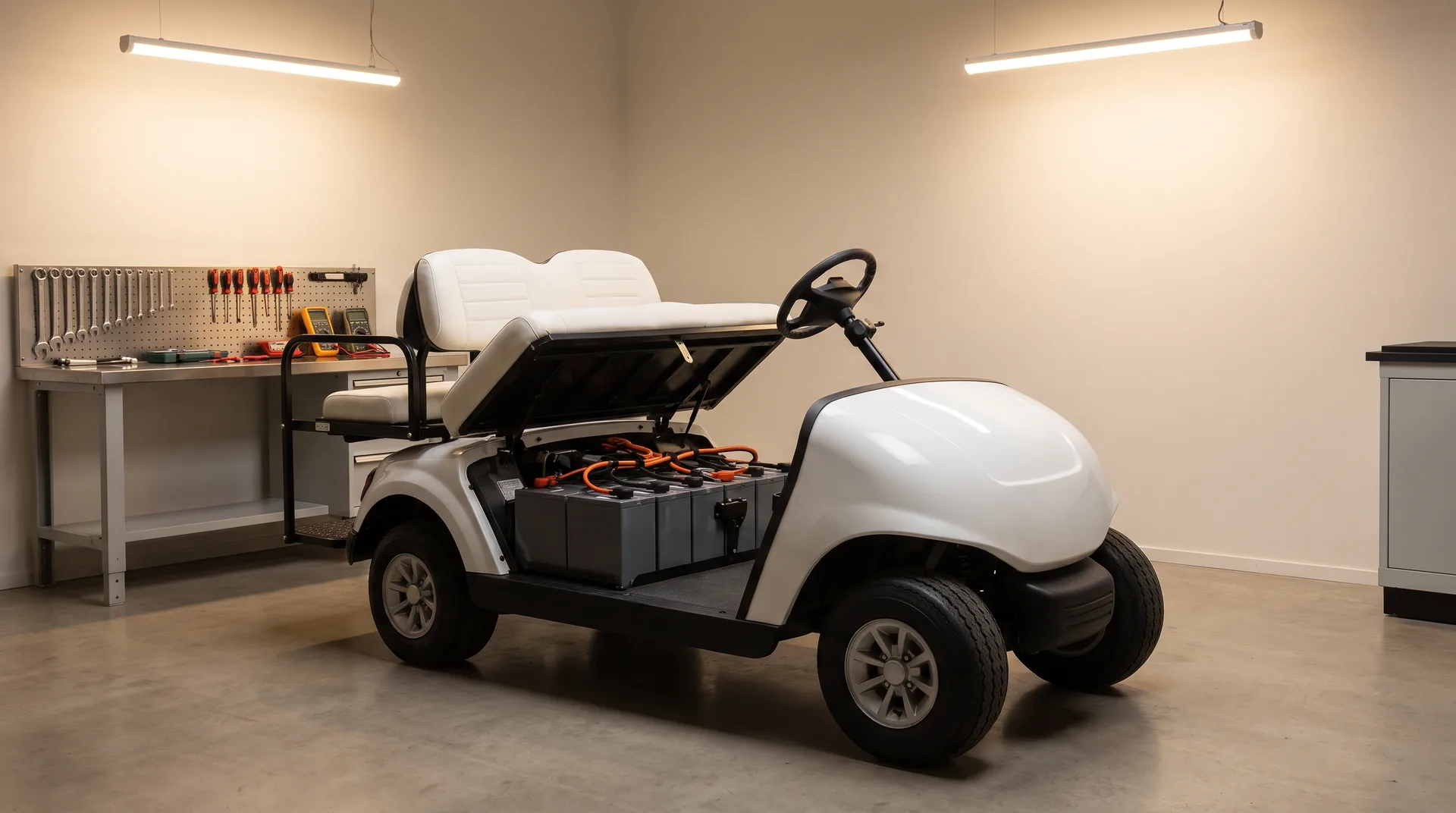
Start with the chassis. Buggies live outdoors in a wet climate, and frame corrosion, especially around battery trays, suspension mounts and floor pans, is the true end of life for many machines; no battery fixes a structural problem. Next the motor: an electric motor is long-lived but not immortal, and bearings, brushes on older designs, and insulation all age. Then the controller and charger, the components a conversion leans on hardest. A reasonably modern controller usually works happily with a lithium pack and its battery management system; a very old one may need replacing, which quietly adds a meaningful sum to the conversion bill. Finally the ordinary wear items, brakes, bushes, steering, tyres, seats. None is expensive alone, but a machine that needs several is telling you something. Our guide on how long electric buggies last puts numbers around these lifespans; the point here is that the conversion only makes sense if the platform has years left in it.
When a lithium conversion is the smart move
Conversion earns its keep when three things line up. The machine is mechanically sound: solid frame, healthy motor, controller of an age that accepts a modern pack without drama. The machine still fits your needs: right size, right seats, right terrain ability, because a conversion cannot add a seat or climb a hill the gearing was never built for. And the sums work: a quality lithium pack professionally installed typically costs a low four-figure sum depending on capacity, which is a fraction of a new machine, and it buys you the full lithium advantage in range, charging and lifespan on a buggy you already own and trust. In that situation, conversion is arguably the best value in the whole market: near-new daily performance for a fraction of new-machine money. Golf club fleets and estates do exactly this, and a used buggy already converted by a reputable specialist is a notably strong buy.
When lithium conversion is throwing good money after old
The trap is anchoring on the wrong comparison. Set against doing nothing, a conversion always looks reasonable. Set against the machine's remaining life, it often does not. Spending a low four-figure sum on a pack that will serve for eight or more years makes no sense in a buggy whose chassis, motor or controller has perhaps two or three left; the pack will outlive the vehicle, and you cannot always economically move it to the next one. Add up the honest total, pack, installation, any controller or charger replacement, plus the backlog of wear items you would fix while the machine is apart, and compare that figure with the price of new: our two-seat S2 starts from £11,500 with a three-year warranty, new batteries, new everything. When the conversion total climbs past a meaningful fraction of that, roughly a third is a sensible alarm line, on a machine with known age and no warranty, the arithmetic has made the decision for you. The same logic applies double if your needs have changed, more seats, hillier ground, business use, because you would be perfecting a machine that no longer fits the job.
- Lithium conversion
- Low four figures, pack and fitting
- New buggy
- From £11,500 for a new Hawke S2
- Lithium conversion
- Range, charging, weight, battery lifespan
- New buggy
- Everything, including chassis and warranty
- Lithium conversion
- Chassis, motor, controller, wear items
- New buggy
- Nothing
- Lithium conversion
- Pack warranty only, machine as-is
- New buggy
- Full multi-year vehicle warranty
- Lithium conversion
- Platform is sound and still fits your needs
- New buggy
- Platform is tired or your needs have changed
| Lithium conversion | New buggy | |
|---|---|---|
| Typical outlay | Low four figures, pack and fitting | From £11,500 for a new Hawke S2 |
| What improves | Range, charging, weight, battery lifespan | Everything, including chassis and warranty |
| What stays old | Chassis, motor, controller, wear items | Nothing |
| Warranty position | Pack warranty only, machine as-is | Full multi-year vehicle warranty |
| Best when | Platform is sound and still fits your needs | Platform is tired or your needs have changed |
Working the numbers without fooling yourself
A simple discipline keeps the decision honest. Get a written conversion quote that includes the pack, installation, and any controller or charger work, then add the cost of every wear item the machine currently needs. Divide that total by a realistic estimate of the platform's remaining years, and you have a cost per year for the conversion route. Do the same for new: price the machine against its warranty period and expected life. For a sound five-year-old buggy, conversion usually wins that comparison clearly. For a fifteen-year-old machine needing brakes, bushes and a charger, new usually wins, and the used and ex-fleet market offers a middle path if new is out of reach. If you are unsure which side of the line your machine sits on, ask someone with no stake in the answer to inspect it.
Frequently asked questions
Is a lithium conversion worth it on an old golf buggy?+
It depends on the machine, not the battery. On a structurally sound buggy with a healthy motor and a reasonably modern controller, conversion is excellent value. On a machine with chassis corrosion, a tired motor or an obsolete controller, the new pack will outlive the vehicle and the money is better put towards a replacement.
How much does a lithium conversion cost?+
As general guidance, a quality pack professionally installed is a low four-figure sum depending on capacity, and the bill rises if the controller or charger needs replacing to suit the new pack. Always get an itemised written quote, and add any outstanding wear items to the true total.
Will a lithium pack work with my existing controller and charger?+
Often, if they are reasonably modern; lithium packs carry their own battery management system. Very old controllers and lead-acid-specific chargers may need replacing, which is a common hidden cost. A reputable converter will confirm compatibility before quoting.
At what point should I buy new instead of converting?+
A practical alarm line is when the honest conversion total, pack, fitting, electronics and outstanding repairs, passes roughly a third of the price of a comparable new machine. Beyond that you are paying near-new money for an old platform with no vehicle warranty.
Does a lithium conversion add resale value?+
Yes, a documented professional conversion with a warranted pack is a genuine selling point, and converted machines are among the strongest buys on the used market. Keep the invoice and the pack warranty; undocumented conversions attract suspicion rather than premiums.
Get both numbers before you decide
Tell us about your current machine and how you use it, and we will give you a straight view on whether conversion or replacement is the better spend, with a real new-machine quote to compare against.

Ready to find the right buggy?
Tell us how and where it will work and we will specify a vehicle and a tailored quote built around you. Every build comes with a 3-year warranty and a 24-hour priority call-out.
Our guides are written and reviewed by the Hawke Electric Vehicles team, the people who specify, build, deliver and support the vehicles. We focus on honest, practical advice and flag where a figure depends on the build rather than guessing.
More guides by Hawke