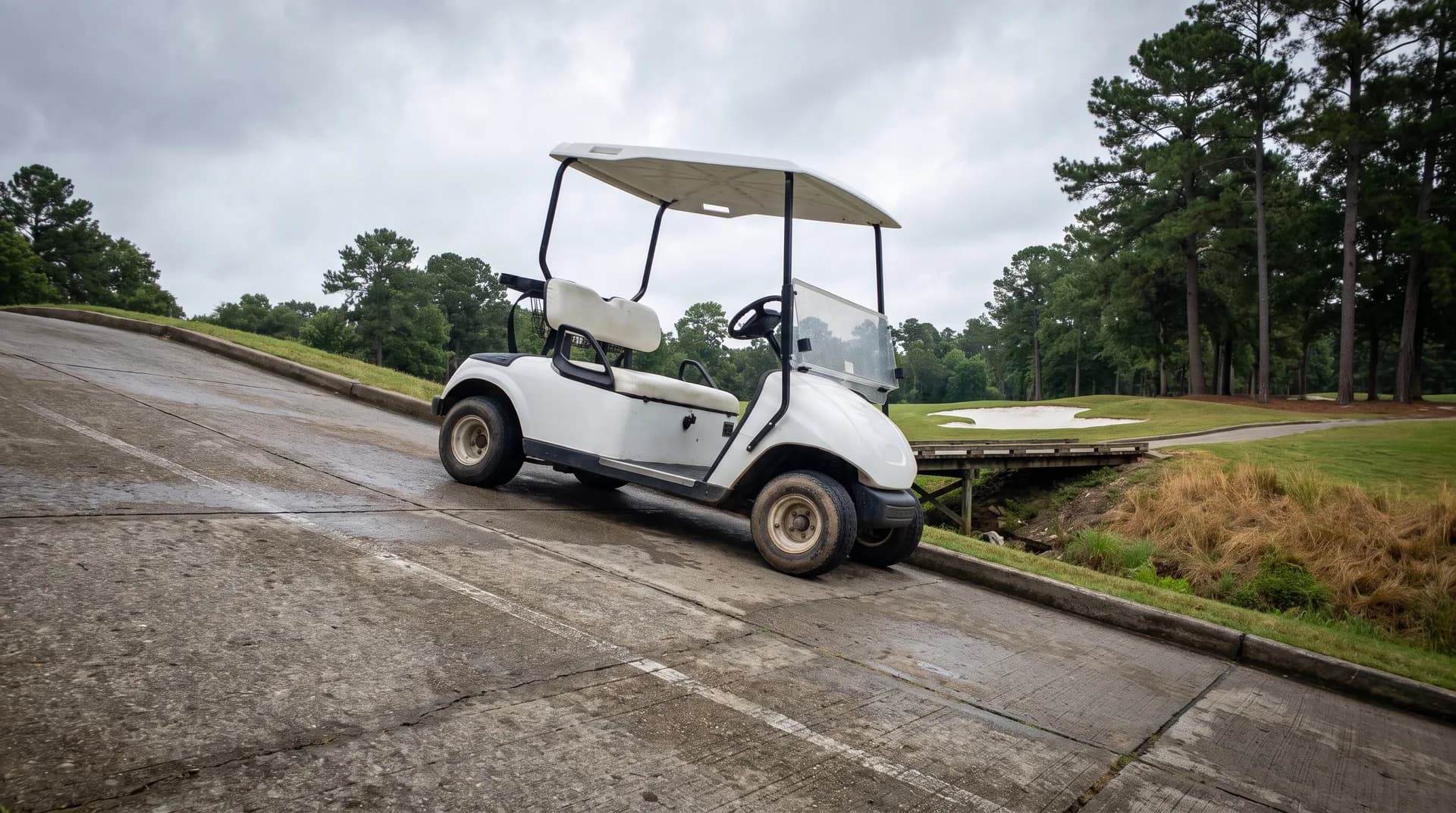
Speed and hill climbing is where the gas versus electric argument gets most heated and least precise, largely because the two behave differently rather than one simply being better. Electric delivers its pulling power immediately; gas builds it and then holds it. On flat neighborhood roads you will barely notice. On a long steep driveway, in heat, with four people aboard, the difference becomes the whole decision.
- Top speeds are broadly similar on comparable standard carts; neither is dramatically faster.
- Electric has more torque from a standstill, so it pulls away better on a slope.
- Gas holds performance better over long sustained climbs without heat or voltage fade.
- Battery state of charge affects electric hill performance; a fuel level does not affect gas the same way.
- Terrain, load and climb length matter far more than the fuel type on its own.
Top speed: closer than the argument suggests
Standard golf carts of both types run at broadly similar speeds, because they are limited by design and by what is sensible on a course or in a community rather than by what the drivetrain could do. Differences between two carts of the same type are usually larger than the average difference between the types. If outright speed matters to you, the relevant questions are the specific model, its controller or governor setup, and whether the roads you use it on legally permit that speed at all, which for street use brings a whole separate set of requirements.
Torque: where electric is genuinely better
An electric motor produces maximum turning force from zero revolutions, which is why an electric cart pulls away from a standstill on an incline without drama, and why it feels more responsive in stop-start use around a community or a course. A gas engine has to build revs before it delivers its pull, so starting on a slope involves more clutch and throttle management and can feel laboured with a full load. For frequent short trips over undulating ground, this is a real everyday advantage that spec sheets do not capture.
- Electric
- Strong, immediate pull
- Gas
- Needs revs, can feel laboured loaded
- Electric
- Very capable
- Gas
- Capable
- Electric
- Can fade as voltage drops and heat builds
- Gas
- Holds up well
- Electric
- Depends on pack capacity and state of charge
- Gas
- Consistent, refuels in a minute
- Electric
- Good, but draws heavily on the pack
- Gas
- Good, and less affected by duration
- Electric
- Weaker as the pack depletes
- Gas
- Unchanged
| Electric | Gas | |
|---|---|---|
| Starting on an incline | Strong, immediate pull | Needs revs, can feel laboured loaded |
| Short steep climb | Very capable | Capable |
| Long sustained climb | Can fade as voltage drops and heat builds | Holds up well |
| Repeated climbs all day | Depends on pack capacity and state of charge | Consistent, refuels in a minute |
| Fully loaded | Good, but draws heavily on the pack | Good, and less affected by duration |
| Late in the day | Weaker as the pack depletes | Unchanged |
The sustained climb problem
This is the honest limitation on electric and it is worth understanding rather than arguing about. Under a long heavy load, pack voltage sags and the motor and controller warm up, and both effects reduce available performance. On a short climb neither has time to matter. On a long one, particularly in heat, with a full load, and with a pack that is already half depleted, an electric cart can feel noticeably weaker than it did that morning. A gas cart does not behave this way: its performance at the end of the day is much the same as at the start, provided there is fuel in it.
What actually decides it on your ground
Three things outweigh the fuel type. First, how long the climbs are: short and frequent favors electric, long and sustained favors gas. Second, load: four adults and equipment change the picture far more than the drivetrain does. Third, duty cycle: a cart doing this all day without a break is a different problem from one doing it twice an afternoon. If your ground is genuinely steep and the work is continuous, either type needs to be specified for it, and a properly specified electric cart with an adequate pack and appropriate gearing will handle far more than an underspecified one of either kind.
Specification beats fuel type
- Pack capacity and chemistry, since lithium generally holds voltage better under load
- Motor and controller rating, not just the headline top speed
- Gearing, which trades top speed for climbing ability
- Brake specification, because what goes up needs to come down safely and repeatedly
- Tire choice, since traction is usually the limit before power is
- How the cart is expected to perform at low state of charge, not just full
Frequently asked questions
Which is faster, a gas or electric golf cart?+
Standard carts of both types run at broadly similar speeds, and the difference between two models of the same type is usually greater than the difference between the types. Neither is dramatically faster as standard.
Do electric golf carts struggle on hills?+
Not on short climbs, where their immediate torque is an advantage. On long sustained climbs, particularly in heat with a full load and a partly depleted pack, performance can fade in a way a gas cart's does not.
Which has more torque, gas or electric?+
Electric, from a standstill, because an electric motor produces maximum turning force at zero revolutions. That is why electric carts pull away from a stop on a slope more easily.
Does battery charge affect hill climbing?+
Yes, noticeably. An electric cart climbs better at high state of charge than at low, so if your ground is demanding, size the pack for the end of the day rather than the start.
What matters more than gas or electric for hills?+
Specification and terrain. Pack capacity, motor and controller rating, gearing, brakes and tires decide whether a cart handles your ground. A well-specified cart of either type outperforms a poorly specified one of the other.
Tell us about your terrain
Send us the gradients, the loads and how long the working day is, and we will tell you what specification actually handles it rather than guessing from a category.
Related solutions
Ready to explore what we build?
See the vehicles and the setting this applies to, or get a tailored quote built around your site.
Ready to find the right buggy?
Tell us how and where it will work and we will specify a vehicle and a tailored quote built around you. Every build comes with a 3-year warranty and a 24-hour priority call-out.
Our guides are written and reviewed by the Hawke Electric Vehicles team, the people who specify, build, deliver and support the vehicles. We focus on honest, practical advice and flag where a figure depends on the build rather than guessing.
More guides by Hawke