Golf buggy top speed dropped suddenly: causes
Written by the Hawke Electric Vehicles Service Team
Quick answer
A golf buggy that suddenly tops out slower than it did has most likely dropped into a reduced-power or limp mode, is being held back by a weak battery under load, has a throttle that no longer reaches full signal, or is dragging a brake. Read any controller fault code first, then check the pack voltage under load, because a sudden change usually has a single clear cause. A gradual decline over months is a different, wear-related pattern.
Tools needed
- Digital multimeter
- The controller or vehicle manual
- Wheel chocks
- Trolley jack and axle stands
- Safety glasses
Parts needed
- Battery if a cell has failed
- Throttle sensor if faulty
Confirm the symptom
This guide covers a top speed that has dropped noticeably and fairly suddenly, over a day or a few drives, rather than fading slowly over months. Note when it changed and whether anything else changed with it, such as a warning light, a beep, hotter running, or shorter range, because those clues point straight to the cause.
If the buggy has been getting slowly slower over a long period, that is usually battery wear, so see the running slow guide. If it is only slow uphill but fine on the flat, that points more to torque and battery capacity. If it hesitates or surges rather than simply topping out lower, see the delayed pedal and jerky acceleration guides. Come back here for a sudden drop in top speed.
What causes it
| Cause | How common | How to confirm | Fix |
|---|---|---|---|
| Reduced-power or limp mode from a fault | very common | Read the controller fault code | How to read golf buggy controller fault codes |
| Weak battery or single failed cell under load | very common | Check pack and per-battery voltage under load | How to test golf buggy batteries with a multimeter |
| Throttle not reaching full signal | common | Read the throttle output at full pedal | |
| Dragging brake or binding wheel | common | Spin each raised wheel and feel for drag | |
| Speed setting or magnet fault | occasional | Check the speed setting and, on Club Car, the speed sensor magnet |
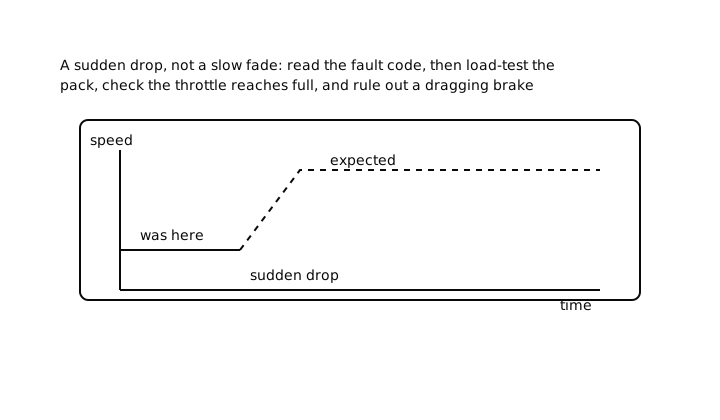
Reduced-power or limp mode
The most common reason for a sudden speed drop is the controller putting the buggy into a reduced-power or limp mode to protect itself, often with a warning light or beep. Reading the fault code tells you why, so this comes first. The fault code guide explains how to read and interpret it.
1Read the controller fault code
Read any code the controller is showing using the fault code guide, and note whether it points to temperature, voltage, the throttle or the motor.
ExpectedA code that names the limiting condition, or no code, which sends you to the battery and throttle checks below
Weak battery under load
A pack that has lost condition, or that has one failing battery, cannot hold voltage under load, so the buggy runs but tops out slower. A sudden drop can follow a single cell or battery failing. The battery voltage test guide covers checking the pack and each battery under load.
2Check pack and per-battery voltage under load
Measure the pack voltage at rest and again under load, and check each battery individually under load to find one that sags far more than the others, following the battery voltage test guide.
ExpectedA pack that holds voltage reasonably under load with all batteries similar; one battery sagging well below the rest is a failed battery
Throttle not reaching full signal
If the throttle no longer reaches its full signal at full pedal, the controller never asks for full speed, so the buggy tops out low. This is worth a quick check, especially if the pedal feel has changed.
3Read the throttle at full pedal
With the buggy safely supported, read the throttle sensor signal and confirm it reaches its full value when the pedal is fully pressed, using the manual's test points.
ExpectedA throttle signal that reaches its full value at full pedal; a signal that stops short means the throttle or its setup is limiting speed
Dragging brake or speed setting
A dragging brake steals speed and range and runs a wheel hot, so spin each wheel to rule it out; the brakes dragging guide covers this. Finally, a changed speed setting, or on Club Car models a displaced speed sensor magnet, can cut top speed, though these are less common.
4Spin the wheels and check the speed setting
Spin each raised wheel to feel for a drag, and check the controller speed setting has not changed. On Club Car models with a speed sensor, check the magnet is present and correctly placed.
ExpectedAll wheels spinning freely, the speed setting unchanged, and any speed sensor magnet in place; a drag or a lost magnet found here is the cause
When to book an engineer
Book an engineer if the code points to an internal controller or motor fault, if a battery needs replacing and you want the pack assessed properly, or if the speed does not recover after the checks above. A sudden speed drop with a fault code often needs the right tool to read and clear correctly, and a pack with one weak battery is worth testing fully before replacing. An engineer can read the system, test the pack and fix the cause.
Common questions
Why did my golf buggy suddenly get slower?
A sudden drop in top speed is most often a reduced-power or limp mode triggered by a fault, or a weak battery that cannot hold voltage under load, sometimes because one battery has failed. Read the controller code first, then load-test the pack. A throttle fault or a dragging brake can also cut speed suddenly.
Can one bad battery cut my top speed?
Yes. One failing battery drags the whole pack voltage down under load, so the buggy runs but cannot reach full speed, and this can appear suddenly when a cell fails. Test each battery individually under load: the one that sags far below the others is the failed battery, and replacing it usually restores performance.
What is limp mode on a golf buggy?
Limp or reduced-power mode is the controller deliberately cutting power to protect the drive system, usually after detecting a fault such as over-temperature, low voltage or a throttle problem. It normally comes with a warning light or beep and a fault code. Read the code to find out why rather than trying to override it.
Is it safe to keep driving a buggy that has lost speed?
If it has entered limp mode, it is protecting itself, so gentle use to get home is usually fine but continued hard use is not wise until you know why. If the cause is a dragging brake, continued driving overheats the brake. Diagnose the cause before relying on the buggy again.
Why is my buggy slow only on hills now?
Slower on hills but fine on the flat points more to torque and battery capacity than a sudden fault, because hills demand the most current. A weak pack shows up first on climbs. If the flat-ground top speed is unchanged, work through the running slow and battery guides rather than this one.
Guided check
Diagnose it step by step
Answer a few questions and we will point you at the most likely cause.
Question 1 of 5
After a short drive, is any wheel hub noticeably warm?
Did this fix it?
Every guide is written from manufacturer service documentation and workshop practice, then reviewed before publication. Read how we write and review our repair guides.