Golf buggy voltage reducer fault: test and fix
Written by the Hawke Electric Vehicles Service Team
Quick answer
When every 12 volt accessory on an electric golf buggy dies at once, the lights, horn and USB sockets, the voltage reducer that steps the pack down to 12 volts is the prime suspect. Confirm it with a multimeter: full pack voltage on the reducer input but little or nothing on the output means the reducer has failed, provided its own fuse and earth are good.
Tools needed
- Digital multimeter
- Small screwdriver set
- Safety glasses
- Insulated gloves
Parts needed
- Replacement voltage reducer of the matching pack voltage
- Reducer supply fuse of the same rating
- Contact cleaner
Confirm the symptom
This guide covers an electric buggy where all the 12 volt accessories have gone dead together: lights, horn, any USB or 12 volt sockets and other low-voltage extras, while the buggy still drives normally. That combination is the signature of a voltage reducer fault, because the reducer feeds all of them from one 12 volt output.
If only one accessory is dead, the reducer is almost certainly fine and the fault is in that item or its own wiring, so use the guide for that accessory instead. If the buggy will not drive at all, that is a main-circuit fault, not a reducer fault. Come back here when the drive is normal but everything at 12 volts is dead.
What is a voltage reducer
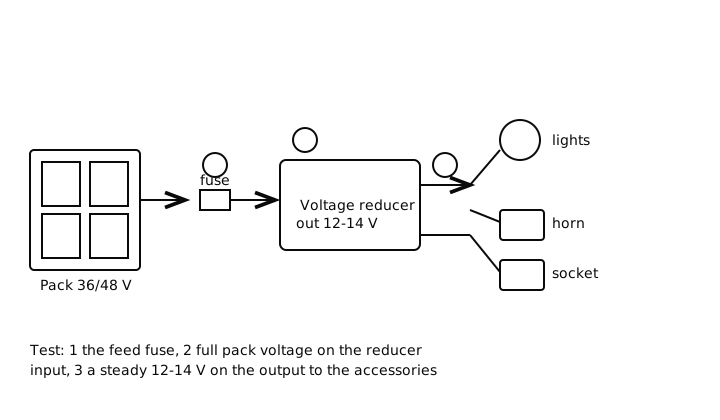
An electric buggy runs its motor from a 36 or 48 volt pack, but lights, horns and sockets are 12 volt items. The voltage reducer, sometimes called a converter, sits between the pack and those accessories and steps the high pack voltage down to a steady 12 to 14 volts. Because everything at 12 volts is fed from this one box, a reducer failure takes out the whole low-voltage side at once while leaving the drive untouched.
What causes it
| Cause | How common | How to confirm | Fix |
|---|---|---|---|
| Blown fuse on the reducer supply | very common | Find and continuity-test the reducer feed fuse | |
| Loose or corroded reducer connection or earth | common | Check the input, output and earth connections are clean and tight | |
| No input voltage reaching the reducer | common | Measure pack voltage at the reducer input terminals | |
| Failed voltage reducer | occasional | Good input but no healthy 12 to 14 V output |
A blown fuse on the reducer supply
Before condemning the reducer, check its fuse, because a blown supply fuse produces exactly the same symptom as a failed reducer: no 12 volt output and every accessory dead. The reducer feed is usually fused close to the pack or the reducer itself.
1Find and test the reducer supply fuse
Locate the fuse in the wire feeding the reducer, remove it and test it on the multimeter continuity range.
ExpectedA good fuse beeps or reads near 0 ohms; an open reading means it has blown and is the likely cause
Replace a blown fuse with the same rating only. If it blows again, there is a short in the reducer or the 12 volt wiring downstream, and fitting a larger fuse is unsafe; the fault needs tracing.
A loose or corroded connection
The reducer has an input from the pack, a 12 volt output to the accessories, and an earth. A loose or corroded connection on any of these can stop the output even when the reducer works, so check the connections before you measure through it.
2Inspect and test the connections
With the key off, check each reducer terminal and its earth for corrosion and tightness, and clean any that are dirty.
ExpectedClean, tight terminals; a corroded or loose connection can interrupt the output and is worth remaking before further testing
No input voltage reaching the reducer
The reducer can only work if it is being fed. Measure the input to be sure the pack voltage is arriving, because a break upstream, or that blown feed fuse, leaves the reducer with nothing to convert.
3Measure the reducer input
With the key on, set the multimeter to DC volts and measure across the reducer input terminals.
ExpectedFull pack voltage, around 38 V on a 36 V buggy or around 51 V on a 48 V buggy; a reading near 0 V means the supply is not reaching the reducer, so fix the feed first
A failed voltage reducer
If the fuse is good, the connections are clean and full pack voltage is reaching the input, but there is no healthy 12 volt output, the reducer itself has failed. This is the last thing to conclude, only after ruling out the cheaper causes above.
4Measure the reducer output
With the key on and good input confirmed, measure across the reducer output terminals.
ExpectedA working reducer outputs a steady 12 to 14 V; near 0 V, or the full pack voltage passing straight through, confirms a failed reducer
Replace a failed reducer with one rated for your pack voltage, a 36 volt reducer for a 36 volt buggy and a 48 volt reducer for a 48 volt buggy, and matched to the current your accessories draw. Fitting the wrong rating can leave it unable to power everything or shorten its life.
When to book an engineer
Book an engineer if the reducer feed fuse keeps blowing, if you measure good input but are not confident replacing the reducer, or if there is no input voltage and the break is somewhere in the pack-side wiring you cannot trace. Getting the reducer rating right and the wiring correct matters, and a technician can confirm the fault and fit the correct part in one visit.
Common questions
What does a voltage reducer do on a golf buggy?
It steps the 36 or 48 volt pack voltage down to a steady 12 to 14 volts to run the 12 volt accessories, such as lights, the horn and USB or 12 volt sockets. Because all of those share the one reducer output, a reducer fault takes them all out together while the drive keeps working.
How do I know it is the reducer and not a fuse?
Check the reducer supply fuse first, because a blown fuse gives the same dead-accessory symptom. Only after the fuse tests good and full pack voltage reaches the reducer input, yet there is no 12 to 14 V on the output, can you blame the reducer itself.
What voltage should the reducer output?
A healthy reducer puts out a steady 12 to 14 V regardless of whether the pack is 36 or 48 V. A reading near zero means no output, and a reading close to full pack voltage means the reducer is passing the high voltage straight through, which can damage the 12 volt accessories.
Can I run 12V accessories without a reducer?
Not from the main pack directly, because connecting 12 volt items to 36 or 48 volts will destroy them. The accessories must be fed either from a correctly rated voltage reducer or, on some setups, from a dedicated 12 volt battery. Match any replacement reducer to your pack voltage.
Guided check
Diagnose it step by step
Answer a few questions and we will point you at the most likely cause.
Question 1 of 3
Are all the lights and accessories dead, rather than just one?
Did this fix it?
Every guide is written from manufacturer service documentation and workshop practice, then reviewed before publication. Read how we write and review our repair guides.