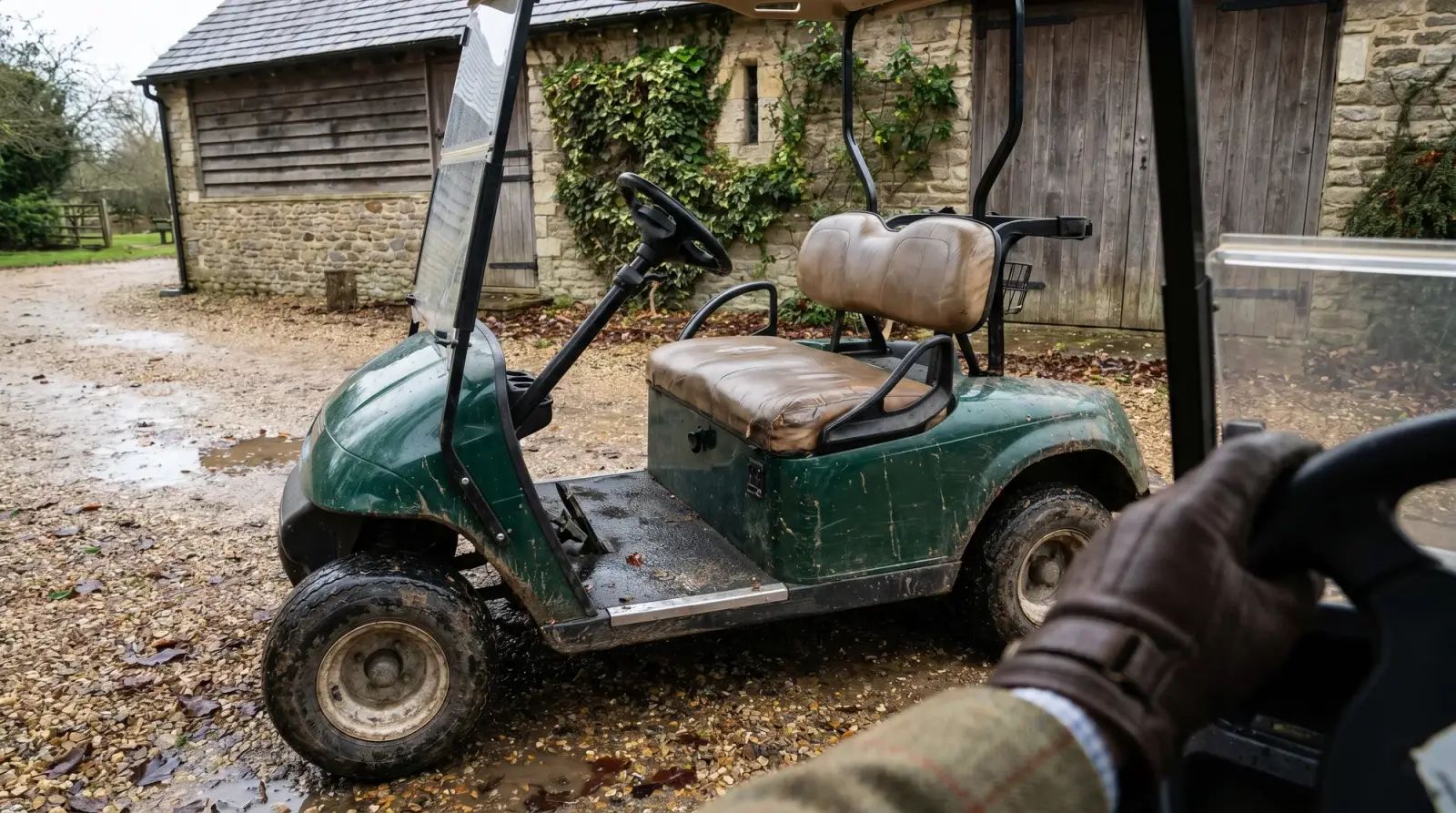
- A used golf buggy is cheaper upfront, but you are buying its age, condition and remaining battery life.
- The battery is the single most important and expensive part to check, so test it under load.
- Inspect the motor, brakes, chassis, tyres and steering, not just how it looks parked.
- Ask for history, charging habits and any warranty, and be wary if there is none.
- Factor likely near-term costs into the price before you decide it is a bargain.
Buying a used golf buggy in the UK can be a smart move, but only if you inspect it properly first. A low price is only a bargain if the buggy is sound, and the parts most likely to cost you later, the battery above all, are the parts least visible from a quick look round. This checklist walks through what to test and what to ask so you buy on facts rather than first impressions. If a new build might suit you better, weigh it against the range and the wider points in our guides.
The honest position is that used buggies vary enormously. Some have been cherished on a single site with careful charging, others have been worked hard and neglected. The price rarely tells you which, so the inspection has to.
Check the battery first
The battery is the heart of an electric buggy and the most expensive thing to replace, so it deserves the most attention. A buggy that looks immaculate but has a tired battery is not a bargain. Do not accept that it holds charge on the basis of a few minutes parked up. Test it the way you will use it.
- 01
Confirm the type and age
Ask whether it is lithium or lead-acid and how old the battery is. Age and chemistry both affect remaining life.
- 02
See it fully charged
Arrive to a charged buggy, or charge it, and note how long that takes and whether it reaches full.
- 03
Test under load
Drive it with weight aboard for a meaningful distance, ideally up an incline, and watch how quickly the charge drops.
- 04
Ask about charging habits
Regular, correct charging extends battery life. Erratic charging or long idle storage shortens it.
Mechanical and structural checks
Beyond the battery, a buggy is a vehicle with moving parts that wear. None of these checks needs special tools, just a careful eye and a proper test drive on the kind of ground you will use.
- Motor and drive: smooth pull away, no grinding, whining or hesitation under load.
- Brakes: firm, even stopping with no pulling to one side; check the parking brake holds on a slope.
- Steering: tight and true, with no excessive play or knocking over bumps.
- Tyres: even wear, good tread and no perishing or cracking in the sidewalls.
- Chassis and body: look underneath for rust, cracks, repairs or accident damage.
- Charger and cables: confirm the correct charger is included and works.
- Reassuring
- Holds charge under load
- Warning
- Drops fast or won't be tested
- Reassuring
- Smooth and quiet
- Warning
- Whine, grind or hesitation
- Reassuring
- Clean, solid
- Warning
- Rust, cracks, hidden repairs
- Reassuring
- Records and honest answers
- Warning
- Vague or evasive seller
| Area | Reassuring | Warning |
|---|---|---|
| Battery | Holds charge under load | Drops fast or won't be tested |
| Motor | Smooth and quiet | Whine, grind or hesitation |
| Chassis | Clean, solid | Rust, cracks, hidden repairs |
| History | Records and honest answers | Vague or evasive seller |
Prefer the certainty of a new build?
If used feels like a gamble, a custom buggy comes specified to you with a 3-year warranty and a battery in full health. Tell us your needs for a tailored quote.
Take a proper test drive
A few minutes round a car park tells you very little. Insist on a test drive that resembles how you will actually use the buggy, on the kind of ground it will work on, with weight aboard. Many problems only show up under load, on a slope or after the buggy has been running for a while, and that is exactly when you want to find them, before money changes hands rather than after.
- Drive on similar ground to your site: grass, slopes or tracks, not just smooth tarmac.
- Carry realistic weight, ideally a couple of people, to load the motor and battery.
- Take it up an incline and check it climbs without straining or losing charge fast.
- Run it long enough to feel whether anything gets hot, noisy or weaker as you go.
- Test the brakes and parking brake on a slope, not just on the flat.
Paperwork, history and warranty
Ask the questions a careful buyer asks. Where has the buggy been used, by whom and how was it stored and charged? Is there any service history, and is any warranty left or transferable? A seller with good answers and records is reassuring; vagueness is a reason to slow down, not speed up.
- Proof of ownership and the right to sell.
- Any service or repair records.
- Remaining or transferable warranty, if any.
- Honest account of where and how it was used and stored.
Price it on the whole picture
Once you have inspected it, price the buggy on its true condition, not the headline figure. A cheaper buggy that needs a battery, tyres or repairs soon may cost more than a dearer one in good health. Our guide to what drives the cost of a golf buggy helps you judge whether a used price is fair once you factor in likely near-term spend, and the buyer's guide helps you decide whether the spec even suits you.
What do used golf buggies cost in the UK?
Used prices vary widely with age, battery condition, seating and finish, so treat any figure as a guide rather than a rule. Older lead-acid models change hands for relatively little, but often need a pack soon, which closes much of the gap to a newer vehicle. Well-kept lithium buggies and larger people-movers hold their value and sit much higher. The honest way to compare is to add the likely cost of an imminent battery replacement, any tyres or brakes, and the absence of a warranty to the asking price, then weigh that total against a new build. As a reference point, a new four-seat carriage from us starts from around £14,900, with smaller two-seat models from around £11,500.
- Lead-acid
- Lower
- Lithium
- Higher
- Lead-acid
- Less, ages faster
- Lithium
- More, holds up well
- Lead-acid
- Slower
- Lithium
- Faster, partial-charge friendly
- Lead-acid
- Light, occasional use
- Lithium
- Regular daily use
| Lead-acid | Lithium | |
|---|---|---|
| Replacement cost | Lower | Higher |
| Likely life left | Less, ages faster | More, holds up well |
| Charging | Slower | Faster, partial-charge friendly |
| Best suited to | Light, occasional use | Regular daily use |
Frequently asked questions
What is the most important thing to check on a used golf buggy?+
The battery. It is the most expensive part to replace, so test it under load over a meaningful distance and ideally up an incline, rather than trusting a few minutes parked up.
How do I tell if a used buggy's battery is worn?+
Charge drops quickly under load, charging takes unusually long or won't reach full, or the seller avoids letting you test it properly. Any of these means pricing in a replacement.
Should I avoid lead-acid used buggies?+
Not automatically, but lead-acid is older technology and heavier, with a shorter life than lithium. Factor the chemistry and age into the value, and read our batteries guide for the differences.
Is a used golf buggy a good deal?+
It can be, if it is sound and priced on its true condition. A low headline price that hides a tired battery or worn mechanicals is not a bargain. Inspect before you decide.
What if I'd rather not gamble?+
A new custom build removes the guesswork: a battery in full health, a specification matched to you and a 3-year warranty. Pricing for it comes back on a quote tailored to your spec.
Related solutions
Ready to explore what we build?
See the vehicles and the setting this applies to, or get a tailored quote built around your site.

Ready to find the right buggy?
Tell us how and where it will work and we will specify a vehicle and a tailored quote built around you. Every build comes with a 3-year warranty and a 24-hour priority call-out.
Our guides are written and reviewed by the Hawke Electric Vehicles team, the people who specify, build, deliver and support the vehicles. We focus on honest, practical advice and flag where a figure depends on the build rather than guessing.
More guides by Hawke