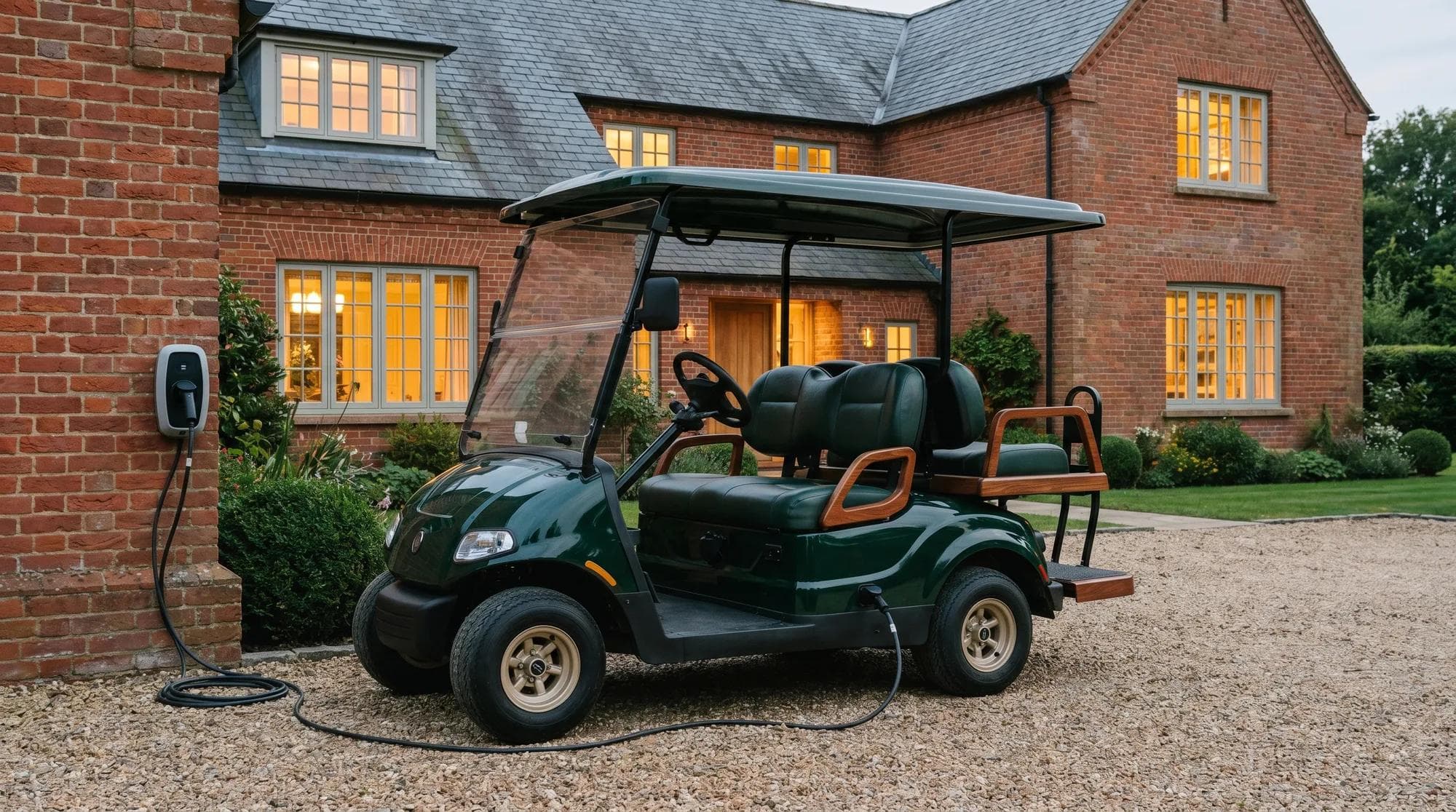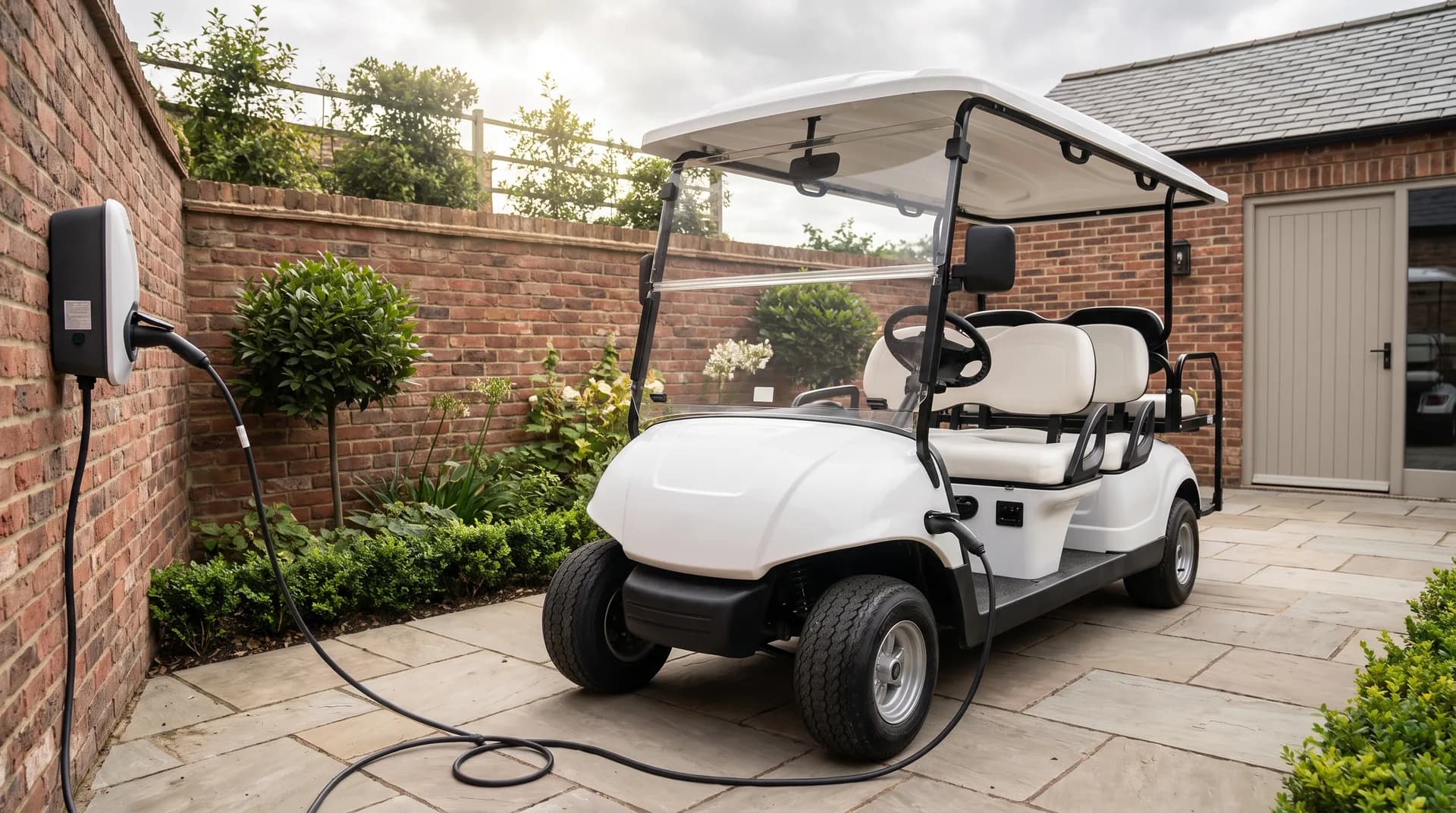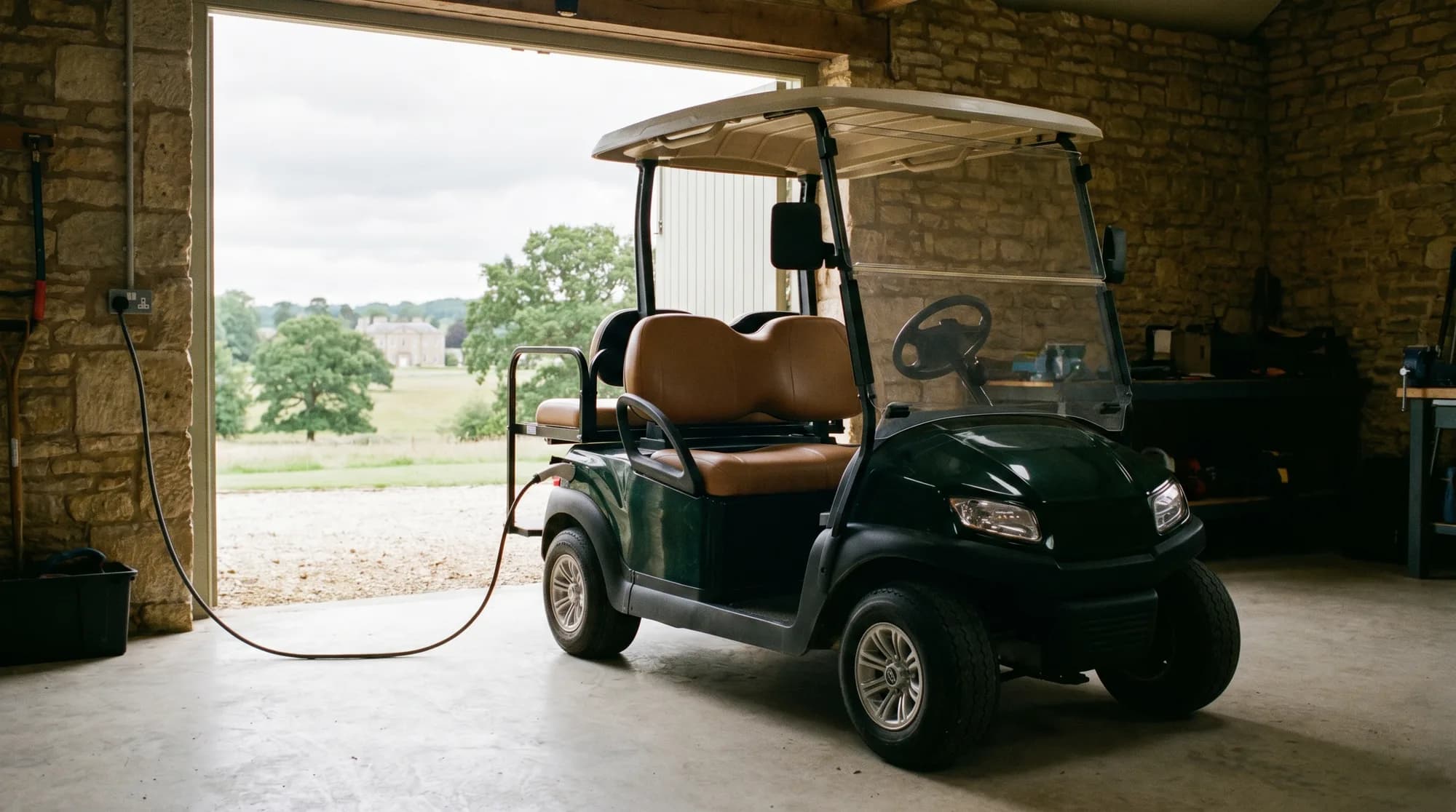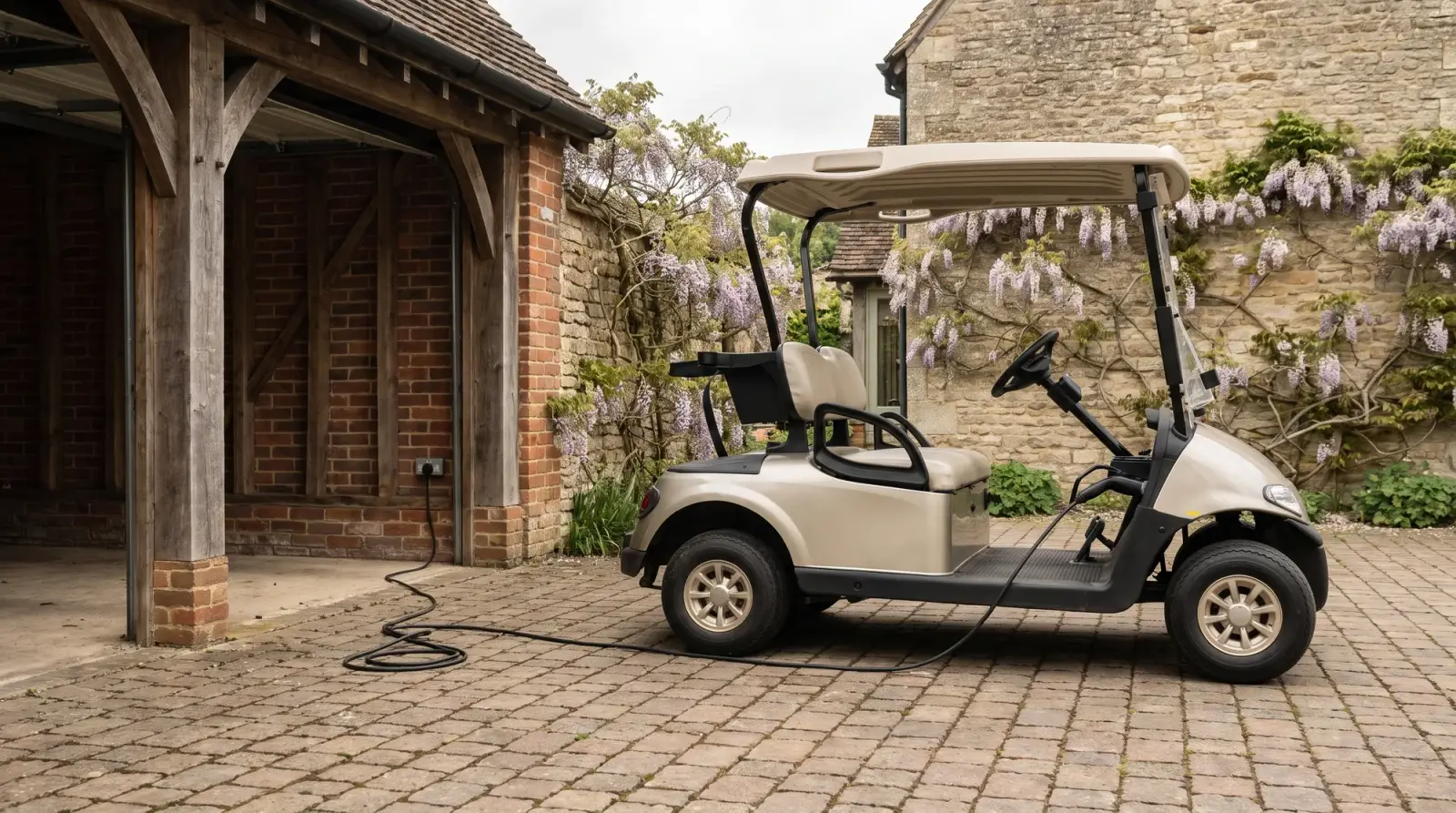
Yes, you can charge a golf buggy at home from an ordinary 13-amp domestic socket. Standard buggies come with an onboard or portable charger designed to plug straight into the mains, so there's no EV wallbox to buy and no special wiring needed for most homes. The buggy's charger draws far less power than an electric car's, closer to a washing machine than a Tesla.
Cheap to run, too. A full charge takes roughly 4 to 8 kWh depending on the battery, which works out at about £1 to £2.50 at typical 2026 tariffs of 25 to 30p per kWh. The real questions are about the setup around that socket: whether your garage wiring is up to it, whether an extension lead is safe, and what to do about British rain. We'll take each in turn.
- A standard 13A household socket is all you need. No wallbox, no three-phase supply, no special installation for most homes.
- A full charge is roughly 4 to 8 kWh, so expect around £1 to £2.50 per charge at typical tariffs.
- Extension leads are a stopgap, not a setup. If you must use one, it should be fully uncoiled, outdoor-rated and RCD protected.
- Old garage or outbuilding wiring should be checked by a qualified electrician before you make it your regular charging point.
- Lithium chargers cut off automatically and can be left connected; lead-acid packs do best with regular, complete charges.
Can you really just plug it into a normal socket?
You can. A typical buggy charger draws somewhere between 5 and 12 amps while working, comfortably inside what a 13A socket is rated for. Plug the charger into the wall, connect it to the buggy's charging port, and walk away. Most buggies charge fully in 4 to 8 hours, so an overnight charge in the garage is the natural routine. If you're new to the process itself, connector types, charge stages and all, our guide on how to charge an electric golf buggy walks through it from scratch.
One caveat. 'Comfortably inside the rating' assumes a sound circuit. A charger running for six hours puts a sustained load on the socket, the cable behind it and every connection in between. Modern ring mains shrug this off. A 1970s garage spur with sun-perished insulation might not, which is why the wiring check below matters more than any other advice on this page.
How much does a full charge cost?
Less than a coffee, in most cases. Here's the arithmetic at typical UK tariffs, treating a full charge as 4 to 8 kWh depending on pack size. Off-peak tariffs change the picture dramatically if you charge overnight.
- 4 kWh charge (small pack)
- about £0.36
- 8 kWh charge (large pack)
- about £0.72
- 4 kWh charge (small pack)
- about £1.00
- 8 kWh charge (large pack)
- about £2.00
- 4 kWh charge (small pack)
- about £1.20
- 8 kWh charge (large pack)
- about £2.40
| 4 kWh charge (small pack) | 8 kWh charge (large pack) | |
|---|---|---|
| Off-peak overnight (~9p/kWh) | about £0.36 | about £0.72 |
| Standard rate (~25p/kWh) | about £1.00 | about £2.00 |
| Higher standard rate (~30p/kWh) | about £1.20 | about £2.40 |
Even charging twice a week on a standard tariff, you're looking at £100 to £250 a year in electricity as a rough guide. On an EV-style off-peak tariff it drops to loose change. For the full ownership picture, including servicing and insurance, see our breakdown of electric golf buggy running costs.
Can you use an extension lead?
As a stopgap, yes. As your permanent setup, no. Extension leads fail in predictable ways under sustained load, and buggy charging is exactly that. Three rules if you have no other option. First, fully uncoil the lead. A coiled cable under load traps heat, and a reel that's fine for a lamp can melt under six hours of charger current. Second, use a proper outdoor-grade lead rated for at least 13A, not a £6 four-way from the supermarket. Third, never daisy-chain leads or adapters. Each junction is a point of resistance, and resistance under load means heat.
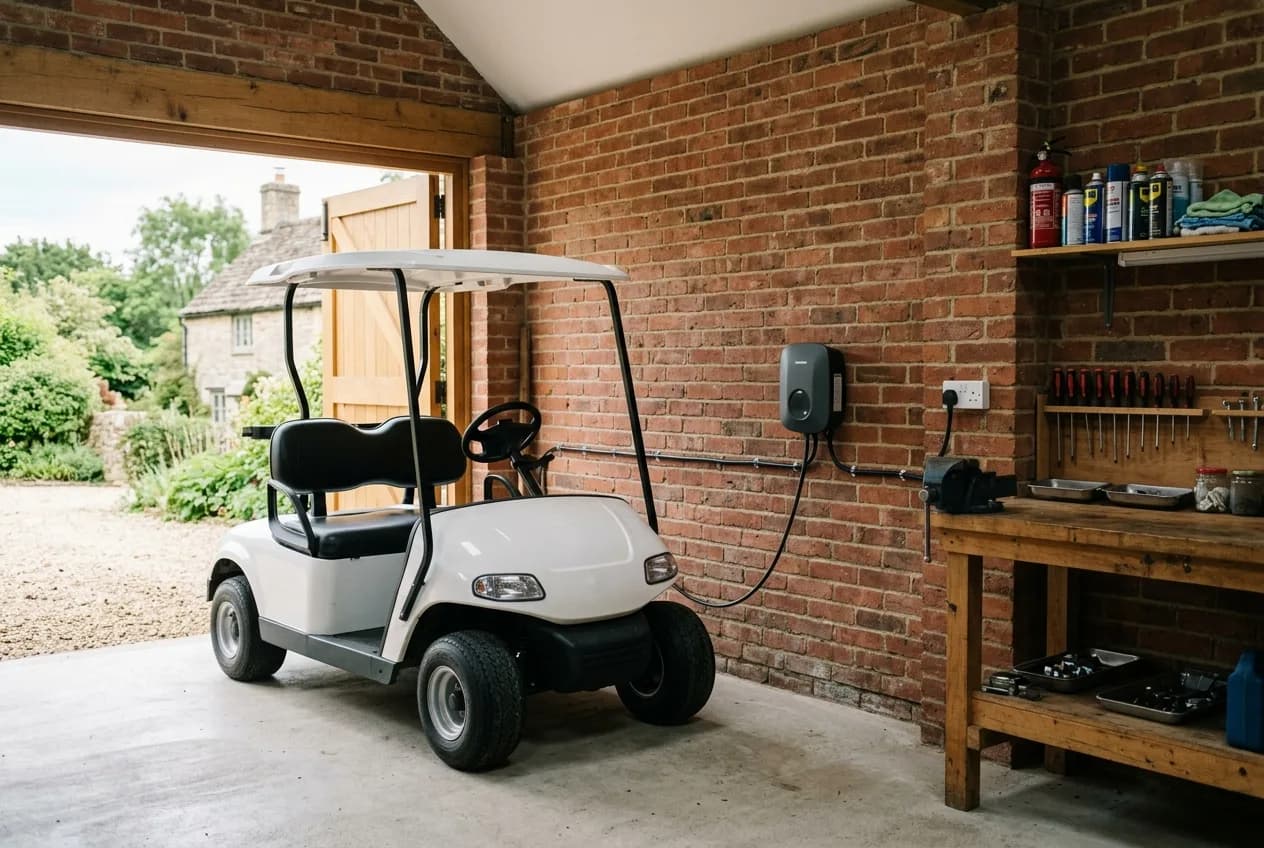
The better answer is to get a socket where the buggy lives. An electrician can add an outdoor-rated RCD-protected socket to a garage, barn or car port for a modest cost, typically far less than people expect, and it removes the whole category of risk in one visit.
What about charging outside in the rain?
British weather being what it is, this comes up a lot. The buggy itself copes with rain fine, but the charging connection is the weak point. If you must charge outdoors, you need a weatherproof (IP-rated) outdoor socket with a hinged cover, the charger itself kept dry and off the ground, and connectors that aren't sitting in a puddle. The best answer, though, is a roof. A car port, lean-to or shed keeps water away from the electrics entirely and does your battery a favour in winter too, something we cover in our golf buggy winter battery care guide.
Setting up safe home charging, step by step
- 01
Pick a dry, ventilated spot
A garage, barn or car port is ideal. Lead-acid batteries give off small amounts of hydrogen while charging, so avoid sealed cupboards and leave some airflow around the buggy.
- 02
Check the circuit
Confirm the socket is RCD protected and the wiring is in good condition. In an older garage or outbuilding, pay an electrician for an hour to inspect it. It's the cheapest insurance you'll ever buy.
- 03
Plug the charger into the wall directly
Charger into socket, then charger into buggy, with the cable routed where nobody will trip on it or run over it. No extension leads, no adapters, no multi-way blocks.
- 04
Set your routine by battery type
Lithium: plug in whenever convenient and let the charger cut off on its own. Lead-acid: charge fully after each day's use rather than little and often, and never store the buggy flat.
- 05
Do a monthly once-over
Glance at the plug, socket and connectors for scorch marks, and feel the plug after an hour of charging. Warm is normal; too hot to hold means stop and get it checked.
Do lithium and lead-acid need different habits?
Yes, and it's worth getting right. Lithium chargers manage themselves. They cut off automatically at full charge, so leaving the buggy plugged in overnight or over a weekend is fine, and partial charges do no harm. Lead-acid is fussier. Those packs last longest with regular full charges, they self-discharge when idle, and leaving one flat for weeks will quietly ruin it. If your buggy lives outside the summer season in a shed, put charging on the calendar, not just in your good intentions.
Frequently asked questions
Can you charge a golf buggy from a normal plug socket?+
Yes. Standard buggies charge from an ordinary 13A domestic socket using the charger supplied with the vehicle. No wallbox or special wiring is needed for most homes, though the circuit should be RCD protected and in good condition.
Can you use an extension lead to charge a golf buggy?+
Only as a stopgap. If you must, use a fully uncoiled, outdoor-grade lead rated for 13A on an RCD-protected circuit, and never daisy-chain. For regular charging, have a socket fitted where the buggy is stored.
How much does it cost to fully charge a golf buggy?+
Roughly £1 to £2.50 at typical 2026 tariffs of 25 to 30p per kWh, since a full charge uses about 4 to 8 kWh. On an off-peak overnight tariff it can drop below 50p.
Do I need special wiring to charge a buggy at home?+
Usually not. A sound, RCD-protected 13A socket is enough. The exception is old garage or outbuilding wiring, which should be checked by a qualified electrician before you rely on it for hours of sustained charging.
Can you charge a golf buggy outside in the rain?+
Only with a weatherproof IP-rated outdoor socket and the charger and connectors kept dry and off the ground. Under a roof is always better. Never leave a standard charger exposed to rain.
If we had to boil this down to one recommendation, it's this: spend your money on the socket, not on gadgets. A properly fitted RCD-protected outdoor socket in the garage or barn where the buggy sleeps turns charging into a non-event, which is exactly what it should be. Everything else, the tariff tweaks and the routines, is fine-tuning.
Home-friendly charging, built in
Every Hawke electric buggy charges from a standard UK socket and comes with a 3-year warranty and 24-hour call-out. See which model fits your home and grounds.
Related solutions
Ready to explore what we build?
See the vehicles and the setting this applies to, or get a tailored quote built around your site.

Ready to find the right buggy?
Tell us how and where it will work and we will specify a vehicle and a tailored quote built around you. Every build comes with a 3-year warranty and a 24-hour priority call-out.
Our guides are written and reviewed by the Hawke Electric Vehicles team, the people who specify, build, deliver and support the vehicles. We focus on honest, practical advice and flag where a figure depends on the build rather than guessing.
More guides by Hawke