When a golf buggy hurts someone on private land, liability usually lands on whoever failed to take reasonable care: sometimes the driver, sometimes the operator whose systems let the accident happen, and often a share of both. For the club, estate or venue running the buggies, the legal exposure flows mainly from the Occupiers' Liability Act 1957 and, where staff or hirers are involved, from health and safety law.
Search this subject and nearly everything you'll find is written by claimant solicitors explaining how injured people can sue. Fair enough, that's their job. This guide is written for the operator side, because the clubs and venues we supply ask us about it constantly and almost nobody covers it. The short version: disclaimers won't save you, but boring, well-documented systems almost always will.
- The Occupiers' Liability Act 1957 puts a duty on you to take reasonable care that visitors are reasonably safe, and buggy operations are part of that.
- Where employees or hirers use buggies, the Health and Safety at Work etc. Act 1974 and the Management Regs require a suitable risk assessment.
- Hire-desk waivers cannot exclude liability for death or personal injury caused by negligence (UCTA 1977 / Consumer Rights Act 2015).
- What actually protects operators: maintenance records, driver conditions, signage, route design, incident logs and proper public liability insurance.
- A hirer who drives negligently carries their own liability, but your systems will still be examined.
What duty do you owe under the Occupiers' Liability Act?
Section 2 of the 1957 Act obliges an occupier to take such care as is reasonable in the circumstances to see that visitors are reasonably safe using the premises for the purposes they're invited there for. Buggies are part of the premises picture: the paths they share with pedestrians, the slopes they're sent down, the machines themselves if you're the one providing them. The duty is about reasonableness, not perfection. A court asks what a sensible operator would have foreseen and done, which is why the operators who lose these cases tend to be the ones with no evidence they thought about the risk at all.
Note the word visitors. Members, green-fee players, hotel guests, wedding parties and contractors are all visitors. Trespassers get a thinner duty under the 1984 Act, but don't lean on that; a hirer's passenger who wanders somewhere unexpected is usually still a visitor.
Where does health and safety law come in?
The moment buggies are part of a business undertaking, the Health and Safety at Work etc. Act 1974 applies: duties to employees who drive them and, under section 3, to anyone else affected by the operation, which captures hirers and bystanders. The Management of Health and Safety at Work Regulations 1999 then require a suitable and sufficient risk assessment. HSE has investigated workplace vehicle incidents on golf courses and estates before now; this is not a theoretical regime.
In practice, a buggy risk assessment for a club or venue covers routes and segregation from pedestrians, gradients and wet-weather rules, driver requirements, passenger limits, maintenance and defect reporting, hire-desk briefings and what happens after an incident. If yours is a paragraph in a dusty binder, rewrite it; if a serious injury reaches court or the HSE, that document is exhibit one. Common mechanical failure points and how to catch them early are covered in our guide to common golf buggy faults.
Do hire waivers actually protect a club?
Far less than most hire desks believe. Under the Unfair Contract Terms Act 1977 (and, for consumers, the Consumer Rights Act 2015), a business cannot exclude or restrict liability for death or personal injury caused by its own negligence. No signature changes that. A waiver that says "driven entirely at your own risk" is legally worthless against a claim that your brakes were unmaintained or your route design was dangerous.
That doesn't make hire agreements pointless. A good one sets driver conditions (minimum age, licence held, no alcohol), records that a briefing was given, allocates responsibility for damage to the buggy itself (property damage terms are treated more generously than injury terms), and creates a paper trail showing your system operating. Think of it as evidence of a responsible operation, not a shield.
Who's liable in the common scenarios?
Every case turns on its facts, but the patterns repeat. The table below sets out how liability typically shakes out, assuming the injury is real and someone was careless somewhere.
- Primary liability usually sits with
- The hirer, for negligent driving
- What the operator will be asked to show
- Driver conditions, briefing given, sensible routes, insurance in place
- Primary liability usually sits with
- Driver, and possibly operator if the route or rules invited it
- What the operator will be asked to show
- Wet-weather policy, signage on gradients, passenger rules
- Primary liability usually sits with
- The operator
- What the operator will be asked to show
- Maintenance records, defect reporting, servicing history
- Primary liability usually sits with
- The employer
- What the operator will be asked to show
- Risk assessment, training records, safe systems of work
- Primary liability usually sits with
- The taker, but operator security examined
- What the operator will be asked to show
- Key control, storage and immobilisation arrangements
| Primary liability usually sits with | What the operator will be asked to show | |
|---|---|---|
| Hirer drives into a pedestrian | The hirer, for negligent driving | Driver conditions, briefing given, sensible routes, insurance in place |
| Passenger thrown out on a slope | Driver, and possibly operator if the route or rules invited it | Wet-weather policy, signage on gradients, passenger rules |
| Brake failure injures someone | The operator | Maintenance records, defect reporting, servicing history |
| Staff member injured working with buggies | The employer | Risk assessment, training records, safe systems of work |
| Buggy left unsecured, taken and crashed | The taker, but operator security examined | Key control, storage and immobilisation arrangements |
Notice the third column. Whoever ends up primarily liable, the operator's systems get examined in every single row. That's the sense in which a passenger injured by a hirer's driving is still your problem: the hirer carries the driving fault, and the claimant's solicitor simultaneously tests whether you should have hired to that person, on that route, in that condition, in that weather.
What actually protects an operator?
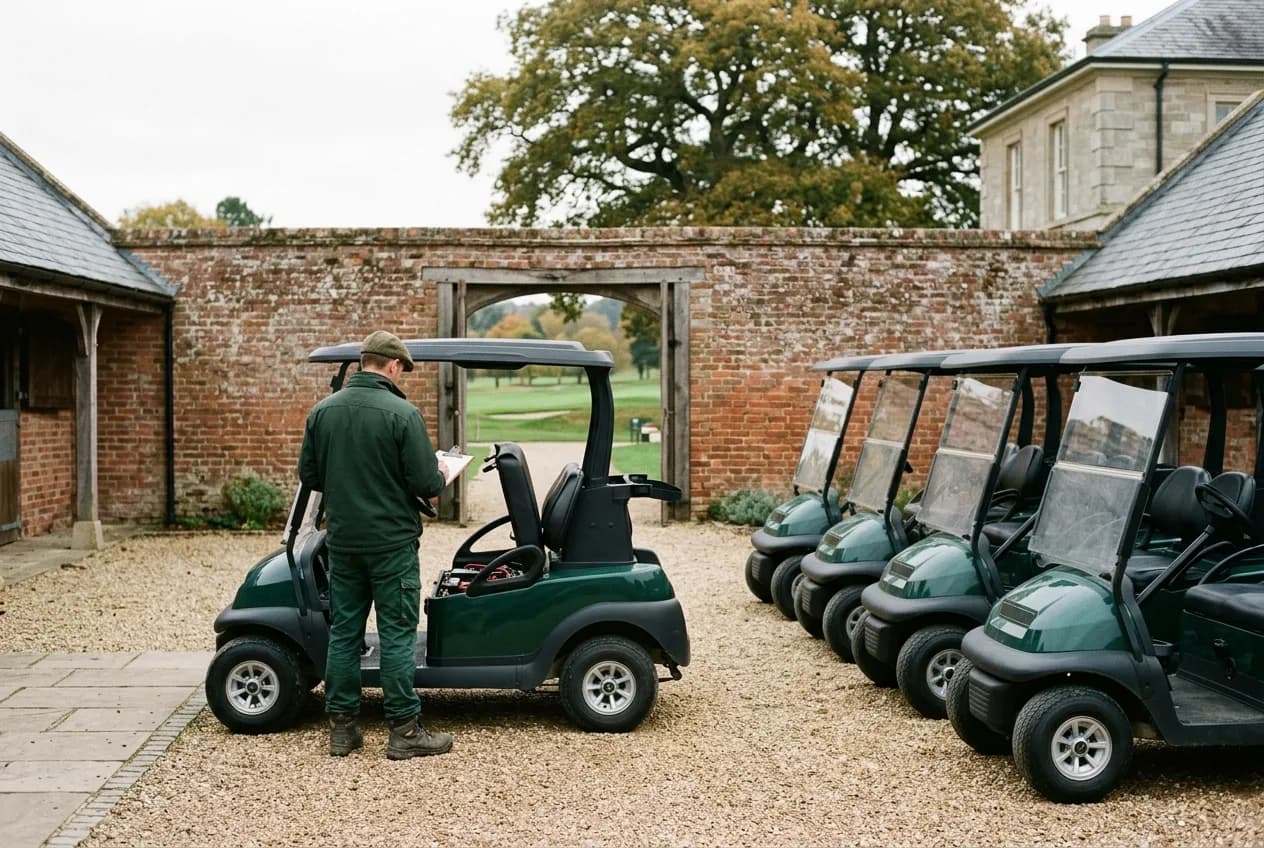
Not eloquent disclaimers. Records. When a claim arrives eighteen months after the event, the operator with a documented system usually resolves it quickly and cheaply; the operator with nothing negotiates from weakness whatever the truth was.
- Maintenance and inspection records for every buggy, with defects logged and signed off when fixed.
- Written driver conditions for hirers: minimum age, licence, sobriety, passenger limits.
- A recorded hire-desk briefing, thirty seconds is enough, covering routes, slopes and pedestrians.
- Route design and signage: segregate buggies from walkers where you can, sign the gradients and blind corners you can't.
- An incident and near-miss log, reviewed a couple of times a year for patterns.
- Public liability insurance at a realistic limit, with buggy operations and hire explicitly disclosed to the insurer.
- Your buggy risk assessment, dated within the last year.
Insurance deserves its own line. Public liability cover responds to visitor injury claims, employer's liability covers staff, and both need the insurer to know buggies and hire are part of the operation. Undisclosed hire activity is a classic reason for cover disputes. Our golf buggy insurance guide covers the policy types, and if your buggies ever touch a public road or car park there's a further layer explained in our guide to road legality for golf buggies.
Frequently asked questions
Who pays if a golf buggy hits someone?+
Usually the negligent party's insurer: the driver's if the driving was at fault, the operator's public liability policy if poor maintenance, routes or systems contributed. Liability is often shared between them.
Is a golf club liable for buggy accidents?+
It can be, where the club failed to take reasonable care: think unmaintained brakes, dangerous routes, hiring to someone obviously unfit to drive. A club with sound systems isn't automatically liable just because an accident happened on its land.
Does the Occupiers' Liability Act cover golf buggies?+
Yes, as part of the occupier's general duty to keep visitors reasonably safe on the premises. Buggy routes, the machines you provide and how they mix with pedestrians all fall within it.
Do hire waivers protect a club from claims?+
Not against personal injury caused by the club's negligence; UCTA 1977 and the Consumer Rights Act 2015 void such exclusions. Waivers still have value as evidence of briefings and driver conditions, and for property damage terms.
What insurance covers buggy accidents on private land?+
Public liability insurance for injuries to visitors and hirers, employer's liability for staff, and specific buggy or motor cover for the machines. Make sure the insurer knows about hire activity and any road or car park use.
If you run buggies and take one action off the back of this article, make it the maintenance record. It's the single document that appears in every scenario in the table above, it's the cheapest to keep, and it's the first thing your insurer's solicitor will ask for. A serviced fleet with a paper trail is both a safer fleet and a defensible one.
Maintenance records, done for you
A Hawke service plan gives your fleet scheduled servicing, documented inspections and 24-hour call-out, which is exactly the paper trail that protects an operator when questions get asked.
Related solutions
Ready to explore what we build?
See the vehicles and the setting this applies to, or get a tailored quote built around your site.

Ready to find the right buggy?
Tell us how and where it will work and we will specify a vehicle and a tailored quote built around you. Every build comes with a 3-year warranty and a 24-hour priority call-out.
Our guides are written and reviewed by the Hawke Electric Vehicles team, the people who specify, build, deliver and support the vehicles. We focus on honest, practical advice and flag where a figure depends on the build rather than guessing.
More guides by Hawke