To sell your golf buggy in the UK, you need three things: an honest valuation based on age, battery health and condition, a sales route that suits your appetite for effort, private sale, trade-in or auction, and the evidence, paperwork, photographs and above all battery proof, that lets a stranger trust the machine. Buggies are not cars: there is no HPI check, no MOT history and no big classified market setting obvious prices, so the seller who prepares well genuinely achieves more than the one who does not. This guide walks through the whole job in order.
- Value the buggy on age, battery health and usage, not on what you paid for it.
- Battery evidence is the single strongest selling tool a used buggy can have.
- Private sale usually achieves the most money but takes the most effort; trade-in is the easiest; auction is the fastest to a certain sale.
- Gather receipts, service records and the charger before you photograph anything.
- Honest listings sell: a described fault costs less than a discovered one.
Valuing your golf buggy honestly
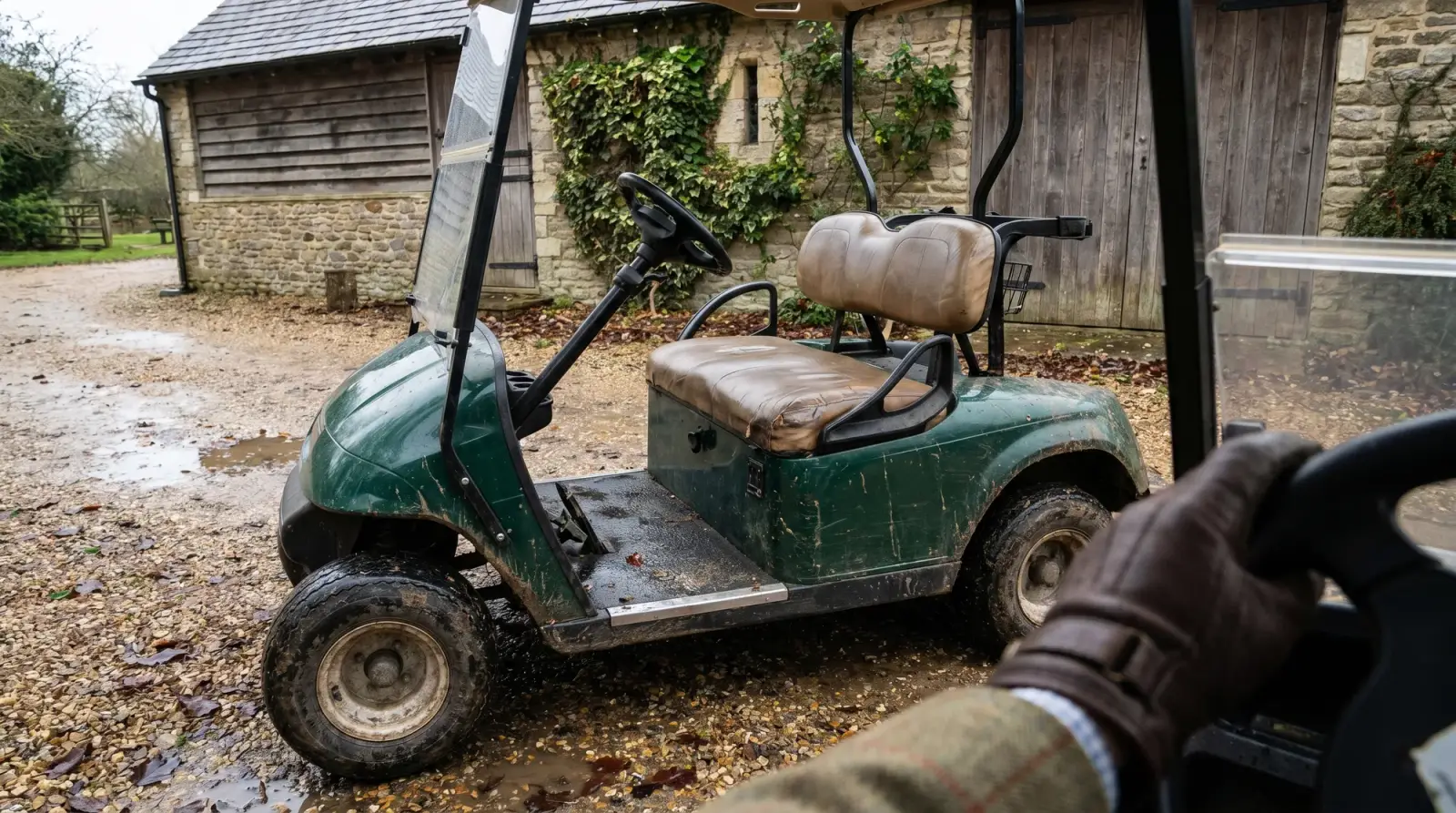
Start with what a buyer actually pays for. Age sets the baseline, and if you are not certain of the year, serial-number decoding will pin it down, our guide on what year is my golf buggy shows how. Battery health then moves the figure more than anything else: chemistry, age of the pack and how it was charged and stored matter far more to a buyer than a scratch on the cowl, because a tired lead-acid pack is a significant bill they will have to pay. Usage comes third, hours or mileage where recorded, and the life the buggy has led, a privately owned machine used two rounds a week is a different proposition from an ex-fleet vehicle worked daily. Condition, storage history and desirable equipment, lithium power, weather protection, good tyres, refine the number from there. Our depreciation and resale guide covers how these factors compound over a buggy's life. Then sense-check against the market: look at what similar machines are advertised for, remember advertised is not achieved, and price with reference to what a dealer would ask for the same buggy with a warranty, your private price needs to sit meaningfully below the dealer-prepared equivalent to be attractive.
Private sale, trade-in or auction: three ways to sell your golf buggy
- Private sale
- Usually the highest
- Trade-in or dealer purchase
- Below private, reflecting resale work
- Auction
- Unpredictable, sometimes strong, often not
- Private sale
- Highest: listing, viewings, haggling
- Trade-in or dealer purchase
- Lowest: one conversation
- Auction
- Low effort, but on the auction's timetable
- Private sale
- None until money clears
- Trade-in or dealer purchase
- High
- Auction
- High once the hammer falls
- Private sale
- Good buggies with evidence, unhurried sellers
- Trade-in or dealer purchase
- Sellers upgrading or valuing convenience
- Auction
- Clearing a vehicle quickly or settling an estate
| Private sale | Trade-in or dealer purchase | Auction | |
|---|---|---|---|
| Likely price | Usually the highest | Below private, reflecting resale work | Unpredictable, sometimes strong, often not |
| Effort and time | Highest: listing, viewings, haggling | Lowest: one conversation | Low effort, but on the auction's timetable |
| Certainty | None until money clears | High | High once the hammer falls |
| Best for | Good buggies with evidence, unhurried sellers | Sellers upgrading or valuing convenience | Clearing a vehicle quickly or settling an estate |
The pattern is the same as with cars. A private sale usually achieves the most because you are selling directly to the end user, but you do the advertising, host the viewings, field the offers and carry the payment risk. Trading in against your next vehicle, or selling directly to a dealer, costs you some value in exchange for speed, certainty and zero admin, and if you are upgrading it can be the sensible route even before convenience is counted. Auctions, covered in detail in our golf buggy auctions guide, suit sellers who value a definite sale on a definite date more than the last pound, results can be strong when two bidders want the same machine, but you should set a sensible reserve and expect fees either side. Whichever route you choose, decide your walk-away figure before the first conversation, not during it.
Paperwork, photos and battery evidence that help you sell your golf buggy
Preparation is where private sellers win or lose. Gather the documents first: the original invoice if you have it, service and repair receipts, battery purchase receipts with dates, the handbook, and both keys. A buggy with a paper trail is a different product from an identical buggy without one. Battery evidence deserves its own effort, because it answers the question every serious buyer is silently asking. State the chemistry, the age of the pack and its source, and demonstrate it working: a charged buggy that completes a decent test drive, a charger shown mid-cycle, and, where you have them, recent range observations in plain terms. If the pack is tired, say so and price accordingly; the buyer who discovers a weak battery after handover was always going to find out. Then photograph the buggy properly: cleaned, in daylight, from all four corners, plus the seats, the tyres, the battery compartment, the charger and the hour meter if fitted. Honest photographs of the flaws too, a kerbed wheel, a torn seat corner, build exactly the trust that sells machines to strangers. Finally, write the listing the way our guide to buying a used golf buggy teaches buyers to read one: year, model, battery chemistry and age, hours, storage history, faults, and what is included. On handover, take payment by bank transfer and see it cleared before the buggy leaves, provide a simple signed receipt stating sold as seen with the price and date, and hand over every key, the charger and the paperwork bundle.
If you are selling because you are upgrading
One practical note: if the reason you are selling is that you want a newer, bigger or better-specified machine, run the trade-in conversation before you list privately. Knowing what your buggy is worth in part exchange gives you a floor under any private negotiation, and if the numbers land close, the convenience of one transaction, old buggy away, new buggy delivered and commissioned, is worth a modest difference. We are always happy to discuss a changeover as part of a written, itemised quotation on your next vehicle, tell us what you are driving and what you want next.
Frequently asked questions
How do I find out what my golf buggy is worth?+
Value it on age, battery chemistry and health, recorded hours or usage, condition and equipment, then sense-check against advertised prices for similar machines, remembering advertised is not achieved. A private price needs to sit clearly below what a dealer asks for a warranted equivalent.
What is the best way to sell a golf buggy in the UK?+
It depends what you value. Private sale usually achieves the most money but takes the most effort and risk; trade-in or dealer purchase is the quickest and most certain; auction gives a definite sale on a definite date with an unpredictable result. Decide your walk-away figure before you start.
Why does battery evidence matter so much?+
Because the battery is the biggest bill a used buggy can hide, and every serious buyer knows it. Receipts showing the pack's age and chemistry, a charged vehicle that test drives well and a charger seen working answer the question directly, and let you defend your asking price.
What paperwork should I hand over with a golf buggy?+
The invoice if you have it, service and battery receipts, the handbook, all keys and the charger, plus a simple signed receipt recording the sale as seen, the price and the date. A documented buggy sells faster and for more than an identical undocumented one.
Should I sell privately or trade in when upgrading?+
Get the trade-in figure first. It puts a guaranteed floor under any private negotiation, and if the two numbers are close, one transaction with the old vehicle collected and the new one delivered and commissioned is usually worth a modest difference.
Upgrading? Let's talk about your next buggy
If you are selling to move up, tell us what you are driving now and what you need next. We will put together a written, itemised quotation, with delivery and commissioning UK-wide and a 3-year warranty on every vehicle.
Related solutions
Ready to explore what we build?
See the vehicles and the setting this applies to, or get a tailored quote built around your site.

Ready to find the right buggy?
Tell us how and where it will work and we will specify a vehicle and a tailored quote built around you. Every build comes with a 3-year warranty and a 24-hour priority call-out.
Our guides are written and reviewed by the Hawke Electric Vehicles team, the people who specify, build, deliver and support the vehicles. We focus on honest, practical advice and flag where a figure depends on the build rather than guessing.
More guides by Hawke