Before you hand over money for a used golf buggy, five physical checks tell you most of what the seller will not: the age and condition of the batteries, the state of the tyres and brakes, how the controller behaves under load, whether the frame is hiding rust, and what the hour meter says about the machine's real working life. This is a hands-on inspection checklist for the viewing itself. It is a different job from our daily inspection checklist, which covers the quick pre-use checks an operator makes each morning, and from the questions to ask when buying, which covers the conversation with the seller. This guide is the part you do with your hands, a torch and twenty minutes.
- Read the battery date codes yourself: the pack's age matters more than the odometer.
- Watch the voltage or battery gauge under load on a hill, sag under load reveals a tired pack.
- Test brakes and steering at walking pace first, then at full speed on open ground.
- Get underneath with a torch: frame rust and chassis repairs hide where sellers hope you will not look.
- An hour meter tells you more about real use than age or appearance ever will.
Start your inspection checklist with the batteries
The battery pack is the most expensive consumable on the vehicle, so it is where an inspection starts. Lift the seat and look at the pack itself. Most batteries carry a date code stamped or printed on the case, often a letter for the month and a digit for the year, and the seller's claim of "new batteries last year" should match what the cases say. Check that all batteries in the pack are the same brand and age, a mixed pack is a sign someone has been replacing single failed units, which drags the whole pack down. On lead-acid, look for corrosion on the terminals, bulging cases and any smell of sulphur. On lithium, ask to see the charger operating and confirm the battery management system is not throwing warning lights.
Then test under load, because a tired pack can look healthy at rest. Drive the buggy up the steepest slope available with a passenger aboard and watch the battery gauge or voltmeter. A healthy pack dips modestly and recovers when you ease off. A pack that sags hard on the climb, or a gauge that plummets in the first ten minutes of driving, is telling you a replacement is close, and a replacement pack is a significant part of the price of the vehicle. Price the buggy accordingly or walk away.
Tyres, brakes and steering: the rolling checks
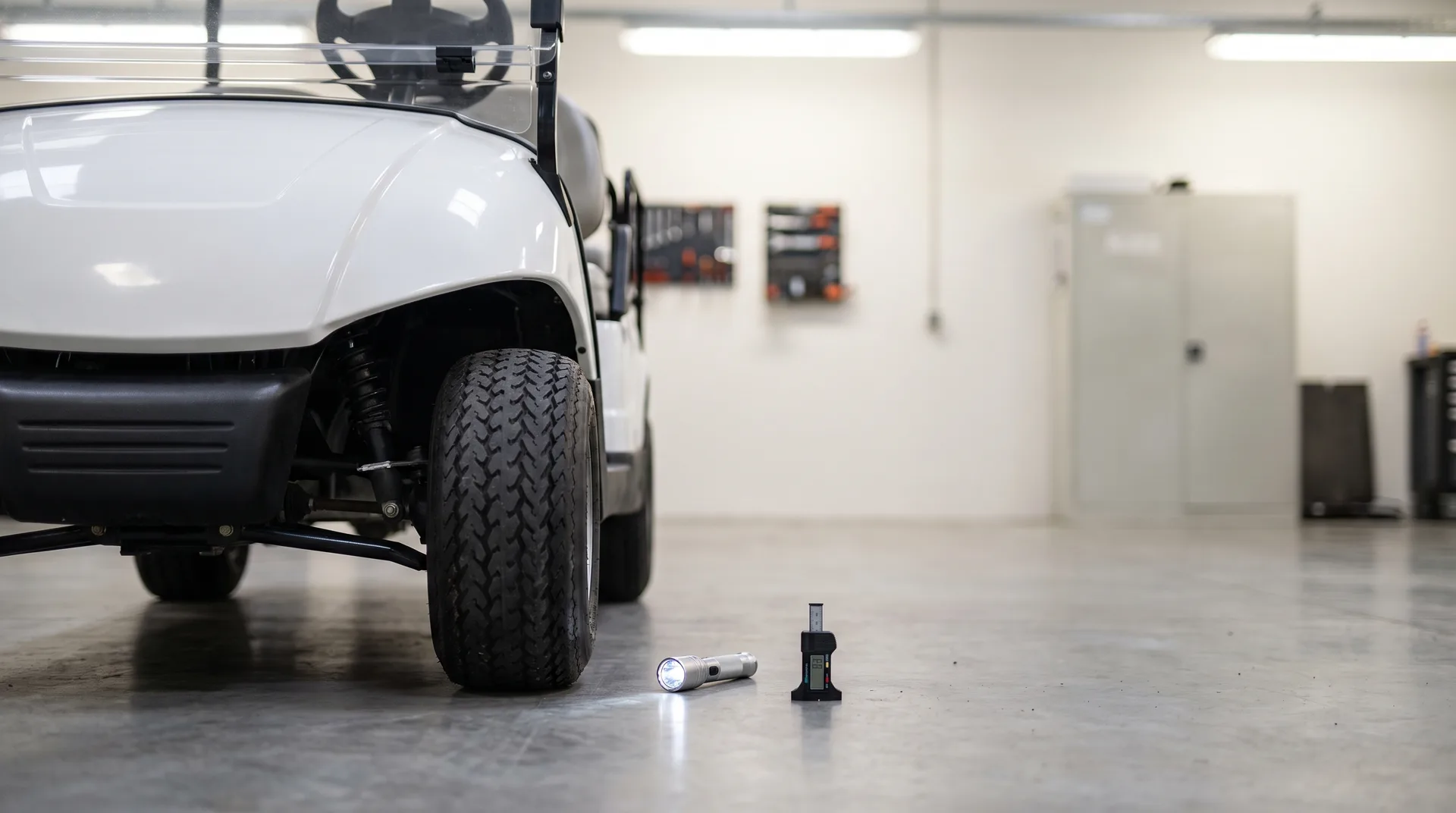
Tyres tell stories. Even wear across the tread is normal. Wear on one edge suggests tracking trouble or a bent component, often after a kerb strike. Check all four for perishing and cracking in the sidewalls, common on machines stored outdoors, and confirm the tyres fit the ground you will use: turf tyres, all-terrain tread and road-biased tyres are different fitments. Brakes come next. At walking pace, apply the brakes and feel for a firm, even stop with no pull to one side. Then repeat at full speed on open ground. Test the parking brake or hill-hold on a slope, a buggy that creeps on a modest gradient has a brake job in its near future. Finally, steering: lift the front end if you can, rock each wheel top to bottom and side to side, and feel for play in the bearings and linkages. On the move, wandering or a wheel that shudders points to worn steering components.
Controller behaviour, frame rust and the hour meter
The motor controller is the machine's brain, and its faults show under your right foot. On the test drive, pull away gently and then firmly. Acceleration should be smooth and progressive both times. Jerking, surging, hesitation, a dead spot in the pedal or cutting out under hard acceleration all point to controller, solenoid or throttle-sensor trouble, which can be an expensive diagnosis. Test reverse as well, and listen for the warning beeper. Then get underneath with a torch. Surface rust on a steel chassis is normal on an older machine; flaking, scaling rust on structural rails, or fresh underseal applied suspiciously recently, is not. Check where the body meets the frame and around suspension mounting points. On aluminium chassis, look for cracked welds instead. Last, find the hour meter if fitted. A golf-course fleet buggy can log well over a thousand hours in a few seasons, while a private machine may do a fraction of that, and the hour count explains condition far better than the year of manufacture.
- Healthy sign
- Matching brand and age, as described
- Walk-away sign
- Mixed ages, bulging cases, corrosion
- Healthy sign
- Modest dip on a climb, quick recovery
- Walk-away sign
- Hard sag uphill, gauge collapses early
- Healthy sign
- Even wear, sound sidewalls
- Walk-away sign
- One-edge wear, cracked or perished rubber
- Healthy sign
- Firm, even stop, holds on a slope
- Walk-away sign
- Pulls to one side, creeps on gradients
- Healthy sign
- Smooth, progressive power
- Walk-away sign
- Jerking, dead spots, cut-outs
- Healthy sign
- Surface rust only, straight rails
- Walk-away sign
- Scaling rust, cracked welds, fresh underseal
| Check | Healthy sign | Walk-away sign |
|---|---|---|
| Battery date codes | Matching brand and age, as described | Mixed ages, bulging cases, corrosion |
| Voltage under load | Modest dip on a climb, quick recovery | Hard sag uphill, gauge collapses early |
| Tyres | Even wear, sound sidewalls | One-edge wear, cracked or perished rubber |
| Brakes | Firm, even stop, holds on a slope | Pulls to one side, creeps on gradients |
| Controller | Smooth, progressive power | Jerking, dead spots, cut-outs |
| Frame | Surface rust only, straight rails | Scaling rust, cracked welds, fresh underseal |
After the inspection checklist: paperwork and price
If the machine passes, close out the non-mechanical checks before you pay. Ask for service records, charger and keys, and any remaining warranty in writing. Confirm the seller actually owns the vehicle, especially with ex-fleet machines. Use anything the inspection turned up to negotiate: tired batteries, worn tyres or a brake job are all real money and a fair reason to adjust the price. Our guide to buying a used golf buggy covers the wider process, and if you would rather skip the gamble entirely, our used golf buggies are inspected, prepared and warranted before sale, and every new Hawke vehicle carries a 3-year warranty.
Frequently asked questions
How do I check a golf buggy battery's age?+
Lift the seat and read the date code on each battery case, usually a stamped or printed letter-and-digit code showing month and year. Check every battery in the pack: they should match in brand and age. A mixed pack means single units have been replaced, which usually shortens the life of the whole set.
What is voltage sag and why does it matter?+
Sag is the drop in battery voltage when the pack works hard, such as climbing a hill with passengers. A healthy pack dips modestly and recovers; a worn pack sags heavily and the gauge collapses early in the day. It is the single best on-the-spot test of a used buggy's most expensive component.
Is rust on a golf buggy frame a deal-breaker?+
Light surface rust on an older steel chassis is normal. Flaking or scaling rust on structural rails, cracks near suspension mounts, or fresh underseal that could be hiding either, are reasons to walk away, because chassis repair rarely makes economic sense on a buggy.
What does a golf buggy hour meter tell me?+
Real working life. An ex-golf-club fleet buggy can log over a thousand hours in a few seasons, while a private-estate machine may do far less. Hours explain the condition of batteries, brakes and bushes better than the year of manufacture, so always ask where the machine worked as well as how old it is.
Should I buy privately or from a dealer?+
A private sale can be cheaper, but you carry all the risk your inspection misses. A prepared machine from an established dealer costs more and comes inspected, with recourse and usually a warranty. If this checklist feels daunting, that difference is what you are paying for.
Skip the gamble on your next buggy
Tell us what you need the vehicle to do and we will quote a prepared, warranted machine, new or used, with support behind it.
Related solutions
Ready to explore what we build?
See the vehicles and the setting this applies to, or get a tailored quote built around your site.

Ready to find the right buggy?
Tell us how and where it will work and we will specify a vehicle and a tailored quote built around you. Every build comes with a 3-year warranty and a 24-hour priority call-out.
Our guides are written and reviewed by the Hawke Electric Vehicles team, the people who specify, build, deliver and support the vehicles. We focus on honest, practical advice and flag where a figure depends on the build rather than guessing.
More guides by Hawke