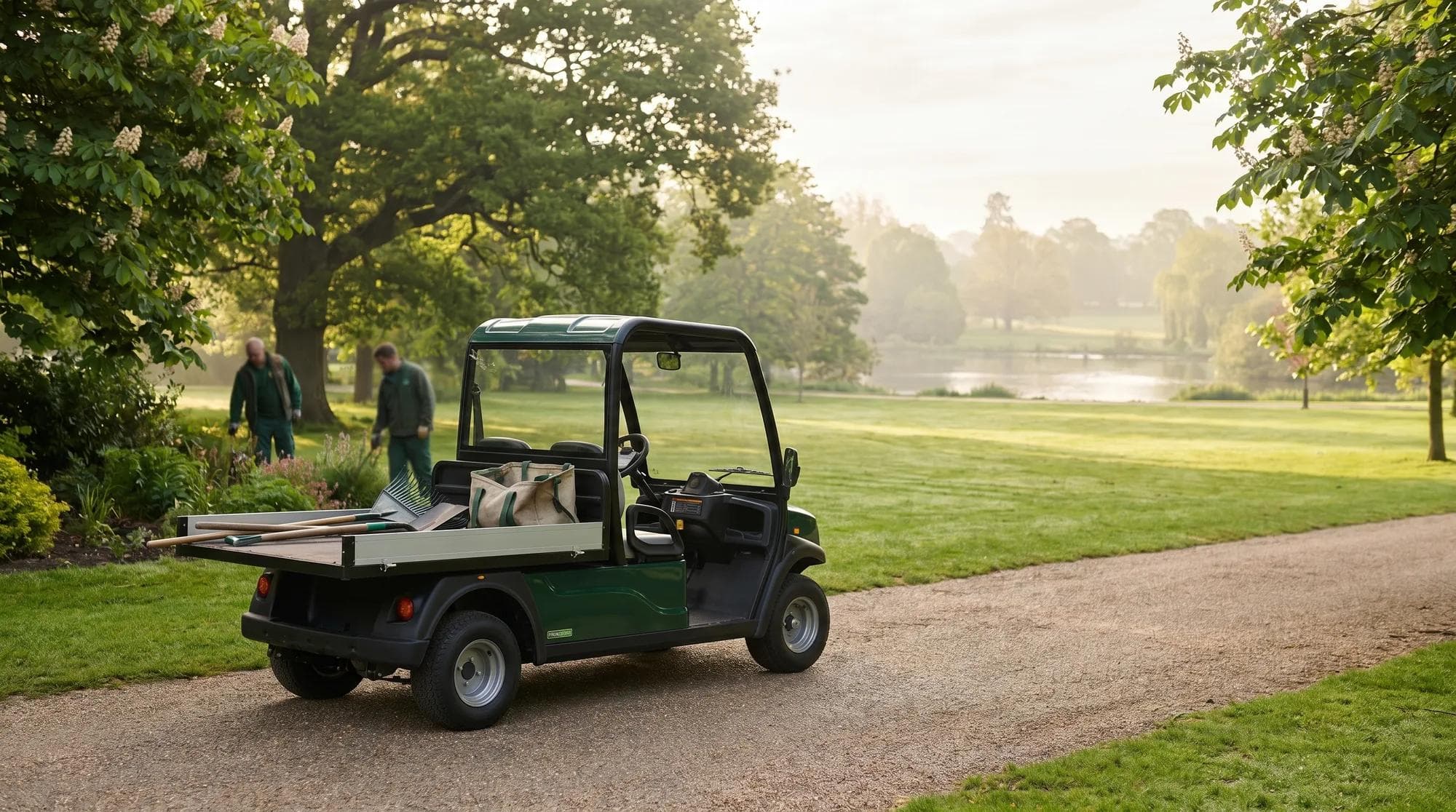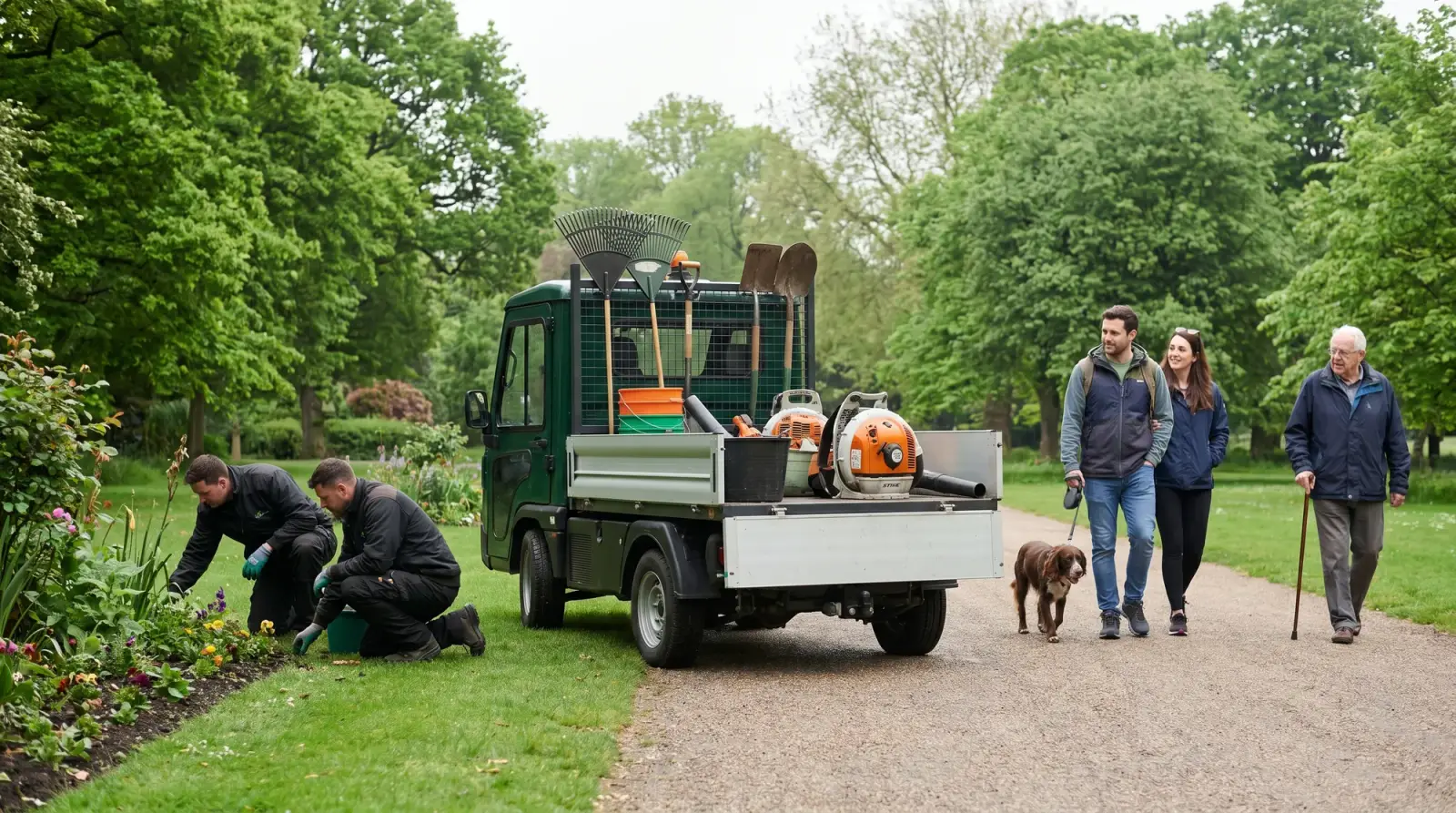
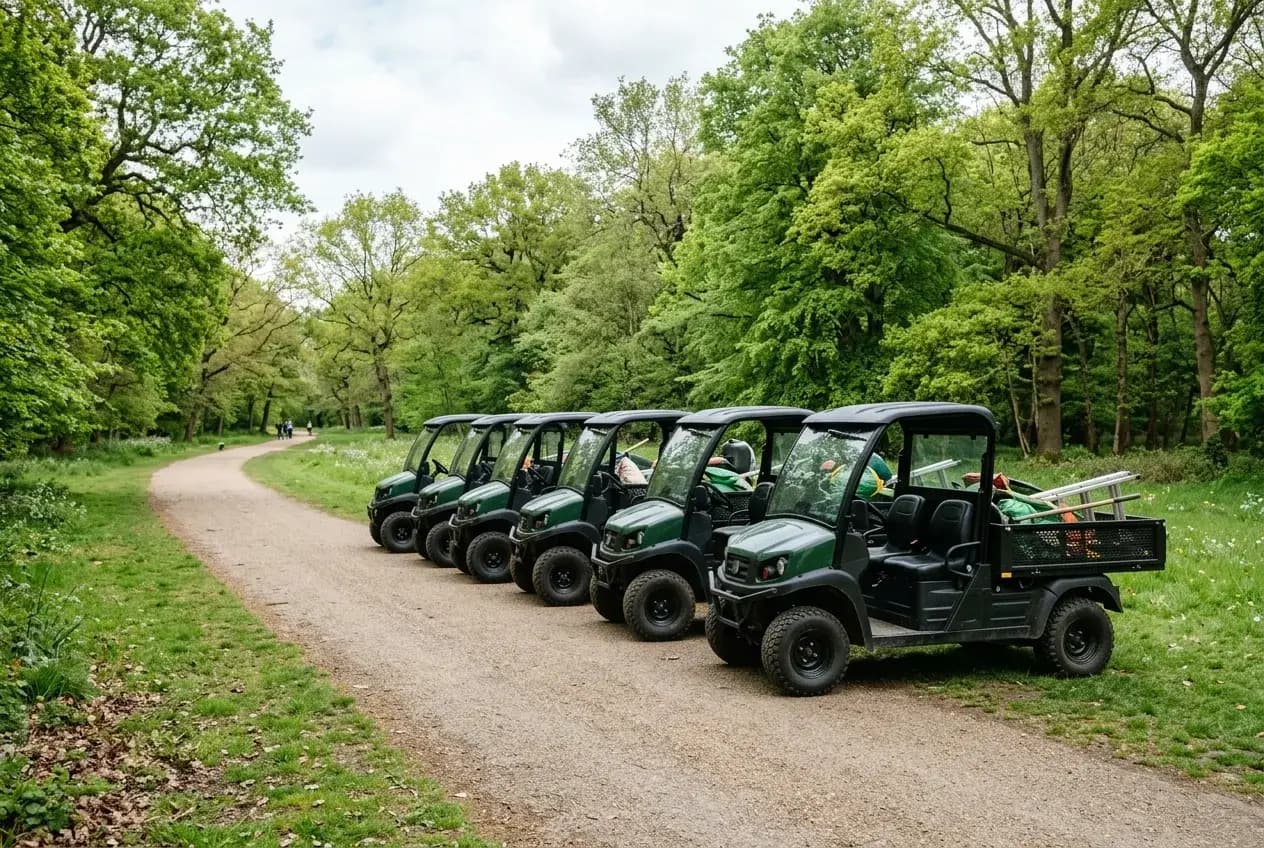
- A council grounds-maintenance electric vehicle is a working utility buggy with a load bed, built to carry a small crew, tools and materials around parks and public green spaces.
- Its main advantage is the setting: it works quietly and with no fumes right next to the public, which a diesel pickup or petrol gator does not.
- Low noise makes early-morning and evening work far less disruptive near homes, schools and busy paths.
- This is a different job from patrol or passenger transport: the brief is carrying tools and crew, not moving the public.
- It supports council air-quality and net-zero commitments by removing a visible source of on-site emissions from spaces full of people.
Grounds-maintenance crews do their work in the busiest public places a council owns. Parks, greens, cemeteries, sports grounds and town-centre planting are full of people walking dogs, taking children out and sitting on benches, and the crew has to move tools, materials and themselves around all of it. The vehicle that does that job is usually a diesel pickup or a petrol utility cart, and both bring noise and fumes into spaces where people have come to get away from exactly that.
An electric grounds-maintenance buggy changes the character of the work. It carries the same crew and kit, but quietly and with no exhaust at the point of use. That suits the setting far better, and it lines up with the air-quality and net-zero aims most councils have now signed up to. This guide looks at what the vehicle needs to do, why electric fits parks work in particular, and how it differs from a patrol vehicle.
What a grounds-maintenance buggy actually needs to do
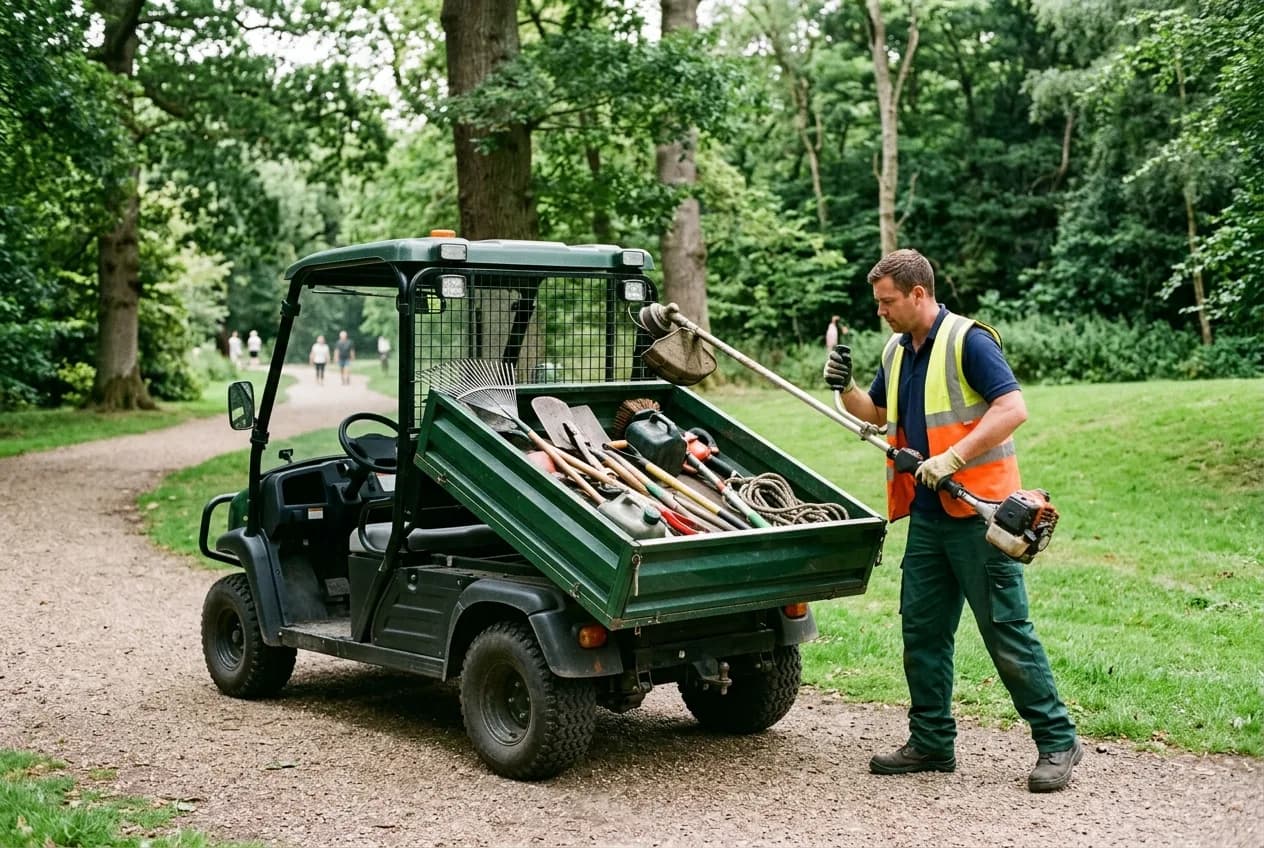
The brief is practical. A grounds crew needs to get to a job with the tools and materials for it, then move on to the next one across a site that may be large and spread out. So the vehicle is built around a load bed: room for mowers, strimmers, hand tools, bags of compost, fencing materials and the day's waste, with a crew seat or two up front. It needs to handle grass, gravel and the odd kerb, cope with a full working day, and be easy for a crew to load and unload all day without fuss.
- A real load bed for tools, materials and green waste, ideally tipping.
- Seating for a small crew alongside the load.
- Enough traction and ground clearance for grass, paths and gravel.
- Range to cover a full shift across a spread-out site on an overnight charge.
This is the same family of vehicle we cover for parks and councils more broadly in our guide to electric buggies for public parks and councils, narrowed here to the grounds-crew job specifically.
Why electric suits work among the public
The strongest argument for an electric grounds vehicle is where the work happens. A diesel pickup idling next to a playground, or a petrol cart trailing fumes along a path full of people, is a poor fit for a space the public uses for fresh air and quiet. An electric buggy removes both problems. There is no exhaust at the point of use, so the air stays clean around the people nearby, and the drive is quiet enough that the crew can work close to benches, cafes and play areas without being a nuisance.
How it supports air-quality and net-zero aims
Most councils now hold air-quality duties and a net-zero or carbon-reduction target, and a grounds fleet is one of the more visible places to act on both. Switching a petrol or diesel utility vehicle to electric removes a known source of on-site emissions from spaces the public uses, and it is the kind of change that is easy to point to and measure. It will not decarbonise a council on its own, but it is a sensible, self-contained step, and it happens in full public view, which does the wider message no harm. Our note on the environmental benefits of electric buggies sets out the running-cost and air-quality case in more detail.
Grounds maintenance is not patrol
It is worth separating two jobs that look similar from a distance. A patrol or warden vehicle is about presence and moving a person or two around to be seen and to respond, which we cover in our guide to electric buggies for security patrol. A grounds-maintenance vehicle is about carrying tools, materials and waste to do physical work. The first is built around visibility and quick movement; the second around payload and a practical load bed. A council that needs both is usually better served by two vehicles specified for their own job than one that half-does each.
- Grounds-maintenance buggy
- Carrying tools, materials and waste
- Patrol buggy
- Presence and quick response
- Grounds-maintenance buggy
- Load bed and payload
- Patrol buggy
- Visibility and seating
- Grounds-maintenance buggy
- Grounds and parks crews
- Patrol buggy
- Wardens and security teams
- Grounds-maintenance buggy
- Quiet and zero-emission near the public
- Patrol buggy
- Quiet and zero-emission near the public
| Need | Grounds-maintenance buggy | Patrol buggy |
|---|---|---|
| Main purpose | Carrying tools, materials and waste | Presence and quick response |
| Build priority | Load bed and payload | Visibility and seating |
| Typical user | Grounds and parks crews | Wardens and security teams |
| Noise and emissions | Quiet and zero-emission near the public | Quiet and zero-emission near the public |
Utility buggies for parks crews
Electric utility vehicles with real load beds, built to order, assembled and finished in the UK, in council colours and specified for grounds work, so crews can carry tools and crew quietly and cleanly across public spaces.
Specifying one for your teams
Because the vehicles are built to order, the spec can follow the work your crews actually do. Tell us the sites, the kit they carry, whether the load bed needs to tip, the daily distance and the terrain, and we will recommend a vehicle and battery to suit, in your council's colours. The aim is a buggy that handles a full shift across your largest park, loads easily all day, and works quietly enough to use early and late near homes. From there it is a question of fleet size, which we are happy to work through honestly with your team.
Equipping your grounds crews?
Tell us the sites, the kit your crews carry and the daily distances, and we will recommend a quiet, zero-emission utility buggy built and branded for your council.
Frequently asked questions
Can an electric buggy carry the tools and materials a grounds crew needs?+
Yes. These are utility vehicles built around a load bed, sized for mowers, hand tools, bags of compost, fencing and green waste, with a tipping option. We match the payload to the work your crews actually do.
Will it cope with grass, gravel and kerbs?+
Yes, when specified for it. We set traction, tyres and ground clearance to suit parks and greens rather than smooth tarmac, so the vehicle works across the sites a grounds crew covers.
How does this help with our air-quality and net-zero aims?+
It removes a visible source of on-site emissions from spaces the public uses, and the change is easy to measure and point to. It is a sensible, self-contained step that supports a council's wider air-quality duties and carbon targets.
Is it quiet enough for early-morning work near homes?+
Yes. The electric drive is quiet, so crews can start at dawn near homes and schools without the engine noise that makes early petrol and diesel work a common source of complaints.
Is this the same as a patrol vehicle?+
No. A grounds-maintenance buggy is built around payload and a load bed for tools and materials. A patrol vehicle is built around visibility and quick movement. If you need both, we usually recommend specifying each for its own job.
Related solutions
Ready to explore what we build?
See the vehicles and the setting this applies to, or get a tailored quote built around your site.

Ready to find the right buggy?
Tell us how and where it will work and we will specify a vehicle and a tailored quote built around you. Every build comes with a 3-year warranty and a 24-hour priority call-out.
Our guides are written and reviewed by the Hawke Electric Vehicles team, the people who specify, build, deliver and support the vehicles. We focus on honest, practical advice and flag where a figure depends on the build rather than guessing.
More guides by Hawke