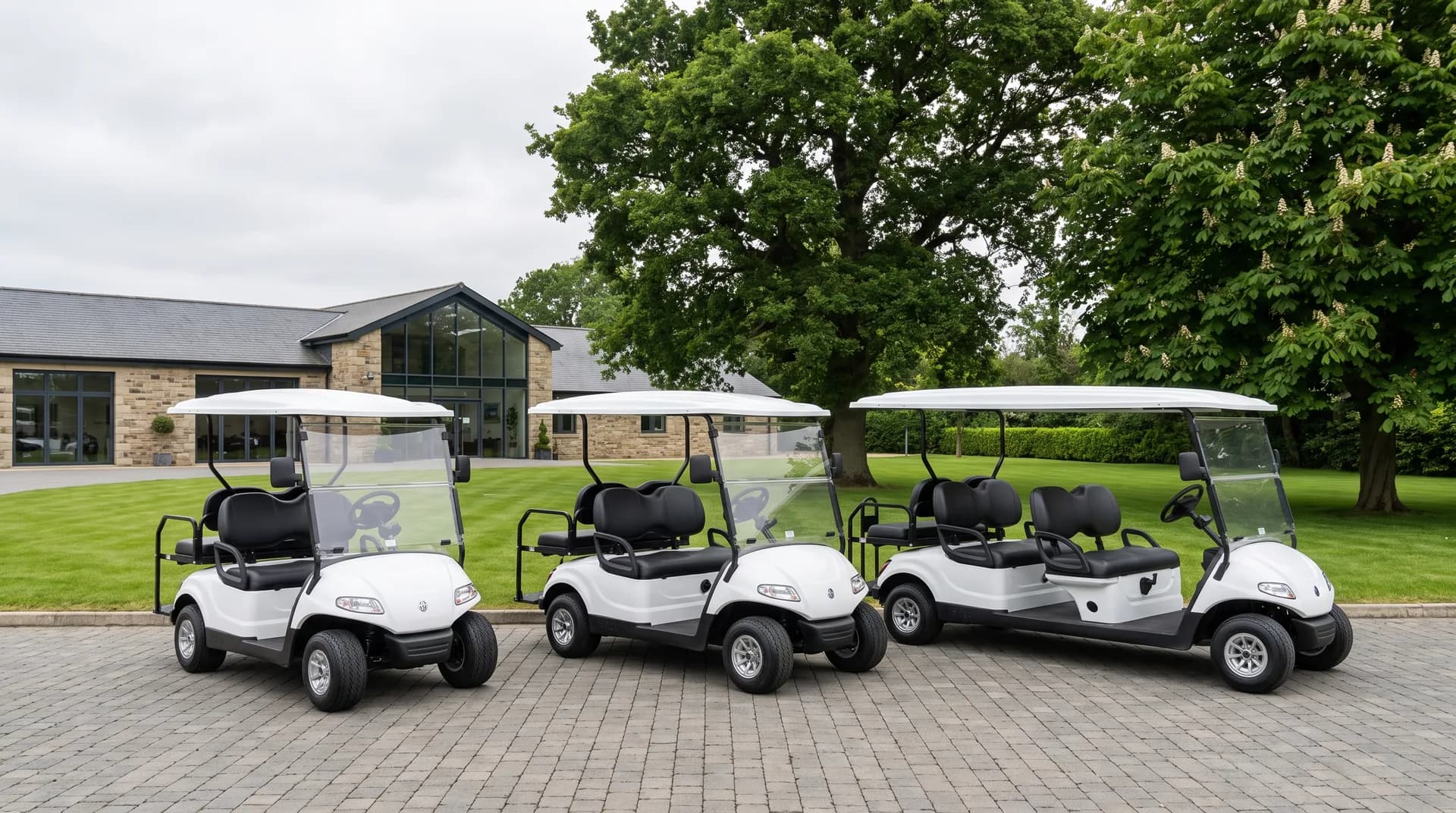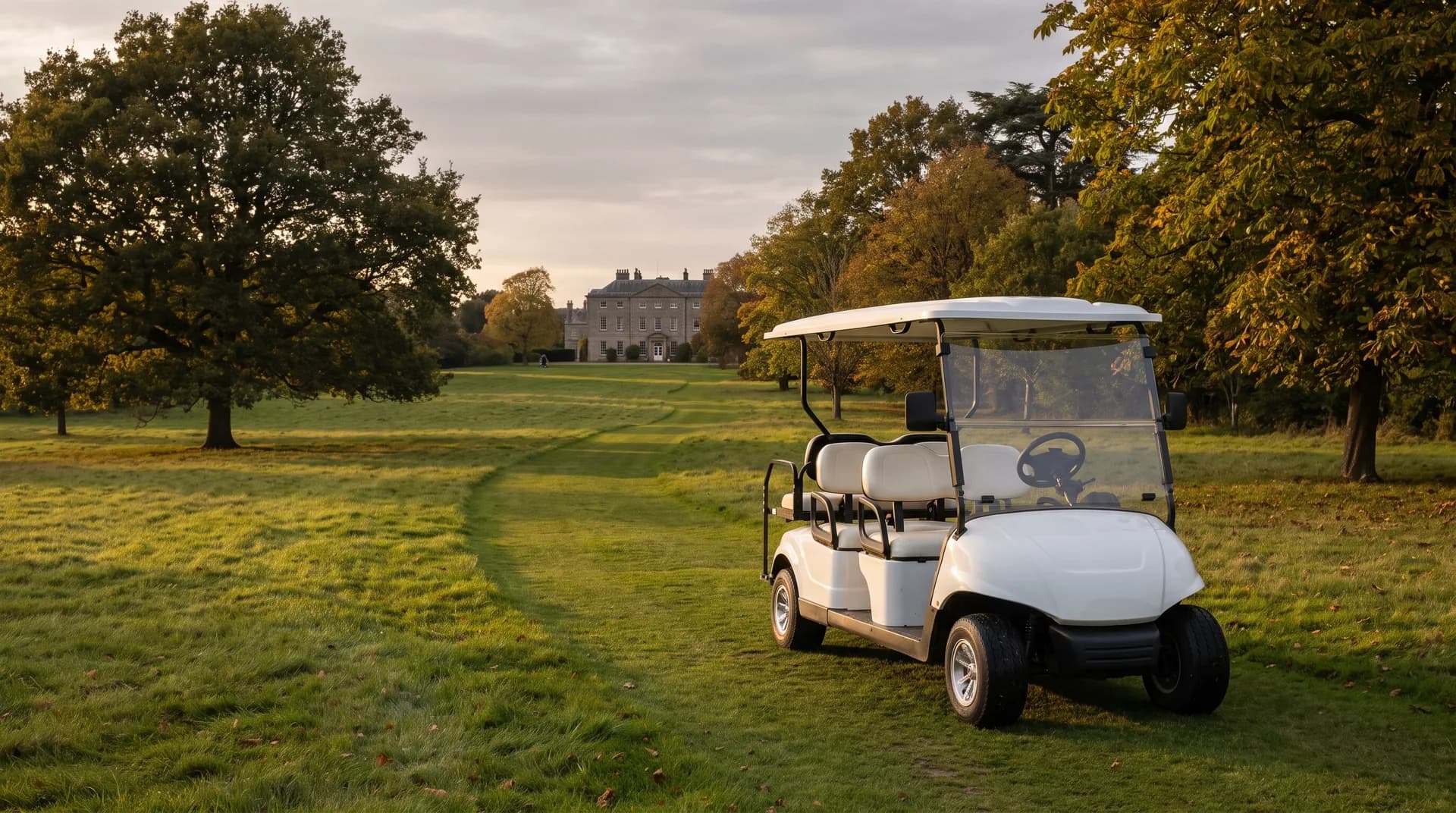
For shuttling people around a private site, an eight-seat electric buggy usually beats a minibus: it is easier to board, cheaper to run, simpler to operate on private land, and it fits paths and courtyards a minibus cannot enter. The minibus wins when the route uses public roads, covers real distance, or must run in any weather with everyone fully enclosed. That is the honest summary; the rest of this guide sets out the reasoning so you can check it against your own site rather than take it on trust.
- On private land the buggy is generally the simpler vehicle to operate, though insurers and site policies still set conditions.
- Boarding is the quiet decider: low, step-free access suits older and less mobile passengers.
- The buggy fits paths, courtyards and doorways a minibus cannot approach.
- The minibus wins on public roads, longer distances and full weather enclosure.
- Electric running costs are pence per mile in electricity, with less to service than an engine.
8-seater buggy vs minibus: where the buggy wins
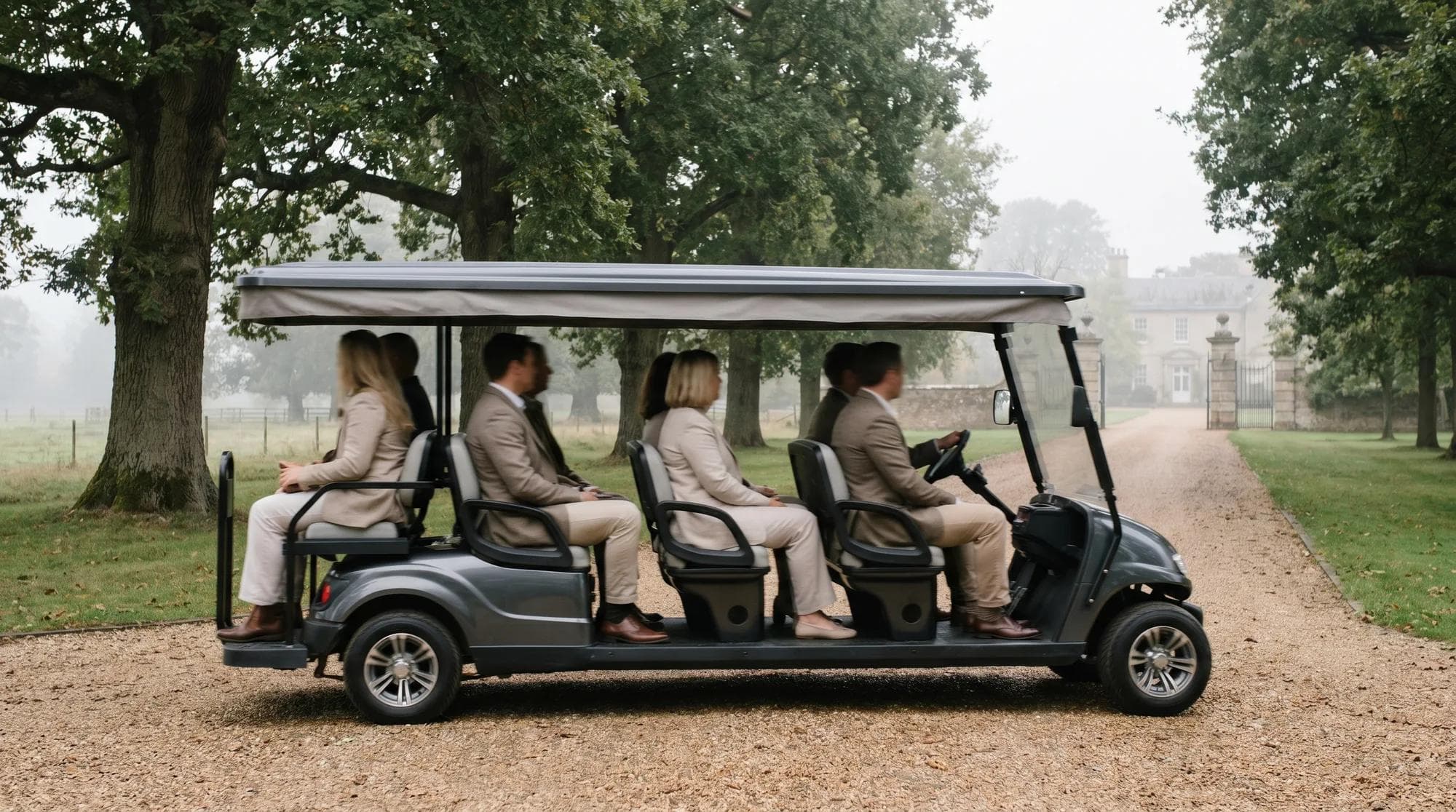
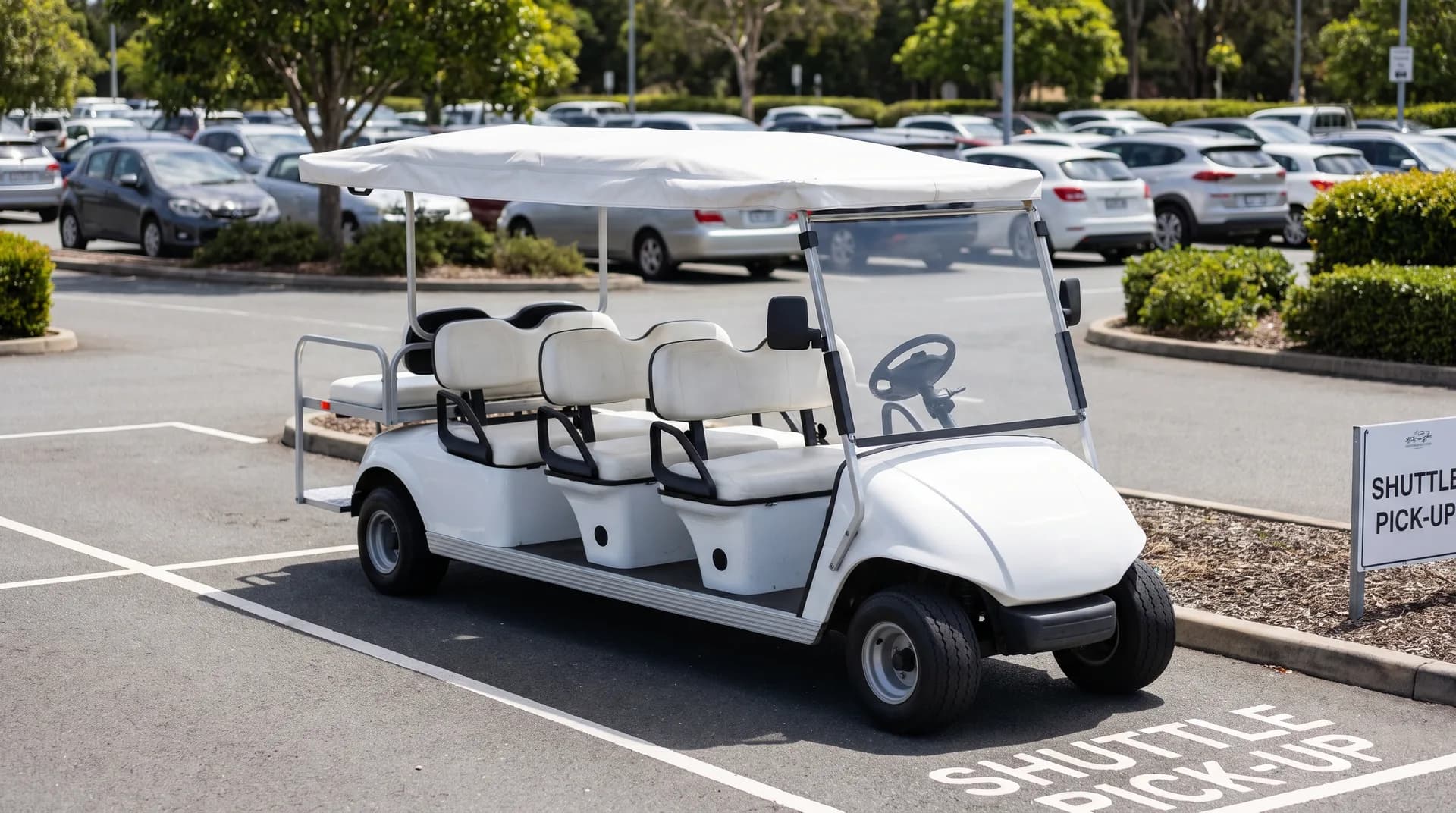
Start with boarding, because it decides more shuttle choices than any spec sheet. An eight-seat buggy sits low, with open sides and a flat floor, so passengers step on and off in seconds without climbing steps or negotiating a sliding door, which matters enormously for older guests, visitors with limited mobility and anyone carrying bags. Bench seating loads a full group in one movement rather than a queue through a single door. Then there is where it can go: a buggy threads paths, courtyards, gateways and lawns that a minibus cannot approach, so it delivers people to the door rather than to the nearest car park. It is near-silent, which guests notice at hotels, weddings and heritage sites, and it produces no exhaust among pedestrians. Running costs follow the electric pattern: pence per mile in electricity, no fuel runs, and far less to service than an engine and gearbox. Our 8-seater range shows the format, with the eight-seat S8 starting from £23,500.
8-seater buggy vs minibus: where the minibus wins
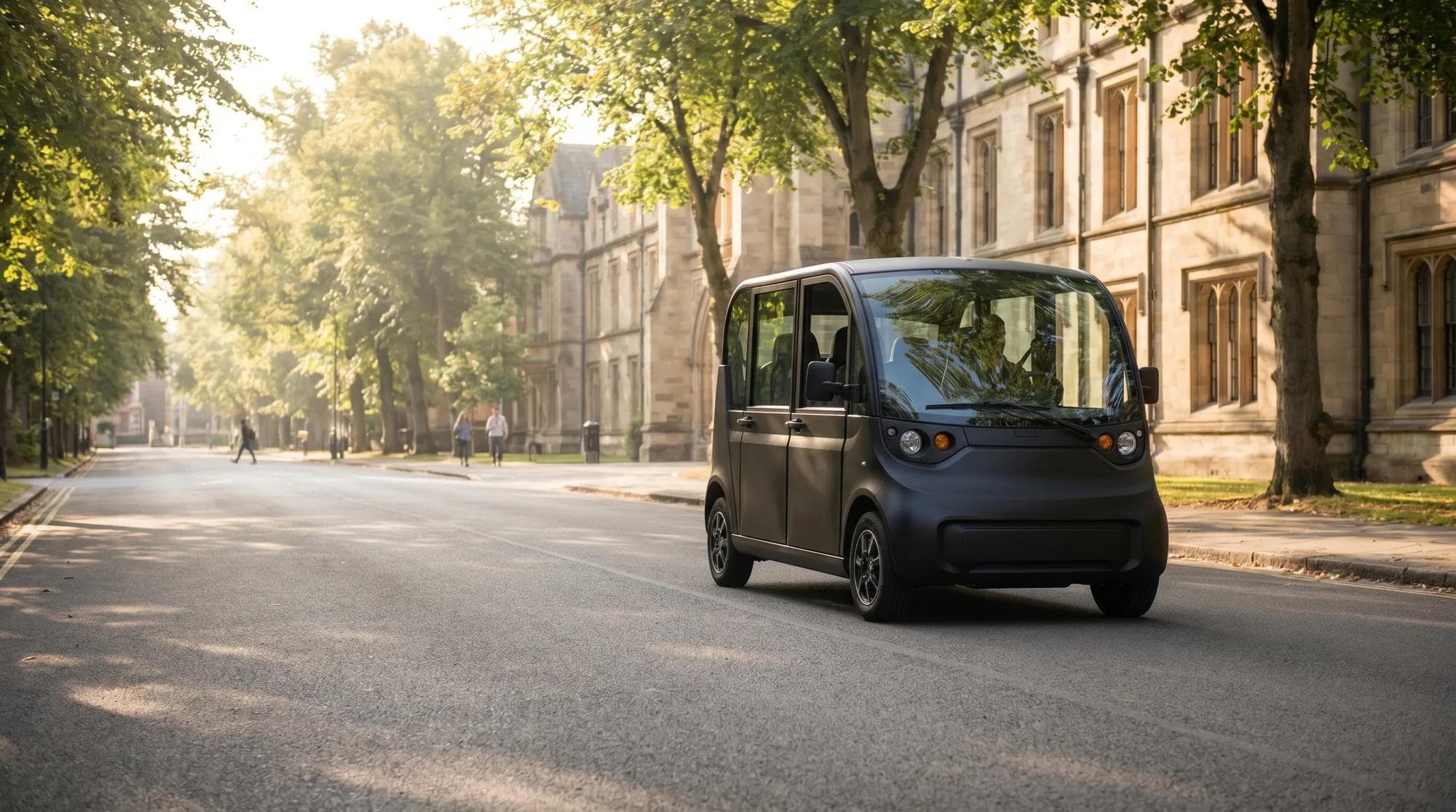
The minibus keeps three clear advantages. First, the public road: a licensed, registered minibus travels between sites, into town and down the motorway, and a standard buggy does not, so if your shuttle route leaves the estate the comparison is over. Second, distance and speed: for a run of several miles the minibus is quicker and more comfortable, where the buggy is built for short, frequent hops. Third, full enclosure: a minibus is warm and dry in January by default, while a buggy achieves weather protection through doors and enclosures that are effective but not the equal of a heated van interior in the depths of winter. Sites with a long exposed link road, or a genuine all-weather, all-season public shuttle obligation, often run one of each: the minibus for the road leg, buggies for everything inside the gates. Our people movers and shuttles guide covers how mixed shuttle operations are put together.
- 8-seat electric buggy
- Low, step-free, open sides
- Minibus
- Steps and a single sliding door
- 8-seat electric buggy
- Paths, courtyards, tight routes
- Minibus
- Roads and car parks only
- 8-seat electric buggy
- No, private land vehicle as standard
- Minibus
- Yes, registered and licensed
- 8-seat electric buggy
- Good with doors and enclosure
- Minibus
- Full, heated enclosure
- 8-seat electric buggy
- Pence per mile in electricity
- Minibus
- Fuel, servicing, MOT, road costs
- 8-seat electric buggy
- Near-silent, zero exhaust
- Minibus
- Engine noise and exhaust
- 8-seat electric buggy
- S8 from £23,500
- Minibus
- Varies widely, new or used
| 8-seat electric buggy | Minibus | |
|---|---|---|
| Boarding | Low, step-free, open sides | Steps and a single sliding door |
| Where it can go | Paths, courtyards, tight routes | Roads and car parks only |
| Public road use | No, private land vehicle as standard | Yes, registered and licensed |
| Weather protection | Good with doors and enclosure | Full, heated enclosure |
| Running costs | Pence per mile in electricity | Fuel, servicing, MOT, road costs |
| Noise and emissions on site | Near-silent, zero exhaust | Engine noise and exhaust |
| Typical from-price | S8 from £23,500 | Varies widely, new or used |
Licensing, drivers and the private-land question
On private land, the regulatory picture generally favours the buggy, though it deserves careful wording. A buggy operated entirely within a private site does not normally need registration, road tax or an MOT, and there is generally no statutory driving-licence requirement off the public road, although your insurer and your own policies will almost certainly impose one, and sensible operators require a full licence plus a site briefing regardless, our guide on whether you need a licence for a golf buggy covers the detail. A minibus brings the full road-vehicle apparatus, registration, MOT, road-legal insurance, and, depending on seats, use and who is paid to drive, potentially additional driver entitlements and operator requirements that need checking for your circumstances. None of this is a reason to avoid a minibus where the route genuinely needs one; it is a reason not to carry that overhead for a shuttle that never leaves the estate.
Deciding for your site
Draw the route before choosing the vehicle. If it stays inside the gates, runs short hops repeatedly, and serves guests who value easy boarding, the eight-seater is the natural fit, and two eight-seaters often beat one minibus by halving waits at peak times. If the route uses public roads or covers miles at a stretch, specify the minibus, or split the route and use both. Hiring an eight-seater for a trial period is an inexpensive way to test passenger reaction and timings on your own ground before committing either way.
Frequently asked questions
Is an 8-seater buggy a genuine minibus alternative?+
For shuttles that stay on private land, yes: easier boarding, lower running costs, access to paths a minibus cannot use, and simpler operation. It is not an alternative where the route uses public roads or covers long distances.
Do you need a driving licence to drive an 8-seater buggy on private land?+
There is generally no statutory requirement off the public road, but insurers and site policies almost always require a full licence and a briefing, and requiring both is good practice regardless.
How do running costs compare between a buggy and a minibus?+
The buggy charges from a standard socket at pence per mile in electricity and has no engine, gearbox or exhaust to service; the minibus carries fuel, servicing and road-vehicle costs. On short internal routes the gap is substantial.
What about winter weather?+
Doors and enclosures keep an eight-seater workable year-round, and passengers are aboard for minutes, not hours. For long exposed routes in hard weather, the minibus's heated cabin is a real advantage.
How many 8-seaters replace one minibus?+
On seat count alone, roughly two. In practice one eight-seater running a short loop frequently often moves more people per hour than a larger vehicle making longer round trips, so start from the route timings, not the seat totals.
Price an 8-seater for your shuttle route
Tell us the route, the passengers and the hours it must run, and we will recommend the right shuttle configuration and price it to your specification.
Ready to find the right buggy?
Tell us how and where it will work and we will specify a vehicle and a tailored quote built around you. Every build comes with a 3-year warranty and a 24-hour priority call-out.
Our guides are written and reviewed by the Hawke Electric Vehicles team, the people who specify, build, deliver and support the vehicles. We focus on honest, practical advice and flag where a figure depends on the build rather than guessing.
More guides by Hawke