UAE logistics operates at a scale that makes walking a productivity drain. A distribution centre in Jebel Ali, a warehouse complex in Dubai South or a yard in a free zone can stretch hundreds of metres end to end. Every time a supervisor, a picker or a maintenance team crosses that distance on foot, minutes evaporate and, in summer, so does their energy. Electric personnel carriers and utility buggies turn those crossings into a quick, comfortable ride, indoors and across the yard.
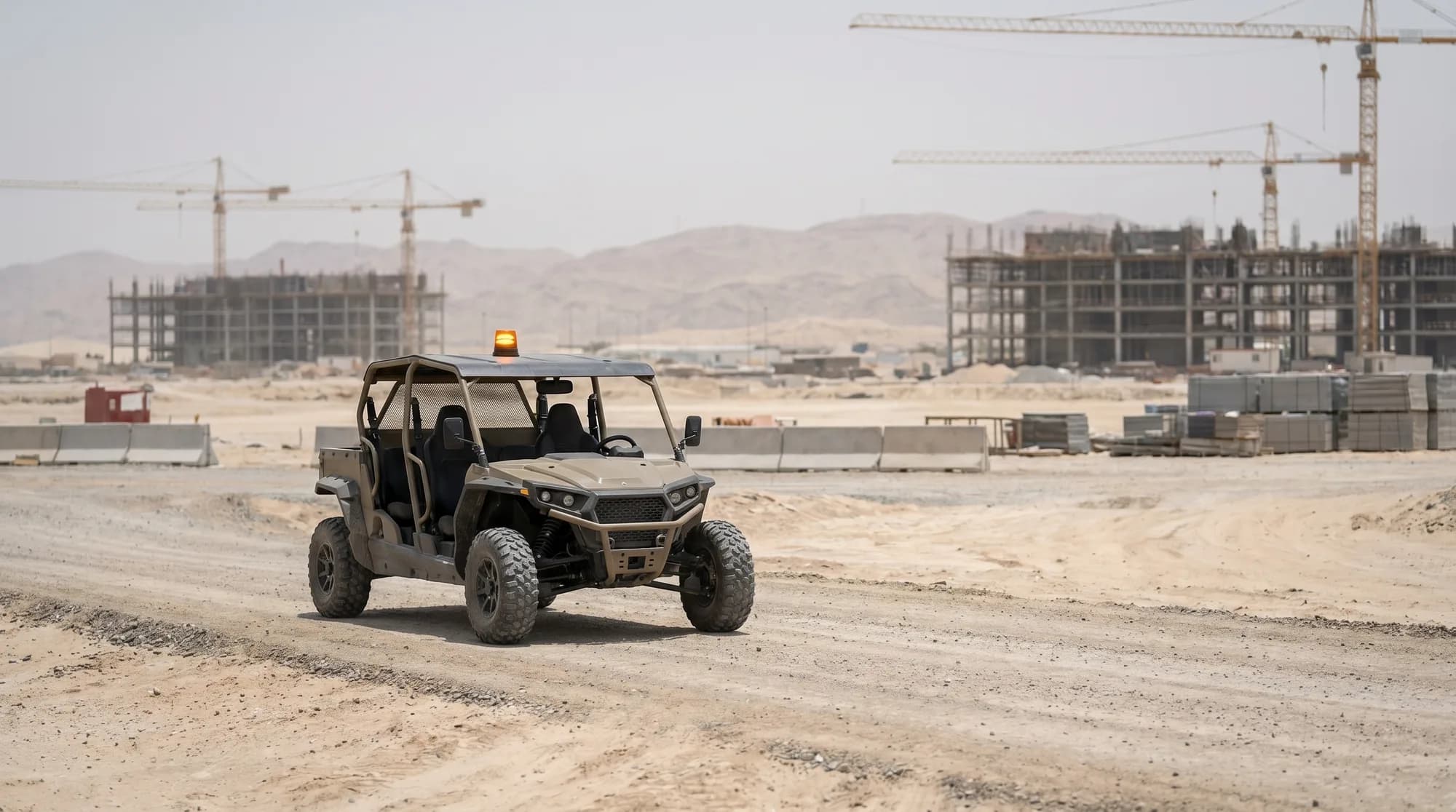
In free zones such as JAFZA and the DWC logistics district, buggies are a familiar sight precisely because they pay back. They move staff between offices and warehouse bays, carry tools and small loads to where they are needed, and keep teams productive across sites that are simply too large to work efficiently on foot. The same logic drives buggy use on construction and industrial sites and airside at UAE airports.
- On large logistics sites a buggy recovers wasted walking time fast, which is where the return on investment really comes from.
- Match the vehicle to the job: personnel carriers for moving teams, utility buggies with a bed for tools and light loads.
- Safety governs indoor and yard use: speed control, visibility, audible warning and clear segregation from forklifts and trucks.
- Electric is the right fit for indoor logistics because it produces no exhaust fumes in enclosed warehouse air.
- Charging strategy keeps a multi-shift operation moving: opportunity charging plus lithium recovery between shifts.
- Confirm site safety rules, permitted routes and free-zone requirements with the operator before you deploy.
Where buggies earn their place in logistics
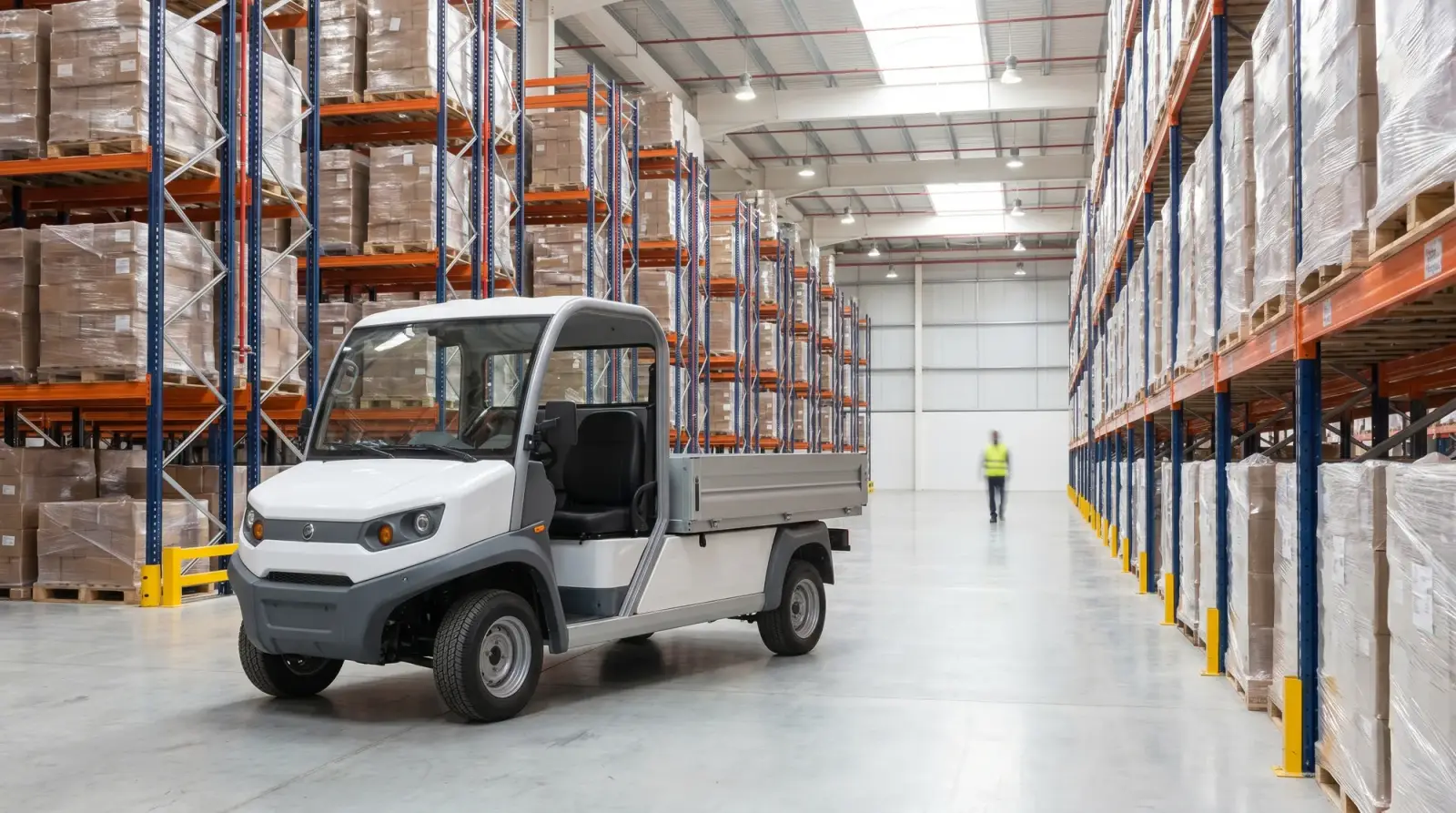
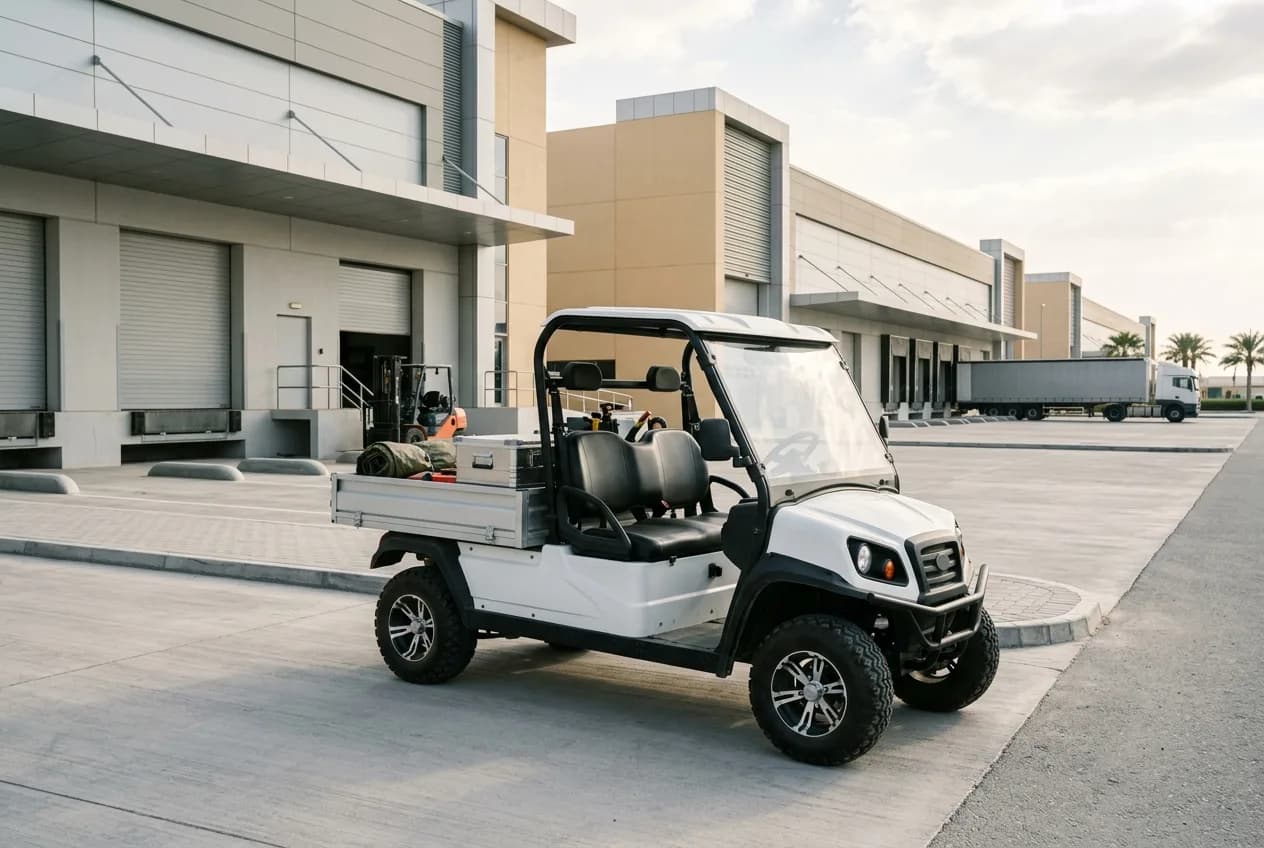
The clearest win is staff movement. Supervisors covering a large floor, teams reporting between bays, and visitors being escorted across a site all lose time on foot. A personnel carrier collapses those minutes into seconds and keeps people fresher across a shift, which matters in the heat. The second win is light material movement: a utility buggy with a cargo bed carries tools, parts, samples and small consignments that do not justify a forklift but still need moving.
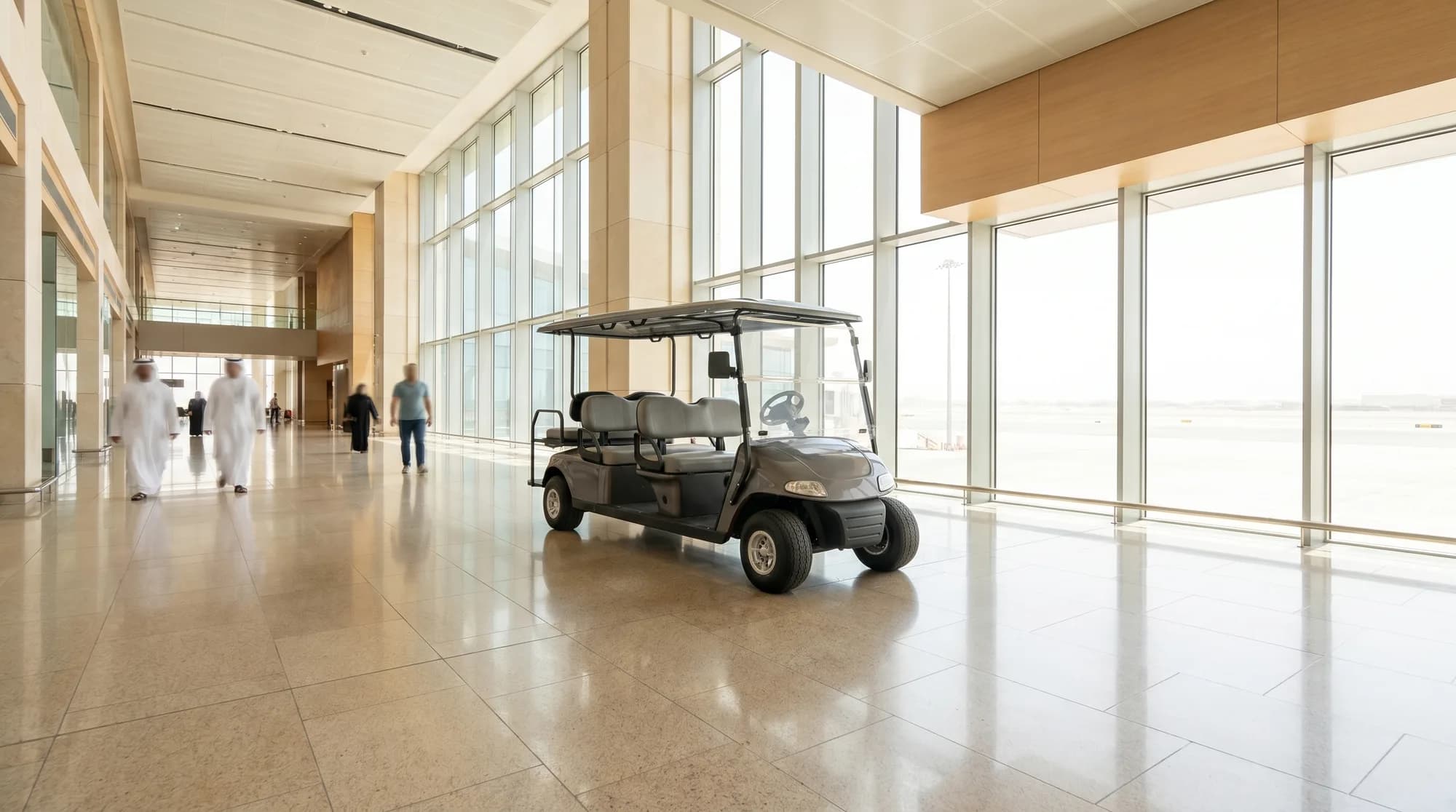
Across a free-zone campus, buggies also link buildings: the office, the warehouse, the gatehouse and the canteen. That is the same logic that drives broader site transport, explored in golf carts for facilities management in the UAE.
- Best vehicle
- Personnel carrier
- Why
- Seats several staff for quick internal transfers
- Best vehicle
- Utility buggy with cargo bed
- Why
- Moves parts and consignments too small for a forklift
- Best vehicle
- Multi-seat passenger buggy
- Why
- Comfortable, controlled movement across a large site
| Best vehicle | Why | |
|---|---|---|
| Moving supervisors and teams | Personnel carrier | Seats several staff for quick internal transfers |
| Carrying tools and light loads | Utility buggy with cargo bed | Moves parts and consignments too small for a forklift |
| Escorting visitors and contractors | Multi-seat passenger buggy | Comfortable, controlled movement across a large site |
Safety in a shared working environment
A warehouse is a busy, hazardous environment shared with forklifts, pedestrians and heavy goods vehicles. A buggy has to fit that safety culture, not undermine it. That means controlled speed, clear all-round visibility, lights and an audible warning, seatbelts where fitted, and disciplined use of marked routes that keep buggies separated from forklift traffic and pedestrian crossings.
- Speed limiting appropriate to indoor and yard use.
- Lights, reflectors and an audible warning for shared aisles.
- Seatbelts and stable handling for the loads carried.
- Clear operating rules: trained drivers and marked, segregated routes.
Why electric suits indoor logistics
Indoors, electric is not just preferable, it is close to essential. A petrol or diesel buggy fills enclosed warehouse air with exhaust, which is a health and ventilation problem the moment doors are closed against the heat. An electric buggy produces no tailpipe emissions, runs quietly so it does not add to a noisy floor, and needs far less maintenance, which keeps it available rather than in the workshop.
Quiet, clean and low-maintenance is exactly the profile a logistics operation wants: a vehicle that turns up, does the work and disappears into the background of a smooth-running site. The lower noise also matters for staff wellbeing across a long shift, and the absence of fumes removes a ventilation headache that diesel and petrol carriers force on any enclosed operation in the Gulf, where doors stay shut against the heat for much of the year.
Floor surfaces, ramps and turning
A warehouse buggy spends its life on polished concrete, over expansion joints, up loading ramps and around tight racking corners. That favours good low-speed control, tyres that grip a sealed floor without marking it, and a turning circle tight enough to work the aisles a forklift uses. Get this wrong and the buggy becomes the vehicle nobody wants to drive in the busy zones, which quietly defeats the point of buying it. Get it right and it threads the same routes as the rest of the materials-handling fleet without drama.
Load security is the other detail worth specifying. A utility buggy carrying tools and small consignments needs a bed that holds its load over ramps and emergency stops, with simple restraint points so nothing slides or falls into a busy aisle. It is a small thing on the spec sheet and a large thing on the floor, where a dropped load is both a safety incident and a delay.
Charging across multiple shifts
Many logistics operations run long or multiple shifts, so a buggy that needs a long off-shift charge is a liability. The practical approach is opportunity charging, plugging in during natural breaks, combined with lithium packs that recover quickly and tolerate frequent partial charging without damage. Place charge points where buggies naturally pause so topping up is automatic rather than a chore.
- 01
Map the natural pauses
Identify where buggies idle during a shift and place charge points there so topping up needs no detour.
- 02
Opportunity charge in breaks
Plug in during shift handovers and quiet spells rather than waiting for a single long charge.
- 03
Run a rotation
Stagger charging so the fleet is never all unavailable at once during a busy period.
- 04
Specify lithium
Choose packs that recover quickly and tolerate frequent partial charges for multi-shift work.
Total cost of ownership
The investment case for a logistics buggy is straightforward: it converts wasted walking time into productive time, with low running costs and minimal maintenance. Electric power means no fuel bills and few moving parts to fail, and a well-built buggy survives years of hard indoor and yard use. Judge it on recovered productivity and uptime, not the purchase price alone. For indicative figures see how much a golf cart costs in the UAE, and price your configuration via /request-a-quote.
Specify a logistics buggy fleet
Tell us your site size, shift pattern and tasks, and we will configure personnel carriers and utility buggies with current indicative pricing in AED.
Frequently asked questions
Are golf buggies allowed inside UAE free zones like JAFZA?+
They are widely used, but each free zone and operator sets its own site safety and traffic rules. Confirm permitted vehicles, routes, speed limits and driver requirements with the operator and free-zone authority before deployment.
Should logistics buggies be electric or petrol?+
Electric, especially indoors. A petrol buggy fills enclosed warehouse air with exhaust, while an electric one produces no tailpipe emissions, runs quietly and needs far less maintenance, keeping it available.
What is the difference between a personnel carrier and a utility buggy?+
A personnel carrier is built to seat several staff for internal transfers, while a utility buggy has a cargo bed for tools, parts and light loads too small to justify a forklift. Many sites run a mix of both.
How do you keep buggies charged across multiple shifts?+
With opportunity charging during natural breaks and lithium packs that recover quickly and tolerate frequent partial charging. Place charge points where buggies naturally pause and run a staggered rotation.
How do buggies stay safe around forklifts and pedestrians?+
Through speed limiting, good visibility, lights and audible warning, trained drivers and disciplined use of marked, segregated routes that keep buggies clear of forklift traffic and pedestrian crossings.
Related solutions
Ready to explore what we build?
See the vehicles and the setting this applies to, or get a tailored quote built around your site.

Ready to find the right buggy?
Tell us how and where it will work and we will specify a vehicle and a tailored quote built around you. Every build comes with a 3-year warranty and a 24-hour priority call-out.
Our guides are written and reviewed by the Hawke Electric Vehicles team, the people who specify, build, deliver and support the vehicles. We focus on honest, practical advice and flag where a figure depends on the build rather than guessing.
More guides by Hawke