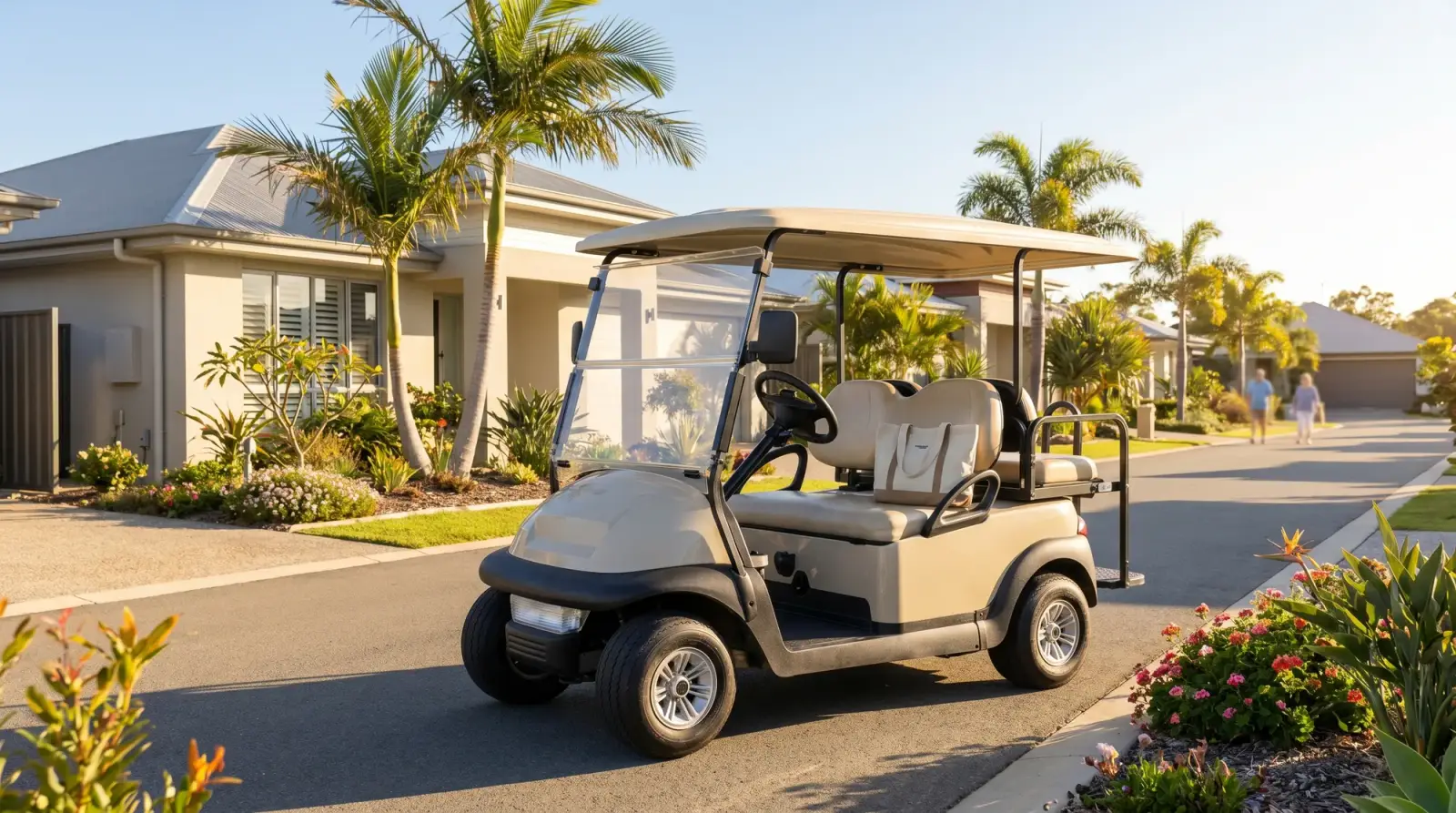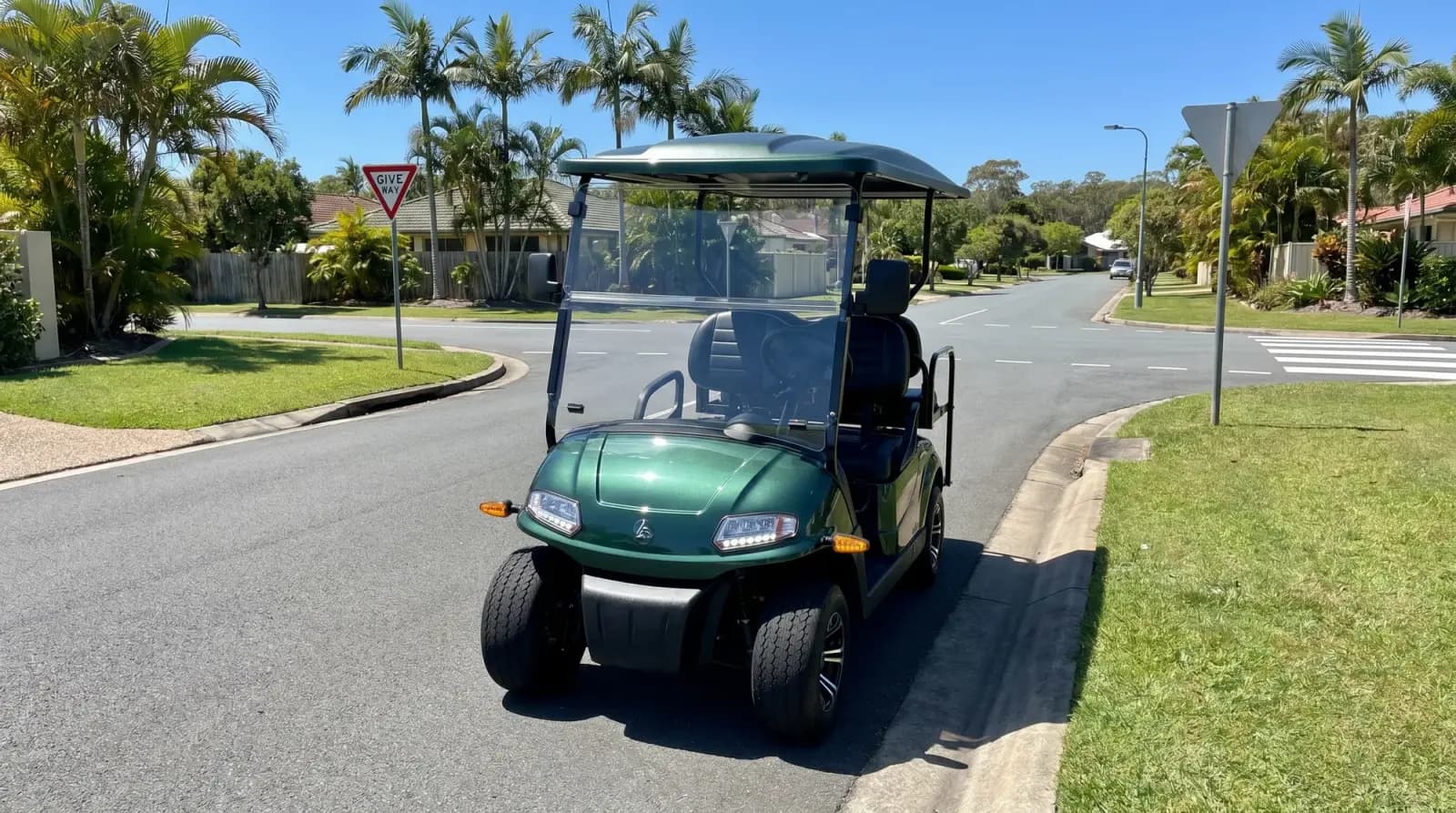
- There is no national street-legal golf cart category. Whether one can be registered for road use depends on your state, territory and often your council.
- Where on-road use is allowed at all, it is usually under a specific exemption or approved local-area scheme, not a blanket right.
- A cart approved for any road use typically needs lights, indicators, mirrors and a compliant set-up.
- Most carts in Australia are used on private land, which avoids the registration question entirely.
- Always confirm classification and requirements with your state transport authority and council before assuming.
Can a golf cart be made street legal and registered in Australia? Honestly, it depends, and the safe default is no unless you confirm otherwise. There is no single national category for a road-legal golf cart. Whether one can be registered or used on a road is set by your state or territory, and often your council, usually through a specific exemption or an approved local-area scheme rather than a blanket right. This guide explains how classification works, what equipment a road-going cart typically needs, and exactly how to check.
Why street-legal is not a simple yes
Australia regulates vehicles state by state. A standard golf cart is generally treated as an off-road vehicle, not designed or approved for ordinary road use. To use one on a road you need a specific legal pathway: an exemption, a registration category that fits, or an approved precinct where local use is permitted. Those exist in some places and not others, and the conditions vary, so a blanket claim that a cart is street legal anywhere in Australia would be misleading.
How classification works
When you ask about road use, you are really asking three questions, and all three are answered locally.
- Vehicle category: how your state classifies the cart and whether a road-going category fits.
- Registration or exemption: whether it can be registered, or used under a specific exemption or approved area.
- Conditions: speed limits, which roads, lighting, insurance and driver licence requirements that apply.
Our companion piece, the road rules by state guide, gives the state-by-state overview to read alongside this.
Equipment a road-going cart usually needs
Where on-road use is permitted, the cart almost always needs to be properly equipped. It is far better to build this in from the start than to retrofit.
- Why it matters
- Visibility and legal requirement for road use
- Why it matters
- Signalling turns on shared roads
- Why it matters
- Awareness of other traffic
- Why it matters
- Many schemes cap speed for local use
- Why it matters
- Commonly required for road-permitted use
| Item | Why it matters |
|---|---|
| Headlights and tail lights | Visibility and legal requirement for road use |
| Indicators | Signalling turns on shared roads |
| Mirrors | Awareness of other traffic |
| Compliant speed set-up | Many schemes cap speed for local use |
| Seatbelts and horn | Commonly required for road-permitted use |
Because our carts are built to order, you can specify lighting and road-relevant equipment once you confirm what your area requires. See the range for the base vehicles.
How to check for your area
- 01
Define your exact route
Note the specific roads or crossings. The answer often depends on the individual road and its speed limit.
- 02
Call your council
Ask whether an approved golf cart area or local permit scheme covers your route, and the conditions.
- 03
Check your state transport authority
Confirm the vehicle category, any registration or exemption, insurance, lighting and licence requirements.
- 04
Specify the cart to match
Build in the lights, indicators, mirrors and speed set-up your confirmed rules require.
Need a cart specified for confirmed road use?
Once you have confirmed your local rules, tell us the equipment required and we will build the cart to match, with everything confirmed on a tailored quote.
Insurance, licensing and liability
Equipment is only part of the picture. Any road-permitted use also raises questions of insurance, driver licensing and liability, and these too are set locally. For private-land use, the considerations are usually simpler, but for any public-road use you should expect to confirm several things before you drive.
- Insurance: what cover is required, and what your provider offers for a road-permitted cart.
- Driver licence: whether a licence is needed and which class, set by your state.
- Permitted drivers and passengers: any age or seating conditions in the local scheme.
- Liability: who is responsible in the event of an incident on a public road.
None of this should put you off if your area genuinely supports road use, but it is far better to confirm it all in advance than to discover a gap later. Treat insurance and licensing as part of the same check as registration and equipment.
Why most people skip the road question
The simplest path is to use the cart where road registration does not apply: private land, golf courses, resorts, farms, and the internal roads of lifestyle and retirement villages. That is where the vast majority of carts in Australia are used, and it avoids the registration question entirely. If a village setting is your situation, see our lifestyle and retirement villages guide. For more, browse our guides.
Frequently asked questions
Can I register a golf cart for the road in Australia?+
It depends entirely on your state, territory and council. There is no national street-legal category. Some areas allow registration or local use under a specific exemption or approved scheme, but it is never automatic. Confirm locally first.
What makes a golf cart street legal?+
Where on-road use is permitted, the cart typically needs lights, indicators, mirrors, a compliant speed set-up and other equipment, plus the right registration or exemption. The exact list is set by your state and council.
Is a golf cart legal on the road in Queensland?+
Some Queensland communities have approved golf cart precincts where local road use is permitted under conditions. That applies only inside the approved area and under the stated rules, so confirm the specifics with the council.
Can you supply a street-legal cart?+
We build carts to order and can specify lighting and road-relevant equipment. But whether a cart is legal on your roads is decided by your state and council, so you must confirm the rules locally and we build to match.
Do I need a driver licence to use one?+
For private land use, generally no. For any road-permitted use, a licence and insurance are commonly required, set by your state transport authority. Confirm before you assume.
Related solutions
Ready to explore what we build?
See the vehicles and the setting this applies to, or get a tailored quote built around your site.
Ready to find the right buggy?
Tell us how and where it will work and we will specify a vehicle and a tailored quote built around you. Every build comes with a 3-year warranty and a 24-hour priority call-out.
Our guides are written and reviewed by the Hawke Electric Vehicles team, the people who specify, build, deliver and support the vehicles. We focus on honest, practical advice and flag where a figure depends on the build rather than guessing.
More guides by Hawke