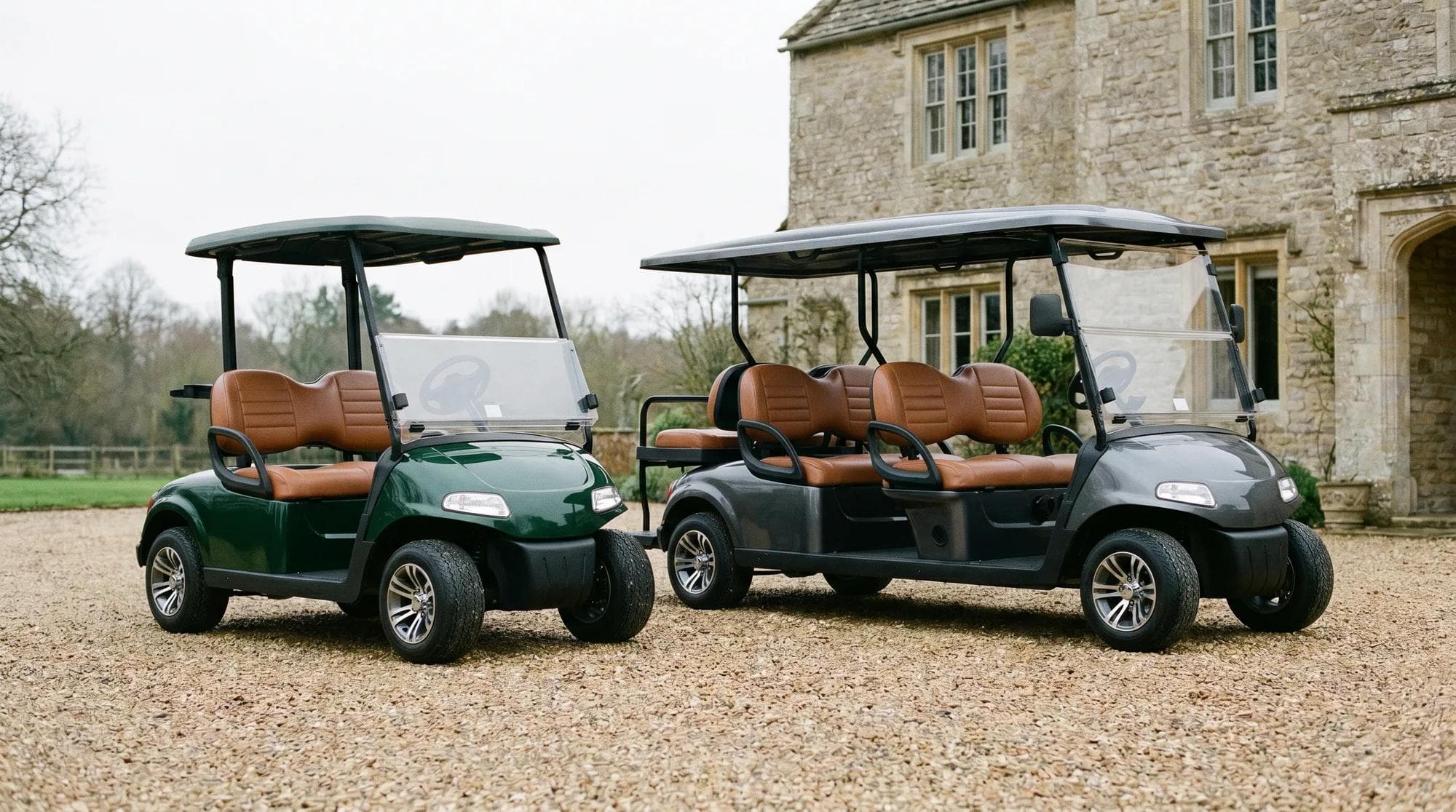
A typical 2-seater golf buggy is roughly 2.3 to 2.4 metres long, 1.2 metres wide and 1.75 to 1.9 metres tall with the roof on, weighing somewhere between 270 and 450kg. That width is the number to write down. It means a buggy fits through a single garage door and a farm gate with room to spare, but it will not go through a standard garden side gate, which is usually only 0.9 to 1 metre wide.
Longer buggies scale in one direction only. A 4-seater stretches to around 2.8 to 3.4 metres and a 6-seater to 3.6 to 4 metres, but widths stay close to that same 1.2 to 1.4 metre band because buggies are built to share cart paths. So the access question is usually settled by width and height, and the storage question by length. This guide gives you the typical numbers, the standard UK openings to measure against, and the trailer and weight facts people forget until moving day.
- Width is the critical dimension: most buggies are 1.2 to 1.4m wide regardless of seat count.
- A standard UK single garage door is about 2.13m wide, so a buggy fits with care. A garden side gate at 0.9 to 1m will not work.
- Length is what grows with seats: roughly 2.4m for a 2-seater, 2.8 to 3.4m for a 4-seater, 3.6 to 4m for a 6-seater.
- Height with roof is typically 1.75 to 1.9m, fine under a standard 2m-plus garage opening but worth checking on older outbuildings.
- Weights run from about 270kg to 450kg and beyond for a 2-seater, which matters for trailers, ramps and mezzanine floors.
How big is a golf buggy, exactly?
There's no single answer because there's no single buggy, but the market clusters tightly. The table below gives typical dimensions by seat count. Treat these as a planning guide, not gospel: specs vary by model, lifted off-road versions run taller and wider, and cargo beds add length. For exact figures on a specific machine, check the manufacturer's spec sheet, and you'll find precise dimensions for every Hawke model on our range pages.
- Length
- 2.3-2.4m
- Width
- 1.2m
- Height (with roof)
- 1.75-1.9m
- Weight
- 270-450kg
- Length
- 2.8-3.4m
- Width
- 1.2-1.4m
- Height (with roof)
- 1.8-2.0m
- Weight
- 400-600kg
- Length
- 3.6-4.0m
- Width
- 1.2-1.4m
- Height (with roof)
- 1.8-2.0m
- Weight
- 550-800kg
| Length | Width | Height (with roof) | Weight | |
|---|---|---|---|---|
| 2-seater | 2.3-2.4m | 1.2m | 1.75-1.9m | 270-450kg |
| 4-seater | 2.8-3.4m | 1.2-1.4m | 1.8-2.0m | 400-600kg |
| 6-seater | 3.6-4.0m | 1.2-1.4m | 1.8-2.0m | 550-800kg |
Note how the width column barely moves. That's deliberate design: buggies of every length are meant to pass each other on a cart path and thread the same pinch points. It's also good news for you, because once your gate or door clears 1.4 metres, you can choose seat count on need rather than access. Choosing on need is its own question, and our guide to what size golf buggy you need tackles it properly.
Will it fit through your gate or garage door?
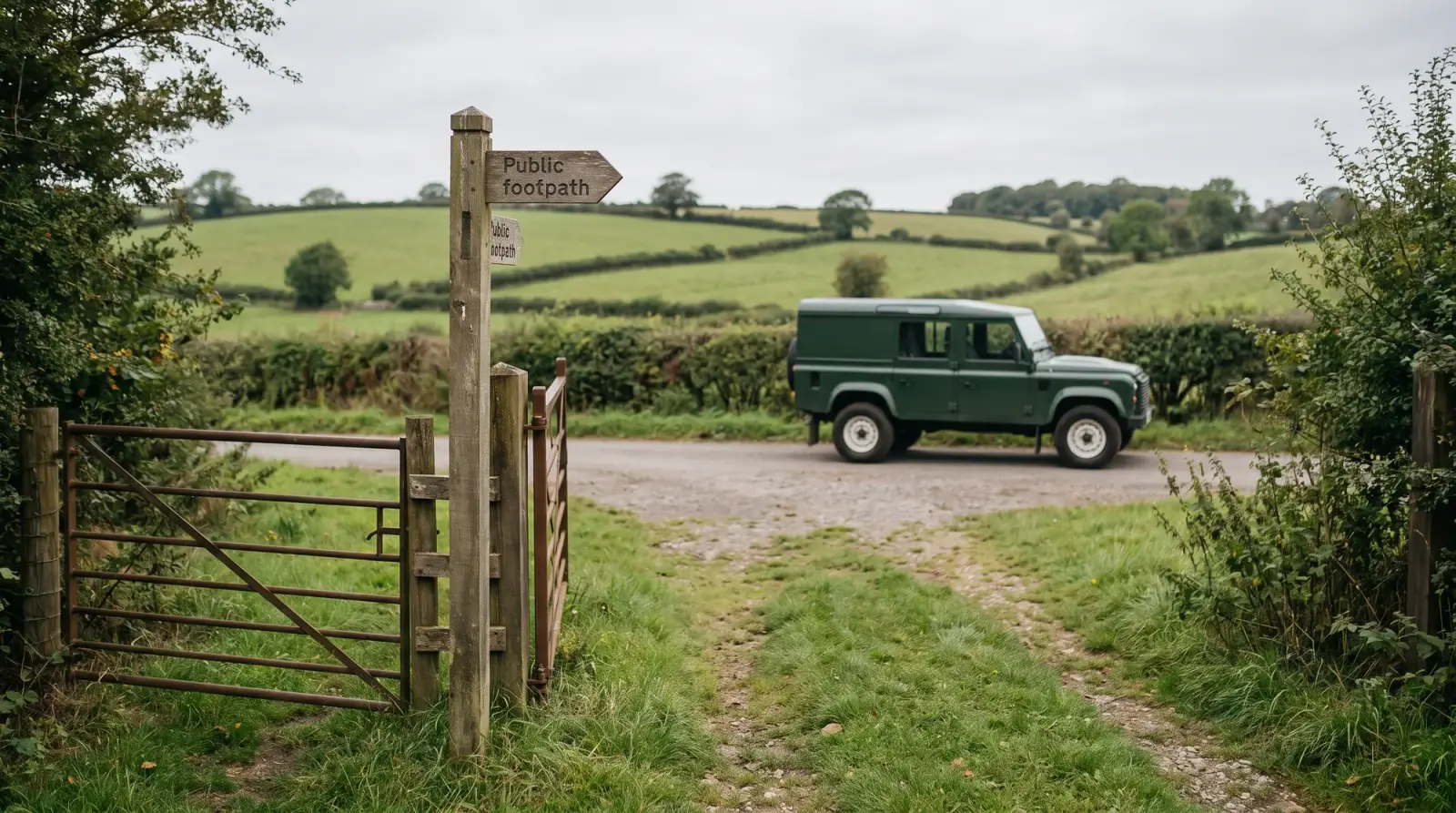
Here are the standard UK openings to measure against. A standard single garage door is about 2.13m (7ft) wide, which gives you 40 to 90cm of clearance over a buggy's width: enough, but mirrors and a confident line matter. A standard field gate is 3.6m, so farm and estate access is a non-issue. The heartbreaker is the garden side gate at 0.9 to 1 metre. No standard buggy fits, and no, taking the wheels off doesn't help. If the only route to your back garden is a side gate, the buggy lives out front or in an outbuilding, and it's better to know that before delivery day.
Height catches people less often but more expensively. A modern garage opening is usually a touch over 2 metres, clearing a 1.75 to 1.9m roof comfortably. Older outbuildings, stable doors and barn lintels on period properties can dip below 1.8m, so measure the lowest point of the opening, not the average. Remember the driver's head sits below the roof line, so the roof is your governing height. Some models let you remove the canopy for a one-off tight squeeze, but you won't want to do it weekly.
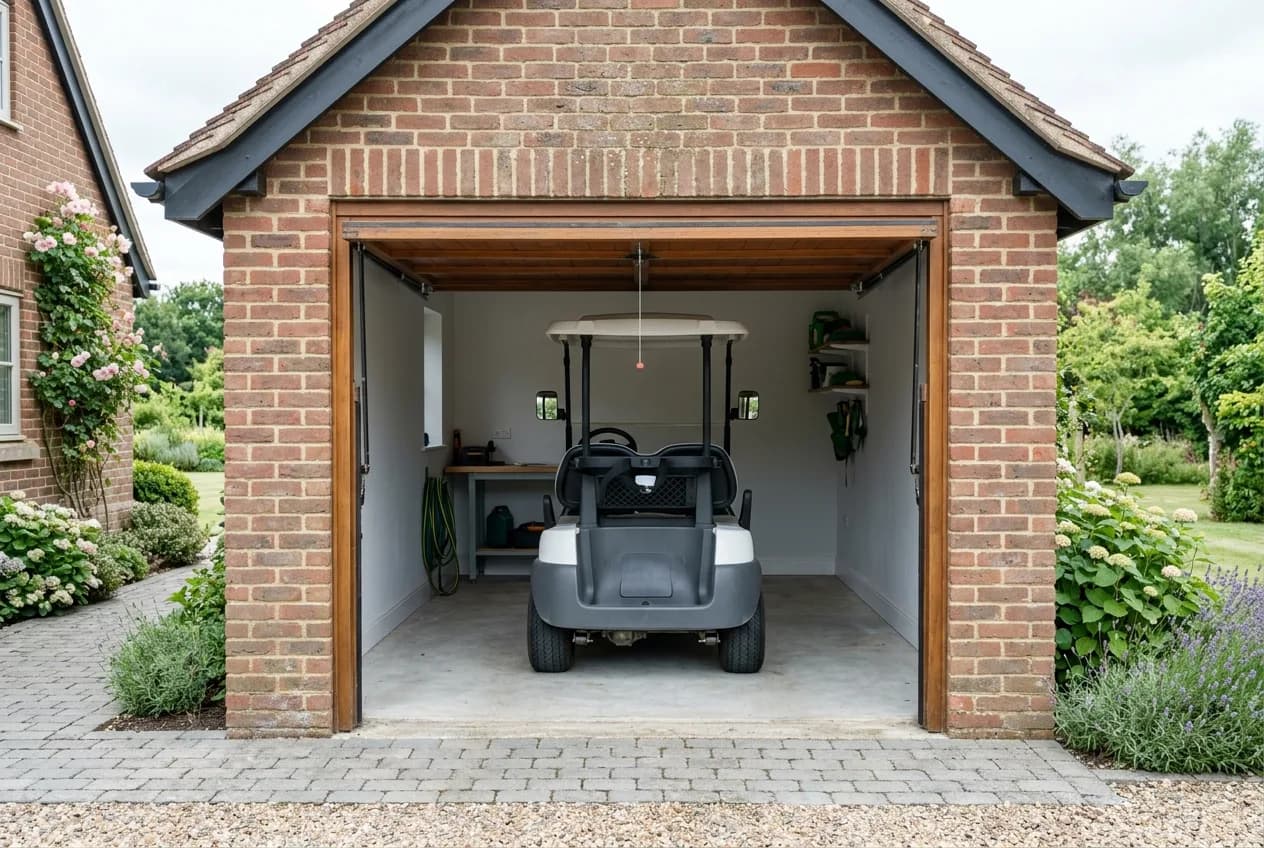
Garage storage: length and turning space
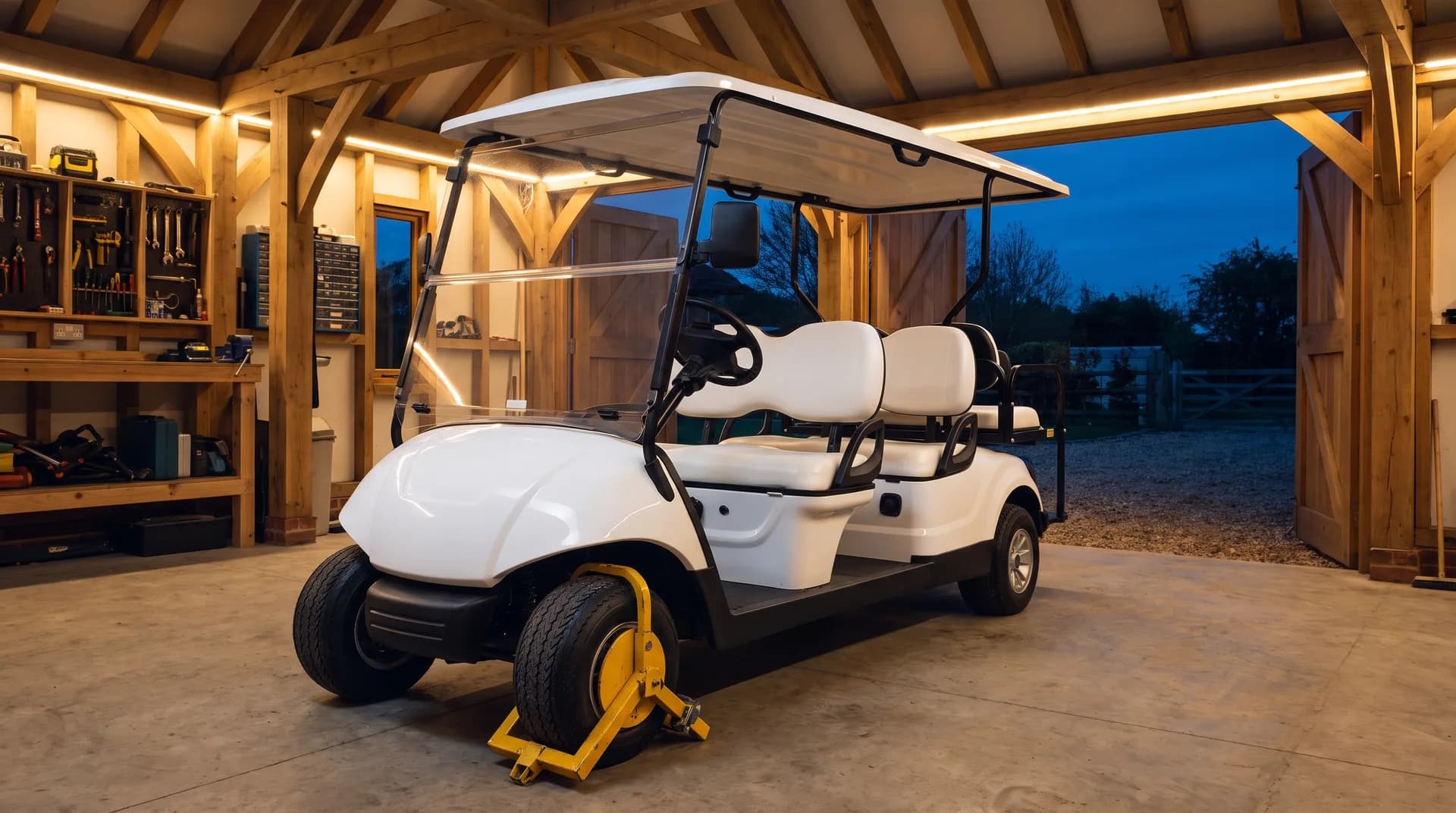
A standard UK single garage runs about 4.8 to 5 metres deep by 2.4 to 2.7 metres wide internally. A 2-seater at 2.4m long uses half the depth, leaving room for a workbench and the charger, which is the ideal arrangement. A 4-seater fits too, though at 3.4m it starts to dominate the space. A 6-seater is a squeeze in depth and usually ends up in a barn or car port instead. Whichever size you run, plan for a socket by the parking spot; our guide to buggy storage and security covers the rest of the setup, from locks to trickle charging.
Turning space is the dimension nobody measures until they're stuck. Typical buggies turn in a 3 to 4 metre circle, tight for their size, but reversing a buggy out of a single garage across a narrow drive still takes a three-point shuffle. If your approach is tight, walk the route with a tape measure before you buy, checking the swing at the tightest corner rather than the width of the straight bits.
Will it fit on a trailer?
A 2-seater buggy suits a typical 2.5 by 1.5 metre (or larger) trailer with a decent margin. The numbers to check are weights rather than dimensions. A 350kg buggy on a 250kg trailer is a 600kg gross load, well within an unbraked trailer's 750kg legal limit, but a 450kg buggy plus trailer and straps starts brushing against it, and 4-seaters generally need a braked trailer. Check your car's towing capacity and the trailer's plated maximum authorised mass, and load the buggy handbrake-on with ratchet straps at four points.
How heavy is a golf buggy in practice?
For a 2-seater, roughly 270 to 450kg depending on battery type and build, with lead-acid packs accounting for a surprising slice of that (a full set of lead-acid batteries can weigh over 100kg, which is why lithium models come in lighter). The weight matters in three places: trailer maths, as above; ramps, which need to be rated for the load with a margin; and floors. A timber mezzanine or old suspended floor that happily holds boxes may not appreciate half a tonne on four small contact patches. Solid concrete is the right answer for storage, and it's what most garages and barns already offer.
Frequently asked questions
How wide is a golf buggy?+
Typically 1.2 metres for a 2-seater and up to about 1.4 metres for larger or lifted models. Width barely changes with seat count, so it's the one dimension you can rely on when checking gates and doorways.
Will a golf buggy fit through a standard gate?+
Through a 3.6m field gate, easily. Through a standard garden side gate of 0.9 to 1 metre, no. Standard buggies are about 1.2m wide, so side-gate access rules out getting one into most back gardens.
Will a golf buggy fit in a single garage?+
Yes. A standard UK single garage door is about 2.13m wide and the garage 4.8m or more deep, so a 2-seater fits with room for a charger and bench. A 4-seater fits too but fills more of the depth.
How long is a 4-seater golf buggy?+
Typically 2.8 to 3.4 metres, depending on the model and whether the rear seats fold to a cargo deck. Six-seaters stretch to roughly 3.6 to 4 metres.
How heavy is a golf buggy?+
As a rough guide, 270 to 450kg for a 2-seater, 400 to 600kg for a 4-seater and up to 800kg for a 6-seater. Lithium models sit at the lighter end because lead-acid packs alone can exceed 100kg.
Before you shortlist a single model, walk the buggy's future route with a tape measure and write down three numbers: the narrowest opening, the lowest lintel and the parking bay's depth. If those read 1.5m, 2m and 3m or better, nearly any 2 or 4-seater will live happily at yours, and you can choose on comfort and spec instead of geometry. Exact dimensions for every model in our line-up are listed on the product pages.
Check exact specs, model by model
Every Hawke buggy's length, width, height and weight is listed on its product page, so you can match a model to your measurements before you request a quote.
Related solutions
Ready to explore what we build?
See the vehicles and the setting this applies to, or get a tailored quote built around your site.

Ready to find the right buggy?
Tell us how and where it will work and we will specify a vehicle and a tailored quote built around you. Every build comes with a 3-year warranty and a 24-hour priority call-out.
Our guides are written and reviewed by the Hawke Electric Vehicles team, the people who specify, build, deliver and support the vehicles. We focus on honest, practical advice and flag where a figure depends on the build rather than guessing.
More guides by Hawke