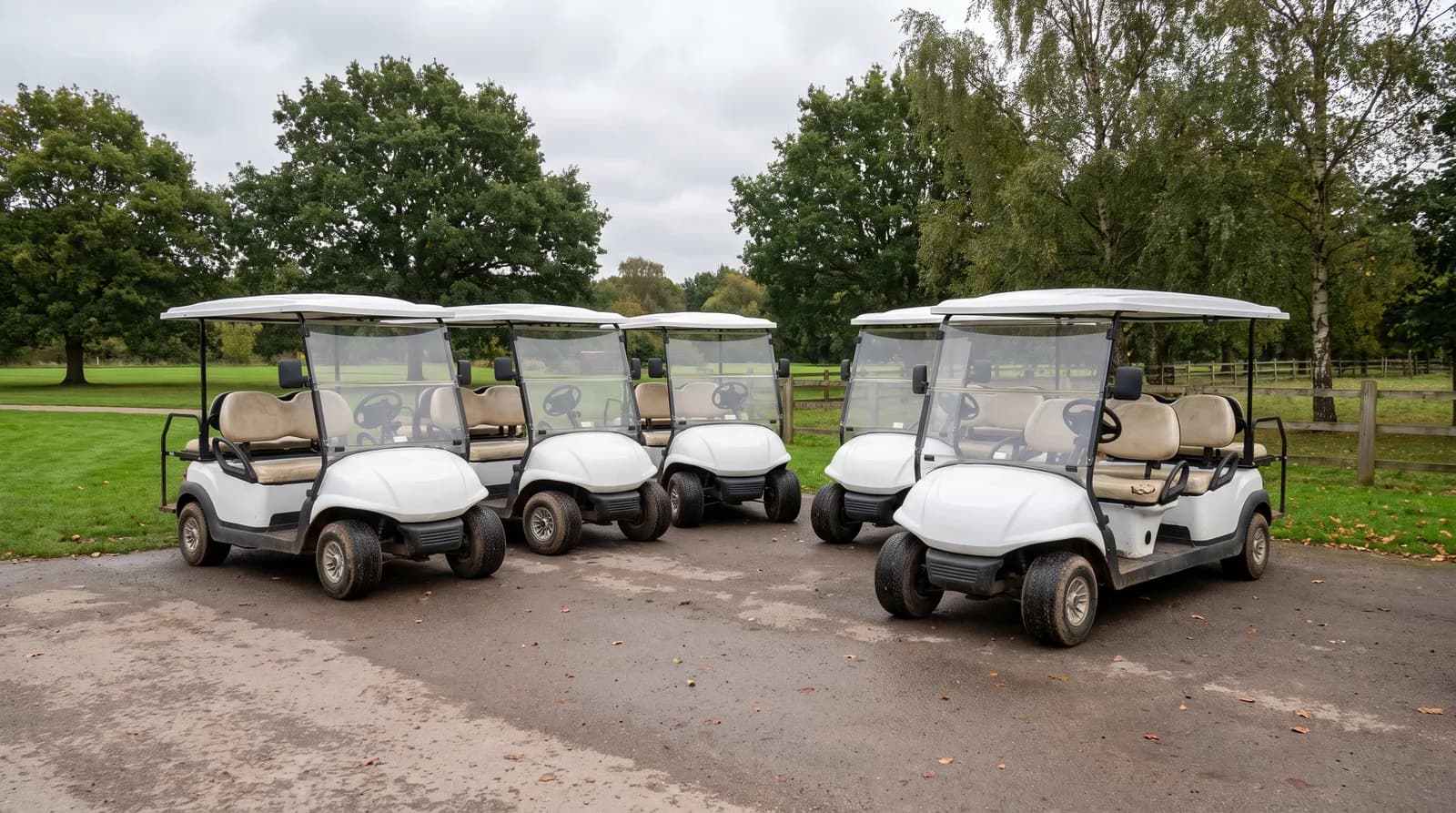
- There is no universal ratio of buggies per visitor. The right number falls out of your own peak arrivals, loop length and round-trip time.
- Size for the busiest realistic hour, not the daily average, because that is when a fleet either copes or fails.
- The core sum is simple: peak passengers to move, divided by what one vehicle clears in that period.
- Round-trip time, including loading, drives the answer as much as seat count does, and it is the figure people most often guess wrong.
- Add a sensible spare margin for breakdowns, charging and worse-than-expected peaks, then validate the plan against a real busy day.
Ask how many buggies an attraction needs and the honest first answer is: it depends. Anyone who quotes you a tidy ratio of vehicles per thousand visitors is guessing, because the real driver is not visitor numbers at all. It is how many people need to move at the busiest moment, how far they are going, and how long the round trip takes. Get those three figures and the fleet size is mostly arithmetic.
This guide sets out a planning method you can run yourself on the back of an envelope, before you talk to anyone about vehicles. It will not replace a proper survey of your site, but it will get you to a sensible ballpark and stop you over-ordering or, worse, opening short. We use the same approach when we quote, and we are happy to run the real numbers with you once you have a rough shape.
Why there is no magic ratio
It is tempting to want a rule like one buggy per thousand visitors. The trouble is that two attractions with identical visitor numbers can need wildly different fleets. A compact site where the car park is a short loop from the gate needs very few vehicles. A sprawling resort where the same number of people travel half a mile, with luggage, on a road that takes ten minutes to drive round, needs many more. Same visitors, different answer.
What actually sets the number is the relationship between three things: how fast people arrive at the peak, how many a vehicle can carry, and how long that vehicle takes to come back for the next load. Change any one and the fleet size changes. So rather than chase a ratio, it is far more reliable to measure those three for your own site and do the sum.
The three numbers you actually need
Before any calculation, gather three figures. None of them needs to be perfect; reasonable estimates are enough to get a useful answer, and you can sharpen them later.
- Peak arrivals. The number of people who need transport in your busiest hour, not your average. For a car-park loop this is the morning rush; for a hotel link it is around opening.
- Loop length and speed. How far the vehicle travels on a full round trip, and the safe operating speed through pedestrian areas, which is deliberately modest.
- Round-trip time. How long one full cycle takes, including loading passengers, the drive out, unloading, and the drive back empty. This is the figure people most often underestimate.
A step-by-step method for sizing the fleet
With those three numbers in hand, the calculation is straightforward. Work through it in order and you will land on a defensible fleet size rather than a hopeful guess.
- 01
Set your peak demand
Decide how many passengers must move in the busiest hour. Be honest about the worst realistic day, such as a sunny bank holiday, not a quiet midweek morning.
- 02
Work out how many trips one vehicle makes per hour
Divide 60 by the round-trip time in minutes. A 10-minute round trip means one vehicle completes 6 trips an hour.
- 03
Work out one vehicle's hourly capacity
Multiply trips per hour by usable seats per vehicle. Six trips at eight seats is 48 passengers an hour, per vehicle.
- 04
Divide demand by per-vehicle capacity
Peak passengers per hour divided by one vehicle's hourly capacity gives the number of vehicles needed to clear the peak. Round up.
- 05
Add a spare margin
Add capacity for vehicles on charge, in service, or simply for a busier-than-expected day. A margin of roughly 15 to 25 percent is a sensible starting point.
- 06
Sanity-check the wait
With that fleet, estimate the longest a guest waits at peak. If it is more than a few minutes, add a vehicle. If it is near zero all day, you may have over-ordered.
A worked example makes it concrete. Suppose 400 people need moving in the peak hour, the round trip takes 10 minutes, and each vehicle seats 8. One vehicle does 6 trips an hour, carrying 48 people. 400 divided by 48 is about 8.3, so round up to 9 vehicles, then add a margin for a fleet of around 11. Change the round trip to 15 minutes and the same demand needs roughly 14 before margin. That single figure moves the answer a lot, which is why measuring it matters.
Where simple maths needs a human eye
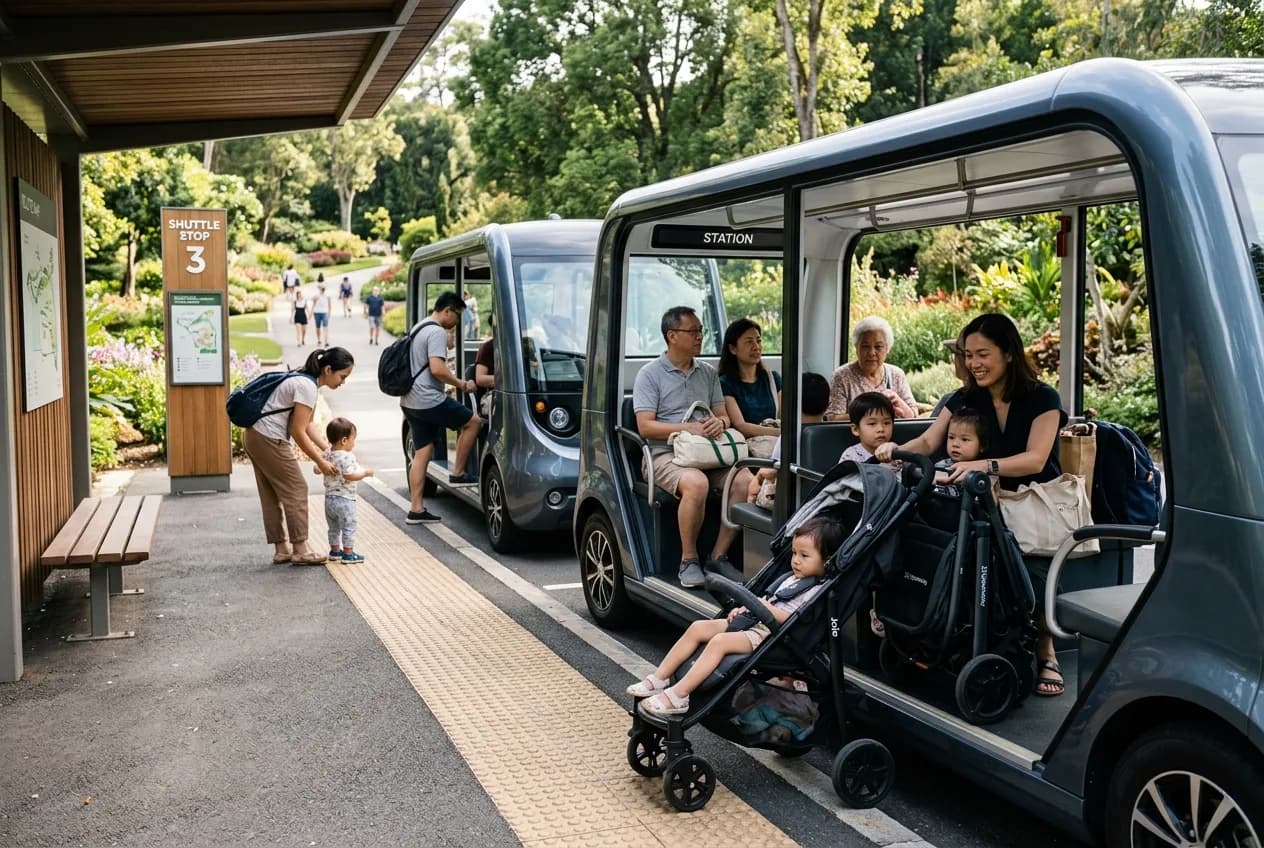
The sum gets you most of the way, but a few things on a real site bend the numbers. Loading is rarely instant: families with pushchairs and bags take longer than the spreadsheet assumes, so build that into your round-trip time. Demand is also lumpy rather than smooth; people arrive in clumps off coaches and car-park rows, so a fleet sized for a steady average will still see queues. And a single long loop behaves differently from several short ones, even at the same total distance.
This is the point at which it is worth talking to someone who sizes these fleets for a living. The method above is genuinely the one we use, but we layer real-world judgement on top: how your particular peaks behave, how loading slows things down, and how to lay out the loops so vehicles are not all caught at one end at the wrong moment. Our shuttle solutions for venues guide goes further on layout.
Don't forget charging and downtime
A fleet on paper assumes every vehicle is available every minute, and reality is not that kind. Vehicles need charging, occasional servicing and the odd unplanned repair. For an electric fleet the good news is that a well-planned charging pattern fits the operating day: vehicles charge overnight and run through opening hours, with the spare margin covering the few that are down at any time.
The practical move is to plan the chargers and the spare vehicles together with the working fleet, not afterwards. Size the battery to the daily distance, make sure there is somewhere for the spares to top up between shifts, and your peak-hour number holds up on the day rather than just in the plan.

A fleet sized to your site
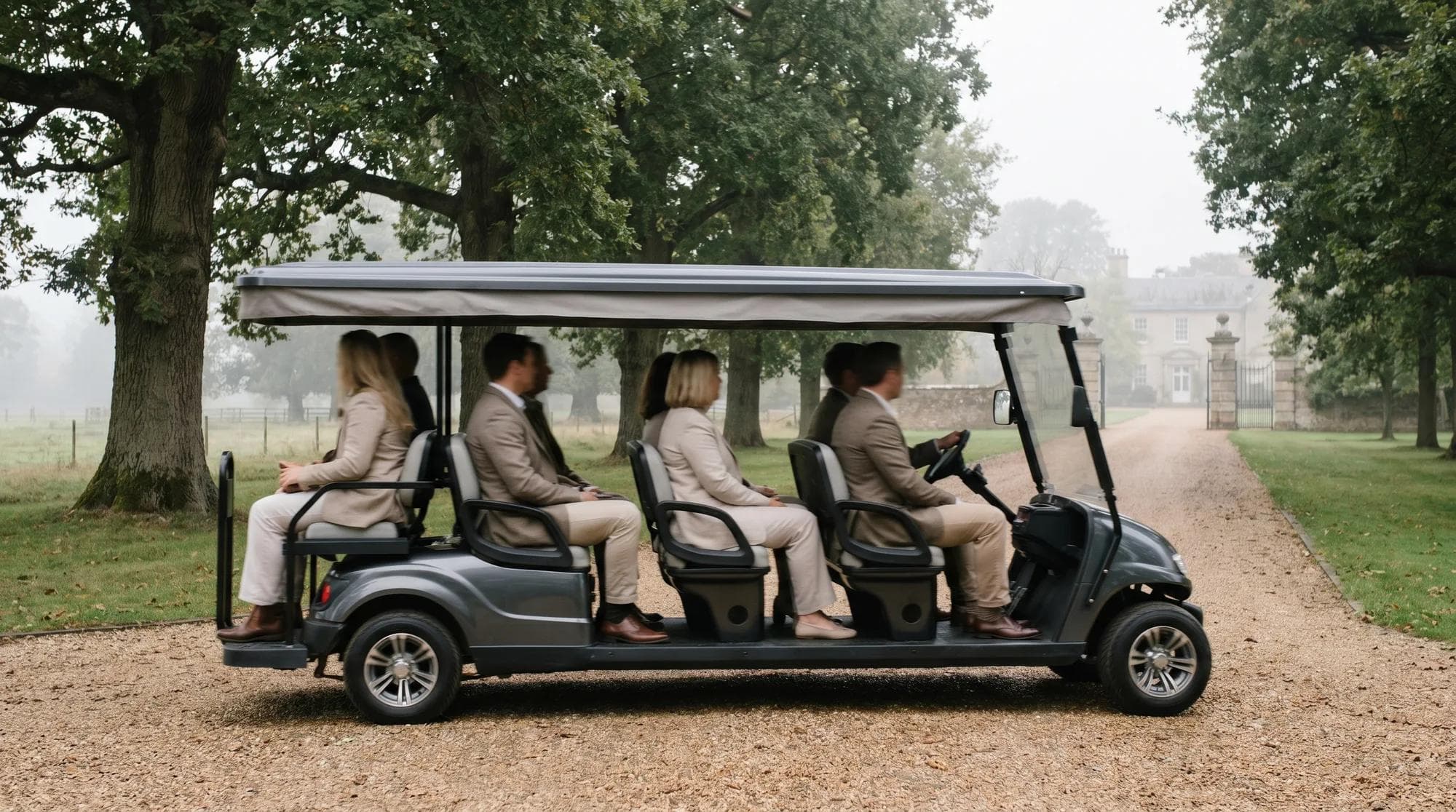
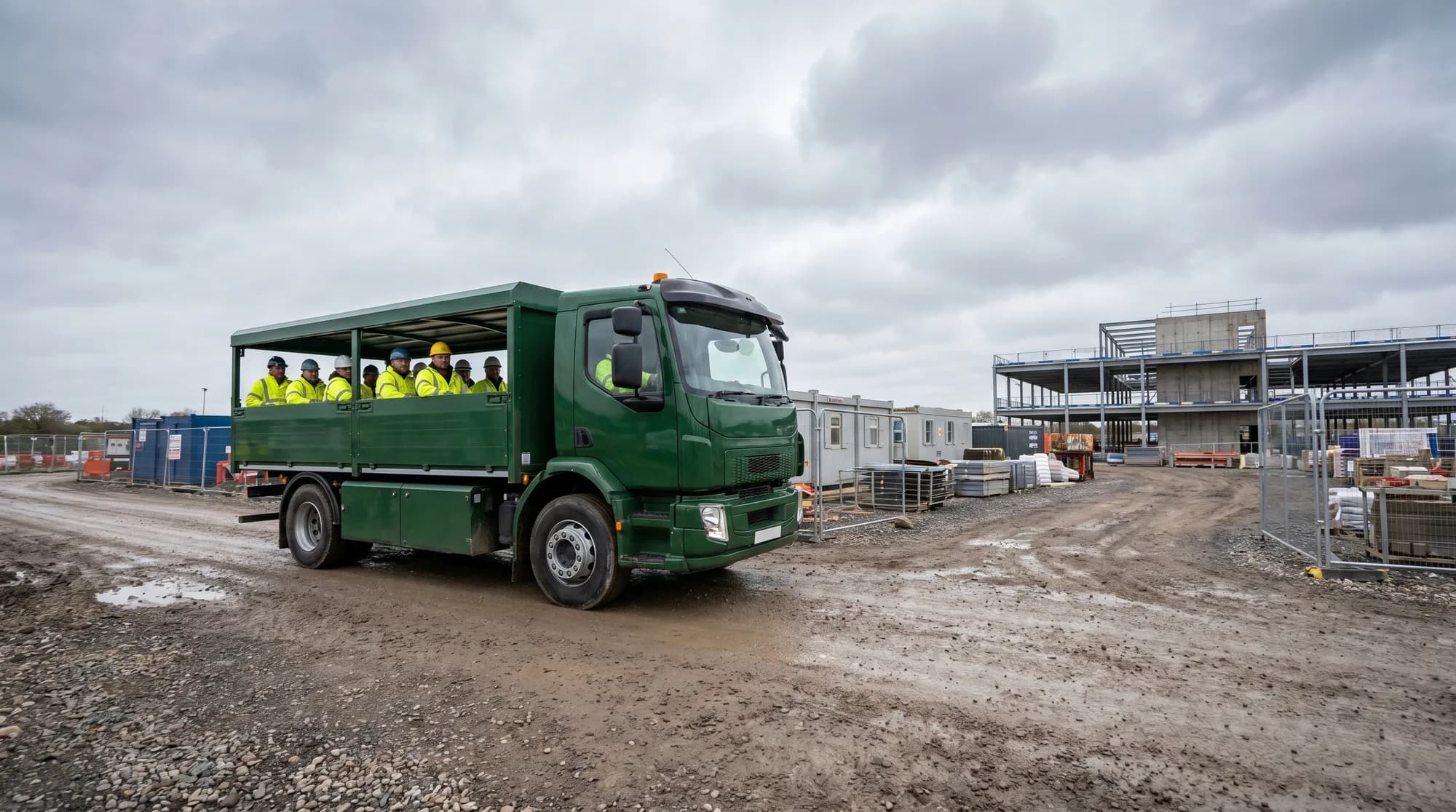
From two seats to eight, plus utility builds, every vehicle is made to order, assembled and finished in the UK and branded as your own, so the fleet fits your loops and your peaks.
Use the estimate as a starting point, not the final word
Treat the number you reach as a strong first draft. It tells you roughly how many vehicles you are buying, which budget you are in, and whether your loop layout helps or hurts. What it cannot do is replace watching a real busy day, ideally before you commit, to see how arrivals actually clump and how long loading really takes. Where the site does not exist yet, a comparable attraction is the next best thing to observe.
The honest summary is that fleet sizing is simple arithmetic wrapped in a few judgement calls. The arithmetic gets you close; the judgement keeps you from opening short or paying for vehicles that sit idle. That is exactly the conversation worth having with the team before you order.
Want us to run the numbers for your site?
Tell us your peak arrivals, your loop length and how long a round trip takes, and we will size a sensible fleet with you, honestly, including spares and charging. No obligation.
Frequently asked questions
Is there a rule of thumb for buggies per visitor?+
Not a reliable one. Two sites with the same visitor numbers can need very different fleets depending on loop length and round-trip time. It is far safer to size from your own peak demand and round-trip time than from a ratio.
Should I size for the average day or the busiest day?+
The busiest realistic day. A fleet sized for the average will queue badly at peak, which is exactly when guests notice. Size for the worst sensible peak and the quieter days look after themselves.
What is the single most important number?+
Round-trip time, including loading and unloading. People consistently underestimate it, and because it sets how many trips each vehicle makes per hour, getting it wrong throws the whole estimate off.
How much spare capacity should I plan for?+
A margin of roughly 15 to 25 percent over the peak-hour figure is a sensible starting point, to cover charging, servicing, breakdowns and busier-than-expected days. We will refine that with you for your specific operation.
Can you help me work out the right number?+
Yes. Give us your peak arrivals, loop length and round-trip time and we will size a fleet with you, including spares and charging, and adjust for how your particular peaks and loading behave.
Related solutions
Ready to explore what we build?
See the vehicles and the setting this applies to, or get a tailored quote built around your site.

Ready to find the right buggy?
Tell us how and where it will work and we will specify a vehicle and a tailored quote built around you. Every build comes with a 3-year warranty and a 24-hour priority call-out.
Our guides are written and reviewed by the Hawke Electric Vehicles team, the people who specify, build, deliver and support the vehicles. We focus on honest, practical advice and flag where a figure depends on the build rather than guessing.
More guides by Hawke