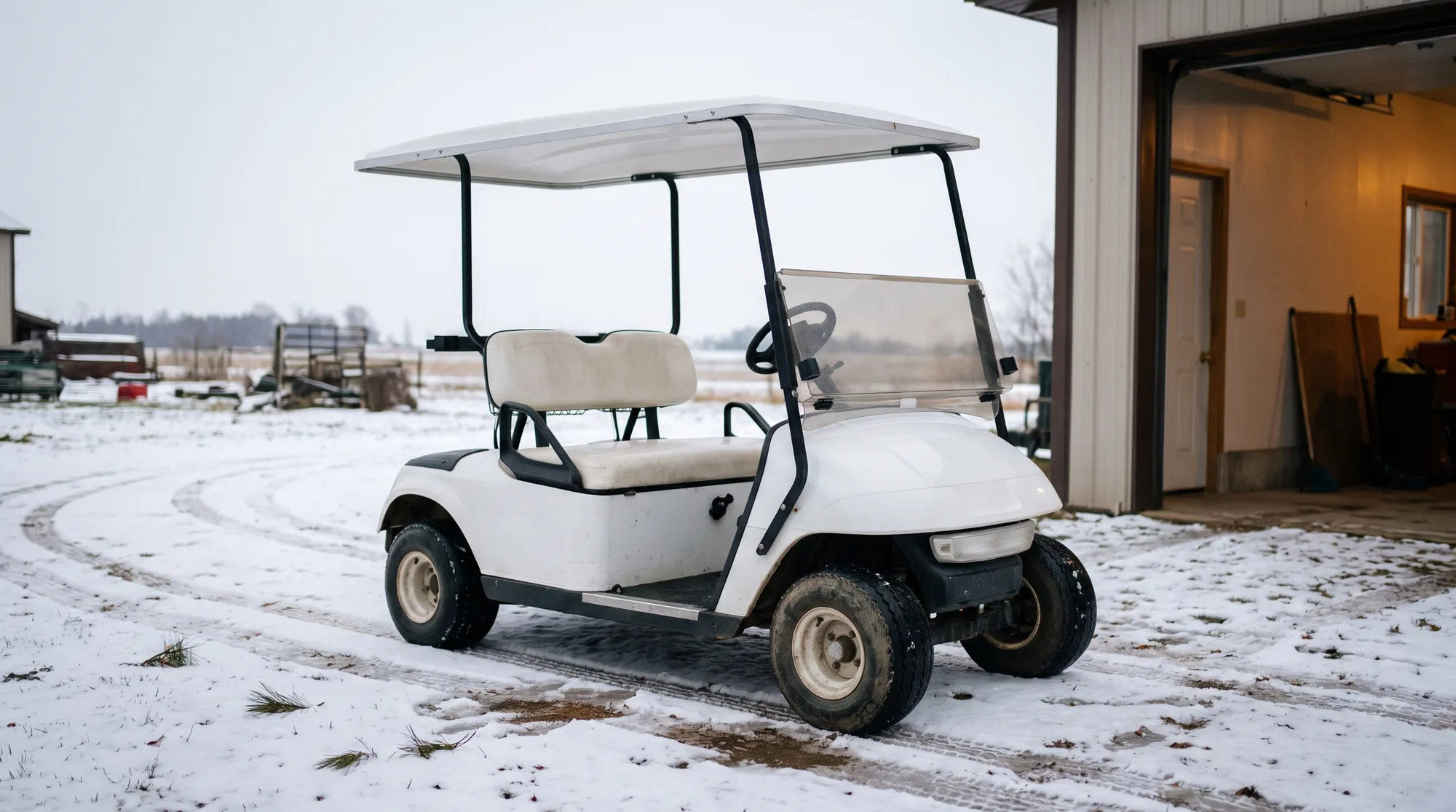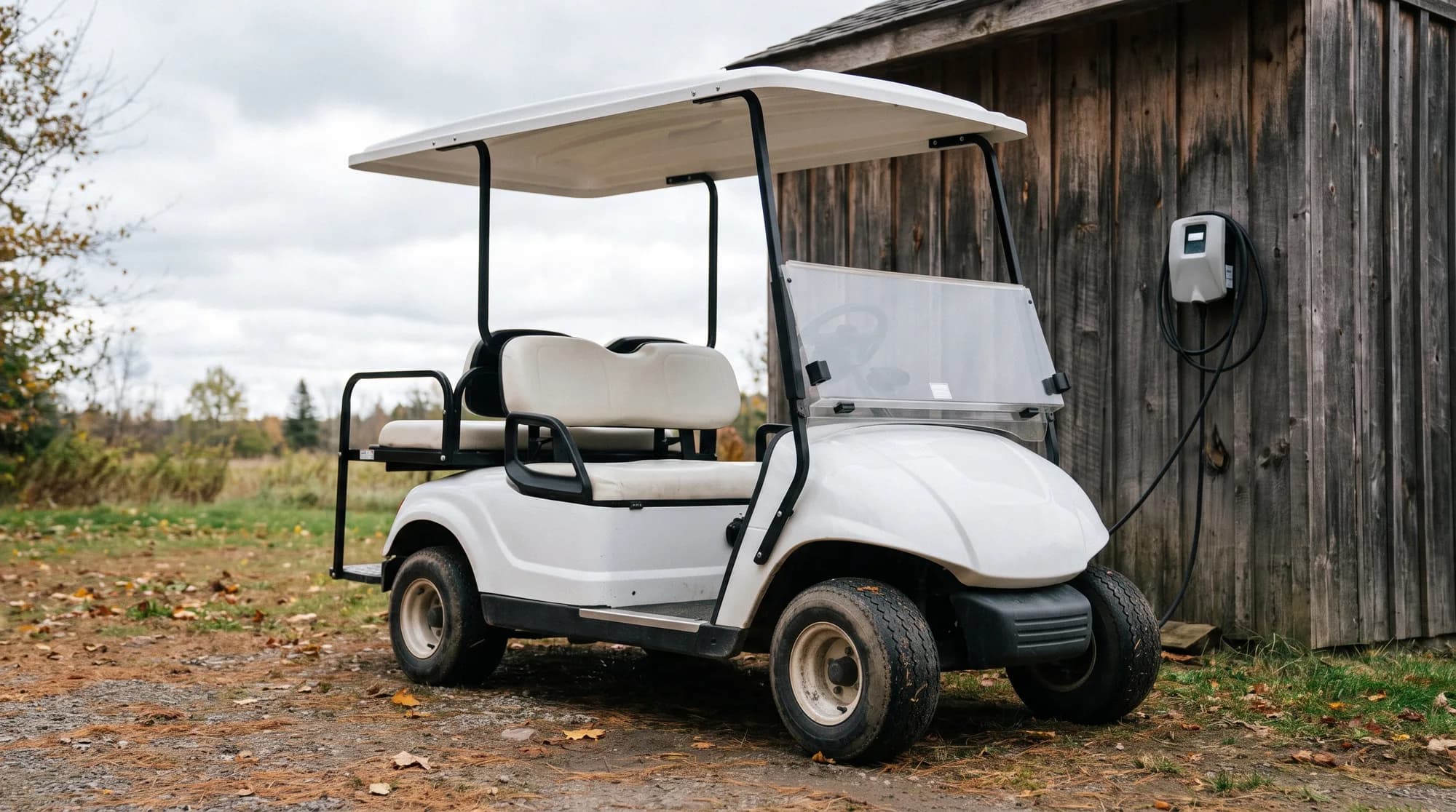
Charging is where golf cart ownership is won or lost. The electricity itself is almost free, typically around a dollar per full charge at Canadian residential rates, but the habits around it decide how long a CA$1,500 to CA$4,000 battery pack survives. Lead-acid and lithium want genuinely different routines, and Canada adds a rule most charging guides skip entirely: what to do when the cart, the charger and the battery are all below freezing. This guide covers the equipment, the costs in CAD, the correct routine for each chemistry and the winter rules.
- A full charge uses roughly 5 to 8 kWh, which costs about CA$0.60 to CA$1.20 at typical Canadian residential rates. Call it a dollar.
- Lead-acid wants a full charge after every significant day of use, and hates being left partly discharged. Lithium is happy with partial charges.
- Never charge a lithium battery below 0 degrees Celsius, and never charge a frozen lead-acid battery. Warm the pack first.
- Use the charger matched to your pack voltage and chemistry. A lead-acid charger profile on a lithium pack, or vice versa, causes real harm.
- Charge from a proper outlet on a healthy circuit. Long, thin extension cords are the top cause of slow charging and melted plugs.
- Lead-acid packs vent hydrogen while charging, so charge in a ventilated space, never a sealed cupboard.
The equipment: what plugs into what
Golf carts run battery systems at 36, 48 or 72 volts, and every cart charges from an ordinary 120-volt household outlet through a charger that converts and controls the flow. Some carts carry the charger onboard, so you just bring a cord; others use an offboard box that lives in the garage. Either way, two matches matter. The charger must match the pack voltage exactly, and it must match the chemistry, because lead-acid and lithium need different charge profiles. Modern lithium conversions and factory lithium carts come with, or specify, a charger with the correct profile and a data connection to the battery management system. If you inherit a used cart, confirm what the charger actually is before trusting it, a point our used cart inspection checklist makes strongly.
What a charge costs in Canada
The arithmetic is friendly. Recharging a typical 48-volt pack from a normal day of use takes roughly 5 to 8 kilowatt-hours from the wall, including charger losses. Canadian residential electricity rates mostly sit between about CA$0.10 and CA$0.18 per kilowatt-hour depending on province and time of use, so a full charge lands around CA$0.60 to CA$1.20. Charge every second day through a six-month season and the annual electricity bill is in the tens of dollars, not hundreds. Compare that with fuel for a gas cart and the running-cost argument for electric drives itself; our electric versus gas guide runs the full comparison. The lesson hiding in the arithmetic is that electricity cost should never influence charging behaviour. Skipping charges to save money saves almost nothing and, for lead-acid, actively shortens the life of the most expensive part on the cart.
The lead-acid routine
Lead-acid batteries live longest when kept as close to full as practical. Every hour spent partly discharged grows sulphate crystals on the plates, and sulphation is permanent capacity loss. So the routine is simple: after any day of significant use, plug in and let the charger complete its full cycle, including the finishing stage where current tapers. Do not interrupt at 80 percent because the meter looks fine, and do not let the cart sit for days half empty. Avoid running the pack deeply flat as a habit; regular deep discharge can cut a lead-acid pack's life dramatically. Once a month in season, check the water after charging and top up with distilled water. And park the charger and cart in a ventilated space, because charging lead-acid releases small amounts of hydrogen gas, which is why a sealed cupboard is the one place a charger should never live.
The lithium routine
Lithium inverts most of that. Partial charges cause no harm and shallow cycles are actually gentler on the cells than full ones, so opportunistic top-ups whenever the cart is parked are fine. There is no watering, no equalizing and no memory effect. Two rules remain. First, temperature: charging below 0 degrees Celsius plates metallic lithium inside the cells and permanently damages them, which is why a properly specified battery management system refuses to charge a cold pack. Treat that refusal as a feature. Bring the cart somewhere warmer, let the pack warm through for several hours, and charge then. Second, storage: for a long winter layup, leave the pack at roughly half charge rather than full, and see our winter storage guide for the complete layup routine for both chemistries.
Winter charging in Canada: the rules that matter
- Never charge a frozen lead-acid battery. If a pack sat discharged in deep cold, thaw it fully indoors and inspect for cracks before any charge.
- Never charge lithium below freezing. Warm the pack first, or choose a pack with built-in heating if the cart must work through winter.
- Cold charging is slow charging. Chargers taper current into a cold pack, so allow extra time rather than assuming a fault.
- If the cart winters in an unheated space with lead-acid batteries, either top-up charge monthly or fit an automatic maintainer rated for the pack.
- Keep the charge port and plug clean and dry. Snow melt and corrosion in the connector cause more winter charging faults than the charger itself.
Set up the charging spot properly
Give the cart a dedicated outlet on a healthy circuit, as close to the parking spot as possible. If an extension cord is unavoidable, use a short, heavy-gauge outdoor-rated cord, because long thin cords drop voltage, slow the charge and can overheat at the plug. Mount an offboard charger off the floor, keep ventilation clear, and route the cable so nobody drives off while plugged in; interlocks prevent that on many carts, but not all. For new builds and property installations it is worth asking an electrician for a dedicated circuit, the same logic as an EV charging point at smaller scale. As a brand building carts to order for Canadian customers, we spec charging equipment around exactly these questions: chemistry, winters and where the cart will actually sleep.
Get the charging spec right from day one
Tell us your cart, property and winters, and we will recommend the battery, charger and setup that fit, with honest CAD figures.
Frequently asked questions
How much does it cost to charge a golf cart in Canada?+
Roughly CA$0.60 to CA$1.20 per full charge at typical residential rates, based on 5 to 8 kilowatt-hours from the wall. A full season of regular use usually costs less than CA$100 in electricity.
Should I leave my golf cart plugged in all the time?+
With a modern automatic charger and a healthy pack, leaving it plugged in between uses is generally fine and keeps lead-acid full. For months-long winter storage, follow a storage routine instead: full charge and monthly top-ups for lead-acid, half charge for lithium.
How long does a golf cart take to charge?+
A depleted lead-acid pack typically needs 6 to 10 hours including the finishing stage. Lithium usually charges faster, often 3 to 6 hours depending on charger output, and tolerates partial top-ups whenever convenient.
Can I charge my golf cart outside in winter?+
You can, provided the equipment is rated for it, the connector stays dry, and the battery itself is above freezing. Lithium must never accept charge below 0 degrees Celsius, and a frozen lead-acid battery must be thawed before charging.
Can I use a car charger on a golf cart?+
No. A 12-volt automotive charger does not match a 36, 48 or 72-volt pack. Use the charger designed for your cart's voltage and chemistry, or individual 12-volt charging only where the pack layout genuinely allows it and you know the procedure.
Related solutions
Ready to explore what we build?
See the vehicles and the setting this applies to, or get a tailored quote built around your site.
Ready to find the right golf cart?
Tell us how and where it will work and we will specify a vehicle and a tailored quote built around you. Every build comes with a 3-year warranty and a 24-hour priority call-out.
Our guides are written and reviewed by the Hawke Electric Vehicles team, the people who specify, build, deliver and support the vehicles. We focus on honest, practical advice and flag where a figure depends on the build rather than guessing.
More guides by Hawke