Every spring, Canadian repair shops meet a procession of golf carts that went into the shed running and came out dead, and the diagnosis is nearly always the same: the battery lost its fight with winter. Cold is the defining fact of golf cart ownership in Canada, and it treats the two common battery chemistries very differently. Lead-acid packs lose capacity, demand attention and can be destroyed outright by a hard freeze; lithium packs cope far better but carry one strict rule of their own about charging below zero. This guide explains what actually happens inside each chemistry when the temperature falls, what it means for range, and the storage routine that gets either type to spring intact.
- Expect 20% to 40% less usable range in deep cold with either chemistry; the electrochemistry simply slows down.
- A discharged lead-acid battery can freeze solid only a few degrees below zero, while a fully charged one is protected to far lower temperatures; charge state is the whole game.
- Most lithium packs must not be charged below about 0 C unless they have built-in heating; discharging in the cold is fine, charging is the risk.
- Store lead-acid fully charged with a maintainer or monthly top-up; store lithium at roughly 40% to 60% charge in a cool, dry place.
- For Canadian conditions, lithium's winter behaviour is the strongest single argument for paying its premium.
Why cold shrinks range in any battery
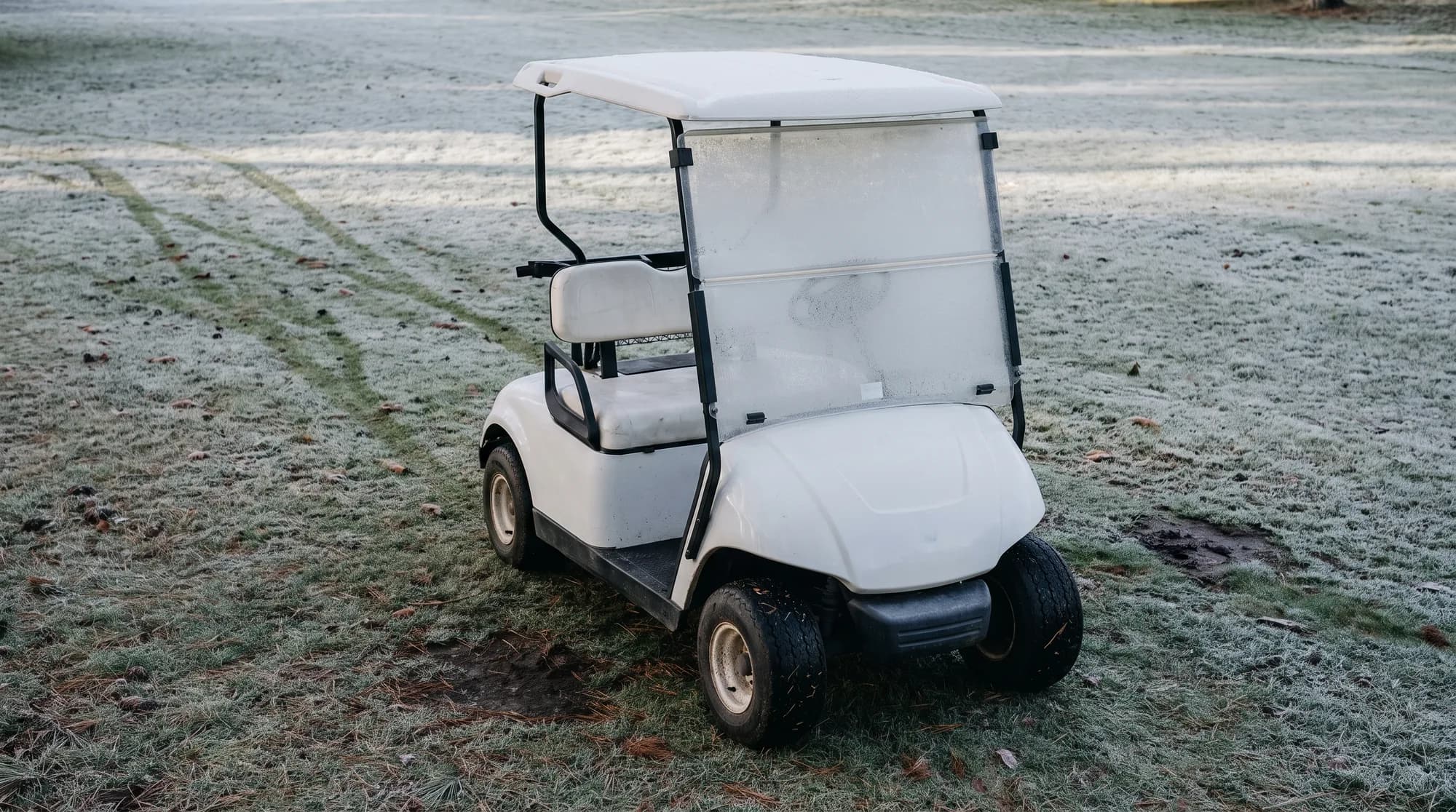
A battery is a chemical machine, and chemistry slows as it cools. At low temperatures the reactions that release current run sluggishly, internal resistance rises, and the pack delivers less of its stored energy before voltage sags. The practical result on a cart is unmistakable: shorter range, weaker hill climbing and a battery gauge that falls faster than usual. In genuinely cold Canadian conditions, a 20% to 40% loss of usable range is normal and temporary; capacity returns as the pack warms. What does not return is capacity lost to physical damage, and that is where the two chemistries part company.
Lead-acid in the cold: the freeze problem
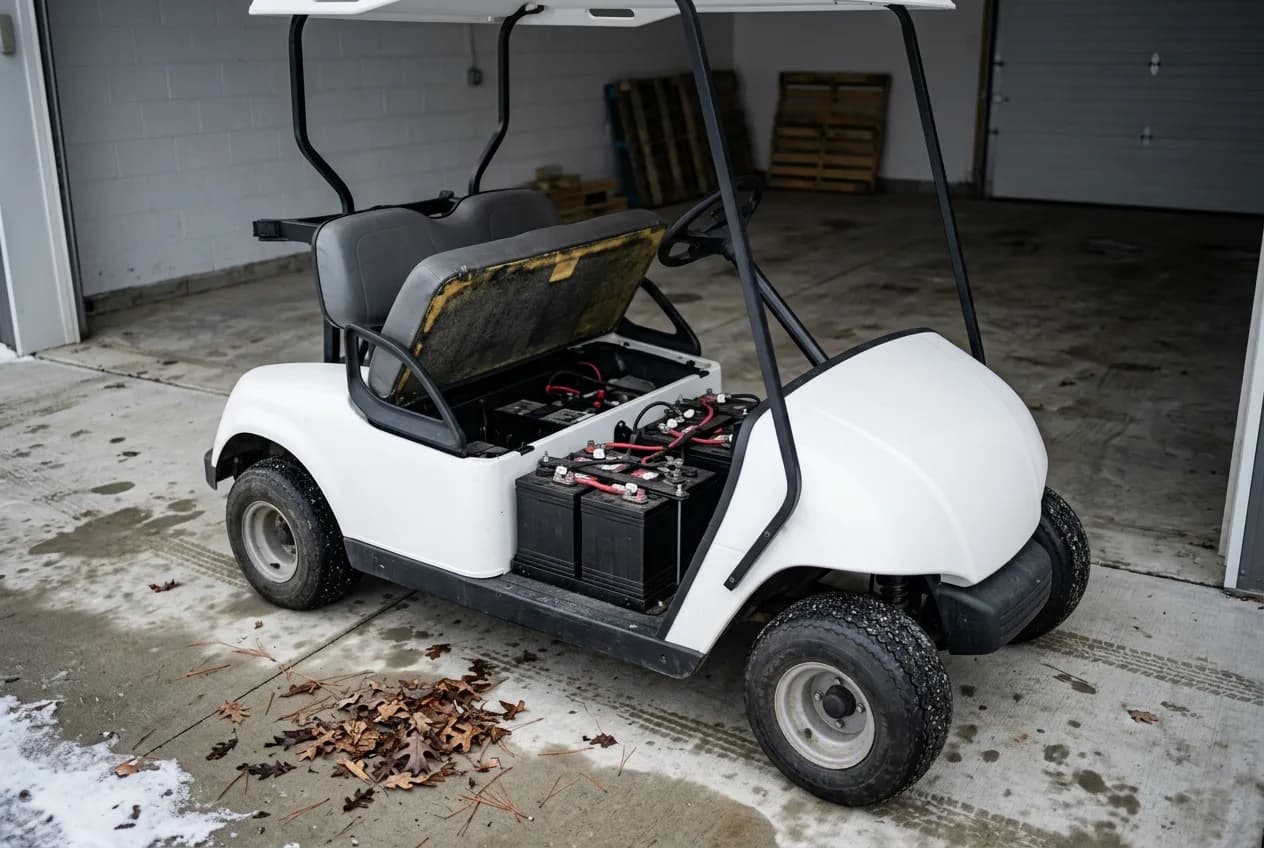
A lead-acid battery's electrolyte is sulphuric acid diluted in water, and its freezing point depends directly on the state of charge. Fully charged, the electrolyte is a strong acid solution that stays liquid to somewhere in the region of minus fifty; deeply discharged, it is mostly water and can freeze at only a few degrees below zero. When it freezes it expands, warping plates and cracking cases, and the damage is permanent even if the battery thaws and reads normal voltage afterwards. This is why the classic Canadian failure is not a battery that died in January but one that was left half-discharged in November. Cold also accelerates self-discharge sulphation in a resting battery, so a pack that sits all winter without charging loses capacity even if it never freezes. The rule for lead-acid in Canada is simple and non-negotiable: store it fully charged, and keep it charged, either with a quality maintainer or a monthly top-up.
Lithium in the cold: better, with one strict rule
Lithium iron phosphate packs, the type in most modern carts, handle Canadian winters far more gracefully. They self-discharge very slowly, so a pack stored part-charged in November still holds most of that charge in April. They tolerate sitting for months without attention, and they retain more of their capacity in cold weather than lead-acid does. The strict rule is about charging: pushing current into most lithium cells below about 0 C causes lithium plating on the anode, which permanently damages capacity and, in bad cases, safety. Quality packs manage the risk themselves, with battery management systems that block charging below the threshold, and some offer built-in heaters that warm the cells before accepting charge. Discharging, that is, driving, in the cold is fine within the pack's rated limits. So the lithium winter routine is short: store it around half charge somewhere cool and dry, and if you use the cart in winter, charge it only when the pack is above freezing, whether by heater, heated storage or simply charging soon after use while the pack retains warmth.
- Lead-acid
- Larger, worsens with age
- Lithium (LiFePO4)
- Smaller, recovers when warm
- Lead-acid
- Severe if discharged
- Lithium (LiFePO4)
- No electrolyte to freeze
- Lead-acid
- Permitted, though slow
- Lithium (LiFePO4)
- Blocked unless the pack is heated
- Lead-acid
- Full charge plus maintainer or monthly top-up
- Lithium (LiFePO4)
- Store at 40% to 60%, then leave it alone
- Lead-acid
- Monthly, all winter
- Lithium (LiFePO4)
- Almost none
| Lead-acid | Lithium (LiFePO4) | |
|---|---|---|
| Cold range loss | Larger, worsens with age | Smaller, recovers when warm |
| Freeze risk | Severe if discharged | No electrolyte to freeze |
| Charging below 0 C | Permitted, though slow | Blocked unless the pack is heated |
| Winter storage | Full charge plus maintainer or monthly top-up | Store at 40% to 60%, then leave it alone |
| Attention needed | Monthly, all winter | Almost none |
The winter care routine, step by step
- 01
Clean and inspect before layup
Wash off summer grime, clean corrosion from terminals, and for flooded lead-acid packs, check and top up the water level with distilled water after a full charge.
- 02
Set the right state of charge
Charge lead-acid to full. Bring lithium to roughly 40% to 60%. Both numbers matter; full is protection for one chemistry and mild stress for the other.
- 03
Choose the storage spot
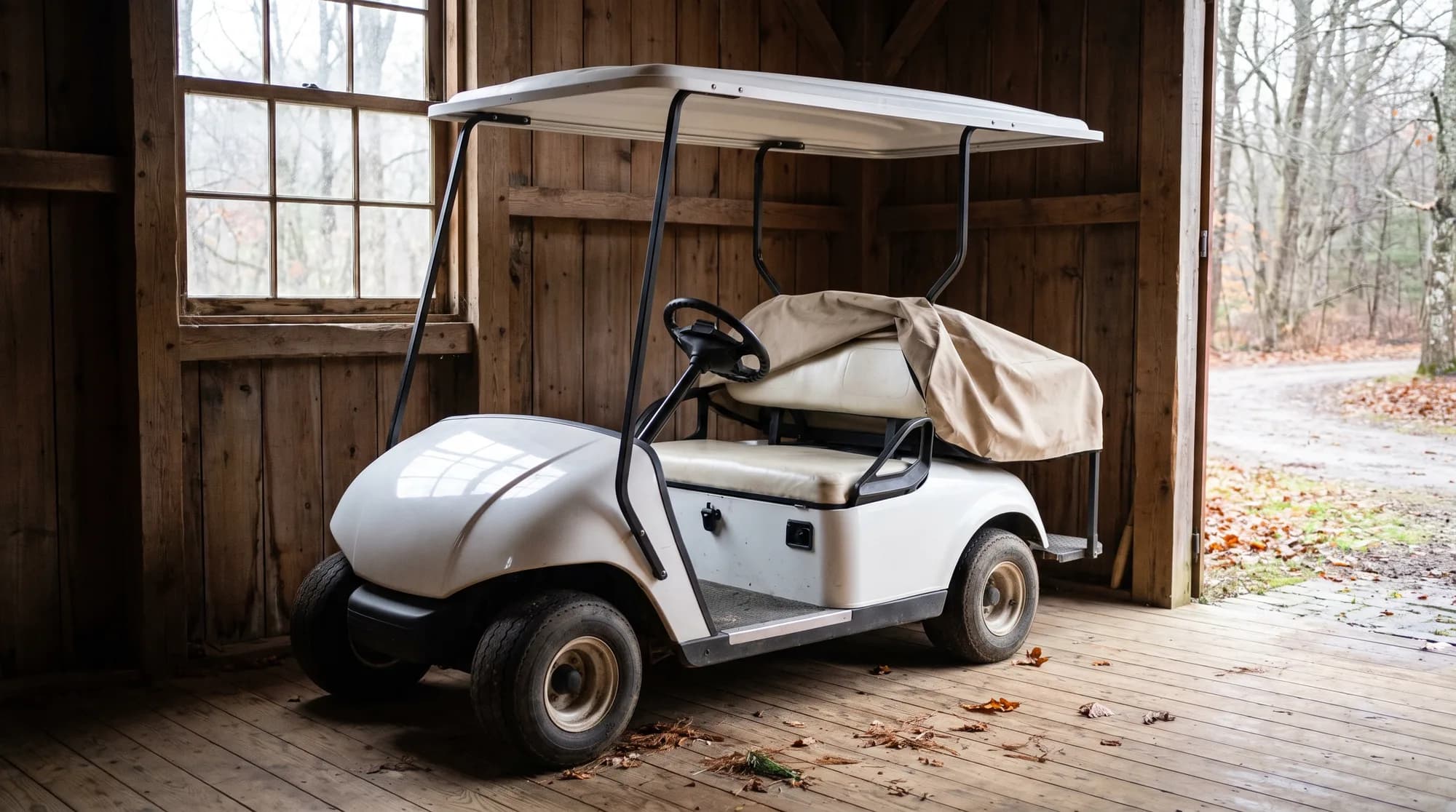
Dry and covered beats warm. A consistent cool temperature in a shed or garage is fine for both chemistries; what kills batteries is moisture, discharge and neglect, not cold storage itself.
- 04
Maintain through the winter
Put lead-acid on a quality maintainer, or top it up monthly. Lithium can generally be disconnected via its main switch and left until spring; check it once mid-winter for peace of mind.
- 05
Wake it up properly
In spring, inspect terminals and cables, charge fully in above-freezing temperatures, and take a short shakedown run before the first heavily loaded trip of the season.
Choosing a chemistry for Canada
If you are buying a cart for Canadian use, winter behaviour is the strongest single argument in the lithium column. The premium of roughly CA$2,000 to CA$4,000 buys a pack that cannot freeze, barely self-discharges, needs no winter attention and typically outlasts two or three lead-acid replacements. Lead-acid remains workable, thousands of Canadian carts prove it every year, but it demands a disciplined owner and a maintainer, and it punishes forgetfulness harshly. If you expect actual winter driving rather than just winter storage, specify a lithium pack with low-temperature charge protection or built-in heating, and give the cart somewhere above freezing to charge.
Frequently asked questions
How much range does a golf cart lose in cold weather?+
Expect roughly 20% to 40% less usable range in deep cold, more for aging lead-acid packs. The loss is temporary and capacity returns as the battery warms, provided the pack has not suffered freeze damage.
Will my golf cart batteries freeze in a Canadian winter?+
A fully charged lead-acid battery resists freezing to very low temperatures, but a deeply discharged one can freeze at only a few degrees below zero and be permanently damaged. Lithium packs have no liquid electrolyte to freeze, though they must not be charged below freezing.
Can I charge a lithium golf cart battery in winter?+
Only when the cells are above roughly 0 C. Quality packs block charging below that threshold, and some include heaters that warm the cells first. Charging soon after driving, while the pack is still warm, or charging in heated space both work.
Should I remove my golf cart batteries for winter?+
Usually not necessary. Lead-acid packs can stay in the cart on a maintainer in a dry shed, and lithium packs can be stored in place at partial charge with the main switch off. Removal only helps if the cart must sit somewhere very damp.
Is lithium worth it just for Canadian winters?+
For many owners, yes. No freeze risk, negligible self-discharge and zero winter maintenance remove the most common Canadian failure modes, and the pack typically lasts two to three times as long as lead-acid.
Spec a battery that ignores winter
We build carts to order with lithium packs suited to Canadian storage and cold-weather use. Tell us your winters and we will recommend and price the right pack.
Related solutions
Ready to explore what we build?
See the vehicles and the setting this applies to, or get a tailored quote built around your site.

Ready to find the right golf cart?
Tell us how and where it will work and we will specify a vehicle and a tailored quote built around you. Every build comes with a 3-year warranty and a 24-hour priority call-out.
Our guides are written and reviewed by the Hawke Electric Vehicles team, the people who specify, build, deliver and support the vehicles. We focus on honest, practical advice and flag where a figure depends on the build rather than guessing.
More guides by Hawke