Range anxiety on a golf cart is rarely about the cart being broken. Far more often it is a tired battery pack, soft tires, a heavy right foot and a charger that never quite finishes the job. The good news is that most of the things stealing your miles are free or cheap to fix, and the few that cost money pay you back in every trip after. This guide walks through what genuinely extends golf cart range, roughly how much each change is worth, and where the real ceiling sits if you want a serious jump.
- The biggest free win is correct tire pressure and a healthy, fully charged battery pack; both can swing range by double digits.
- Smooth driving, less weight and avoiding long hill-holds add meaningful miles with no parts at all.
- A worn lead-acid pack near the end of its life can lose half its usable range; testing tells you if that is your problem.
- A lithium conversion is the single largest range upgrade, often adding 30 to 60 percent over a same-size lead-acid pack.
- Charge fully and charge often; lead-acid hates sitting partly charged and loses capacity for it.
First, know what range you should expect
Before chasing extra miles, set a realistic baseline. A healthy 48-volt cart on lead-acid batteries typically covers somewhere around 25 to 40 miles per charge in easy conditions, while a lithium pack of similar size often reaches 40 to 60 miles or more. Hills, heat, passengers and cargo all pull those numbers down. If your cart is delivering far less than the low end of its expected range, the problem is condition or setup, not physics. Our guide to how far an electric golf cart can go breaks down typical figures by pack type and terrain.
The free wins: pressure, weight and driving
Start here because it costs nothing. Under-inflated tires are the most common quiet range thief on a golf cart. A soft tire spreads its contact patch and drags, and the motor pays for it on every yard. Check the sidewall for the recommended pressure and keep all four within a pound or two of it. The same logic covers our tires and wheels guide, where aggressive off-road tires also cost on-path range.
- 01
Set tire pressure cold
Inflate to the sidewall figure first thing in the morning, before driving warms the tires. Recheck monthly; cold weather drops pressure fast.
- 02
Strip dead weight
Empty the cargo bed of tools, sand bottles and rain gear you are not using today. Every extra 100 pounds nibbles at range, especially on hills.
- 03
Drive smooth
Ease onto the pedal rather than stabbing it. Hard launches dump current as heat. Coast into stops instead of accelerating to the last second.
- 04
Avoid the hill-hold
Holding the cart still on a slope with the pedal cooks the motor and controller and drains the pack. Use the brake and park brake instead.
Battery condition: the hidden ceiling
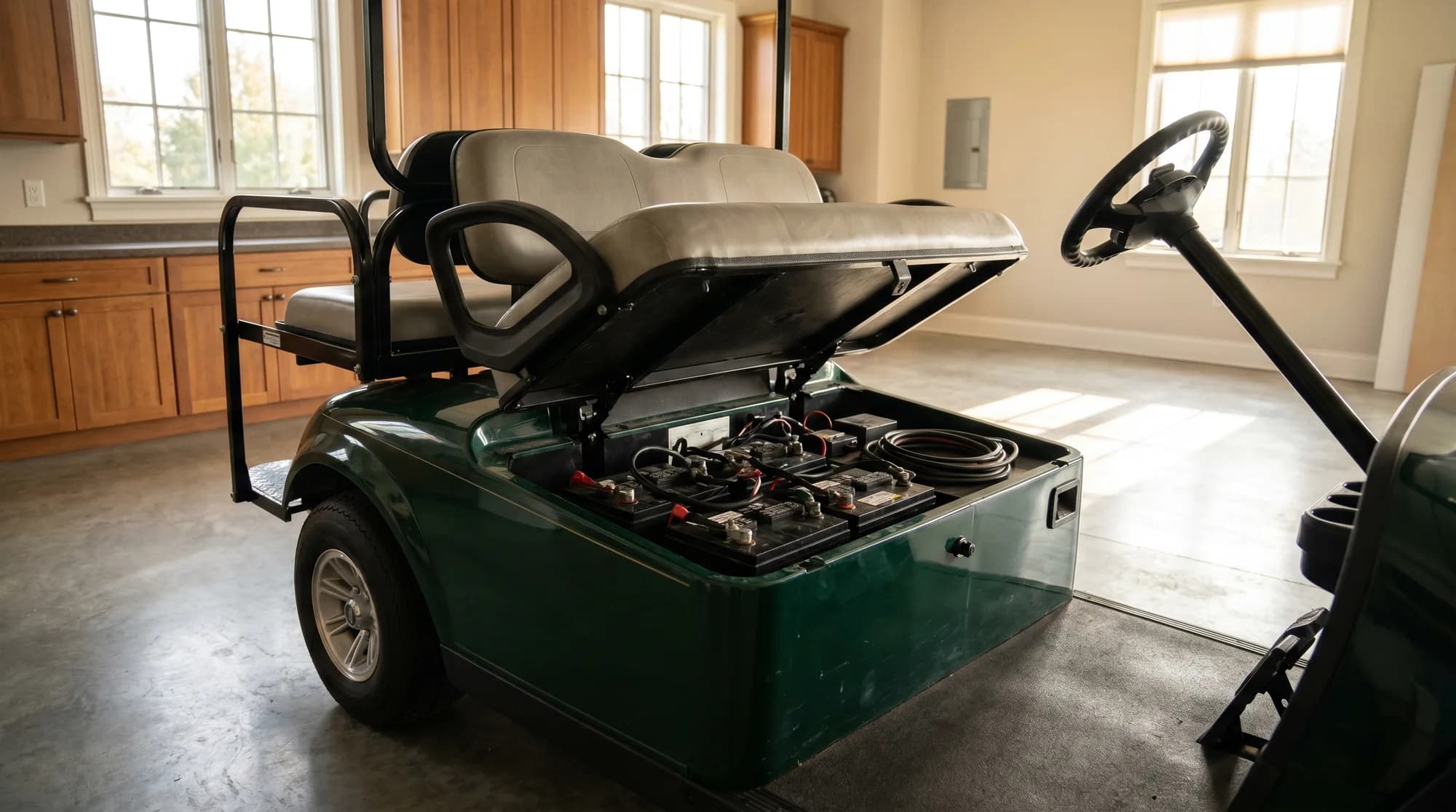
If the free wins do not restore your range, the battery pack is the prime suspect. Lead-acid batteries lose capacity steadily as they age, and a pack in its final year can deliver barely half the miles it did when new. One weak battery in a series string drags the whole pack down, so the cart is only ever as strong as its worst cell. Our guide to how long golf cart batteries last explains the typical lifespan you are working against.
Water level matters too on flooded lead-acid. A pack run low on distilled water sulfates and loses capacity permanently. Top up to the correct level after charging, never before, and never with tap water. If a battery reads low under load even after a full charge, it is failing, and replacing the whole matched set at once is almost always better than swapping one. Our battery care and lifespan tips cover the full routine.

Charging habits that protect range
How you charge has a direct effect on how many miles you keep over time. Lead-acid batteries want to be fully charged and not left sitting partly empty; a half-charged pack left for days loses capacity it never gets back. Charge after every meaningful use, let the charger complete its full cycle, and use a quality automatic charger matched to your pack. Our charging a golf cart at home guide covers chargers, outlets and timing in detail.
- Habit
- Best for lead-acid
- Effect
- Preserves capacity
- Habit
- Harmful to lead-acid
- Effect
- Permanent capacity loss
- Habit
- Fine for lithium
- Effect
- No memory effect
- Habit
- Important
- Effect
- Balances and conditions
- Habit
- Risky
- Effect
- Under or over charges
| Habit | Effect | |
|---|---|---|
| Full charge after each use | Best for lead-acid | Preserves capacity |
| Leaving pack at half charge | Harmful to lead-acid | Permanent capacity loss |
| Partial top-ups (lithium) | Fine for lithium | No memory effect |
| Letting charger finish | Important | Balances and conditions |
| Cheap mismatched charger | Risky | Under or over charges |
The big upgrade: lithium
When you have done everything above and still want more, lithium is the largest single range upgrade available. A lithium pack delivers most of its rated capacity as usable energy, weighs far less than the equivalent lead-acid set and holds its voltage under load, so a same-size lithium pack often adds 30 to 60 percent more range. It also charges faster and lasts far longer in cycles. The trade-off is upfront cost. Our lithium conversion guide covers the decision and the install.
Most owners who think they need a new cart actually need correct tire pressure, a healthy pack and a charger that finishes the job. Fix those three and the range complaints usually disappear.
So what should you do first?
Work cheapest to costliest. Set tire pressure, lighten the load and smooth your driving today. Then test the battery pack and fix charging habits this week. If range is still short and the pack is old, plan a replacement, and if you want the biggest jump and longest service life, budget for lithium. If you would like help speccing a cart or a pack to a real range target, tell us your routes and we will put honest numbers against it.
Spec a cart to your real range needs
Tell us your daily distance and terrain, and we will match a battery and build to it with an honest price.
Frequently asked questions
What is the single best way to add golf cart range?+
If the battery is healthy, correct tire pressure and smooth driving give the biggest free gains. For a large permanent jump, a lithium conversion typically adds 30 to 60 percent over a same-size lead-acid pack.
Why does my cart suddenly have less range?+
The most common causes are an aging or weak battery, low tire pressure, leaving the pack partly charged, or carrying extra weight. Test the pack and check pressure first.
Does charging more often help or hurt range?+
For lead-acid, charging fully after each use helps and leaving it partly charged hurts. Lithium tolerates partial charges with no penalty, so frequent top-ups are fine.
How much range do soft tires really cost?+
Under-inflated tires can cost roughly 10 to 20 percent of range through extra rolling drag, which is why pressure is the first thing to check.
Will a bigger motor give me more range?+
Not usually. A bigger motor adds power and speed, not range, and can use more energy. Range comes from battery capacity, efficiency and good condition.
Related solutions
Ready to explore what we build?
See the vehicles and the setting this applies to, or get a tailored quote built around your site.

Ready to find the right buggy?
Tell us how and where it will work and we will specify a vehicle and a tailored quote built around you. Every build comes with a 3-year warranty and a 24-hour priority call-out.
Our guides are written and reviewed by the Hawke Electric Vehicles team, the people who specify, build, deliver and support the vehicles. We focus on honest, practical advice and flag where a figure depends on the build rather than guessing.
More guides by Hawke