Every golf club that owns, hires out or permits buggies should have a written buggy policy, and if staff or hirers use them, a risk assessment isn't optional: the Management of Health and Safety at Work Regulations 1999 require one. The reassuring part is that a good policy fits on two pages, and this guide gives you the complete contents list.
Committees usually reach for a policy after a near miss: a buggy on its side by the 12th, a visitor who turned out to be fourteen, an insurer asking awkward questions after a dinged clubhouse wall. Writing it before the incident is cheaper in every way. Here's what belongs in the document, clause by clause, plus the risk assessment that should sit underneath it.
- If employees or hirers use buggies, a risk assessment is legally required under the Management of Health and Safety at Work Regulations 1999.
- The core clauses: driver eligibility, medical exemptions, weather rules, designated routes, passenger limits, hire conditions, maintenance and incident reporting.
- Most UK clubs set driver requirements at 17 or over with a full driving licence, because that's what insurers expect.
- A traffic-light weather system written into the policy prevents the same argument happening every wet Saturday.
- Record daily checks and periodic inspections; the paper trail is what protects the club after an incident.
Why does a club need a written buggy policy?
Because when something goes wrong, the first question from the insurer, the HSE or a claimant's solicitor is 'show me your policy and risk assessment'. A club that can produce a sensible document, signed hire agreements and an inspection log is in a strong position even after a genuine accident. A club that can't is negotiating from weakness, and may find its insurance response less friendly than expected. Our golf buggy insurance guide covers the cover side; the policy is what makes that cover dependable.
There's a softer reason too. A written policy makes decisions consistent. The hire desk doesn't have to improvise when a sixteen-year-old asks for the keys, and the greenkeeper doesn't have to relitigate the wet-weather rules with a different member every Saturday morning. The document absorbs the arguments so your staff don't have to.
Start with the risk assessment
Where staff drive buggies or the club hires them to visitors, the Management of Health and Safety at Work Regulations require a suitable and sufficient risk assessment, written down if you have five or more employees. Walk the course and look for what a buggy makes dangerous: steep slopes and side-slopes, blind crests, path pinch points, crossings shared with pedestrians, banks beside water hazards, car park manoeuvring and reversing near the clubhouse. For each hazard, note who's at risk and what controls you'll apply, whether that's a marked route, a speed limit, a no-go zone or a physical barrier.
Review it annually and after any incident or course change. A new tee, a re-routed path or a new fleet with different handling all justify a fresh look. Templates are sold online, and they're fine as a starting skeleton, but the value is in the walk-round, not the paperwork. Nobody knows where buggies get into trouble on your course better than your own greens staff.
What should the policy cover? The full checklist
- Purpose and scope: which vehicles, whose (club fleet, private, hired-in), and who the policy binds
- Driver eligibility: minimum age and licence requirement, and any induction or familiarisation for first-time drivers
- Medical exemption route: what evidence is accepted, who approves it and how long approval lasts
- Weather and course-condition rules: the traffic-light system, who makes the daily call and how it's communicated
- Designated routes, crossing points and no-go areas, ideally with a course map
- Speed, passenger and behaviour rules: seats-only occupancy, no under-age drivers, bags secured, no driving under the influence
- Hire desk conditions: signed hire agreement, damage liability and deposits, key control and return checks
- Private buggy conditions: proof of insurance, maintenance standards and storage or charging arrangements
- Daily pre-use checks and periodic maintenance, with records kept
- Insurance: what the club's policy covers and what hirers or owners must hold themselves
- Incident and near-miss reporting, including when RIDDOR applies to staff incidents
- Review date and document owner, so the policy doesn't quietly go stale
The clauses that cause the most debate
Driver age and licences
Most UK clubs land on 17 or over with a full driving licence, and it's usually the insurer's requirement rather than the club's preference. Some policies allow younger drivers under direct supervision on quiet days; if yours does, check the insurance wording actually supports it before the clause goes in. We've unpacked the age question, including holiday parks and private land, in our guide to what age you can drive a golf buggy.
Medical exemptions and weather rules
These two clauses have to work together. The weather section sets out your traffic-light system and who makes the call; the exemption section says what happens to medical certificate holders on amber days, typically path-only access along defined routes. Writing that pairing down keeps the club on the right side of its Equality Act duties, and it spares the pro shop a legally loaded conversation every wet weekend.
- Bare minimum
- Age and licence confirmed at hire
- Best practice
- Licence sighted and recorded, plus a two-minute familiarisation for first-time drivers
- Bare minimum
- Visual check when faults are reported
- Best practice
- Daily pre-use checklist signed off, plus scheduled servicing with records kept
- Bare minimum
- Manager's judgement on the day
- Best practice
- Written traffic-light criteria, one named decision-maker, status published by 7.30am
- Bare minimum
- Verbal conditions at the desk
- Best practice
- Signed hire agreement covering damage liability, routes and passenger rules
- Bare minimum
- Note in the day book
- Best practice
- Standard incident form, photos, insurer notified, risk assessment reviewed
| Bare minimum | Best practice | |
|---|---|---|
| Driver checks | Age and licence confirmed at hire | Licence sighted and recorded, plus a two-minute familiarisation for first-time drivers |
| Inspections | Visual check when faults are reported | Daily pre-use checklist signed off, plus scheduled servicing with records kept |
| Weather decisions | Manager's judgement on the day | Written traffic-light criteria, one named decision-maker, status published by 7.30am |
| Hire paperwork | Verbal conditions at the desk | Signed hire agreement covering damage liability, routes and passenger rules |
| Incident handling | Note in the day book | Standard incident form, photos, insurer notified, risk assessment reviewed |
Maintenance, records and the paper trail
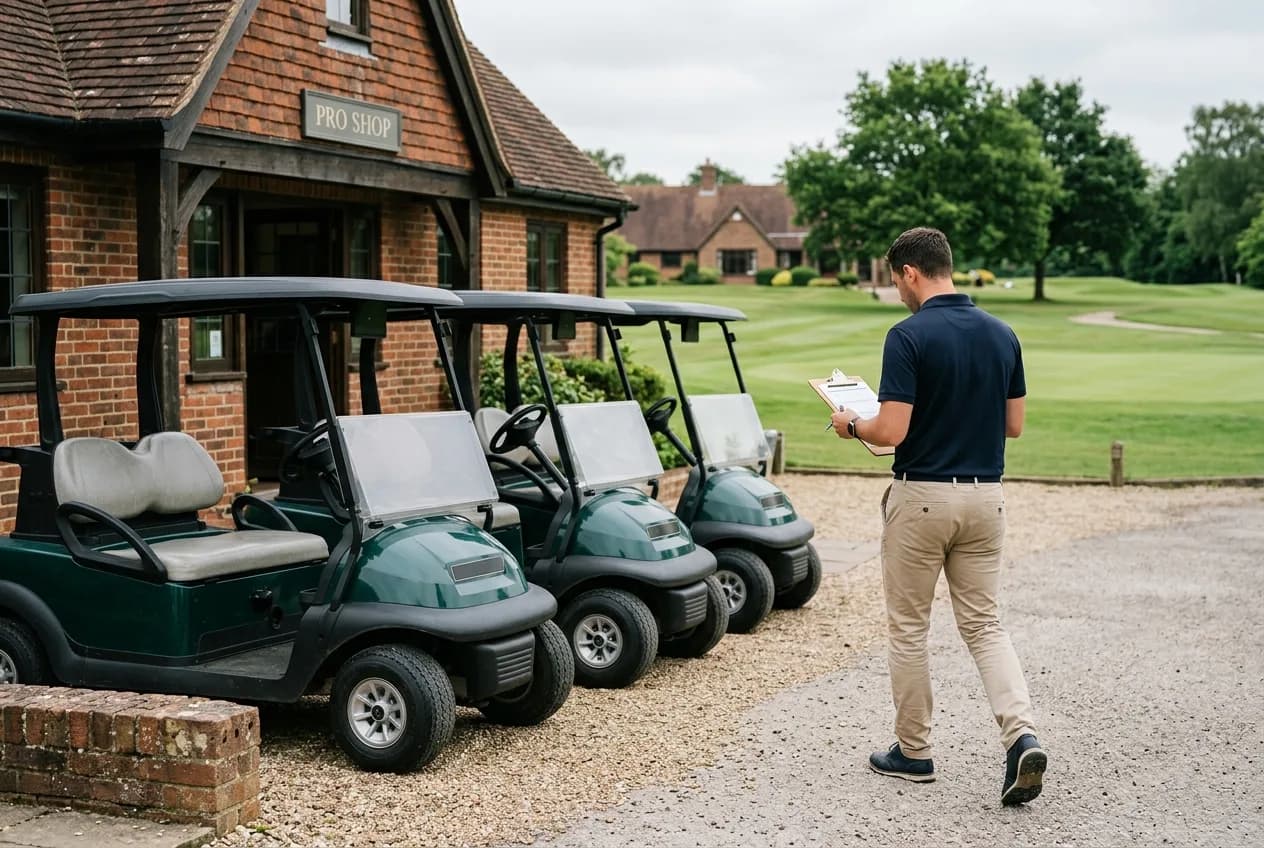
The policy should require a short daily pre-use check (brakes, steering, tyres, battery, lights and hooter where fitted) and periodic servicing in line with the manufacturer's schedule, all recorded. It sounds bureaucratic; in practice it's a laminated sheet and thirty seconds per vehicle. Those records matter twice: they catch developing faults before they strand a member on the 14th, and they're your evidence of reasonable care if a brake failure ever ends up in a claim. Our rundown of common golf buggy faults shows what the daily check is actually looking for.
Draft the policy in-house using the checklist above, walk the course with your greens staff for the risk assessment, then pay for one hour of a solicitor's time to review it. That order gets you a document the club actually follows, at a fraction of the cost of buying a generic template that never quite fits. Review it every twelve months, and every time the fleet changes.
Frequently asked questions
What should a golf club buggy policy include?+
Driver eligibility (age and licence), a medical exemption route, weather and course-condition rules, designated routes and crossings, speed and passenger rules, hire conditions and damage liability, maintenance and daily checks, insurance requirements, and incident reporting. A contents checklist is included in this guide.
Is a risk assessment legally required for club buggies?+
Where employees use buggies or the club hires them out as part of its undertaking, yes. The Management of Health and Safety at Work Regulations 1999 require a suitable and sufficient risk assessment, recorded in writing if the club has five or more employees.
What age and licence should clubs require for buggy drivers?+
Most UK clubs require drivers to be 17 or over with a full driving licence, chiefly because insurers expect it. Check your own policy wording before allowing anything more relaxed, such as supervised younger drivers.
Are golf clubs liable for buggy accidents?+
They can be. Clubs owe a duty of care over vehicle condition, route safety and who they hand keys to. A signed hire agreement shifts some damage liability to the hirer, but it doesn't remove the club's duty. Good maintenance records and a followed policy are the club's best protection.
How often should club buggies be inspected?+
A short documented pre-use check daily, plus servicing to the manufacturer's schedule, typically annually at minimum for club fleets in regular use. Batteries, brakes and tyres deserve extra attention through the wet months.
Renewing or expanding your club fleet?
Hawke supplies UK golf clubs with modern lithium buggy fleets backed by a 3-year warranty and 24-hour call-out, with servicing support that keeps your inspection records simple.
Related solutions
Ready to explore what we build?
See the vehicles and the setting this applies to, or get a tailored quote built around your site.

Ready to find the right buggy?
Tell us how and where it will work and we will specify a vehicle and a tailored quote built around you. Every build comes with a 3-year warranty and a 24-hour priority call-out.
Our guides are written and reviewed by the Hawke Electric Vehicles team, the people who specify, build, deliver and support the vehicles. We focus on honest, practical advice and flag where a figure depends on the build rather than guessing.
More guides by Hawke