Private sales account for a large share of the UK used golf cart market, and they are cheaper for a straightforward reason: the discount is the value of the protection you are giving up. That is a perfectly reasonable trade to make, but it should be made knowingly, and a surprising number of buyers assume protections that do not apply. This guide sets out the practical position and the steps that reduce the risk.
- A private seller must not misdescribe the vehicle, but owes you far less than a trader does.
- There is no general right to a vehicle being of satisfactory quality in a private sale.
- Wear and faults that emerge afterwards are normally yours to deal with.
- Written descriptions matter, so keep the advert and any messages.
- An independent inspection is the single most effective risk reduction available.
What a private seller does owe you
The core obligation in a private sale is that the vehicle must be as described. If the seller states the battery pack was replaced last year, that the cart has never been used commercially, or that it is a particular model or year, those statements need to be true, and a buyer who relies on a false statement has a claim. The seller must also actually own the vehicle and be entitled to sell it. Beyond that the protections thin out quickly, which is the essential difference from buying from a trader.
What they do not
- Private sale
- Yes
- Buying from a trader
- Yes
- Private sale
- No general duty
- Buying from a trader
- Yes
- Private sale
- No general duty
- Buying from a trader
- Yes, where you made the purpose known
- Private sale
- No
- Buying from a trader
- Yes, within the statutory period
- Private sale
- No
- Buying from a trader
- Yes
- Private sale
- Very limited
- Buying from a trader
- Meaningful
| Private sale | Buying from a trader | |
|---|---|---|
| Must match the description | Yes | Yes |
| Must be of satisfactory quality | No general duty | Yes |
| Must be fit for your stated purpose | No general duty | Yes, where you made the purpose known |
| Short-term right to reject | No | Yes, within the statutory period |
| Repair or replacement remedies | No | Yes |
| Practical recourse if it fails | Very limited | Meaningful |
The row that matters most is satisfactory quality. In a private sale, a cart that turns out to need a battery pack, or brakes, or a controller, is generally your problem, even if it failed the week after you bought it. Buyer beware is close to literally the position, subject to the description being honest. That is why the inspection you do before paying carries so much more weight than it would when buying from a dealer.
Practical steps that genuinely reduce risk
- 01
Screen before you travel
Ask for photographs of the battery date codes, the hour meter if fitted, and the underside. Ask what pack is fitted, when it was installed and what its measured state of health is. Most poor vehicles are eliminated here, at no cost.
- 02
See it where it lives
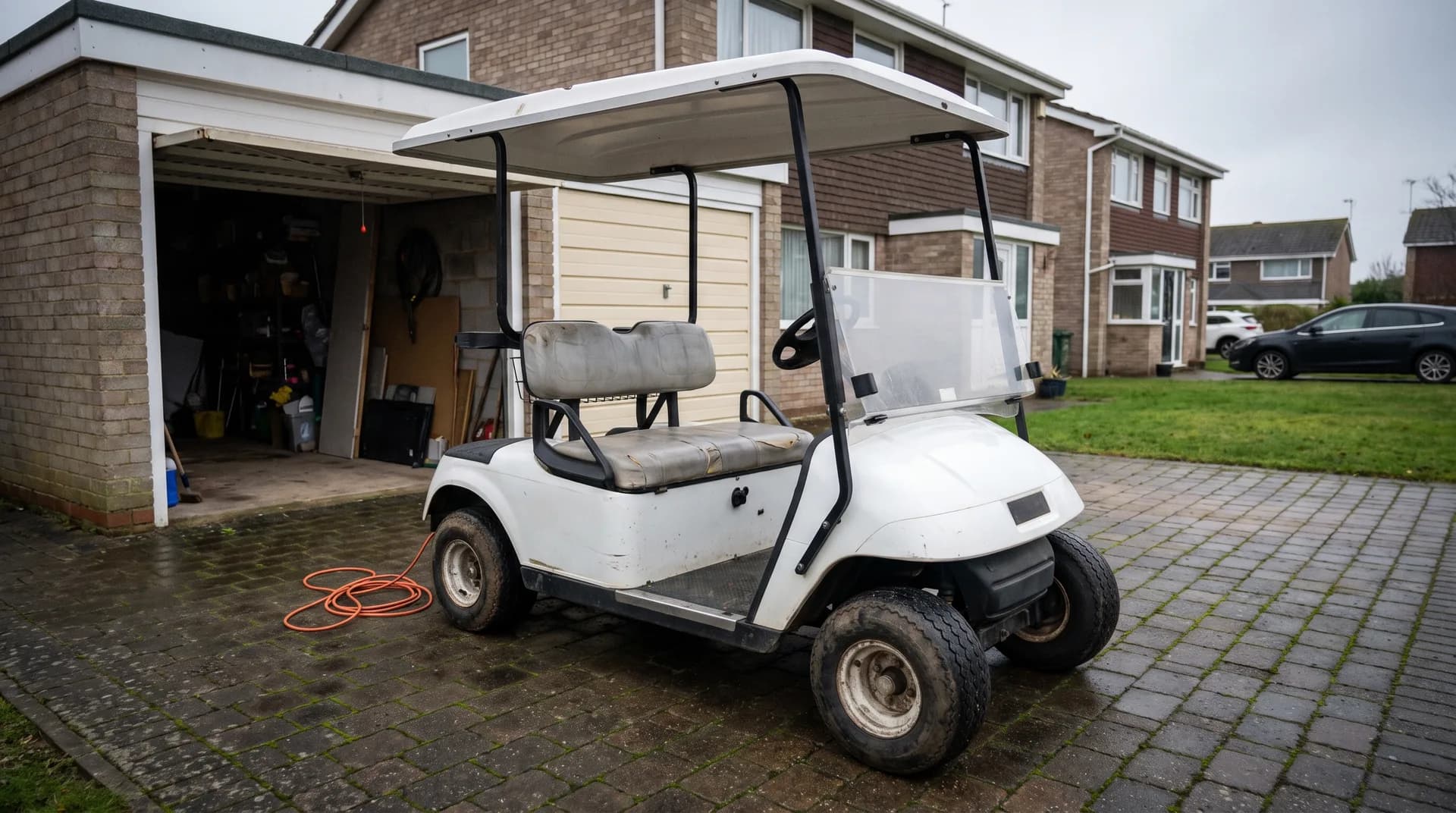
View at the seller's own address rather than a car park or a neutral meeting point. It confirms the vehicle is theirs, shows you how it has been stored, and lets you see the charger in situ.
- 03
Inspect properly
Work through a structured check rather than a walk around. Our pre-purchase inspection checklist covers battery, brakes, tires, steering, controller behaviour and frame in a sensible order.
- 04
Drive it under load
Charge it fully, then drive it continuously for long enough to load the pack, carrying realistic weight and using a gradient if there is one. Short drives prove nothing about battery condition.
- 05
Consider an independent inspection
Paying an engineer to assess a vehicle costs a fraction of a battery pack. On a private purchase with no recourse afterwards, it is the best value spend available.
- 06
Keep the paperwork
Save the advert, the messages and a written receipt naming both parties, the vehicle, the price and the date. If a description later turns out to be false, this is the evidence.
Paying safely
Pay by a traceable method and pay the person who owns the vehicle, at the address where you viewed it. Avoid arrangements that separate the payment from the handover: deposits to hold a vehicle you have not seen, payment to a third party, or delivery promised after payment on a vehicle you have only seen in photographs. These are the situations where the small number of genuinely fraudulent listings in this market do their damage, and they are entirely avoidable by insisting on the ordinary sequence of view, inspect, pay, collect.
When a private sale is the right call
It is the right call when you can assess a battery pack and a chassis competently, or are willing to pay someone who can, and when the saving is real rather than notional. It is the wrong call when you need the vehicle to work reliably from day one with somebody to ring if it does not, when it is going into commercial service, or when you are buying several. In those cases the premium for buying from a dealer buys inspection, warranty and recourse, which is exactly what a private sale removes. Our guide to where to buy a used golf cart compares the channels in full.
Frequently asked questions
Do I have any rights buying a golf cart privately?+
Limited ones. The vehicle must be as described and the seller must be entitled to sell it, but there is no general duty that it be of satisfactory quality or fit for your purpose, and no right to reject or to have it repaired. Faults that emerge afterwards are normally yours.
Can I return a used golf cart bought privately?+
Generally no, unless the vehicle was misdescribed. Private sales carry no short-term right to reject, which is one of the main practical differences from buying from a trader.
Should I get a golf cart inspected before buying?+
On a private purchase, it is the single most effective thing you can do. An independent inspection costs a fraction of a battery pack and there is no recourse afterwards, so the money is well spent.
How should I pay a private seller?+
By a traceable method, to the owner, at the address where you viewed the vehicle, after you have inspected it. Avoid deposits on unseen vehicles, payment to third parties, or paying before collection.
Is buying privately worth the saving?+
It is if you can assess a battery pack and chassis, or will pay someone who can. It is not if the cart is going straight into commercial service or you need somebody to call when something does not work.
Want the protection as well as the price?
Our approved used golf carts are inspected, battery-health tested and warranted, and we will tell you honestly when a private buy or a new build would serve you better.
Related solutions
Ready to explore what we build?
See the vehicles and the setting this applies to, or get a tailored quote built around your site.

Ready to find the right golf cart?
Tell us how and where it will work and we will specify a vehicle and a tailored quote built around you. Every build comes with a 3-year warranty and a 24-hour priority call-out.
Our guides are written and reviewed by the Hawke Electric Vehicles team, the people who specify, build, deliver and support the vehicles. We focus on honest, practical advice and flag where a figure depends on the build rather than guessing.
More guides by Hawke