Very few disappointing used golf cart purchases involve deliberate deception. Most involve an honest seller who does not know the answer, a buyer who did not think to ask, and a battery pack that seemed fine on a short drive around a yard. These are the signals that reliably separate a good buy from an expensive one, in roughly the order you will encounter them.
- Vagueness about the battery pack is the single most reliable warning sign.
- A seller who resists a long test drive is telling you why.
- Freshly cleaned terminals on an otherwise dusty vehicle deserve a question.
- Standing damage from long storage is common and is often understated.
- No paperwork and no history is not fatal, but it must be reflected in the price.
1. Nobody can tell you the battery's age
The pack is the most valuable consumable on the vehicle and its installation date is a single fact. If nobody knows it, either the vehicle has changed hands without records or the answer is unwelcome. Date codes are usually stamped or labelled on the batteries themselves, so ask the seller to photograph them before you travel. A seller who will not, or who says they cannot get to them, has told you something useful.
2. The test drive is offered as a short loop
A tired pack will drive convincingly for a few minutes because the voltage has not yet sagged under sustained load. That is exactly why a five-minute loop of a yard proves nothing. Ask to drive it continuously for a proper period, fully loaded if you can, and on a gradient if one is available. Resistance to this is not always evasion, but it is always worth noting, and a seller confident in the vehicle rarely objects.
3. Suspiciously clean battery terminals
Terminals and interconnects that gleam on a vehicle that is otherwise dusty have usually been cleaned recently, and the common reason is corrosion that was visible and is now less so. Clean terminals are not a problem in themselves and good owners do maintain them. The signal is the mismatch between how clean the terminals are and how clean everything else is. Look for residue in the tray, staining on the surrounding metal, and any sign of the white or blue-green crust that indicates ongoing leakage.
4. It has been standing for months
A cart that has stood unused through a winter, particularly on lead-acid, is a different proposition from one used regularly. Standing damage is real, frequently permanent and routinely understated, because the seller genuinely believes the vehicle is fine having only just charged it. Our guide to a golf cart not holding charge after winter explains what happens to a pack left flat. Treat any long-standing vehicle as needing a full pack assessment, not a test drive.
5. Fresh paint in one place only
Localised repainting on a vehicle that is otherwise original usually indicates impact repair, and on a cart the concern is not the panel but what is behind it. Check the frame alignment, look along the vehicle from the front and rear for a consistent stance, check for uneven tire wear that suggests bent steering geometry, and look at the suspension mounting points on that side. Cosmetic repair is fine. Cosmetic repair concealing frame damage is not.
6. The charger is missing or is not the right one
A missing charger is a modest cost but a meaningful signal, because it usually means the vehicle has been separated from its equipment at some point, which in turn means the history is less complete than described. A mismatched charger is worse: chargers are matched to pack chemistry and voltage, and running the wrong profile damages batteries steadily and invisibly. If the charger does not obviously belong to the vehicle, ask what has been charging it and for how long.
7. Brakes that need a long push
Golf cart brakes are simple and their condition is easy to feel. A pedal that travels a long way before biting, a parking brake that will not hold on a slope, or braking that pulls to one side all point to work that is due. None of it is expensive individually and all of it is safety-critical, so the point is not to walk away but to price it in and insist it is put right before the vehicle carries anyone.
8. Corrosion in the battery tray or on the frame
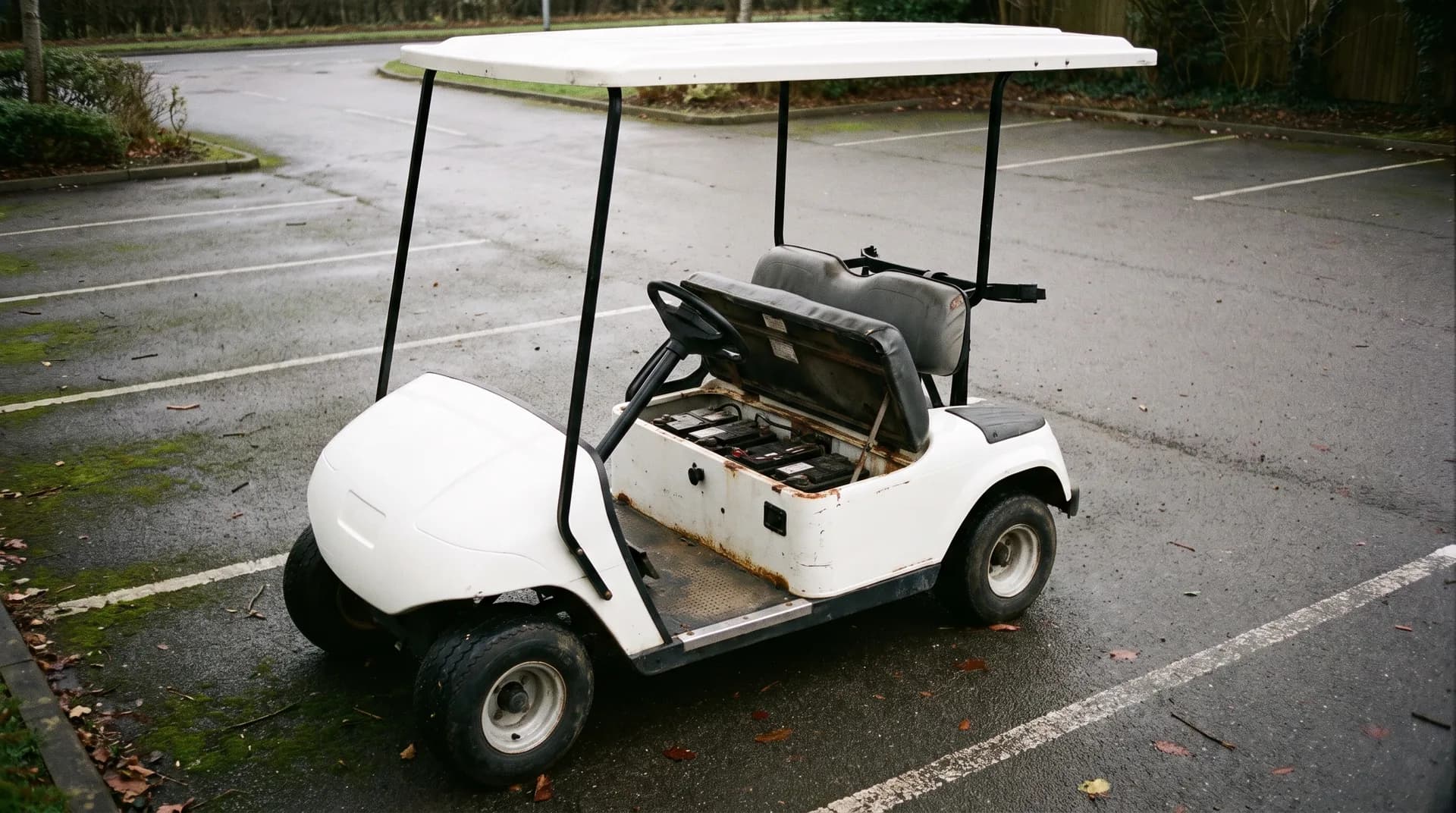
Surface rust on a working vehicle is normal. Structural corrosion in the battery tray, on the frame rails or around suspension mounts is not, and it is disproportionately common on vehicles that have lived near the coast, on farms where they meet fertiliser and slurry, or under acid leakage from a failing pack. Take a torch, look underneath properly rather than glancing, and press on anything that looks soft.
9. No paperwork of any kind
Golf carts used on private land do not carry registration documents in the way road vehicles do, so an absence of paperwork is normal rather than sinister. What you do want is some evidence of provenance: a purchase receipt, service records, a fleet disposal note, anything that establishes the seller is entitled to sell it and gives you a history. Where there is nothing at all, that is a reason to discount rather than a reason to walk, provided the vehicle checks out and the seller is identifiable.
10. A price that is well under the market
In a thin market, genuine bargains exist, usually because someone wants a vehicle gone rather than because they have concealed a fault. But a price a long way below comparable vehicles is worth understanding before you commit rather than after. Ask directly why it is priced where it is. A straight answer, an ex-fleet disposal, a house move, a pack that is known to be due, is reassuring. An evasive one is the most informative signal on this list.
Frequently asked questions
What is the biggest risk buying a used golf cart?+
The battery pack. It is the largest consumable on the vehicle, it degrades whether or not the cart is used, and it will drive convincingly on a short test even when it is close to the end of its life. Always buy on measured state of health rather than a short drive.
How long should a used golf cart test drive be?+
Long enough to load the pack properly rather than a lap of a yard. Drive continuously, carry the number of people you actually intend to, and use a gradient if one is available, because voltage sag under sustained load is what reveals a tired pack.
Do used golf carts come with documents?+
Not registration documents, since golf carts used on private land are not registered like road vehicles. You should still expect some provenance, such as a receipt, service records or a fleet disposal note, and an absence of all of it should be reflected in the price.
Is surface rust on a golf cart a problem?+
Surface rust on a working vehicle is normal. Structural corrosion in the battery tray, on frame rails or around suspension mounts is a genuine concern, and is most common on coastal and farm vehicles or where a pack has leaked.
Should I walk away from a cheap golf cart?+
Not automatically, since genuine bargains exist in a thin market. Ask directly why it is priced where it is. A clear reason is reassuring, and an evasive answer is the most useful warning sign of all.
Rather not take the risk?
Every approved used cart we supply is inspected, has its battery health measured and reported, and comes with a warranty. Tell us what you need and we will find it or tell you honestly that new is the better buy.
Related solutions
Ready to explore what we build?
See the vehicles and the setting this applies to, or get a tailored quote built around your site.

Ready to find the right golf cart?
Tell us how and where it will work and we will specify a vehicle and a tailored quote built around you. Every build comes with a 3-year warranty and a 24-hour priority call-out.
Our guides are written and reviewed by the Hawke Electric Vehicles team, the people who specify, build, deliver and support the vehicles. We focus on honest, practical advice and flag where a figure depends on the build rather than guessing.
More guides by Hawke