Search for the best golf cart in Canada and you will find ranked lists that could have been written for Arizona. They compare trim levels and cup holders and never mention the thing that separates a good Canadian cart from a bad one: what happens between November and April. The best cart for a flat Niagara vineyard, a hilly Muskoka cottage lot and a Vancouver Island hobby farm are three different machines. So instead of a leaderboard, this is a criteria guide. Work through the seven decisions below in order and the right specification chooses itself, whatever badge ends up on the front.
- Battery chemistry is decision one: lithium costs CA$2,000 to CA$4,000 more but handles Canadian winters, storage and cold starts far better than lead-acid.
- Buy range with headroom; cold weather can cut usable range by 20% to 40%, so spec well above your longest regular run.
- Terrain sets the drivetrain: hills, gravel and towing need more torque, ground clearance and all-terrain tires than a fairway cart carries.
- Seating is about your worst week, not your average day; cottage families outgrow two-seaters fast.
- If you ever want to use public roads, check your province and municipality first, because the rules decide the spec, not the brochure.
1. Battery chemistry: the Canadian decision
In warm climates lithium versus lead-acid is a cost calculation. In Canada it is closer to a lifestyle one. Lead-acid packs lose a large share of their capacity in cold weather, need monthly charging attention through winter, and can suffer permanent freeze damage if stored discharged in an unheated shed. Lithium packs hold more of their capacity in the cold, can sit part-charged for months without harm, and typically last two to three times as many seasons. The catch is that most lithium systems should not be charged below freezing unless the pack is heated or brought somewhere warm, so if you plan genuine winter use, ask specifically about low-temperature charging protection. For a machine that works hard from May to October and then sleeps, lithium is usually the better Canadian answer despite the up-front premium.
2. Range: buy headroom, not the brochure figure
Manufacturer range figures are produced on flat ground in mild weather with a light load. Your October reality involves cold air, wet grass, hills, passengers and gear, and each of those takes a bite. A sensible rule for Canada is to buy at least half again the range of your longest regular day, so if the dock, the neighbours and back is 15 kilometres, do not buy a cart that claims 20. Cold alone can take 20% to 40% of usable range, and an aging lead-acid pack loses more each season on top.
3. Terrain: fairway spec versus real property spec
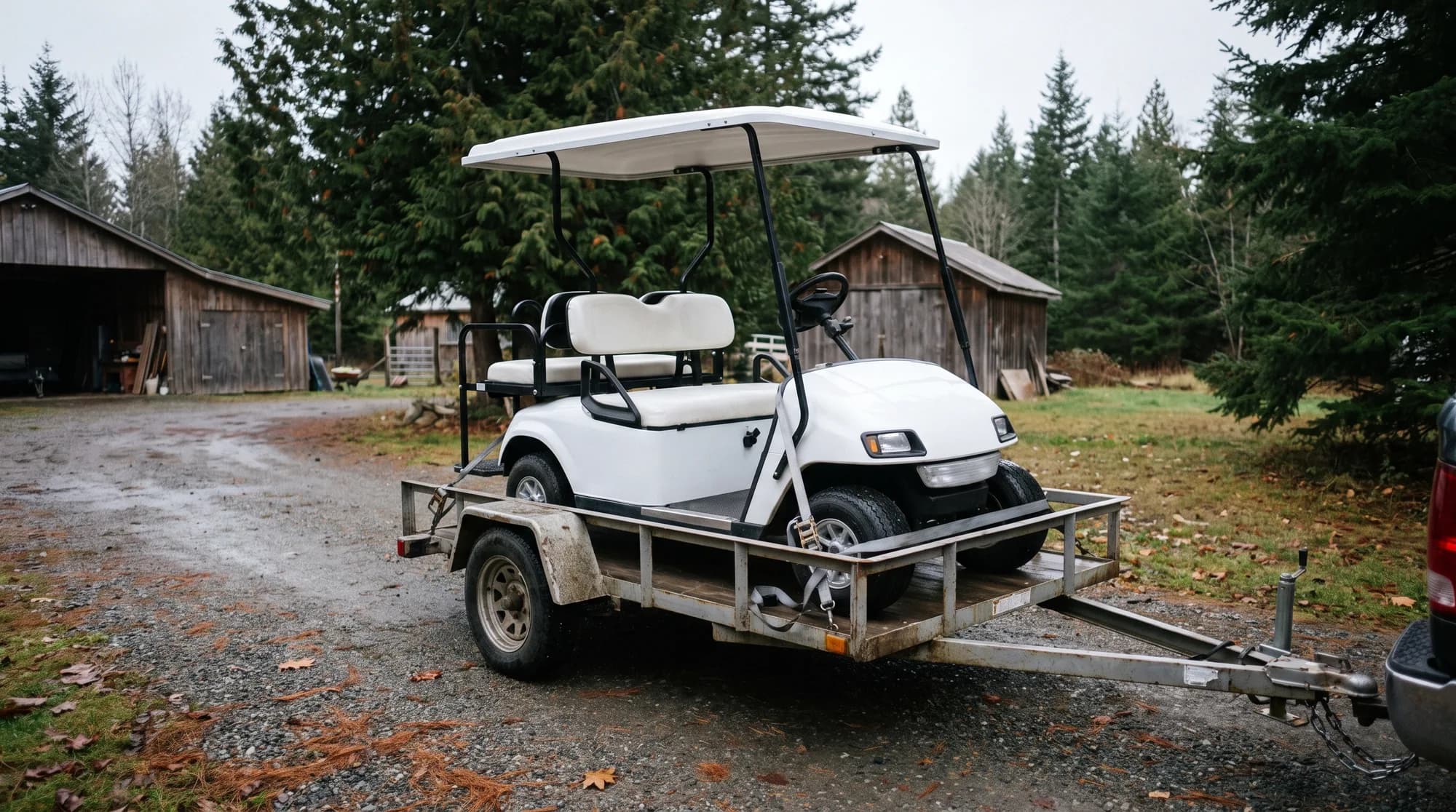
A course cart is designed for mown grass and gentle gradients. Much of Canada is not that. If your ground includes steep driveways, loose gravel, tree roots, mud in May or a skim of early snow, look for a stronger motor and controller, real ground clearance, and all-terrain tires. If you will tow a trailer, a mower or a load of firewood, check the manufacturer's towing figure rather than assuming. Underspecified carts do not fail dramatically; they just get slower, hotter and shorter-ranged until you resent them.
4. Seating and cargo: plan for the busy weekend
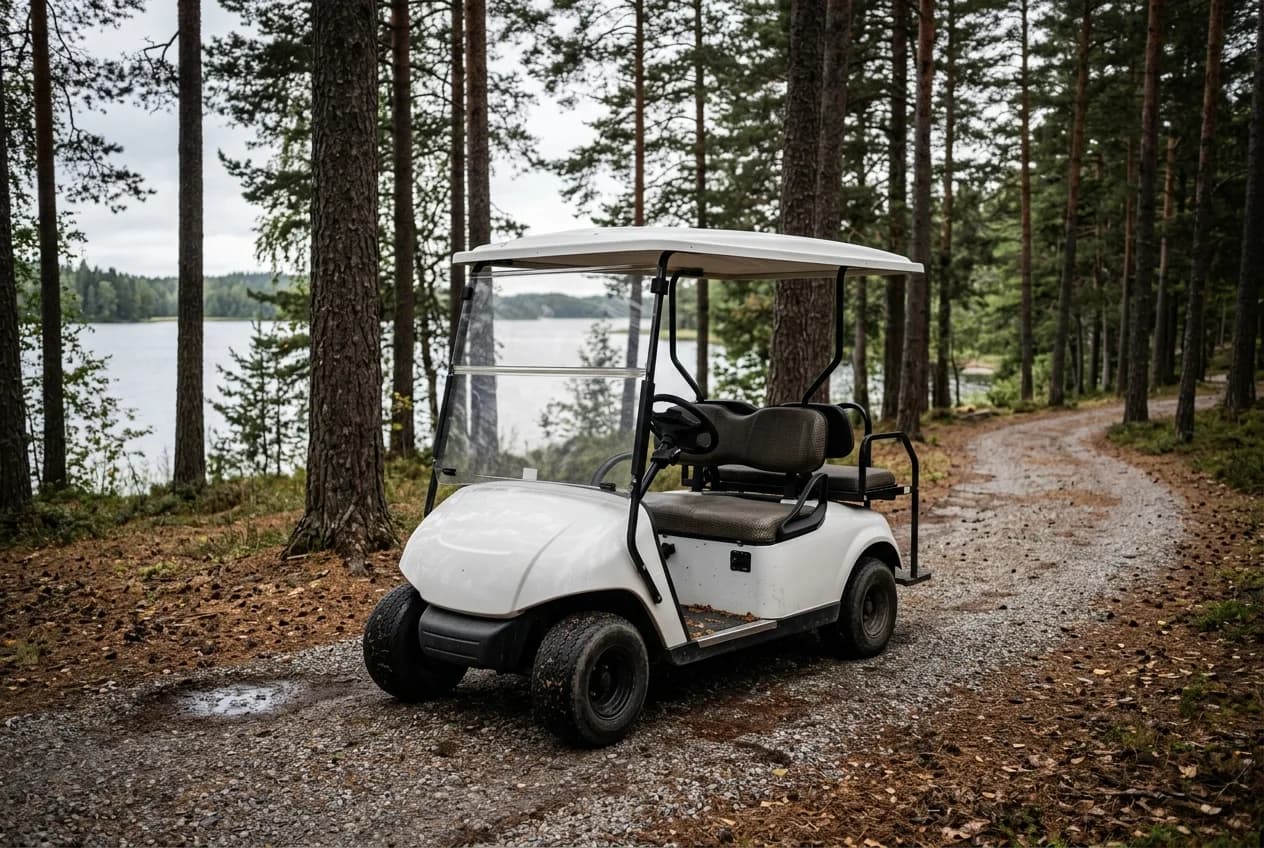
Buy for your worst week. A two-passenger suits a couple on a course; a cottage that hosts family in August needs four or six seats, and a rear seat that flips to a cargo deck is one of the most useful options in the catalogue. Think about what the cart will actually carry: coolers, propane cylinders, dock gear, luggage from the parking area. Payload and deck space cost little to specify at order time and are annoying to retrofit.
5. Weather protection: the season-stretcher
The difference between a cart you use from June to September and one you use from April to November is mostly weather protection. A hard windshield, a proper enclosure and a small heater kit turn shoulder-season trips from an endurance test into a non-event. If the cart lives outdoors, a fitted cover and an outdoor-rated charging point are not accessories, they are part of the purchase. Specify them up front and the cost disappears into the build; buy them piecemeal later and it stings.
6. Road rules: check before you spec
Whether you can drive a cart on public roads in Canada depends on your province and your municipality, and the honest answer is that most ordinary golf carts are not road vehicles by default. Ontario runs a pilot framework that lets participating municipalities permit golf carts on certain roads, other provinces handle things through their own vehicle acts and local bylaws, and federally, Transport Canada defines low-speed vehicles as a separate, regulated class. If road use matters to you, confirm the local position first, because it may dictate lights, mirrors, seatbelts and registration, and no accessory kit can turn a cart into something your province does not recognise.
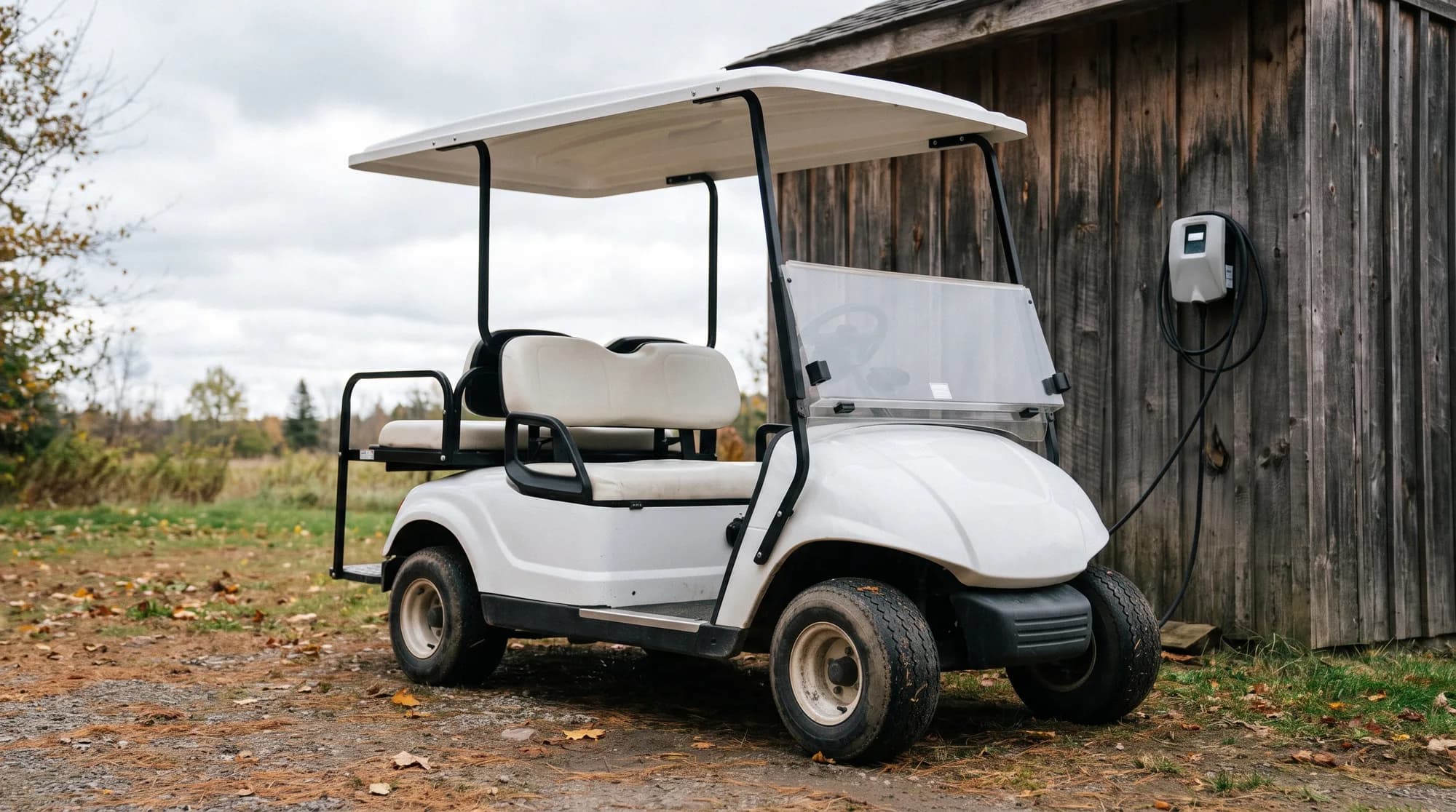
Charging deserves a line in the same decision. Wherever the cart parks, it needs a covered, outdoor-rated outlet on its own circuit, because a full charge is only a few kilowatt-hours and an ordinary 120-volt supply handles it overnight. What ruins the arrangement is the trailing extension cord across a wet yard, which is both a nuisance and a genuine fire risk. If you are specifying a cart for a new build or a renovation, ask the electrician for a dedicated outlet at the parking spot; it is a trivial cost during construction and an annoying one afterwards.
7. Build quality, warranty and parts
Finally, the boring criteria that decide how the cart feels in year five: a frame and body that shrug off gravel rash and UV, marine-grade fasteners if you are near water, a warranty that actually covers the battery for multiple years, and a supplier who will still answer the phone. A cart built to order lets you get all seven of these decisions right at the factory rather than compromising on whatever a forecourt happens to hold.
- Cottage / acreage
- Lithium, storage-tolerant
- Course / flat community
- Either, lithium still preferred
- Cottage / acreage
- High torque, hill-rated
- Course / flat community
- Standard
- Cottage / acreage
- All-terrain
- Course / flat community
- Turf
- Cottage / acreage
- 4 to 6, flip cargo deck
- Course / flat community
- 2 to 4
- Cottage / acreage
- Enclosure, heater, cover
- Course / flat community
- Windshield
| Cottage / acreage | Course / flat community | |
|---|---|---|
| Battery | Lithium, storage-tolerant | Either, lithium still preferred |
| Drivetrain | High torque, hill-rated | Standard |
| Tires | All-terrain | Turf |
| Seats | 4 to 6, flip cargo deck | 2 to 4 |
| Protection | Enclosure, heater, cover | Windshield |
- Which battery chemistry, and can it charge safely below freezing if I need it to?
- Does the claimed range beat my longest regular run by at least half again?
- Is the motor and clearance rated for my worst hill, surface and towing job?
- Will the seating and cargo layout survive my busiest weekend?
- What weather protection do I need to use it in April and November?
- Do my province and municipality allow the road use I am imagining?
- Who warranties the battery, for how long, and who supplies parts in five years?
Frequently asked questions
What is the best golf cart brand in Canada?+
There is no single answer, because the right cart depends on your terrain, seating needs and winters. Judge any brand against the criteria that matter in Canada: battery chemistry, cold-weather behaviour, torque, warranty and parts support.
Is lithium or lead-acid better for Canadian winters?+
Lithium, in most cases. It tolerates months of storage part-charged, keeps more capacity in cold weather and lasts more seasons. Just confirm the pack has low-temperature charge protection if you plan to charge it below freezing.
How much range do I need?+
Take your longest regular day and add at least 50%. Cold weather, hills and passengers can cut usable range by 20% to 40%, and batteries lose a little more capacity every season.
Can I drive my golf cart on the road in Canada?+
It depends on your province and municipality. Ontario has a pilot framework for participating municipalities, and Transport Canada treats low-speed vehicles as a separate regulated class. Check locally before you buy a spec around road use.
Are six-seat golf carts worth it?+
For cottages and families that host guests, usually yes, especially with a rear seat that flips into a cargo deck. For one or two people on flat ground, a four-passenger is cheaper, lighter and easier on the battery.
Spec the right cart, not the nearest one
Tell us your terrain, your winters and your busiest weekend, and we will build a specification around them. Hawke carts are built to order for exactly this reason.
Related solutions
Ready to explore what we build?
See the vehicles and the setting this applies to, or get a tailored quote built around your site.
Ready to find the right golf cart?
Tell us how and where it will work and we will specify a vehicle and a tailored quote built around you. Every build comes with a 3-year warranty and a 24-hour priority call-out.
Our guides are written and reviewed by the Hawke Electric Vehicles team, the people who specify, build, deliver and support the vehicles. We focus on honest, practical advice and flag where a figure depends on the build rather than guessing.
More guides by Hawke