This is one of the most common questions we're asked, and the honest answer surprises people. A standard golf buggy is built for private land, and most never need to be anything else. The moment any part of a journey uses a public road, though, the rules change completely, and that includes simply crossing one. Here's what making a buggy road legal actually involves in the UK, why converting a private-land buggy is rarely the smart move, and the route we'd point you to instead.
What does road legal actually mean?
Road legal isn't a single box you tick. It's several separate things that all have to line up before a vehicle can legally use a public road. In broad terms you need the vehicle to fall into the correct category, to have passed the right type approval, to be registered with the DVLA, to carry the required road equipment, to be insured for road use, and to be driven by someone with the correct licence. Miss any one of those and the vehicle isn't road legal, however well it's been finished.
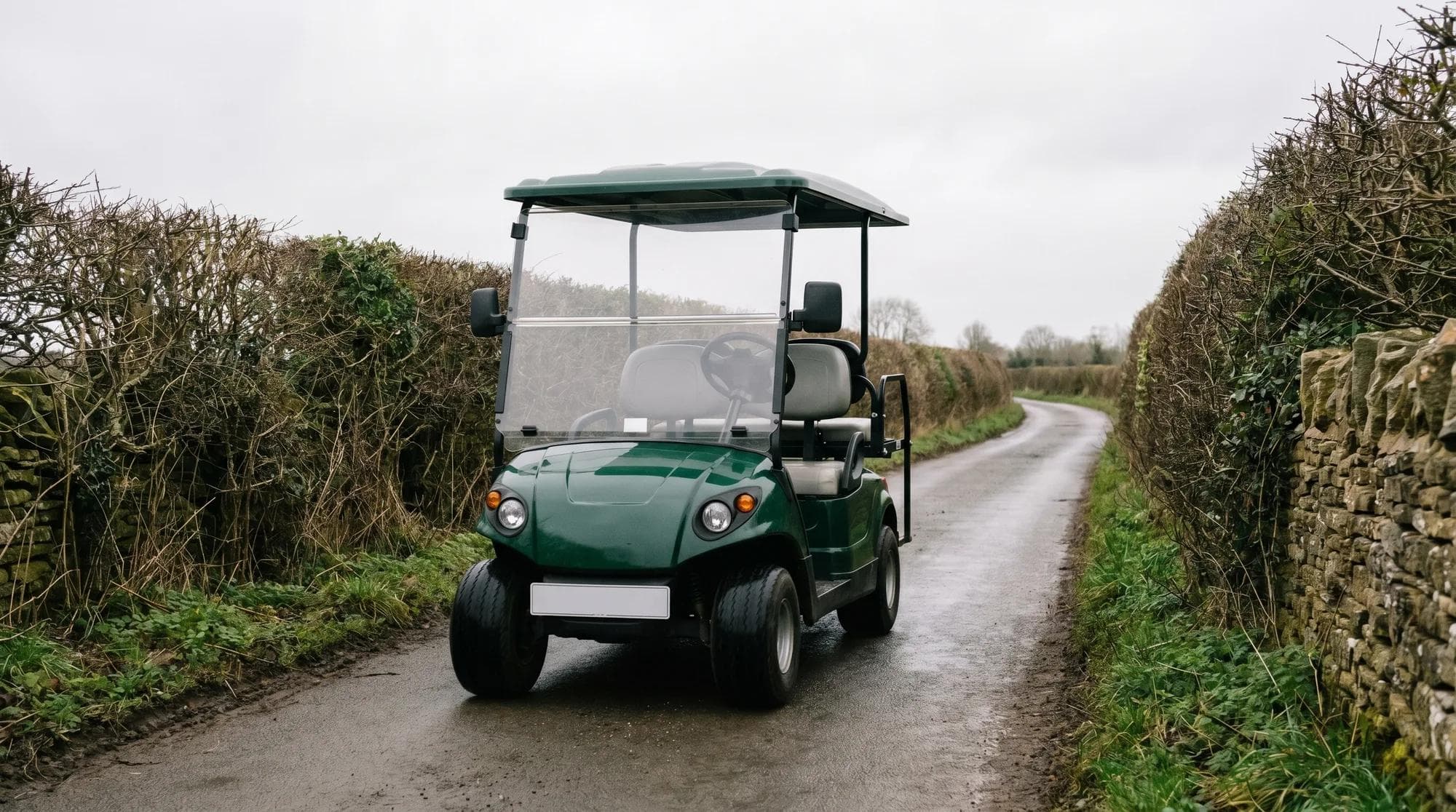
It also helps to be clear about what counts as road use. Driving along a public road plainly counts. So does crossing one, even a short hop between two parts of a site. If your route touches a public road at any point, you're in road-legal territory. Our pillar guide on whether golf buggies are road legal in the UK covers the wider picture, and can you drive a golf buggy on the road deals with the everyday version of the question.
The realistic steps to road legal
If you do need a buggy for the road, here are the pieces that generally have to come together. The order can vary and the detail depends on the vehicle, so use this as a map rather than a checklist.
- Get the vehicle category right. A road-going buggy has to fit a recognised vehicle category, and that decision shapes everything that follows, from the approval route to the equipment it needs. This is usually settled at the design stage, not bolted on later.
- Pass type approval, usually Motorcycle Single Vehicle Approval (MSVA). For a low-volume or one-off vehicle, the typical route is an MSVA inspection, where the vehicle is checked against safety and construction standards. A buggy designed only for private land is unlikely to meet these as supplied.
- Register with the DVLA. Once approved, the vehicle is registered so it can be taxed and identified. Registration follows approval, not the other way round.
- Fit the required road equipment. Think road-standard lighting, indicators, mirrors, a horn and other items the category demands. These have to meet specific standards, not just be present.
- Arrange road insurance. Private-land cover isn't the same as road insurance. You'll need a policy that covers road use for the vehicle and its category.
- Hold the correct licence. The driving licence category you need depends on the vehicle, so confirm what applies before anyone drives it on a road.

Why a standard buggy isn't built to be converted
Here's the part that catches people out. A standard golf buggy is engineered for private land. Its frame, brakes, lighting provision, electrics and overall construction are designed around that use, not around the standards a road vehicle has to meet. Adding a few lights and mirrors doesn't change the underlying design, and type approval looks at the whole vehicle, not just the accessories on the front.
So a retrofit usually means trying to bring a vehicle up to a standard it was never built to reach. That can be expensive, slow and uncertain, and there's no guarantee the result passes. It's a bit like trying to make a quiet garden tool into a road vehicle: possible to attempt, rarely sensible. Road-readiness is something you design in from the start, not something you add on at the end.
Road-readiness is designed in from the start, not bolted on at the end.
Convert, or buy road-ready? An honest comparison
Set the two routes side by side and the picture is usually clear. Converting a private-land buggy means taking on the cost, time and risk of approval on a vehicle that wasn't built for it. Specifying a purpose-built road-legal or single-seat model means the road-readiness is part of the design from day one.
- Convert a standard buggy
- Built for private land
- Buy road-ready or bespoke
- Designed for the road from the outset
- Convert a standard buggy
- Uncertain; may not pass
- Buy road-ready or bespoke
- Specified to meet the route from the start
- Convert a standard buggy
- High, and on you to manage
- Buy road-ready or bespoke
- Built around the requirement
- Convert a standard buggy
- Money spent with no guarantee
- Buy road-ready or bespoke
- Lower, because it's planned in
- Convert a standard buggy
- Rarely the sensible choice
- Buy road-ready or bespoke
- Anyone who genuinely needs road use
| Convert a standard buggy | Buy road-ready or bespoke | |
|---|---|---|
| Starting point | Built for private land | Designed for the road from the outset |
| Approval outcome | Uncertain; may not pass | Specified to meet the route from the start |
| Effort | High, and on you to manage | Built around the requirement |
| Risk | Money spent with no guarantee | Lower, because it's planned in |
| Best for | Rarely the sensible choice | Anyone who genuinely needs road use |
Our view is simple. If you genuinely need road use, don't start by buying a private-land buggy and hoping to convert it. Tell us at the enquiry stage, and we can talk through a vehicle specified for the road from the outset, whether that's a purpose-built road-legal model, a single-seat option or a bespoke build. It's almost always smarter, and usually cheaper in the end, than chasing approval on the wrong vehicle.
What to do before you commit
If road use is on the table, flag it before you buy, not after. A few minutes at the enquiry stage saves a lot of wasted money and time later. Tell us where the buggy will go, whether the route touches a public road at all, and how it'll be used day to day. We'll be straight with you about whether you need a road-ready vehicle, and help you specify the right one. If you're still mapping out the rules around tax, testing and driving, our guide to golf buggy licence, tax and MOT in the UK is a good next read.
Frequently asked questions
Can you make a golf buggy road legal in the UK?+
In principle a vehicle can be made road legal if it has the correct category, passes type approval (usually Motorcycle Single Vehicle Approval), is registered with the DVLA, carries the required road equipment, is insured for the road and is driven on the right licence. In practice, a standard buggy is built for private land and isn't designed to be converted, so a purpose-built road-legal model is usually the better route. Confirm the requirements for your specific vehicle.
What is Motorcycle Single Vehicle Approval (MSVA)?+
MSVA is the type-approval route commonly used for one-off or low-volume vehicles. The vehicle is inspected against safety and construction standards before it can be registered and used on the road. A buggy designed only for private land is unlikely to meet these standards as supplied, so check the route with a qualified approval specialist.
Do I need to register a golf buggy with the DVLA to use it on the road?+
Yes. To use a vehicle on a public road it generally needs to be registered with the DVLA once it has the correct approval, so it can be taxed and identified. Registration follows approval, not the other way round. Confirm the exact requirements for your vehicle and category.
Does crossing a public road count as road use?+
Yes. Even crossing a public road counts as road use, so the same rules apply as driving along one. If any part of your route touches a public road, you're in road-legal territory and need a vehicle specified for it.
Is it cheaper to convert a buggy or buy a road-legal one?+
We won't quote a figure, because it depends on the vehicle and the approval route. But converting a private-land buggy carries real cost, time and risk with no guarantee of passing, while a purpose-built road-legal model has the road-readiness designed in from the start. For genuine road use, the road-ready route is usually smarter and often cheaper overall.
What licence do I need to drive a road-legal buggy?+
The licence category you need depends on the vehicle and its classification, so there's no single answer that fits every buggy. Confirm what applies to your specific vehicle before anyone drives it on a public road. Our licence, tax and MOT guide covers the wider picture.
Need a buggy for the road? Tell us first
If your route touches a public road, flag it at the enquiry stage and we'll talk through a vehicle specified for the road from the outset, no wasted conversions. Start with a tailored quote.
Related solutions
Ready to explore what we build?
See the vehicles and the setting this applies to, or get a tailored quote built around your site.

Ready to find the right buggy?
Tell us how and where it will work and we will specify a vehicle and a tailored quote built around you. Every build comes with a 3-year warranty and a 24-hour priority call-out.
Our guides are written and reviewed by the Hawke Electric Vehicles team, the people who specify, build, deliver and support the vehicles. We focus on honest, practical advice and flag where a figure depends on the build rather than guessing.
More guides by Hawke