- Lithium golf cart batteries are lighter, charge faster and last far longer per cycle than lead-acid, but cost more up front.
- Lead-acid is cheaper to buy and still proven, but it is heavy, needs regular watering and topping up, and fades sooner.
- Over the life of the cart, lithium usually works out cheaper because you replace the pack far less often.
- Lithium holds its voltage and power as it discharges, so range and hill performance stay consistent right to the end of a charge.
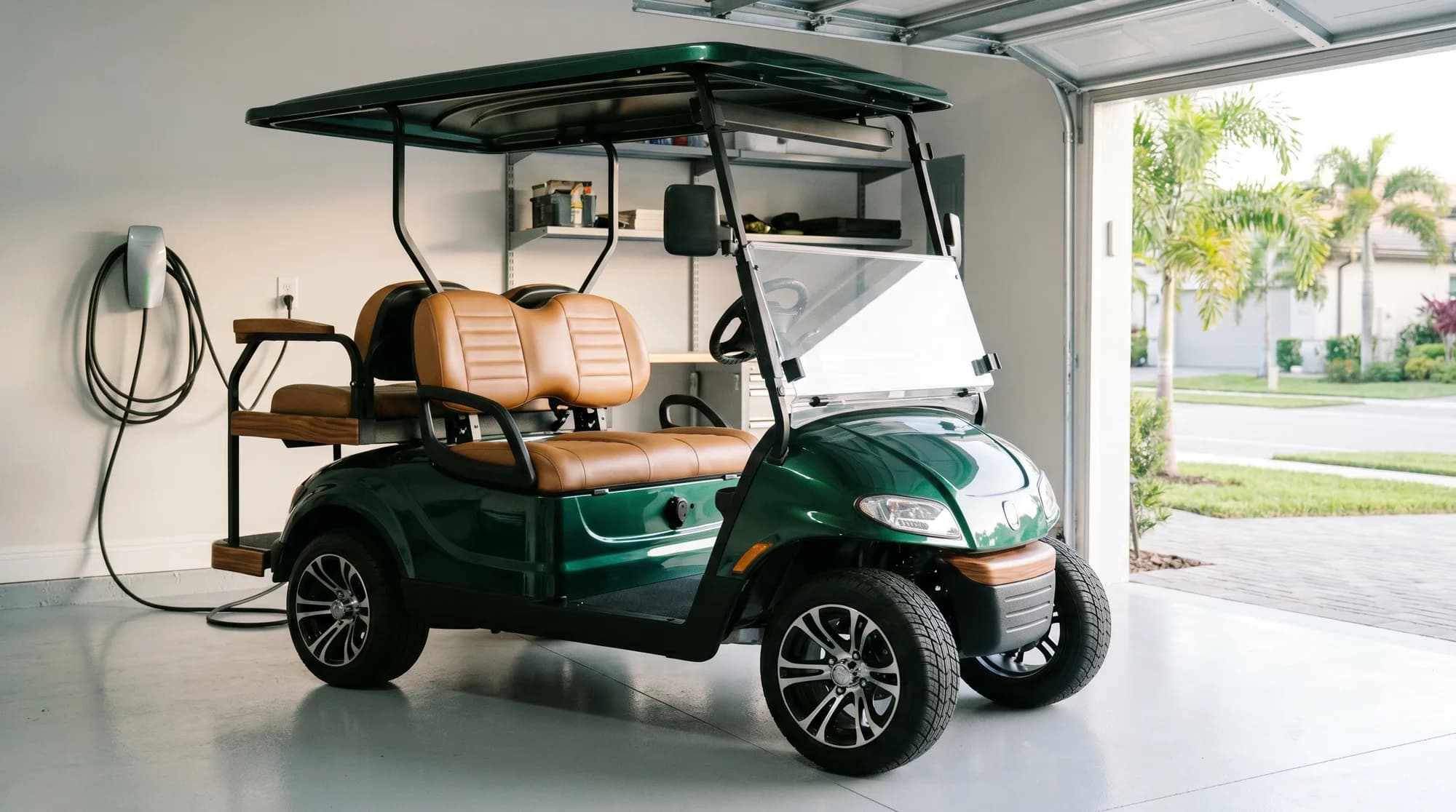
- Every Hawke golf cart is built around a lithium pack, which is why we focus on long service life rather than the lowest sticker price.
If you are choosing between lithium and lead-acid golf cart batteries, lithium is the stronger choice for almost every modern buyer: it lasts longer, charges faster, weighs much less and needs no watering. Lead-acid is cheaper to buy and still works, but it is heavy, high-maintenance and wears out sooner. Below is the honest, no-jargon breakdown so you can decide what suits your golf cart and how you use it.
The two battery types in one minute
A golf cart battery has one job: store enough energy to move a heavy vehicle, with people aboard, reliably and for years. Two chemistries dominate. Flooded lead-acid (sometimes sold as deep-cycle) is the traditional option that has powered carts for decades. Lithium (usually lithium iron phosphate, or LiFePO4) is the modern standard used in premium builds, including every cart we make.
Both will drive your cart around a course, a resort or a community. The difference is how they behave over hundreds of charges, how much they weigh, how much looking-after they need, and what they cost you across the years you actually own the cart.
Lithium vs lead-acid, side by side
- Lithium (LiFePO4)
- Very long, thousands of charge cycles
- Lead-acid
- Shorter, hundreds of cycles before fade
- Lithium (LiFePO4)
- Light, often under half the weight
- Lead-acid
- Heavy, a major part of cart weight
- Lithium (LiFePO4)
- Faster, can top up partially with no harm
- Lead-acid
- Slower, prefers full regular charges
- Lithium (LiFePO4)
- None, sealed and fit-and-forget
- Lead-acid
- Regular watering, cleaning, terminal care
- Lithium (LiFePO4)
- Steady power and range to the end
- Lead-acid
- Power and range tail off near empty
- Lithium (LiFePO4)
- Higher to buy
- Lead-acid
- Lower to buy
- Lithium (LiFePO4)
- Usually lower, fewer replacements
- Lead-acid
- Higher, replaced more often
| Factor | Lithium (LiFePO4) | Lead-acid |
|---|---|---|
| Lifespan (cycles) | Very long, thousands of charge cycles | Shorter, hundreds of cycles before fade |
| Weight | Light, often under half the weight | Heavy, a major part of cart weight |
| Charging | Faster, can top up partially with no harm | Slower, prefers full regular charges |
| Maintenance | None, sealed and fit-and-forget | Regular watering, cleaning, terminal care |
| Performance as it drains | Steady power and range to the end | Power and range tail off near empty |
| Up-front cost | Higher to buy | Lower to buy |
| Cost over cart's life | Usually lower, fewer replacements | Higher, replaced more often |
Why lithium usually wins on cost over time
The sticker price of lead-acid is tempting, but it is only part of the story. Lead-acid packs typically need replacing several times across the life of a well-used cart, and each replacement is labour plus materials. Lithium packs last far longer per cycle, so you buy once and run for years. When you add up replacements, water, charger wear and your own time, lithium often costs less in the long run even though it costs more on day one.
Range, hills and consistent power
One thing that surprises people moving from lead-acid to lithium is how consistent the power feels. Lead-acid voltage sags as the pack drains, so the cart can feel sluggish on hills near the end of a round, and your usable range shrinks. Lithium holds its voltage almost flat, so the cart pulls the same on the last hole as the first, and you get more of the rated range as genuinely usable miles.
If you drive a hilly course, a resort with slopes or carry passengers and gear, that steady delivery matters. It is also why heavier multi-seat builds in the range are designed around lithium rather than lead-acid.
Weight, charging and everyday convenience
- Weight: lithium can save a large amount of weight, which improves range, handling and tire life and is gentler on the course.
- Charging: lithium charges faster and is happy with partial top-ups between uses, so you can plug in whenever it is convenient.
- Maintenance: lithium is sealed, so there is no watering, no acid, no corroded terminals and no scheduled cleaning ritual.
- Cold and heat: a good lithium pack with a proper battery management system handles temperature swings more gracefully than older lead-acid.
When lead-acid might still make sense
Lead-acid is not obsolete. If a cart is used very lightly, the budget is tight up front, and someone is happy to do the watering and upkeep, lead-acid can still serve. It is also widely available and cheap to replace in a pinch. But for anyone who wants low fuss, long life and consistent performance, lithium is the better fit, and it is the standard we build to.
Want a golf cart built around a long-life lithium pack?
Every Hawke cart is custom-built around a lithium battery and backed by a 3-year warranty. Tell us how you will use it and we will spec the right pack and range for the job.
How to choose for your situation
- 01
Map your real use
Note how far you drive between charges, how hilly the ground is, how many seats and how much load you carry.
- 02
Decide your horizon
If you plan to keep the cart for years, weigh total cost over that period, not just the first battery purchase.
- 03
Match the pack to the job
Heavier carts, more passengers and longer routes point firmly to lithium for steady power and range.
- 04
Ask about warranty and support
A pack is only as good as the warranty and the help behind it. Read [our guides](/guides) and ask before you buy.
Frequently asked questions
Are lithium golf cart batteries worth the extra cost?+
For most owners, yes. They last far longer per charge cycle, need no maintenance and keep their performance, so the higher up-front price is usually offset by fewer replacements over the cart's life.
Can I put lithium batteries in an old lead-acid golf cart?+
Often you can convert, but it is not always a simple swap. Voltage, charger compatibility and the battery management system all matter, so it should be done properly rather than mixing parts. A purpose-built lithium cart avoids the compromise.
Do lithium golf cart batteries need any maintenance?+
Effectively none. They are sealed, so there is no watering, no acid topping-up and no terminal cleaning routine. Sensible charging habits are all that is needed.
Which lasts longer, lithium or lead-acid?+
Lithium, by a wide margin. Lithium packs are rated for thousands of charge cycles, while lead-acid is measured in hundreds before capacity fades noticeably.
Does cold weather affect golf cart batteries?+
Both chemistries are affected by cold, but a quality lithium pack with a proper battery management system generally copes better. If you run a cart in cold conditions, mention it so the build can account for it.
Related solutions
Ready to explore what we build?
See the vehicles and the setting this applies to, or get a tailored quote built around your site.

Ready to find the right buggy?
Tell us how and where it will work and we will specify a vehicle and a tailored quote built around you. Every build comes with a 3-year warranty and a 24-hour priority call-out.
Our guides are written and reviewed by the Hawke Electric Vehicles team, the people who specify, build, deliver and support the vehicles. We focus on honest, practical advice and flag where a figure depends on the build rather than guessing.
More guides by Hawke