You can make a golf cart faster, and only two routes actually raise the top speed: adjusting the controller's speed settings, which is dealer-adjustable on many models, or fitting a more powerful motor. Everything else, including the popular lithium conversion, changes how quick the cart feels rather than how fast it goes.
Before we get into either route, the ground rules, because this is a topic where the caveats matter more than the technique. Extra speed is for private land only. It can void your warranty. Your insurer may treat derestriction as a material change to the risk. And most UK golf carts are limited to 12 to 15 mph for reasons that don't disappear just because the limiter does. If that paragraph hasn't put you off, read on, because there's a right way and several wrong ways to do this.
- Most UK golf carts are factory-limited to 12 to 15 mph. Controller speed settings and motor swaps are the only routes that truly raise that.
- More speed changes nothing legally: a golf cart isn't road-legal in the UK at 12 mph and it isn't road-legal at 20 mph either.
- A lithium conversion often feels quicker because voltage stays steadier under load, but it doesn't raise the limited top speed.
- Derestriction can void your warranty, and insurers may treat it as a material change you're obliged to disclose.
- Hire fleets and club golf carts should stay restricted. If you genuinely need more pace, buy a vehicle specified for it instead.
Why is your cart limited in the first place?
It's not arbitrary. A cart carries passengers on bench seats, often without belts, on wet grass and slopes, with brakes sized for its factory speed. At 12 mph all of that hangs together. Raise the speed by half and the braking distance grows far more than half, the body roll in a turn gets worse, and a passenger sliding off a bench seat becomes a genuine possibility rather than a theoretical one. Manufacturers also limit speed to protect turf; greenkeepers can tell you exactly which golf carts on the fleet have been fiddled with just by looking at the wear patterns. Speed limits on golf carts are a package deal with the rest of the engineering.
The legal bit, before anything else
Making a cart faster changes nothing about where you can drive it. A standard golf cart is not road-legal in the UK, full stop, and no speed adjustment in either direction alters that; our guide to cart road legality covers the detail. You'll also see a 4 mph figure quoted online as some kind of cart speed law. It isn't. That figure belongs to Class 2 mobility vehicles on pavements and has nothing to do with golf carts. On private land with no public access, speed is between you, your warranty and your insurer. But be careful with the word private: under the Road Traffic Act's public place doctrine, car parks, event sites and estate roads open to the public can count as public places even on private property.
Fleet operators should treat this as settled: keep club and hire golf carts restricted, and document that they are. Our guide to fleet compliance under PUWER explains where speed settings fit into equipment duties.
Route 1: controller and speed-code settings
The cheapest legitimate route. Many modern golf carts store their top speed as a software setting in the motor controller, sometimes called a speed code or drive profile, and a dealer with the right handset can adjust it in minutes. Some models offer selectable modes from the factory, a slower golf setting and a faster private-land setting, in which case you're not modifying anything at all. The advantages are real: no new hardware, components stay matched, and the change is reversible. Ask the dealer two questions first: what does this do to my warranty, and what's the maximum the brakes and chassis are rated for. If the answers are vague, walk away.
Route 2: motor swaps
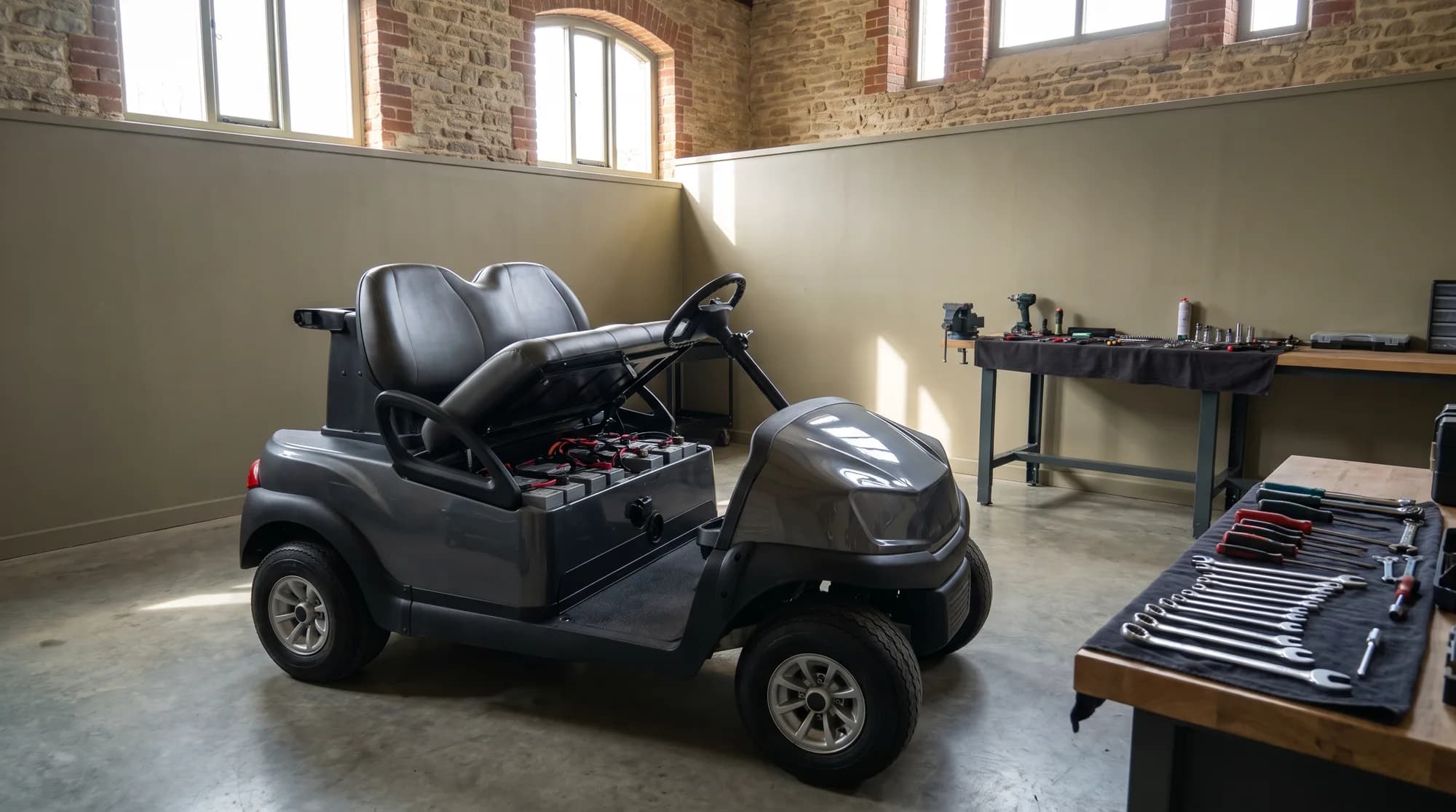
A higher-speed or higher-torque motor transforms performance, and for most owners it's the wrong answer anyway. Fitted properly you're typically looking at £600 to £1,500 or more once the controller and wiring are upgraded to match, and the stress doesn't stop at the motor: brakes, axles, and suspension all now operate beyond what they were designed around. Done without matching upgrades it's how you turn a safe slow vehicle into an unsafe fast one. There are legitimate cases, usually steep-terrain estates that need torque rather than speed, but they're better served by buying the right vehicle than rebuilding the wrong one.
The lithium myth
Owners who convert to lithium almost always report the cart feels faster. Mostly, it isn't. What's changed is voltage sag: a lead-acid pack's voltage drops noticeably under load and as it discharges, so the cart gets sluggish on hills and towards the end of a round. Lithium holds its voltage steadier, so the cart pulls consistently all day. Same top speed, much better delivery. If the sluggishness is what's actually bothering you, a lithium conversion solves the real problem without touching the limiter, and it's the option we'd point most frustrated owners at first.

Comparing the options honestly
- Typical cost (rough guide)
- £0 to £150
- Effect on top speed
- Modest rise where the model supports it
- Verdict
- The sane option, private land only
- Typical cost (rough guide)
- £600 to £1,500+
- Effect on top speed
- Significant
- Verdict
- Rarely worth it; stresses brakes and axles
- Typical cost (rough guide)
- £1,200 to £2,500
- Effect on top speed
- None, but feels quicker under load
- Verdict
- Do it for consistency and range, not speed
- Typical cost (rough guide)
- £150 to £600
- Effect on top speed
- Varies wildly
- Verdict
- Skip: warranty and insurance risk
- Typical cost (rough guide)
- Quote-based
- Effect on top speed
- Whatever you actually need
- Verdict
- The right answer for most people
| Typical cost (rough guide) | Effect on top speed | Verdict | |
|---|---|---|---|
| Dealer speed-code adjustment | £0 to £150 | Modest rise where the model supports it | The sane option, private land only |
| Motor swap with matched controller | £600 to £1,500+ | Significant | Rarely worth it; stresses brakes and axles |
| Lithium conversion | £1,200 to £2,500 | None, but feels quicker under load | Do it for consistency and range, not speed |
| Aftermarket speed kit | £150 to £600 | Varies wildly | Skip: warranty and insurance risk |
| Buy a cart specified for the job | Quote-based | Whatever you actually need | The right answer for most people |
When more speed is simply a bad idea
Some cases against, from people who see the aftermath. Carrying passengers, especially children or elderly relatives, on bench seats without belts: no. Wet grass, which roughly doubles stopping distances at the best of times: think hard. Golf course use, where a faster cart tears turf on every acceleration and turn: your greenkeeper will find out. And any situation where other people use the cart, because the limiter you removed was also protecting you from their judgement. Speed on a cart is like seasoning; the right amount is less than enthusiasts think.
Frequently asked questions
How fast can a golf cart legally go in the UK?+
There's no specific cart speed law because golf carts aren't road vehicles; most are factory-limited to 12 to 15 mph. On genuinely private land no speed limit applies, but the vehicle remains not road-legal regardless of its speed, and public place rules can still catch car parks and event sites.
Can you derestrict an electric golf cart?+
Often yes, via dealer-adjustable controller settings on many models. Whether you should is another matter: it's for private land only, it may void your warranty, and your insurer may treat it as a material change. Hire and club fleets should stay restricted.
Does making a cart faster void the warranty?+
It can. Aftermarket speed kits and motor swaps commonly void the drivetrain warranty, and even dealer speed adjustments can affect cover on some brands. Get the warranty position in writing before any change is made.
Why is my golf cart limited to 12 mph?+
Because the brakes, tires, seating and stability were all engineered around that speed, and because turf and passenger safety suffer quickly above it. The limiter is part of the vehicle's safety case, not an artificial restriction bolted on at the end.
Are lithium golf carts faster?+
Not in top speed, no. Lithium packs hold voltage steadier under load, so the cart accelerates more consistently and doesn't fade on hills or late in the day. It feels quicker while the limited maximum stays the same.
If your cart feels slow, work out what's actually wrong first. Fading on hills points to the battery, not the limiter, and a lithium pack fixes it. If you do need more pace for a big private estate, have the speed setting adjusted properly by a dealer with the warranty position in writing. And if you're specifying a new vehicle, buy the performance you need up front, with the motor, brakes and payload rated for it as a matched package, rather than derestricting something that was never designed for the job.
Need real performance? Spec it properly
Tell us about your ground, your loads and your hills, and we'll quote a vehicle with the motor, braking and payload specified for the job from day one, covered by a 3-year warranty.
Related solutions
Ready to explore what we build?
See the vehicles and the setting this applies to, or get a tailored quote built around your site.

Ready to find the right golf cart?
Tell us how and where it will work and we will specify a vehicle and a tailored quote built around you. Every build comes with a 3-year warranty and a 24-hour priority call-out.
Our guides are written and reviewed by the Hawke Electric Vehicles team, the people who specify, build, deliver and support the vehicles. We focus on honest, practical advice and flag where a figure depends on the build rather than guessing.
More guides by Hawke