Golf cart motor power is quoted in kilowatts, and the kW figure answers one question: how much work can this motor do? More kilowatts means the cart can climb steeper hills without slowing to a crawl, carry a full load of passengers without complaint, and tow more behind it. What the kW figure does not tell you is how fast the cart goes, because top speed on a cart is set deliberately by the controller, not by the motor running out of muscle. This guide puts motor power in plain English: what kW and torque actually change, what they do not, how AC and DC motors differ in general terms, and how to read a spec sheet against the ground your cart will actually work on.
- kW measures how much work the motor can do; torque is its turning force from a standstill.
- More power improves hills, laden performance and towing, the things that strain a cart.
- Top speed is limited deliberately by the controller; more kW does not raise it.
- AC motors are the modern standard, generally smoother and more efficient; DC motors are simpler and common on older golf carts.
- Match motor power to your ground and loads, not to the biggest number on the page.
What golf cart motor power actually measures
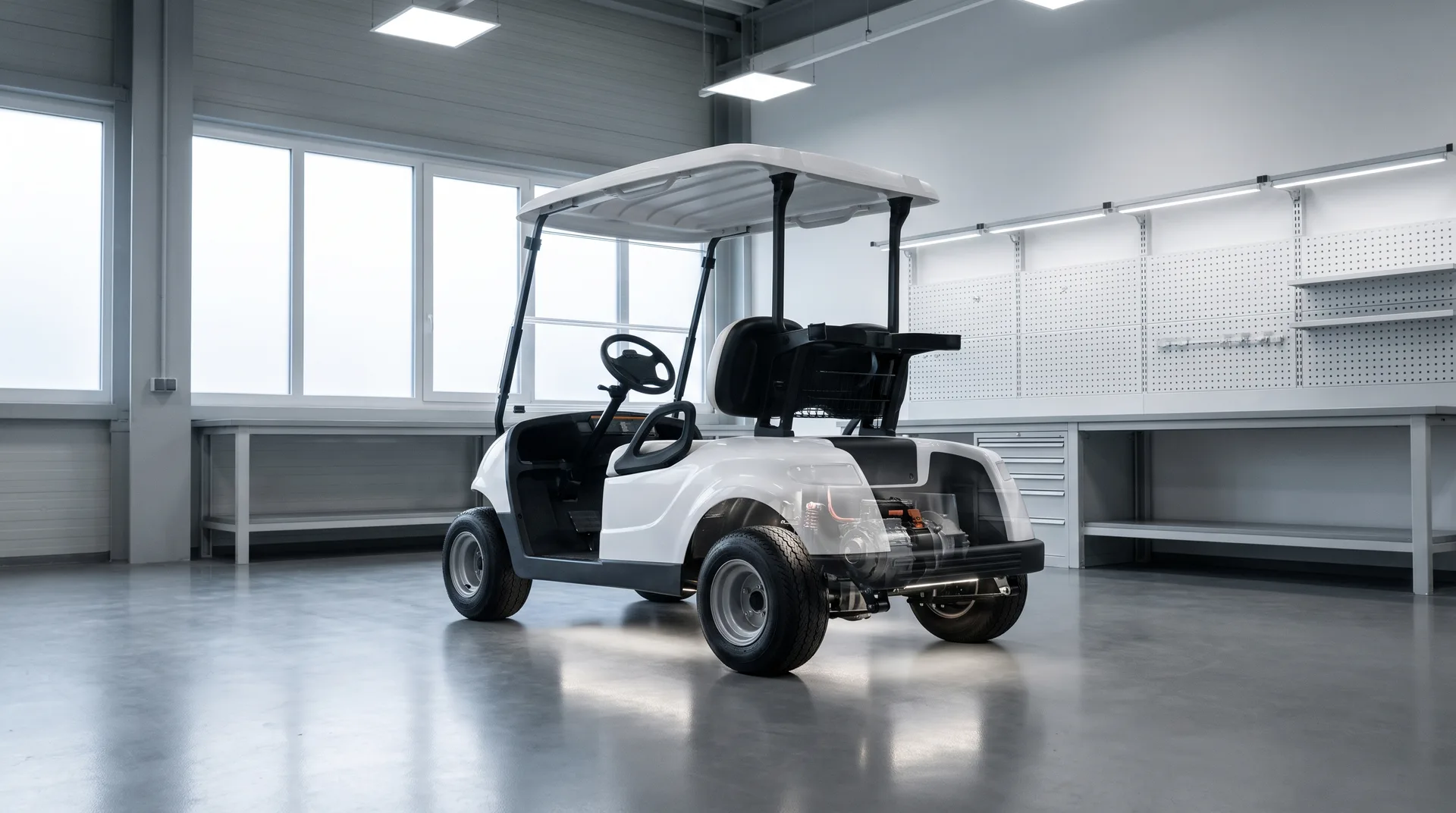
Two numbers describe an electric motor's muscle. Power, in kilowatts, is the rate at which it can do work; torque is the twisting force it applies to the wheels, and electric motors deliver strong torque from a standstill, which is why even a modest cart pulls away briskly. The relationship to daily life is direct. Climbing a hill is work; so is hauling six passengers, crossing soft or wet grass, or towing a trailer of tools. A motor with more capability in reserve does those jobs at pace and without heat building up, where an undersized motor slows, strains and ages faster. Manufacturers sometimes quote two figures, a continuous rating the motor sustains all day and a higher peak rating for short bursts; the continuous figure is the honest one to compare, since hills are climbed on it. The motor works as part of a system with the battery and controller, which our explainer on how electric golf carts work sets out end to end.
What more power changes: hills, loads and towing
Where motor power earns its money is under load. On the flat, with two people aboard, almost any cart feels fine, and spec-sheet differences vanish. Put the same golf carts on a long slope with every seat full and they separate immediately: the stronger motor holds its pace, the weaker one slows and works hot. The same applies to laden utility work and towing, where the motor is moving the cart's own weight plus everything aboard and behind it. This is why the honest sizing question is not how powerful is a golf cart in general, but what will yours be asked to do: a flat parkland course asks little, a hilly estate with wet grass and loaded seats asks a great deal, and a cart that tows asks most of all. If a cart you already own struggles on climbs it managed before, that is usually a battery or maintenance issue rather than the motor shrinking, and our guide on losing power uphill works through the causes.
Why more kW does not mean more speed
It surprises many buyers, but a cart's top speed is a decision, not a limit the motor hits. The controller caps speed deliberately, because golf carts share space with pedestrians, golfers and guests, work on grass and gradients, and are driven by people with no special training; a modest ceiling is a safety feature, and site operators often specify lower caps again for crowded venues. So two golf carts with quite different motors can share an identical top speed, and the extra kilowatts in the stronger machine appear as composure under load rather than pace on the flat. The full picture on cart speeds, and why chasing more is usually the wrong instinct, is in our guide to how fast electric golf carts go.
AC versus DC golf cart motors in general terms
Older golf carts mostly use DC motors: simple, robust, cheap to maintain, and still perfectly serviceable, though brushed types need occasional attention and efficiency is lower. Modern golf carts have moved to AC motors, which are generally smoother, more efficient and better at fine control, and pair naturally with regenerative braking, feeding energy back to the battery on descents while holding the cart to a controlled speed downhill. AC drivetrains also manage heat better under sustained load, which suits hilly ground and heavy duty. For a buyer the practical reading is straightforward: on a used cart a DC motor is normal and nothing to fear, while a new machine will typically be AC, and the differences show up as refinement and efficiency rather than headline numbers. When you compare models across the range, weigh the motor rating against your steepest hill and heaviest regular load, and if you are unsure, describe the ground honestly when you enquire; matching the drivetrain to the site is precisely the specifying work a supplier should do for you.
Frequently asked questions
How powerful is a typical golf cart motor?+
Cart motors are rated in single-figure kilowatts, sized for their job: enough to climb, carry and tow within the vehicle's rating, not to reach high speeds. Larger passenger and utility models carry stronger motors than two-seat course golf carts. Compare continuous ratings, not peak figures.
Does a bigger motor make a golf cart faster?+
No. Top speed is capped by the controller as a deliberate safety decision, so extra motor power shows up as better hill climbing and laden performance, not a higher maximum.
Is an AC motor better than a DC motor in a golf cart?+
AC is the modern standard: generally smoother, more efficient, better under sustained load and paired with regenerative braking. DC motors on older golf carts remain simple and dependable. For a new cart AC is the norm; on a used one a healthy DC motor is fine.
What is torque and why does it matter on a cart?+
Torque is the motor's turning force. Electric motors deliver it from a standstill, which gives golf carts their brisk pull-away and their ability to start on a slope fully laden. For hilly sites, strong torque matters more than headline speed.
My cart feels down on power. Is the motor worn out?+
Usually not. Fading performance is far more often the battery pack ageing, a charging problem or a mechanical drag such as brakes binding. Have the batteries tested before condemning the motor, and get a fault diagnosed rather than guessed at.
Match the right drivetrain to your ground
Tell us about your hills, loads and daily routes, and we will recommend a cart with the motor and battery to handle them comfortably, specified honestly for the work.
Related solutions
Ready to explore what we build?
See the vehicles and the setting this applies to, or get a tailored quote built around your site.
Ready to find the right golf cart?
Tell us how and where it will work and we will specify a vehicle and a tailored quote built around you. Every build comes with a 3-year warranty and a 24-hour priority call-out.
Our guides are written and reviewed by the Hawke Electric Vehicles team, the people who specify, build, deliver and support the vehicles. We focus on honest, practical advice and flag where a figure depends on the build rather than guessing.
More guides by Hawke