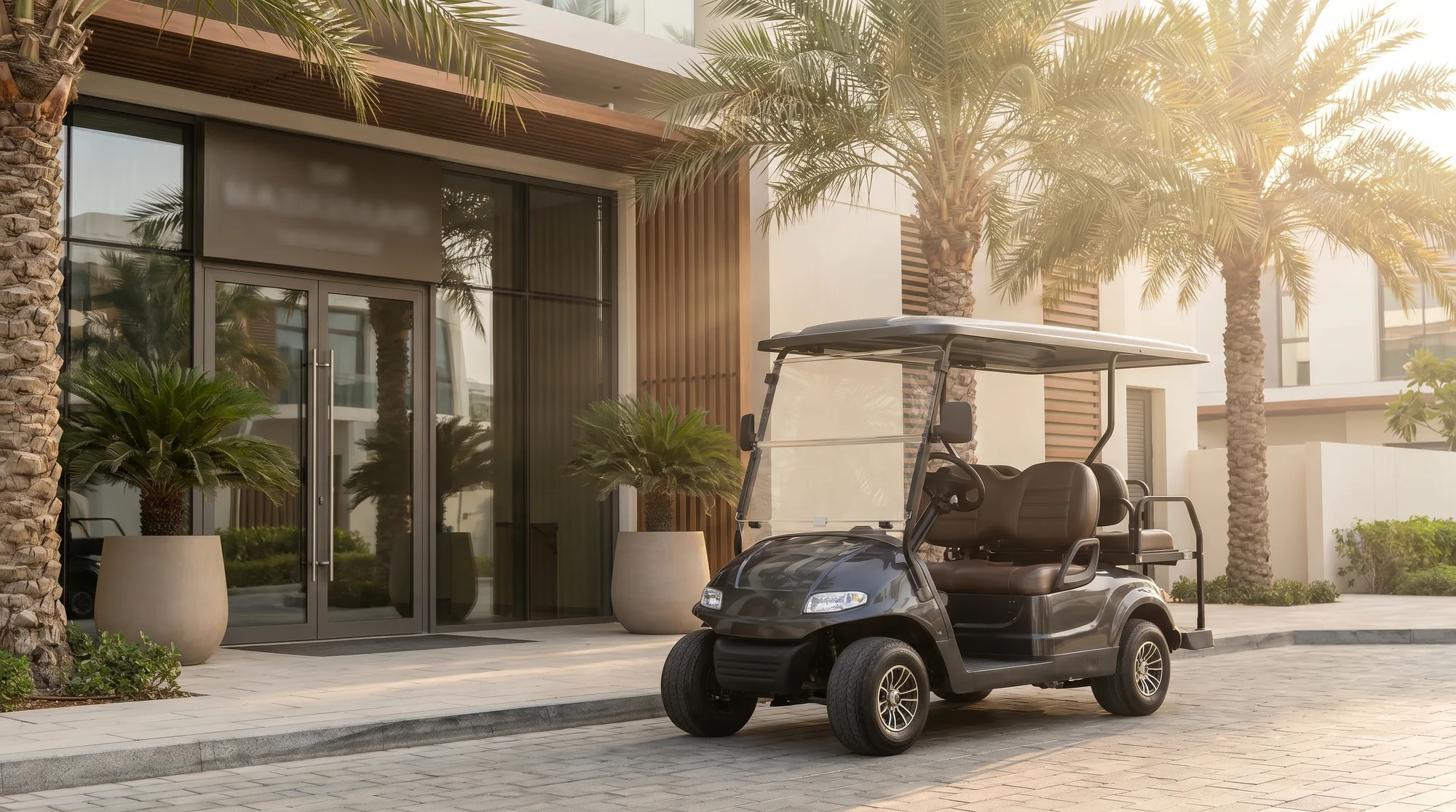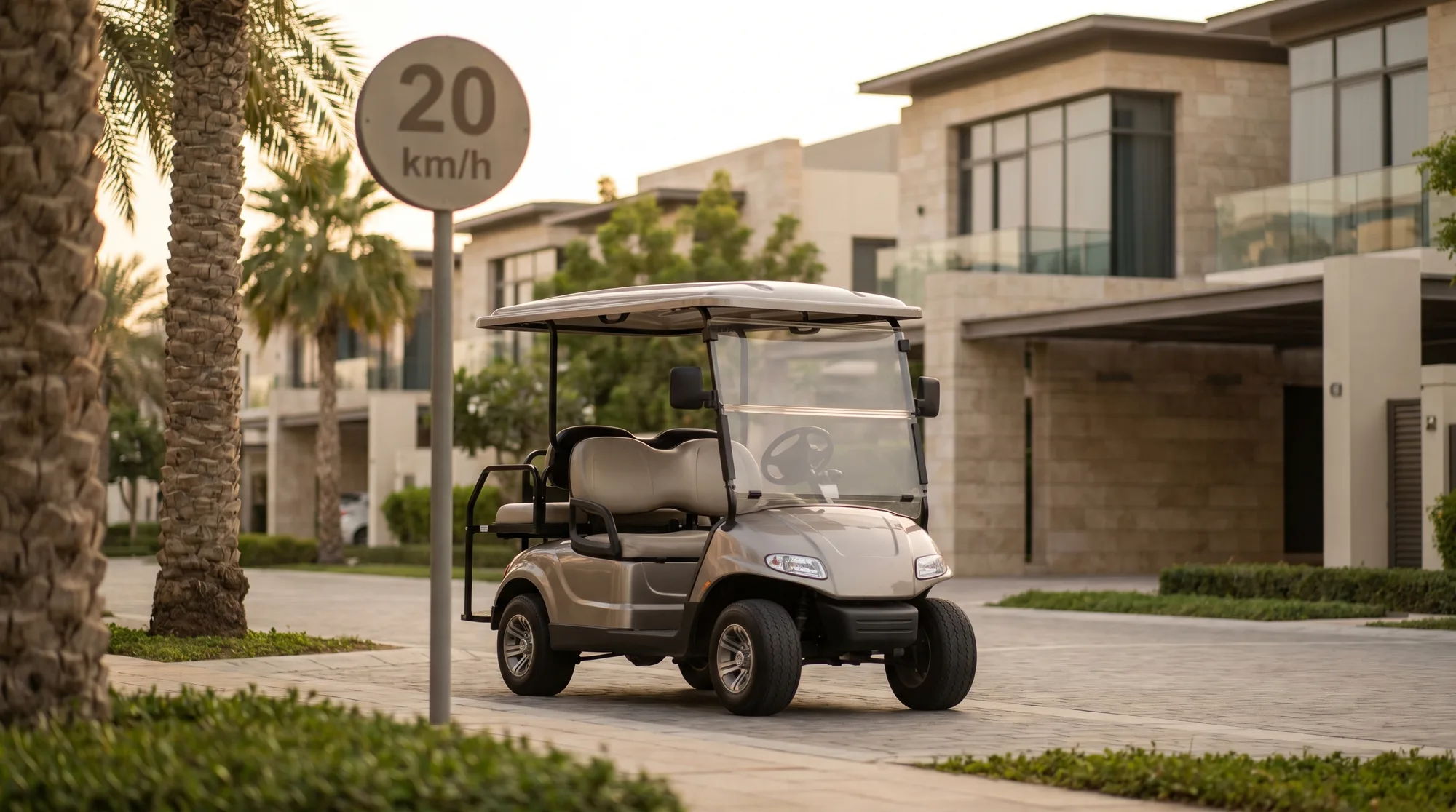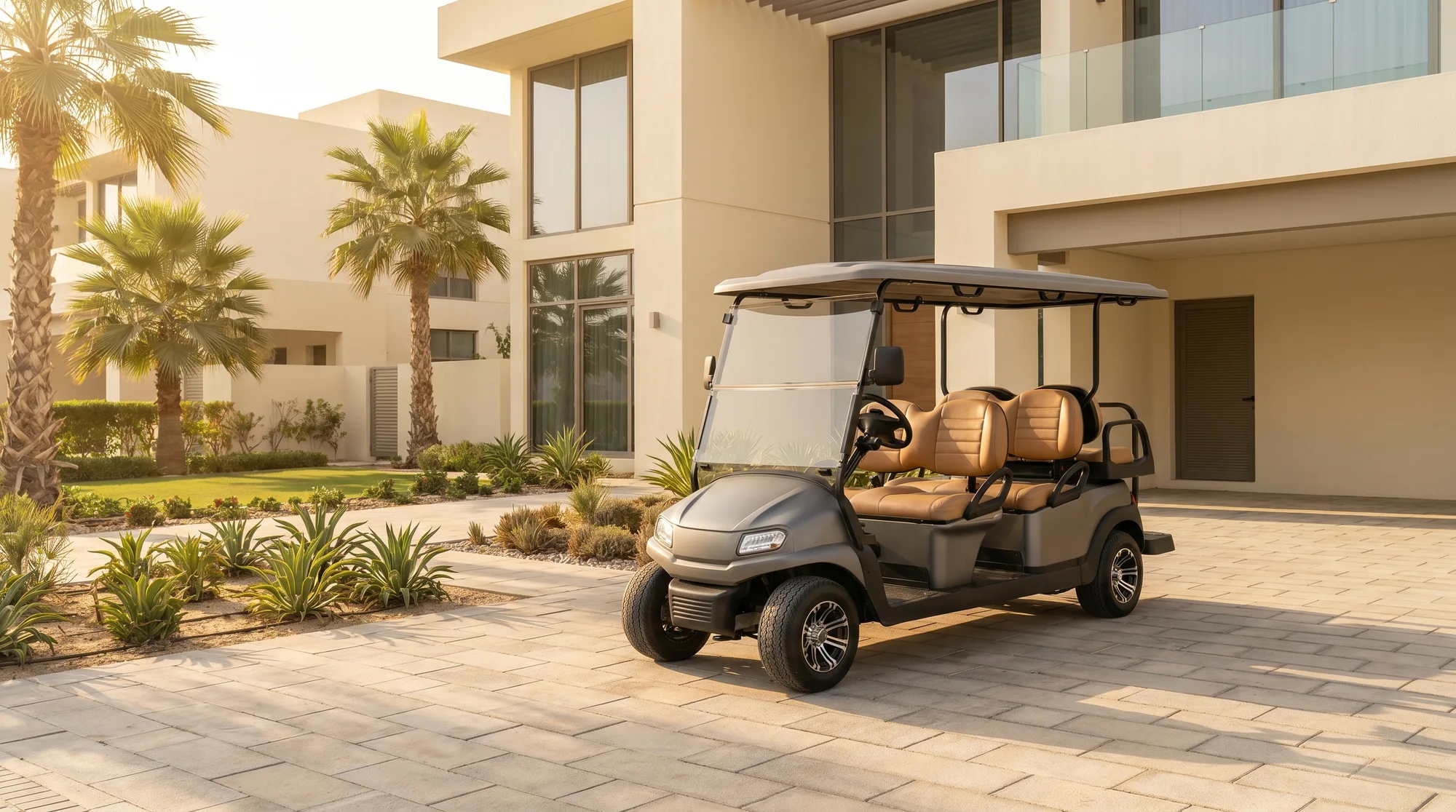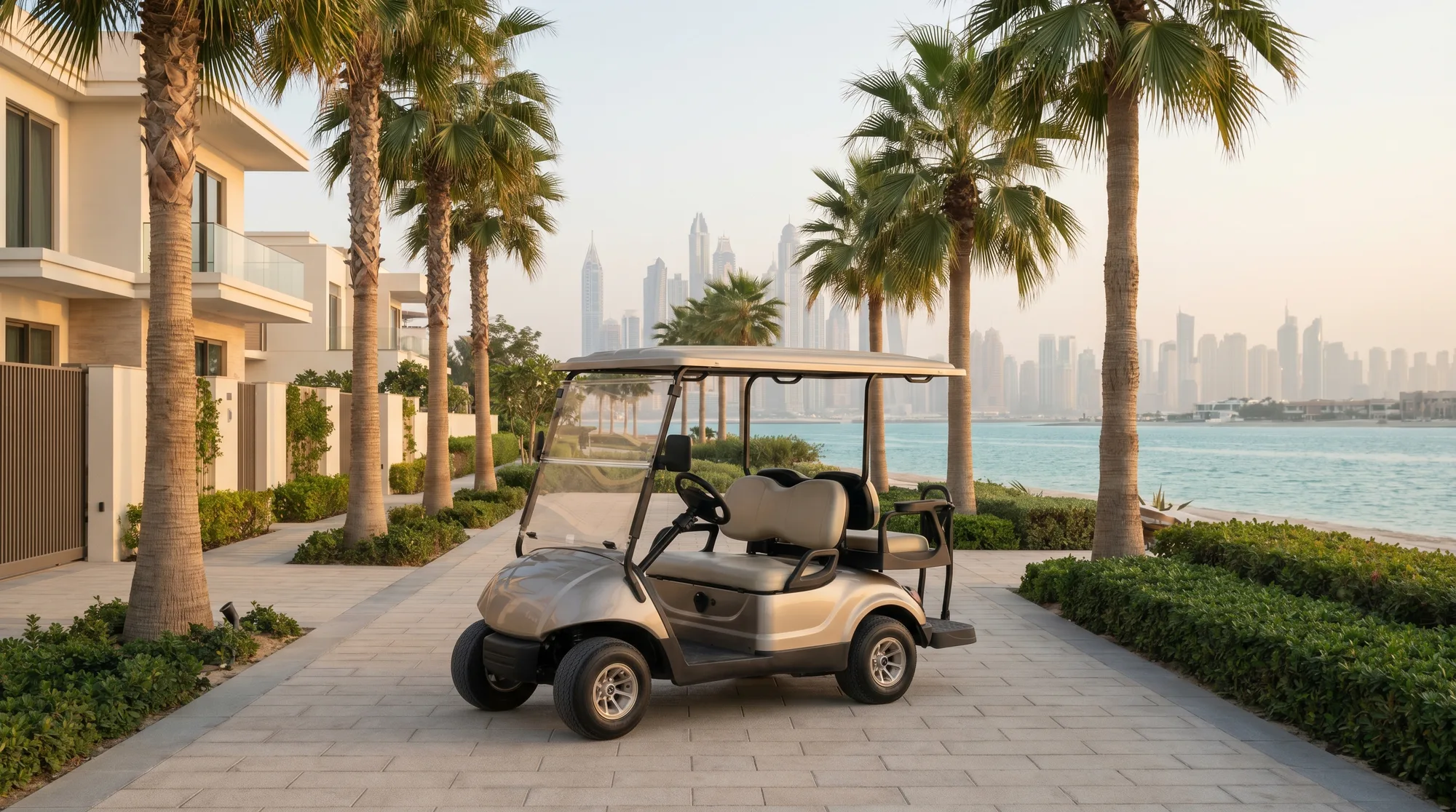
It is one of the first questions any buyer in the Emirates asks, and the honest answer surprises people. A golf cart, or golf buggy as it is just as often called here, is not classified as a road-legal vehicle for public roads in the UAE. The Roads and Transport Authority (RTA) and the federal traffic framework treat these low-speed electric vehicles as private-use machines, not as cars or motorcycles that can be registered for general road use.
That does not make them illegal to own or drive. It simply defines where you can use one. In practice that means inside gated communities, on golf courses and resorts, across farms and private estates, and within industrial plots and free zones. Understanding that line is the single most useful thing you can do before you buy.
What the RTA actually classifies a golf buggy as
The UAE traffic system is built around vehicles that meet full road-vehicle standards: crash structures, lighting, registration plates, periodic testing and mandatory insurance. A standard golf buggy meets none of those by design. Its top speed, its open body and its low-speed braking all place it outside the category of a registrable road vehicle.
So rather than being banned, it sits in a different bucket entirely. It is a private mobility vehicle for controlled, low-speed environments. The same logic applies to a forklift on a logistics yard or a utility vehicle on a farm. The vehicle is perfectly legitimate; it just is not meant to share a carriageway with traffic moving at 80 to 120 km/h.
Where you can legally drive one
This is where buggies come into their own in the UAE. The country is full of large, planned, low-speed environments that are ideal for electric carts.
- Gated residential communities such as Palm Jumeirah, Arabian Ranches, Dubai Hills Estate, Emirates Hills, Jumeirah Islands and The Springs and Meadows.
- Golf estates including Jumeirah Golf Estates and Damac Hills, both for course use and within the surrounding residential roads where the developer permits it.
- Resorts, hotels and beach clubs that use buggies for guest transfers and grounds movement.
- Farms, private estates and stables, where buggies cover long distances over dust and gravel.
- Industrial plots, warehouses and free-zone facilities for moving people and light loads on site.
For a deeper, community-by-community view of the Dubai picture, see our guide to where you can legally drive a golf cart in Dubai, and for the specific developer policies, the rules in Dubai's gated communities. Owners in the capital should read the rules in Abu Dhabi instead, as the island communities set their own terms.
Where you cannot
You cannot drive a golf buggy on a public road, a Sheikh Zayed Road service lane, a public roundabout or any carriageway that carries registered traffic. Crossing a short public stretch to get from one private area to another is also a grey area that community security and the police can act on. If your route would put the buggy on a public road at any point, that is the moment you need a different solution, or formal permission.

What communities expect before you drive
Even on private land, the big master developers, Emaar, Nakheel, Damac and Aldar among them, set their own standards. Most will ask that the buggy is fit for safe shared use before you take it onto community roads.
- Why it matters
- Visibility at dusk and in underground or shaded areas
- Why it matters
- So other residents and security can read your intent
- Why it matters
- Increasingly required, especially where children travel
- Why it matters
- Lets security identify and track the vehicle
- Why it matters
- Many communities cap speed and set a minimum driver age
| Why it matters | |
|---|---|
| Working headlights and tail lights | Visibility at dusk and in underground or shaded areas |
| Indicators and brake lights | So other residents and security can read your intent |
| Seatbelts | Increasingly required, especially where children travel |
| Community registration sticker | Lets security identify and track the vehicle |
| Sensible speed and driver age rules | Many communities cap speed and set a minimum driver age |
Because a compliant buggy passes these checks far more easily, it is worth specifying lights, indicators and seatbelts from the start rather than retrofitting later.
Does it need RTA registration?
If the buggy never leaves private land, it generally does not need an RTA traffic plate or standard motor insurance, because it is not a road vehicle. What it does need is whatever your community or facility requires: registration with security, a safety check, and sometimes proof of third-party liability cover. We cover this in detail in registering a golf cart in the UAE.
The common misconceptions
A few myths circulate among new buyers, and clearing them up early saves disappointment. The first is that a buggy can be made road legal with a few accessories. Adding lights and mirrors does not change its legal classification; it remains a private-use vehicle whatever you bolt on. The second is that quiet residential public streets are a safe grey area. They are not, because the issue is the road's ownership, not its traffic level. The third is that what is allowed in one country must apply here. Buggy laws differ widely between markets, and the UAE has its own clear position.
The final misconception is that the rules never change. They do. Communities update their policies, developers tighten safety requirements, and the authorities refine their guidance over time. Treating any rule, including the ones in this guide, as a starting point to confirm rather than a fixed fact is the safest habit an owner can have.
A quick reality check before you buy
Put together, the legal picture is straightforward once you accept its core principle: a golf buggy is a private-land vehicle, full stop. If your life happens largely inside a gated community, resort or estate, that principle is liberating rather than limiting, because a buggy will quietly improve dozens of small daily journeys. If your essential trips require public roads, a buggy is the wrong tool and no amount of specification will fix that. Knowing which camp you fall into is the single most valuable thing to settle before you spend a dirham.
Why the heat and dust change the buying decision
Legality is only half the story. The UAE climate is hard on vehicles. Summer surface temperatures push past 45C, and fine sand gets into everything. Lithium battery packs cope with the heat far better than older lead-acid systems, hold charge through long storage, and last longer in daily villa use. If you are buying a buggy you intend to keep for years, the climate alone is a strong argument for a modern, sealed, lithium-based electric platform.
Heat does more than drain a battery. It softens cheap plastics, fades unprotected upholstery and shortens the life of tyres left standing on hot tarmac. The buggies that last in the Gulf tend to share a handful of traits: a sealed battery that does not need topping up, corrosion-resistant fixings, UV-stable trim and a charger rated for high ambient temperatures. None of these are exotic, but they are easy to miss when comparing two buggies purely on price and seat count.
There is a practical storage angle too. Many UAE residents travel during the hottest months, leaving the buggy idle for weeks. A lead-acid pack can self-discharge and sulphate if it sits flat in that heat, whereas a good lithium system holds its charge and wakes up ready to drive. If your household empties out each summer, this difference alone can decide which buggy is still healthy when you return.
Climate also shapes what a buggy costs to own over time, since a heat-degraded battery is the most expensive thing to replace. We break the numbers down in how much a golf cart costs in the UAE, and if budget is tight, new versus used golf carts in the UAE explains why a cheap used buggy with a tired pack can cost more in the long run.
How the legality question affects resale
Because buggies are private-use vehicles, their second-hand value is driven less by mileage and more by condition, battery health and how cleanly they pass a community safety check. A buggy that already carries working lights, indicators, brake lights and seatbelts is far easier for the next owner to register, which supports its resale price. Keeping the original invoice, any community permits and a record of servicing makes a future sale smoother and protects the value of what is, in many communities, a genuinely useful asset.
Not sure which buggy suits your community?
Tell us your community and how you will use the buggy, and we will recommend a compliant, climate-ready specification.
Frequently asked questions
Can I drive a golf cart on the road in the UAE?+
No. Golf buggies are not registered or insured for public roads and are not road legal there. They are for private use on gated communities, golf courses, resorts, farms and industrial plots.
Is it illegal to own a golf cart in the UAE?+
Not at all. Ownership is completely legitimate. The restriction is only on where you drive it, namely private land rather than public roads.
Do I need a driving licence to use a buggy in my community?+
The RTA does not licence buggies as road vehicles, but many communities set their own minimum driver age and competence rules. Check your community policy.
Can I cross a public road to reach the golf course?+
Generally no. The moment a buggy touches a public road it is outside its permitted use. Some communities arrange controlled crossings, so ask your management before assuming it is allowed.
Will police stop a buggy inside a gated community?+
Inside private community roads the developer and security manage use. Issues usually arise only when a buggy strays onto public roads or is driven unsafely.
Related solutions
Ready to explore what we build?
See the vehicles and the setting this applies to, or get a tailored quote built around your site.

Ready to find the right buggy?
Tell us how and where it will work and we will specify a vehicle and a tailored quote built around you. Every build comes with a 3-year warranty and a 24-hour priority call-out.