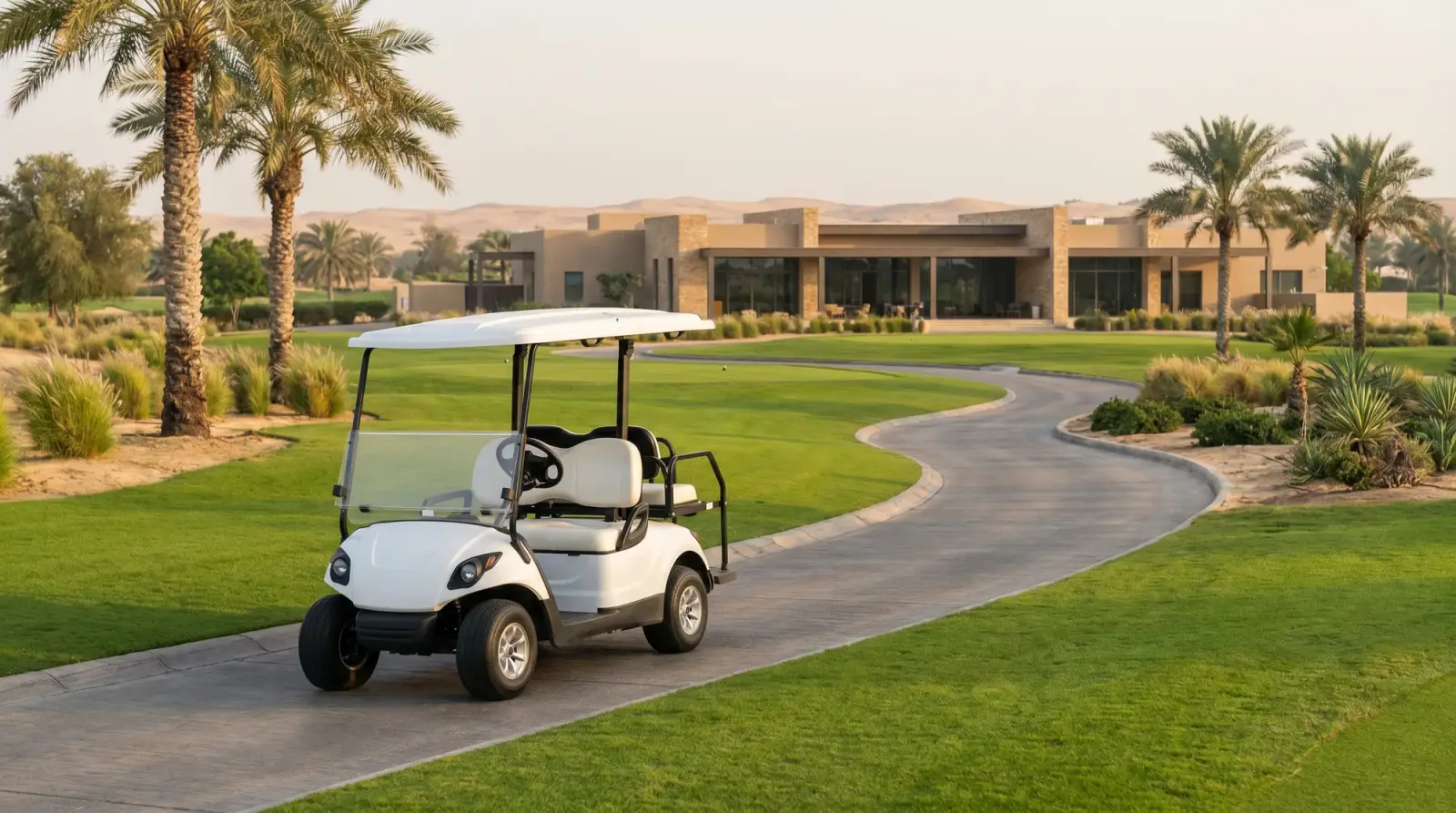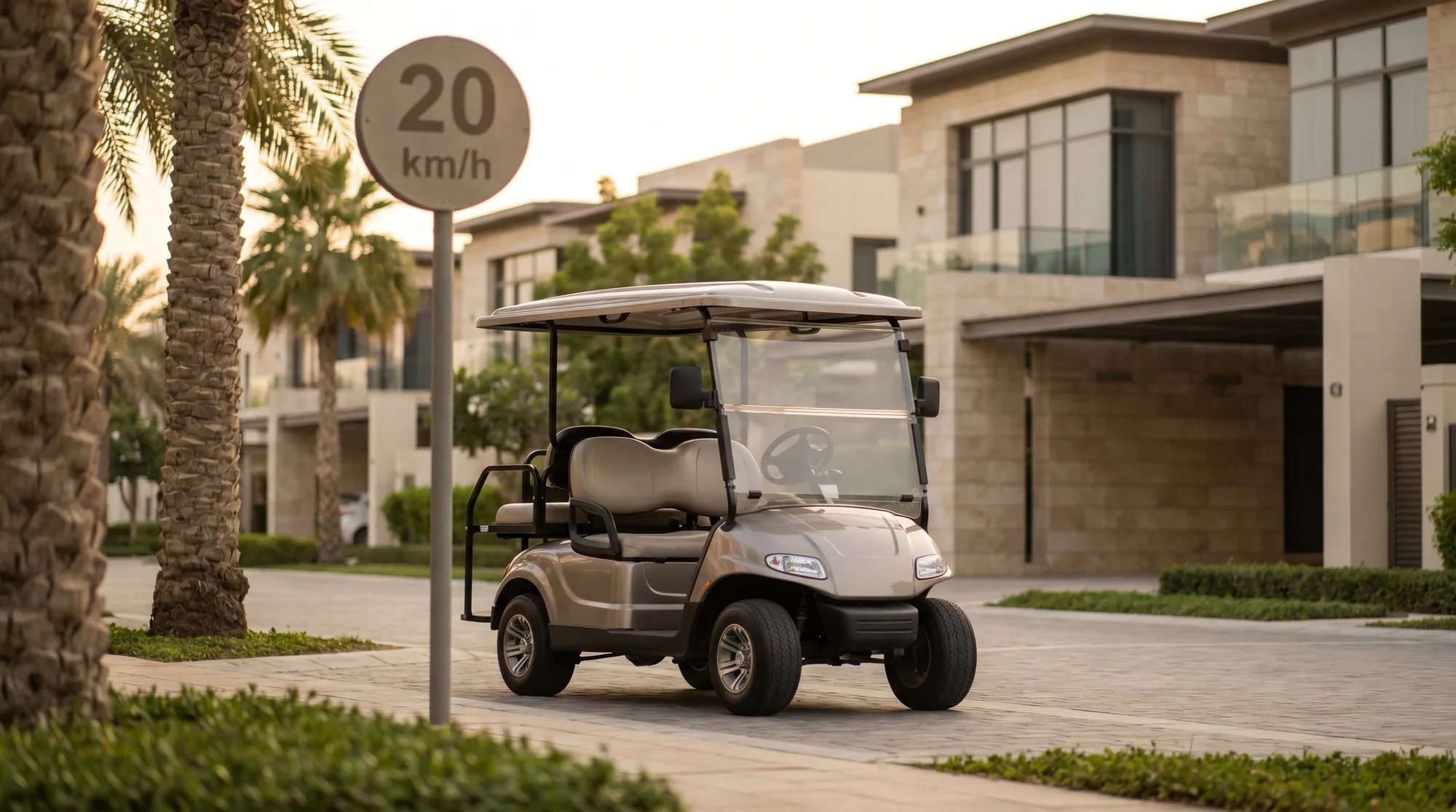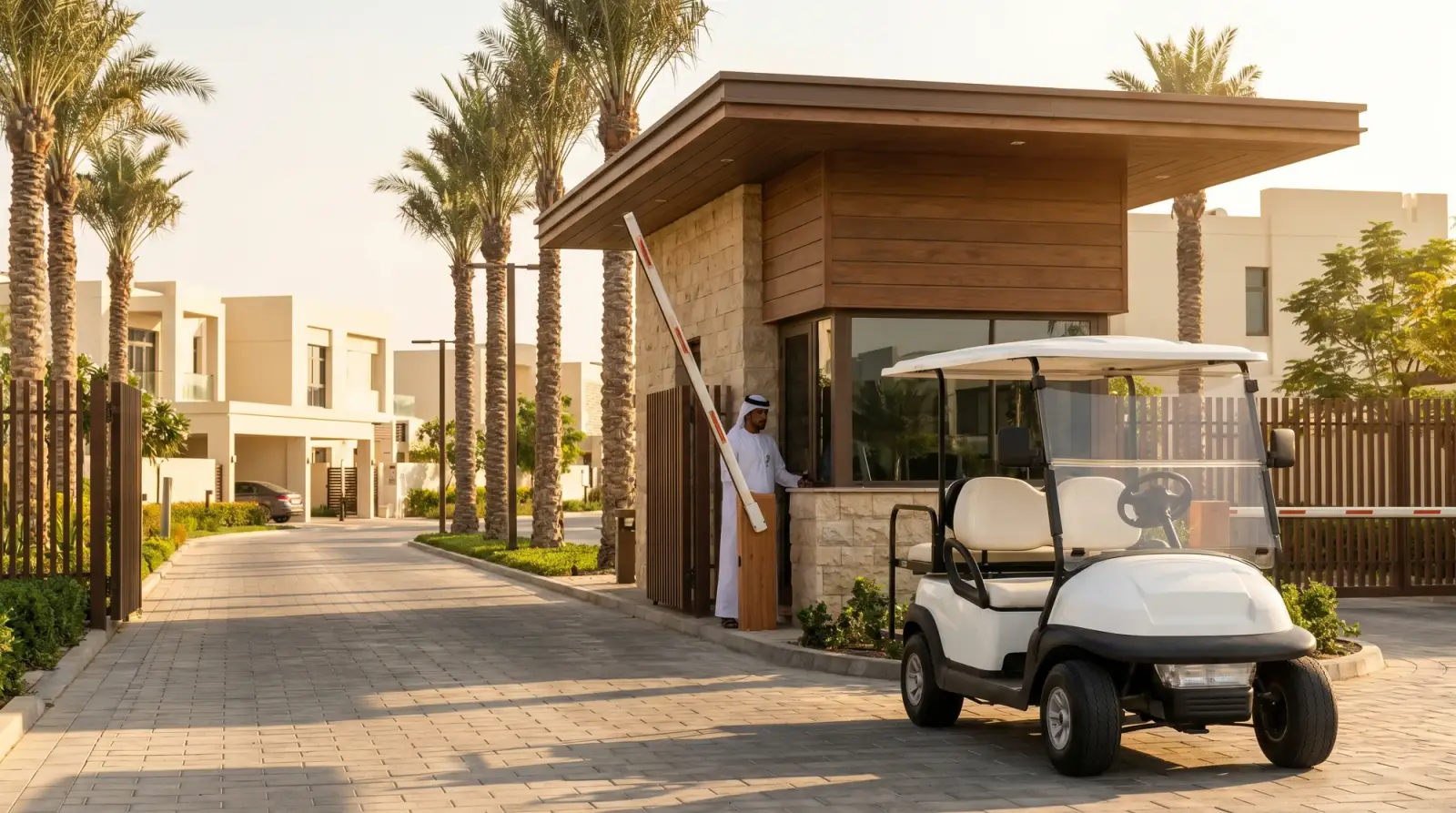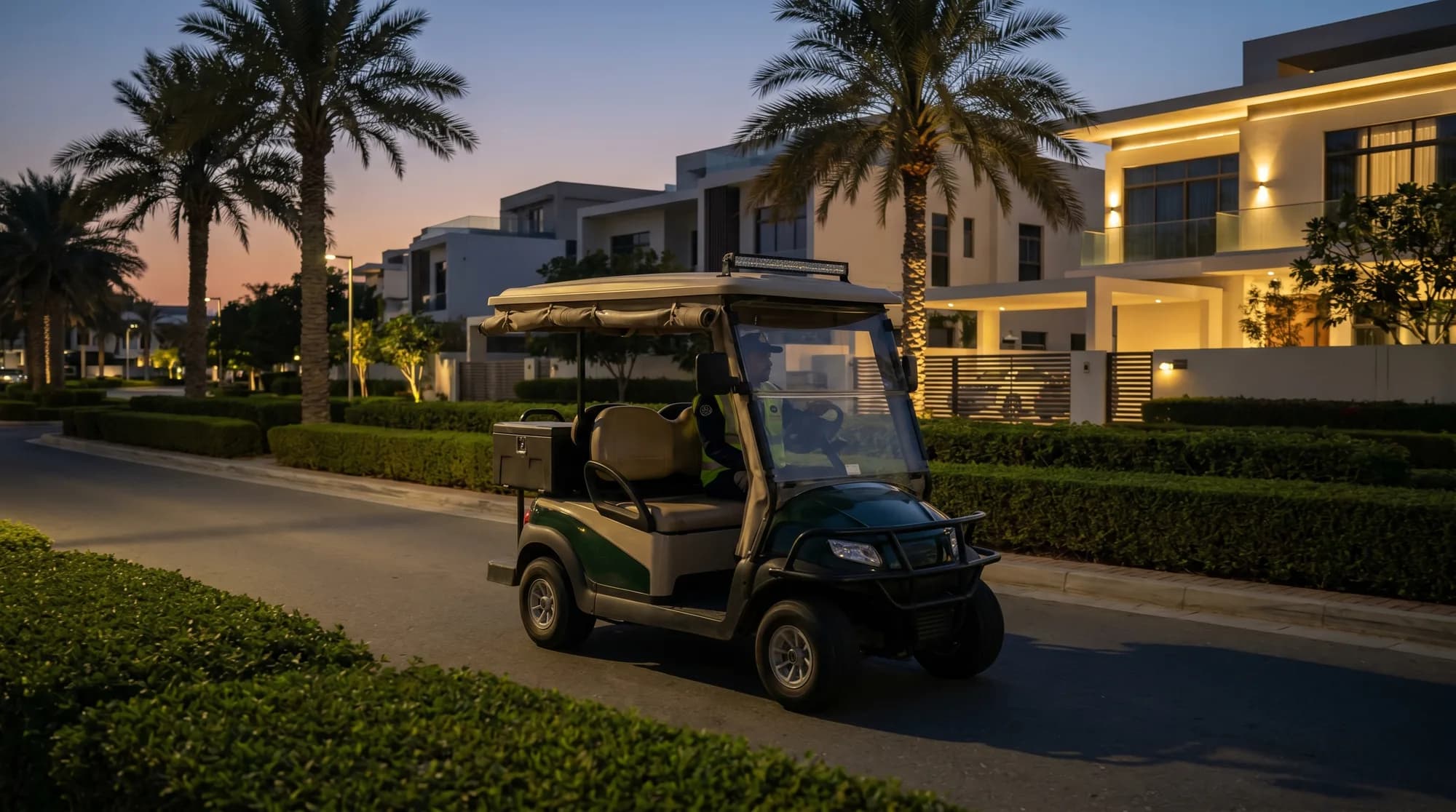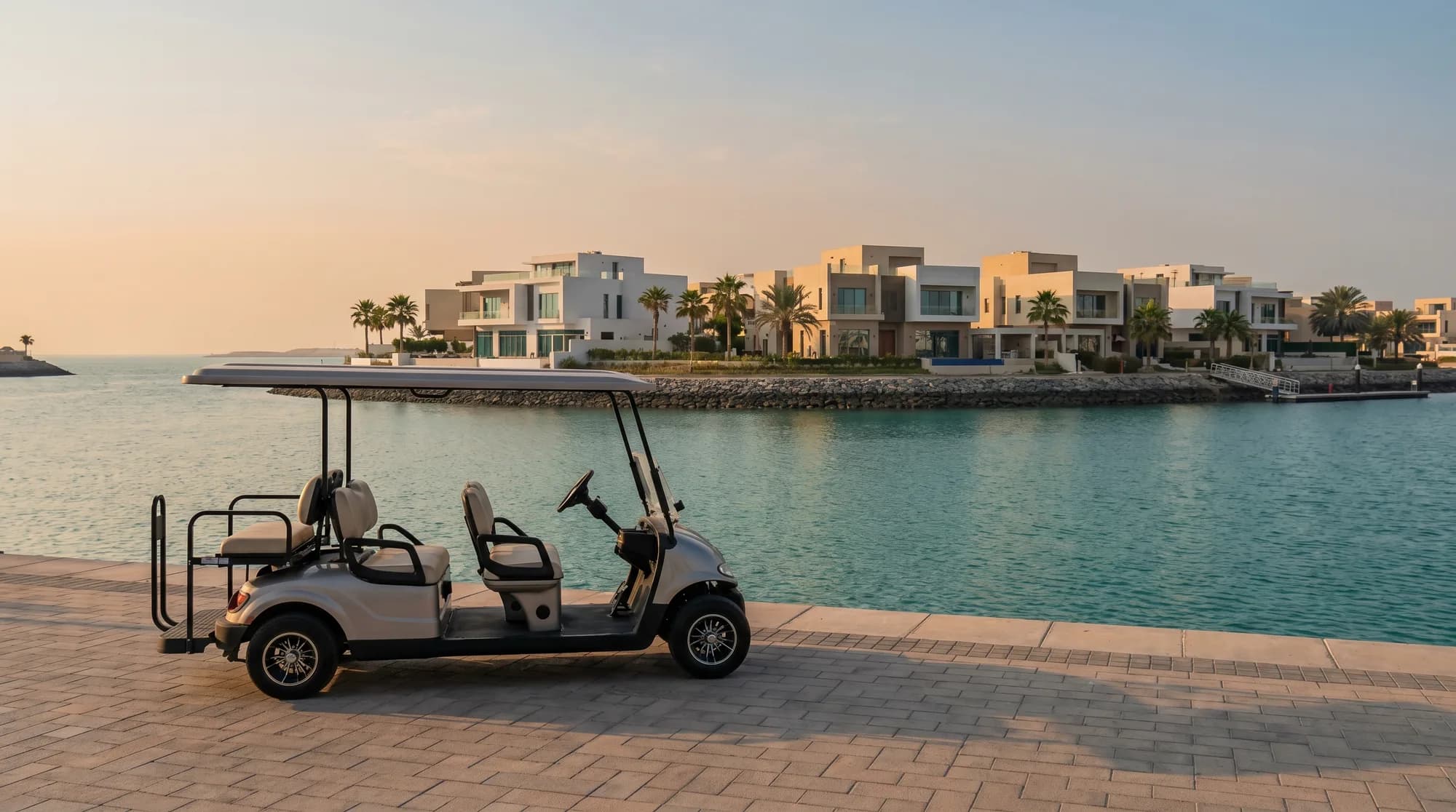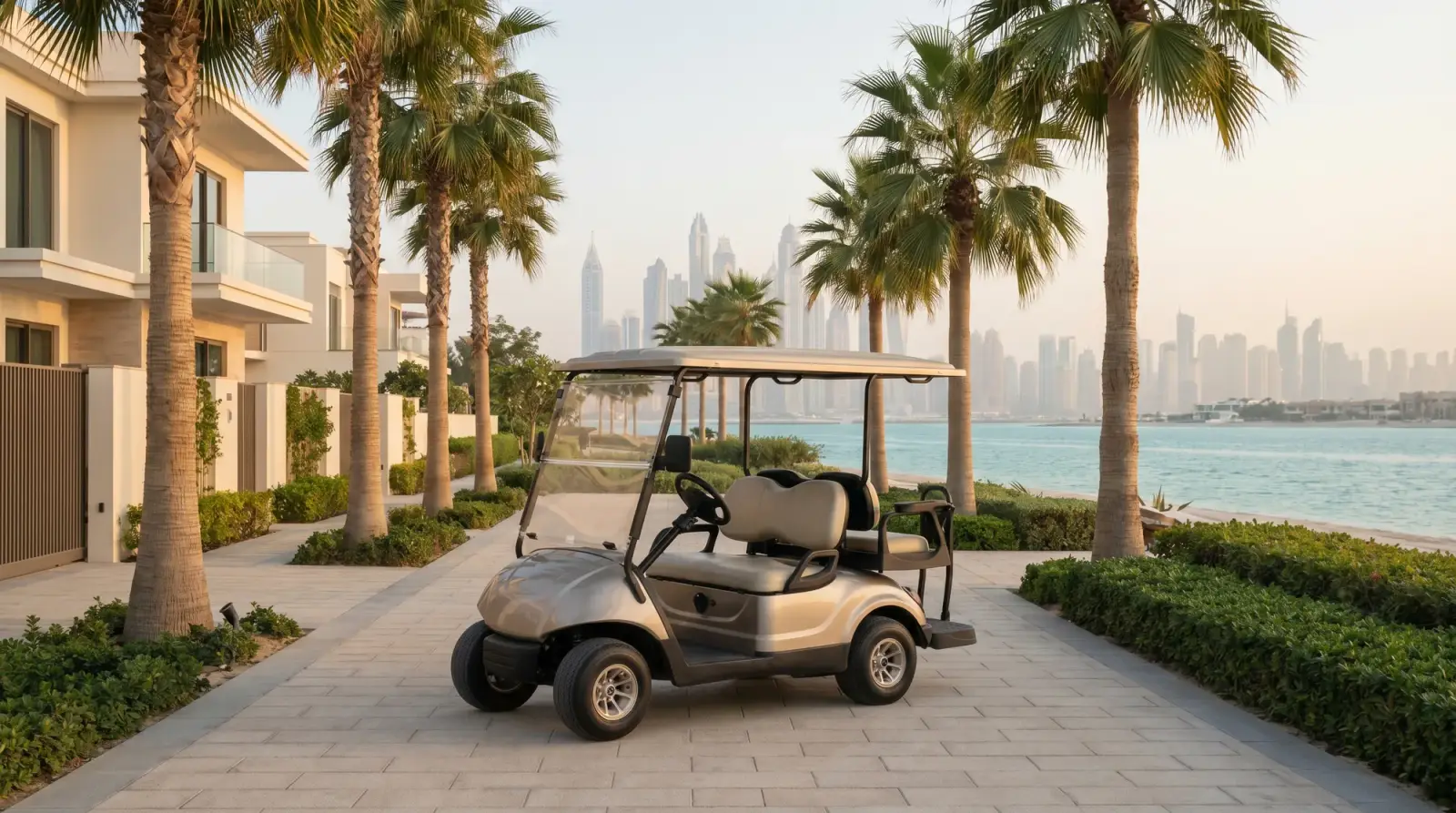
Palm Jumeirah was built for a particular kind of life: villas strung along slender fronds, the sea a few steps away, and a layout where the nearest beach club or the trunk can feel deceptively far on foot in August heat. That geometry is exactly why golf buggies have quietly become a fixture on the Palm. A buggy turns the long, exposed walk down a frond into a cool, two-minute glide, and for many residents it has become the natural way to move within the community.
But the Palm is also one of the most demanding environments in Dubai for a vehicle, because it is surrounded by sea. The salt air that makes the setting beautiful is also corrosive, and it shapes which buggies last here and which quietly rust away. This guide covers both sides: how Palm residents actually use buggies, and what to buy so yours survives the salt.
- Frond villa layouts make a golf buggy genuinely useful for beach, trunk and neighbour trips on the Palm.
- Palm Jumeirah is a Nakheel development, so expect community registration and a safety check before driving on internal roads.
- Salt air is the defining factor: corrosion-resistant fixings, sealed electronics and protected finishes matter more here than almost anywhere.
- Buggies remain private-use only; they cannot be driven on the public road sections of the Palm, including the trunk's main carriageway.
- Confirm the current policy with Palm Jumeirah community management and the RTA before you buy or register.
Why the Palm suits buggies so well
The fronds are long, low-speed and residential, the kind of environment buggies were made for. A villa near the tip of a frond is a serious walk from the beach in summer, and a buggy collapses that distance to nothing. Families use them for the school drop within the community, for carrying beach gear and groceries, and for the simple pleasure of an evening loop with the sea breeze coming off the water.
It is the same private-land logic that applies across Dubai, set out in where you can legally drive a golf cart in Dubai. The Palm simply happens to be one of the communities where that logic pays off most, because so much of daily life happens within walking, or rather buggying, distance.
The rules to expect on Palm Jumeirah
Palm Jumeirah is a Nakheel master development, and like other gated communities it sets its own terms for buggies on internal roads. In practice that means you should expect to register the buggy with community security and to pass a basic safety check before using it on the fronds. The usual pass-or-fail items are working headlights and tail lights, indicators, brake lights and seatbelts.
What you cannot do is take a buggy onto the public road sections, including the main trunk carriageway and any RTA-managed roads. A buggy is a private-use vehicle, and that line holds on the Palm exactly as it does everywhere. We explain the framework in whether golf carts are road legal in the UAE, and the developer-specific expectations in the rules in Dubai's gated communities.
Salt air: the factor that decides which buggy lasts
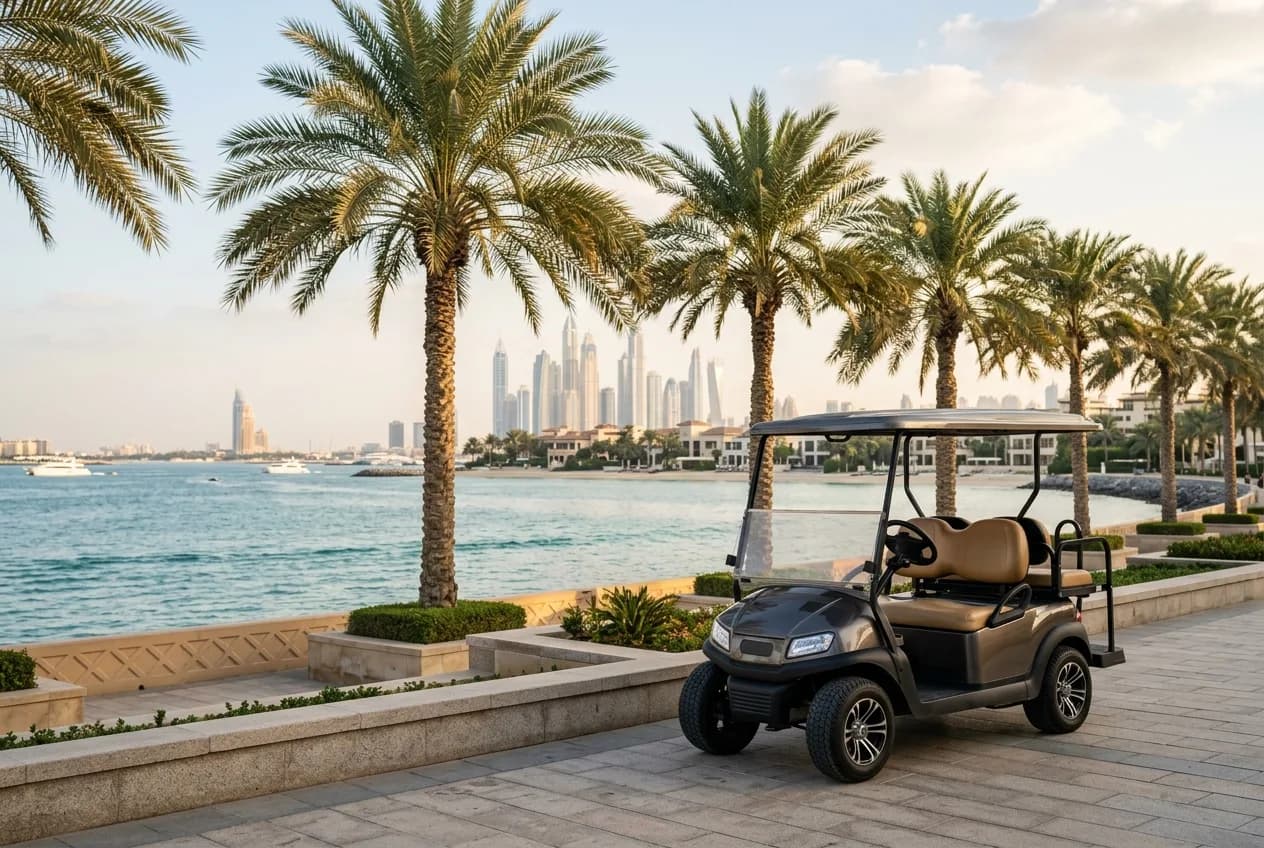
Here is what separates a buggy that thrives on the Palm from one that fails early. The sea air carries fine salt that settles on every surface and works its way into fixings, connectors and exposed metal. Combine that with high humidity and intense heat, and you have an environment that punishes any corner cut on corrosion protection.
The buggies that survive share a clear set of traits: stainless or coated fixings rather than bare steel, sealed electrical connectors, protected battery terminals, UV-stable and salt-tolerant trim, and a finish designed to shrug off humidity. None of this is exotic, but it is easy to overlook when comparing two buggies purely on seat count and price. On the Palm, corrosion resistance is not a luxury, it is the spec that determines whether the buggy is still healthy in five years.
- Inland community
- Standard acceptable
- Palm Jumeirah
- Corrosion-resistant essential
- Inland community
- Helpful
- Palm Jumeirah
- Critical against salt humidity
- Inland community
- Lithium preferred
- Palm Jumeirah
- Lithium strongly preferred
- Inland community
- UV protection
- Palm Jumeirah
- UV plus salt tolerance
- Inland community
- Occasional
- Palm Jumeirah
- Regular fresh-water rinse
| Inland community | Palm Jumeirah | |
|---|---|---|
| Fixings | Standard acceptable | Corrosion-resistant essential |
| Electrical sealing | Helpful | Critical against salt humidity |
| Battery type | Lithium preferred | Lithium strongly preferred |
| Finish and trim | UV protection | UV plus salt tolerance |
| Rinse-down routine | Occasional | Regular fresh-water rinse |
Heat, storage and the lithium advantage
The Palm has the same summer extremes as the rest of Dubai, with surface temperatures past 45C, plus the humidity of being surrounded by sea. A modern sealed lithium battery handles this far better than older lead-acid systems: it copes with heat, holds charge through long summer absences, and avoids the topping-up and sulphation problems that plague flooded batteries in the Gulf.
Storage is a real consideration here, because many Palm residents travel for weeks in the hottest months. A lithium pack left properly charged will wake up ready to drive; a tired lead-acid pack can sit flat and degrade. For a community where the buggy is a daily-life tool, that reliability matters.
Practical ownership on the fronds
Day to day, a Palm buggy rewards a little routine care. Rinse it down with fresh water regularly to clear salt, keep it shaded or garaged when you can, charge it on a charger rated for high ambient temperatures, and check fixings and connectors periodically for early signs of corrosion. Do that, and a well-specified buggy will give years of quiet, cool, convenient service in one of Dubai's most walkable, or buggy-able, communities.
When the time comes to buy, the registration step is worth thinking about up front. A buggy that already carries working lights, indicators, brake lights and seatbelts will pass the community check first time, which saves a second visit from security; the full process is set out in registering a golf cart in the UAE. It is also worth buying from a supplier who understands coastal communities and can specify the corrosion protection from the start, as we discuss in where to buy a golf cart in Dubai.
Choosing the right size for frond life
Most Palm households land on a four-seat buggy: enough for the family and beach gear, compact enough for frond roads and villa parking. Larger six-seat models suit bigger families or those who entertain, while a two-seat buggy can be plenty for a couple. Whatever the size, the corrosion brief stays the same, because the salt does not care how many seats you have.
What a Palm buggy costs to buy and run
Budget on the Palm follows the same indicative ranges as the rest of Dubai, with one caveat: it is worth spending a little more on corrosion protection and battery quality, because cutting corners on a frond is a false economy. As a guide, an entry buggy sits around AED 28,000 to AED 45,000, a typical four-seater roughly AED 40,000 to AED 70,000, and premium or larger models from AED 70,000 to AED 130,000-plus. Good used buggies run around AED 15,000 to AED 35,000, but on the Palm a used buggy with hidden salt corrosion or a heat-tired battery can cost far more to put right than the saving. These are indicative ranges only; for a tailored figure see how much a golf cart costs in the UAE.
Running costs are modest. Electricity to charge a buggy used for short frond trips is small, and the main ongoing consideration is maintenance against the salt. A buggy that is rinsed, garaged and kept in good order asks very little, while one left exposed to the sea air without care will quietly accumulate corrosion that becomes expensive later. On the Palm, a small amount of routine attention is the cheapest insurance you can buy.
Buying for the Palm? Spec it for the salt
Tell us your frond and how you will use the buggy, and we will recommend a corrosion-resistant, lithium-based specification built for Palm Jumeirah's sea air.
Frequently asked questions
Can I drive a golf buggy on Palm Jumeirah?+
Yes, on the private community roads of the fronds, subject to registering with Palm Jumeirah community security and passing a safety check. You cannot drive on the public road sections such as the main trunk carriageway.
Do I need to register my buggy on the Palm?+
Most likely. As a Nakheel community, the Palm typically requires buggies to be registered with security and to pass a check on lights, indicators, brake lights and seatbelts. Confirm the current policy with your community management.
Does the sea air really affect a golf buggy?+
Yes, significantly. Salt air accelerates corrosion of fixings, connectors and exposed metal. On the Palm, corrosion-resistant fixings, sealed electronics and a regular fresh-water rinse are essential for a buggy to last.
What size buggy is best for a frond villa?+
A four-seat buggy suits most Palm households, balancing family space with easy frond manoeuvring and villa parking. The corrosion-resistant specification matters more than the seat count.
Is lithium worth it for a Palm Jumeirah buggy?+
Strongly so. Lithium copes far better with the heat and humidity, holds charge through long summer absences, and avoids the maintenance problems of lead-acid packs in a coastal Gulf climate.
Related solutions
Ready to explore what we build?
See the vehicles and the setting this applies to, or get a tailored quote built around your site.
Ready to find the right buggy?
Tell us how and where it will work and we will specify a vehicle and a tailored quote built around you. Every build comes with a 3-year warranty and a 24-hour priority call-out.
Our guides are written and reviewed by the Hawke Electric Vehicles team, the people who specify, build, deliver and support the vehicles. We focus on honest, practical advice and flag where a figure depends on the build rather than guessing.
More guides by Hawke