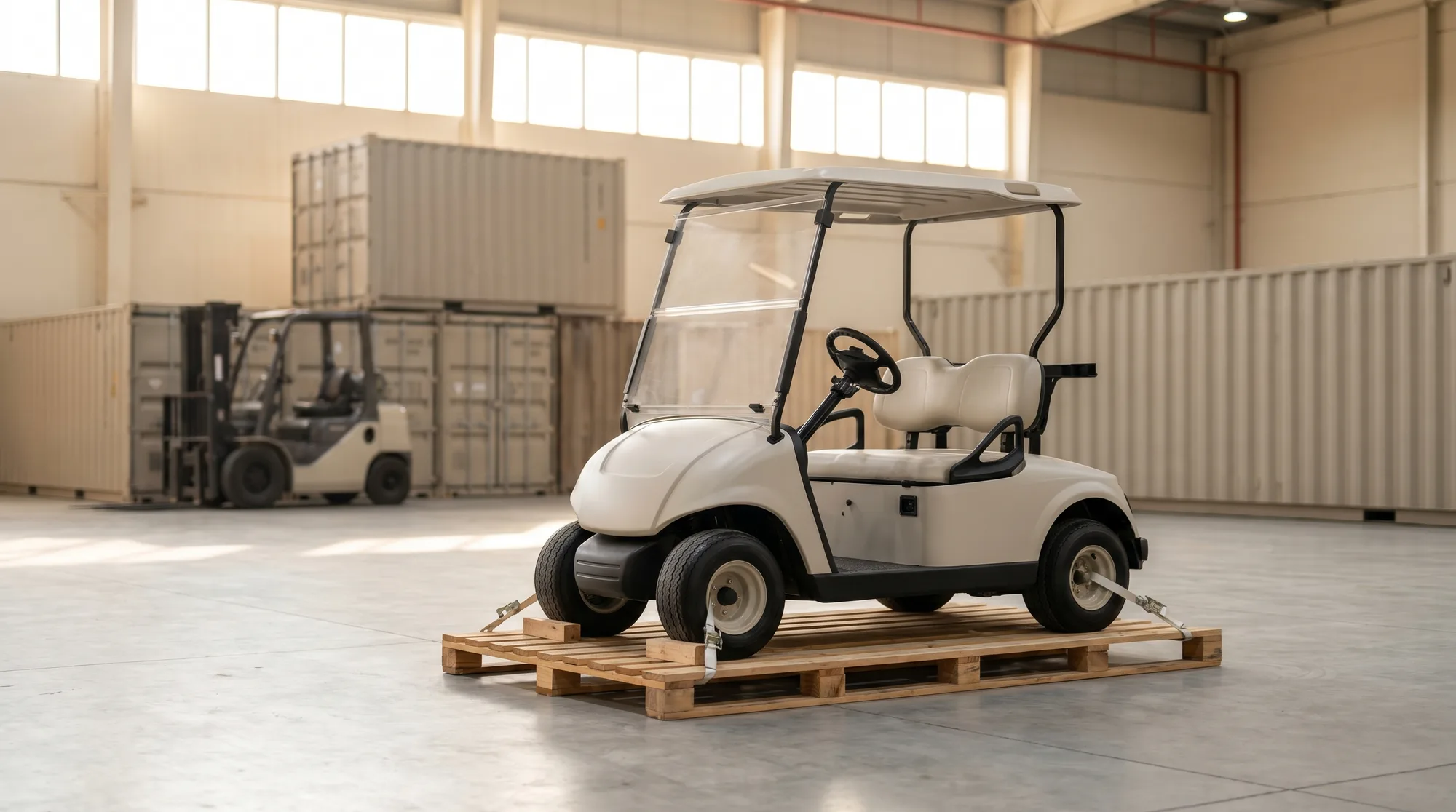
Every few weeks a UAE buyer spots a golf cart listed overseas for what looks like a bargain and wonders whether shipping it in would beat buying locally. It is a fair question, and sometimes the answer is yes. But the headline price abroad is rarely the price you pay once a container, a customs declaration, duty and a charger sat at the wrong voltage have all had their say. This guide walks through the real cost and the real process of importing a golf cart to the UAE, so you can decide with your eyes open.
The single most important thing to understand before you start: importing a cart does not change what it is allowed to do. A cart shipped in from anywhere remains a private-use vehicle here, exactly like one bought in Dubai. If you have not read it yet, our guide to whether golf carts are road legal in the UAE explains why, and it applies to imports in full.
Why people consider importing in the first place
There are three honest reasons buyers look abroad. The first is price: certain models look dramatically cheaper in markets where golf carts are a mass-market item. The second is choice: a specific color, a lifted off-road build or a particular seat layout that is hard to find locally. The third is sentiment, usually someone relocating who wants to bring a cart they already own and trust.
All three are valid starting points. The mistake is stopping at the overseas price. A cart is a bulky, heavy, awkward item to ship, and the costs that attach themselves to it on the way to Jebel Ali or Khalifa Port can quietly erase the saving you went looking for.
The true landed cost, step by step
Think in terms of landed cost: the total to get the cart standing in your villa garage, charged and ready. It has several layers, and skipping any one of them produces a misleading comparison.
- 01
Purchase price abroad
The figure you see in the overseas listing, ideally with a real, recent battery health report if the cart is used.
- 02
Freight and packing
A golf cart usually ships as part of a container or as break-bulk cargo. Expect crating or pallet costs plus the sea freight to a UAE port.
- 03
Marine insurance
Cover for the cart in transit. Cheap relative to the cargo, and worth having for a vehicle that can be damaged in handling.
- 04
Customs duty and clearance
The GCC common customs duty is typically 5 percent of the CIF value. Add the clearing agent's fee and port handling charges.
- 05
Inland delivery and setup
Transport from the port to your community, plus any charger swap or commissioning once it arrives.
Add those layers together and compare the total against a local quote for an equivalent cart. Often the gap narrows to the point where local support, warranty and zero clearance hassle win easily. To benchmark against the local market, see how much a golf cart costs in the UAE.
Customs, duty and the GCC specification angle
Goods entering the UAE are assessed on their CIF value, that is the cost of the cart plus insurance plus freight. The GCC common external tariff applies a standard duty of around 5 percent to most products, though you should always confirm the current rate and any vehicle-specific treatment with UAE Customs or your clearing agent, because classifications and rates are updated over time.
You will need clean paperwork: a commercial invoice or proof of purchase, a bill of lading, and identification. A licensed clearing agent handles the declaration at the port; trying to clear a vehicle yourself as a first-timer is rarely worth the time saved. Keep every document, because the same paperwork supports your community registration and any future resale.
The charger and voltage trap
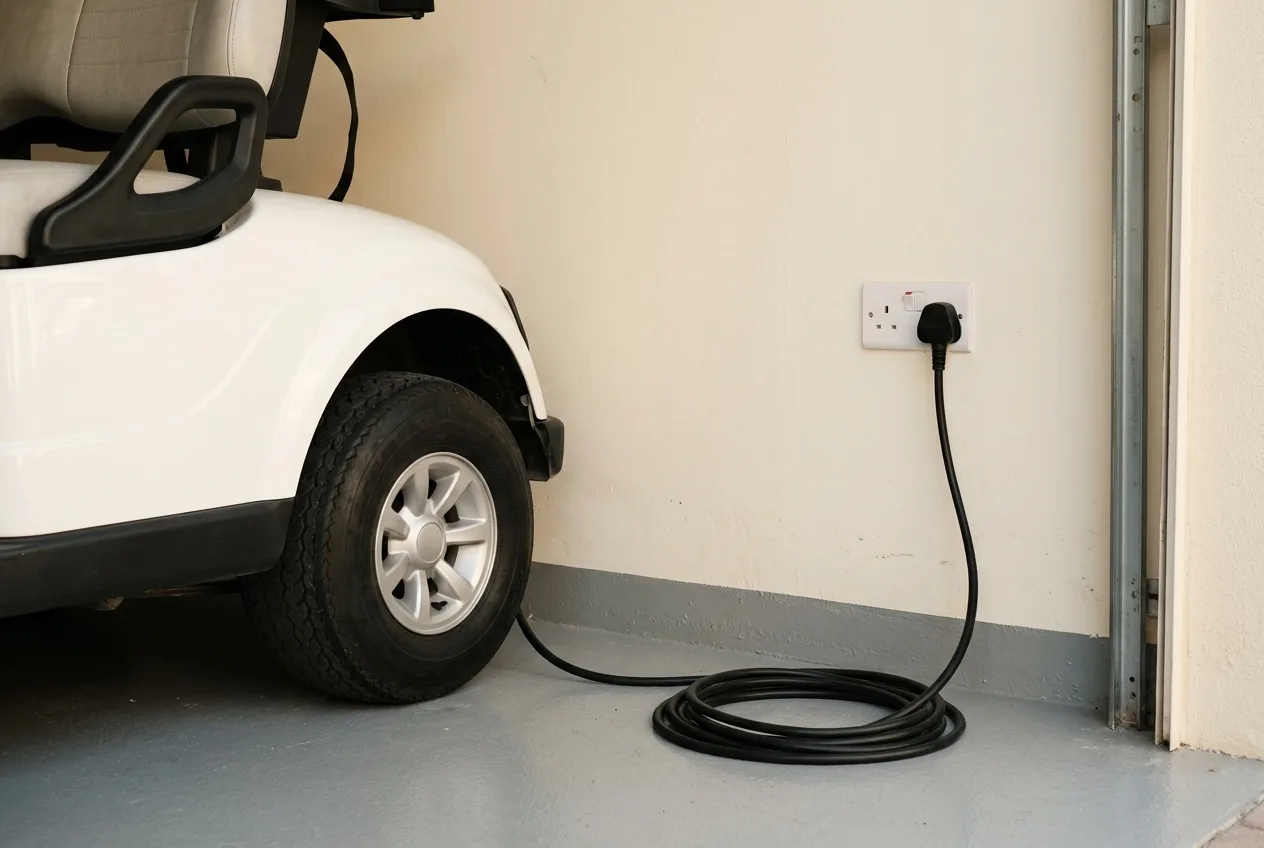
This catches more importers than customs ever does. The UAE mains supply is 230V at 50Hz. A cart built for a 110V to 120V market arrives with a charger that will not simply plug into a Gulf socket and work. Sometimes the onboard charger is dual-voltage and you just need the right plug; often it is not, and you face buying a UAE-suitable charger before the cart is usable.
Always confirm the charger's input voltage range in writing before you ship anything. A cart you cannot charge on arrival is an expensive paperweight until the right charger turns up, and a mismatched or improvised charging setup is a genuine safety risk with a lithium pack in a hot garage.
Heat, lithium and why the source market matters
A cart that lived its whole life in a temperate climate may never have been stress-tested by a Gulf summer. Lead-acid packs in particular suffer in extreme heat, self-discharging and degrading faster than they would back home. If you are importing a used cart, a tired battery is the hidden cost that can dwarf the duty you paid, because a replacement pack is the single most expensive part to renew.
This is why source market and battery type matter as much as price. A modern, sealed lithium platform copes far better with heat, long summer storage and daily villa use. If your import decision hinges on a cheap used cart, weigh it against the long-run maths in new versus used golf carts in the UAE before you commit a container to it.
Import versus buy local: an honest comparison
- Import
- Can look lower abroad
- Buy local
- Set in AED, no surprises
- Import
- Freight, insurance, duty, clearing, charger
- Buy local
- Usually included or transparent
- Import
- Must verify 230V compatibility
- Buy local
- Built for UAE mains
- Import
- Often hard to honour locally
- Buy local
- Local service and parts
- Import
- Weeks of shipping and clearance
- Buy local
- Delivered and commissioned
| Import | Buy local | |
|---|---|---|
| Headline price | Can look lower abroad | Set in AED, no surprises |
| Added costs | Freight, insurance, duty, clearing, charger | Usually included or transparent |
| Charger and voltage | Must verify 230V compatibility | Built for UAE mains |
| Warranty and support | Often hard to honour locally | Local service and parts |
| Time and effort | Weeks of shipping and clearance | Delivered and commissioned |
None of this means importing is always wrong. For a genuinely rare build, or for someone relocating with a cart they love, it can make sense. But for the typical villa owner who simply wants a reliable, climate-ready cart for their community, a local purchase usually wins on total cost and peace of mind. If you are weighing it up, our overview of where to buy a golf cart in Dubai is a useful counterpoint.
Tempted to import? Get a local quote to compare
Before you commit to a container, tell us the cart you have in mind and we will quote a GCC-suited equivalent so you can compare like for like.
Frequently asked questions
Does importing a golf cart make it road legal in the UAE?+
No. An imported cart is a private-use vehicle exactly like a locally bought one. It can be used on private land such as gated communities, golf courses and estates, but never on public roads.
How much is customs duty on a golf cart in the UAE?+
The GCC common customs duty is typically around 5 percent of the CIF value, that is the cart price plus insurance and freight. Confirm the current rate and classification with UAE Customs or a licensed clearing agent.
Will my overseas charger work in the UAE?+
Only if it supports 230V at 50Hz. Many chargers built for 110V to 120V markets will not, so confirm the input voltage range in writing before shipping, or budget for a UAE-suitable charger.
Is it cheaper to import a golf cart than to buy locally?+
Sometimes on the headline price, but rarely once freight, insurance, duty, clearance and any charger swap are added. For most residential buyers a local purchase is comparable in cost and far simpler.
What documents do I need to import a golf cart?+
Typically a commercial invoice or proof of purchase, a bill of lading, your identification, and a licensed clearing agent to handle the customs declaration at the port. Keep all of it for community registration and resale.
Related solutions
Ready to explore what we build?
See the vehicles and the setting this applies to, or get a tailored quote built around your site.

Ready to find the right golf cart?
Tell us how and where it will work and we will specify a vehicle and a tailored quote built around you. Every build comes with a 3-year warranty and a 24-hour priority call-out.