Golf club cart policies look arbitrary from the car park and make complete sense from the greenkeeper's shed. Path only. No golf carts today. Members' golf carts by arrangement. One rider per vehicle. Every one of these rules exists because something about the course, the turf, the insurance or the fleet made it necessary, and clubs are generally poor at explaining why, which is how they acquire a reputation for being obstructive. This guide sets out the common UK club cart policies, what each one is actually protecting, and how to work with them, whether you are a golfer trying to plan a round or a club trying to write a policy that members will accept.
- Almost every restriction is protecting turf, and turf damage in winter shows all summer.
- Path-only is the middle setting between full access and suspension, not a punishment.
- Suspension decisions are made on the morning by greenkeeping and cannot be pre-booked around.
- Clubs set their own arrangements for players who need a cart for mobility reasons; ask your club directly.
- Bringing your own cart is a separate policy again, and usually needs permission and insurance evidence.
Why clubs restrict golf carts at all
Turf, almost entirely. A golf course is a growing surface with a limited recovery window, and vehicle traffic concentrated on wet ground causes compaction, rutting and wear that takes months to grow out and shows up as thin, poor turf exactly where members walk most. In winter, when growth stops, the damage does not recover at all until spring, which is why restrictions cluster in the months when demand for golf carts among older members is highest, an unfortunate but unavoidable collision. Beyond turf, clubs restrict for safety on steep or wet ground, for insurance conditions, and simply for fleet capacity. Understanding that the rule is protecting the course you want to play next summer makes the January notice on the pro shop door considerably easier to accept.
- What it means in practice
- Golf Carts may drive on fairways, subject to normal etiquette
- What it is protecting
- Nothing restricted; conditions are good
- What it means in practice
- Golf Carts stay on made paths throughout
- What it is protecting
- Wet or fragile turf, with golf carts still available
- What it means in practice
- Drive on the path, turn onto the fairway at right angles to your ball
- What it is protecting
- Spreading wear rather than concentrating it
- What it means in practice
- No golf carts at all that day
- What it is protecting
- Saturated or frozen ground where any traffic causes damage
- What it means in practice
- Permission, insurance evidence and often a fee
- What it is protecting
- Insurance position and fleet revenue
- What it means in practice
- No availability regardless of conditions
- What it is protecting
- A modest fleet against a busy tee sheet
| What it means in practice | What it is protecting | |
|---|---|---|
| Full course access | Golf Carts may drive on fairways, subject to normal etiquette | Nothing restricted; conditions are good |
| Path only | Golf Carts stay on made paths throughout | Wet or fragile turf, with golf carts still available |
| 90-degree rule | Drive on the path, turn onto the fairway at right angles to your ball | Spreading wear rather than concentrating it |
| Golf Carts suspended | No golf carts at all that day | Saturated or frozen ground where any traffic causes damage |
| Members' own golf carts by arrangement | Permission, insurance evidence and often a fee | Insurance position and fleet revenue |
| Fleet fully booked | No availability regardless of conditions | A modest fleet against a busy tee sheet |
Path only, and the 90-degree rule
These are the two middle settings between free rein and suspension, and they are both compromises designed to keep golf carts available while limiting damage. Path only is self-explanatory and is the more restrictive: vehicles never leave made surfaces, which protects the turf completely but adds walking at each shot, and can make the cart less useful for exactly the players who need it most. The 90-degree rule is the more elegant option where paths allow it: drive along the path, then turn at right angles onto the fairway to reach your ball, minimising the distance travelled on grass and spreading wear across the width of the hole rather than wearing a track. Clubs that use it well signal it clearly on the first tee. Either way, follow it precisely, because the alternative when a rule is ignored is not a stricter rule, it is suspension.
Winter and wet-weather suspensions
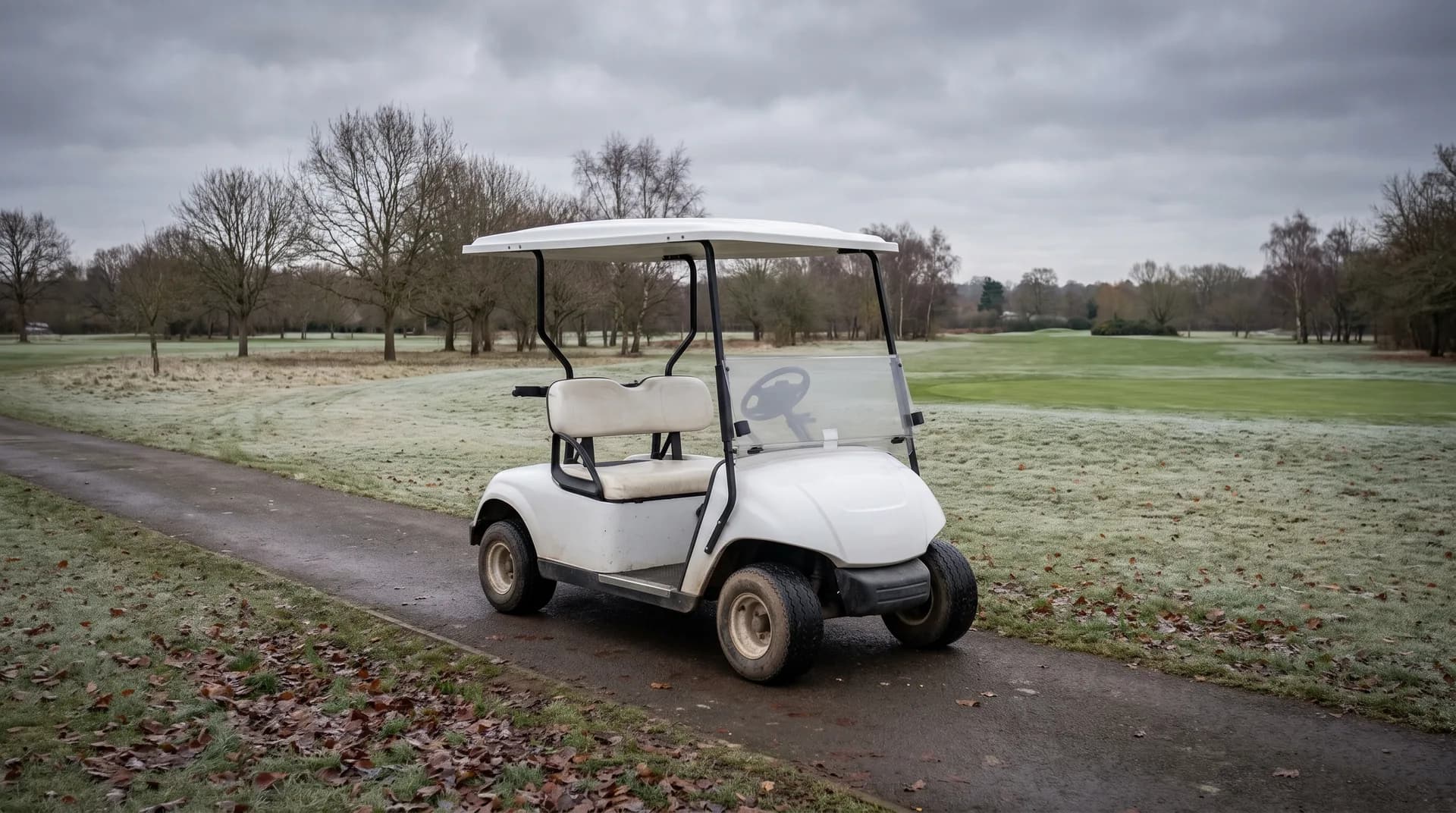
The decision to suspend is made on the morning, by greenkeeping, on the basis of the ground rather than the forecast, and it cannot be pre-booked around. That is worth understanding before you argue with the pro shop: nobody in the building has the authority to overrule the course manager on turf, and an advance booking, an annual ticket or a visitor green fee does not change a decision about saturated ground. Frost is a special case that surprises people: driving on frozen or thawing turf damages the grass plant itself, so a bright, dry, cold morning can be a stricter day for golf carts than a wet one. The practical response is to check with the club on the morning rather than assuming, and, if you rely on a cart, to have a conversation with the club in advance about what happens on restricted days.
Players who need a cart for mobility reasons
Many UK clubs operate specific arrangements for players who need a cart in order to play at all, and those arrangements vary considerably from club to club. Some maintain an exemption list; some require a form or evidence; some hold a vehicle in reserve on restricted days; some allow single-rider vehicles on the course when standard golf carts are suspended, because their footprint and weight are different. What is consistent is that this is set at club level, so the only reliable answer is the one your own club gives you. If you need a cart to play, raise it with the club secretary or the golf operations manager rather than at the pro shop counter on the morning, ask specifically what happens on path-only and suspended days, and get the arrangement recorded. Clubs are generally willing; they are less able to improvise at short notice.
Bringing your own cart
A separate policy again, and one where clubs are more cautious than golfers expect. Typical conditions include written permission, evidence of insurance covering use on the course, a storage or trail fee, restrictions on where it may be stored and charged, agreement that club course conditions and restrictions apply identically, and sometimes a condition or age standard for the vehicle. The reasons are straightforward: the club's insurance position, its fleet revenue, charging infrastructure and the practical problem of storing private vehicles. If you are considering it, our guide to taking your own cart to the golf club sets out the questions to ask, and the essential first step is a conversation with the club rather than a purchase followed by a conversation.
For clubs: writing a policy members will accept
Most cart policy friction is a communication problem rather than a policy problem. Members accept restrictions readily when they understand what is being protected and can see the rule applied consistently; they resent them when the rule appears without explanation, changes without notice, or is applied to some players and not others. Four things help. Publish the policy, including the criteria for path-only and suspension, so nobody is surprised. Announce decisions early on the day, on the same channel every time. Explain the reason briefly whenever you restrict, because one sentence about turf recovery does more for compliance than any number of signs. And set out the mobility arrangement openly rather than handling it case by case at the counter, which is fairer to the players concerned and easier for your staff. If you are drafting the document itself, our guide to writing a golf club cart policy walks through the clauses and includes a checklist, and fleet sizes for golf clubs covers the capacity side of the same question.
Frequently asked questions
Why does my golf club say path only today?+
Because the turf is wet or fragile enough that traffic on the grass would cause compaction and wear that takes months to recover. Path-only is the compromise setting: golf carts remain available, but they stay on made surfaces. The alternative is usually suspension.
Why are golf carts not allowed when it is frosty?+
Driving on frozen or thawing turf damages the grass plant itself rather than simply marking the surface, so a bright, dry, cold morning can be a stricter day for golf carts than a wet one. The decision is made by greenkeeping on the morning, based on the ground.
What is the 90-degree cart rule?+
Drive along the path, then turn at right angles onto the fairway to reach your ball, and return the same way. It minimises the distance travelled on grass and spreads wear across the hole rather than wearing a track, so clubs use it to keep golf carts available in marginal conditions.
Can I get a cart if I need one for mobility reasons?+
Many UK clubs operate specific arrangements, but they are set club by club and vary widely. Speak to the club secretary or golf operations manager in advance rather than at the counter on the morning, ask what happens on path-only and suspended days, and get the arrangement recorded.
Can I bring my own cart to a golf club?+
Usually only with written permission. Clubs commonly require evidence of insurance covering use on the course, charge a storage or trail fee, restrict where it may be stored and charged, and apply the same course restrictions as to their own fleet. Ask before buying, not after.
Reviewing your club's cart fleet?
Whether you are renewing, expanding or adding single-rider capacity for restricted days, tell us the course and we will quote it properly.
Related solutions
Ready to explore what we build?
See the vehicles and the setting this applies to, or get a tailored quote built around your site.
Ready to find the right golf cart?
Tell us how and where it will work and we will specify a vehicle and a tailored quote built around you. Every build comes with a 3-year warranty and a 24-hour priority call-out.
Our guides are written and reviewed by the Hawke Electric Vehicles team, the people who specify, build, deliver and support the vehicles. We focus on honest, practical advice and flag where a figure depends on the build rather than guessing.
More guides by Hawke