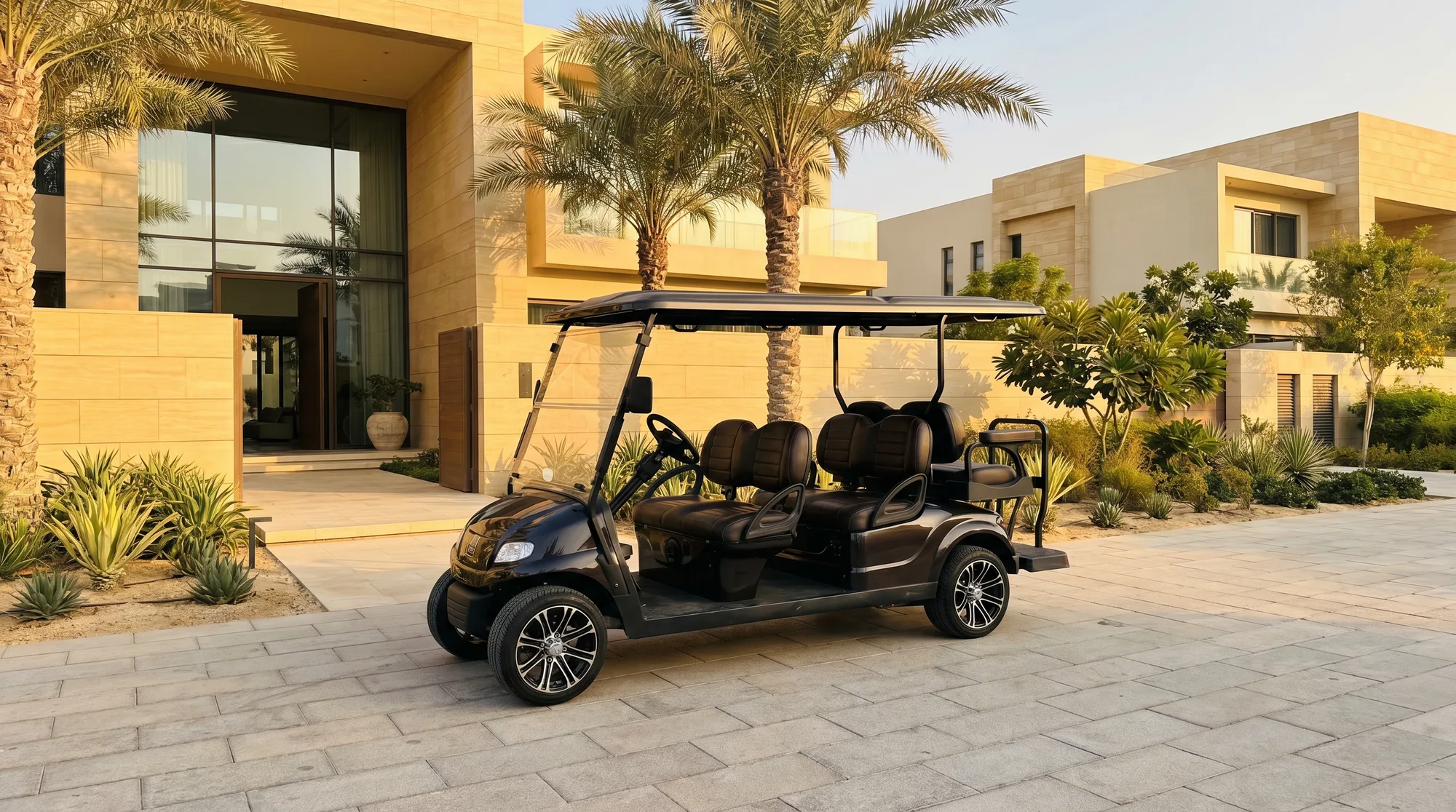
On a large UAE estate, a golf cart is not a leisure item. It is the vehicle that gets a technician, a toolbox and a spare part from one end of a community, business park or resort to the other in minutes rather than the half hour a walk would take in 45C heat. For facilities teams, the cart is a productivity tool, and specifying it badly costs real money in downtime, fuel-equivalent running and staff time lost to a vehicle that cannot take the climate.
This guide is for the people who actually run estates: facilities managers, operations leads and procurement. It treats the cart as fleet equipment, covering how many you need, what to specify for utility work, how to handle charging across a property, and how to think about total cost rather than sticker price. The leisure questions matter less here; uptime and durability matter most.
Why estates run on golf carts in the UAE
The economics are simple. On a sprawling residential community, a business park or a resort, distances are large and the heat makes walking them slow, tiring and, for much of the year, genuinely unpleasant. A cart collapses those distances. A maintenance call that meant a long walk with a heavy bag becomes a two-minute drive, the technician arrives fresh rather than exhausted, and the spare part comes with them rather than requiring a second trip.
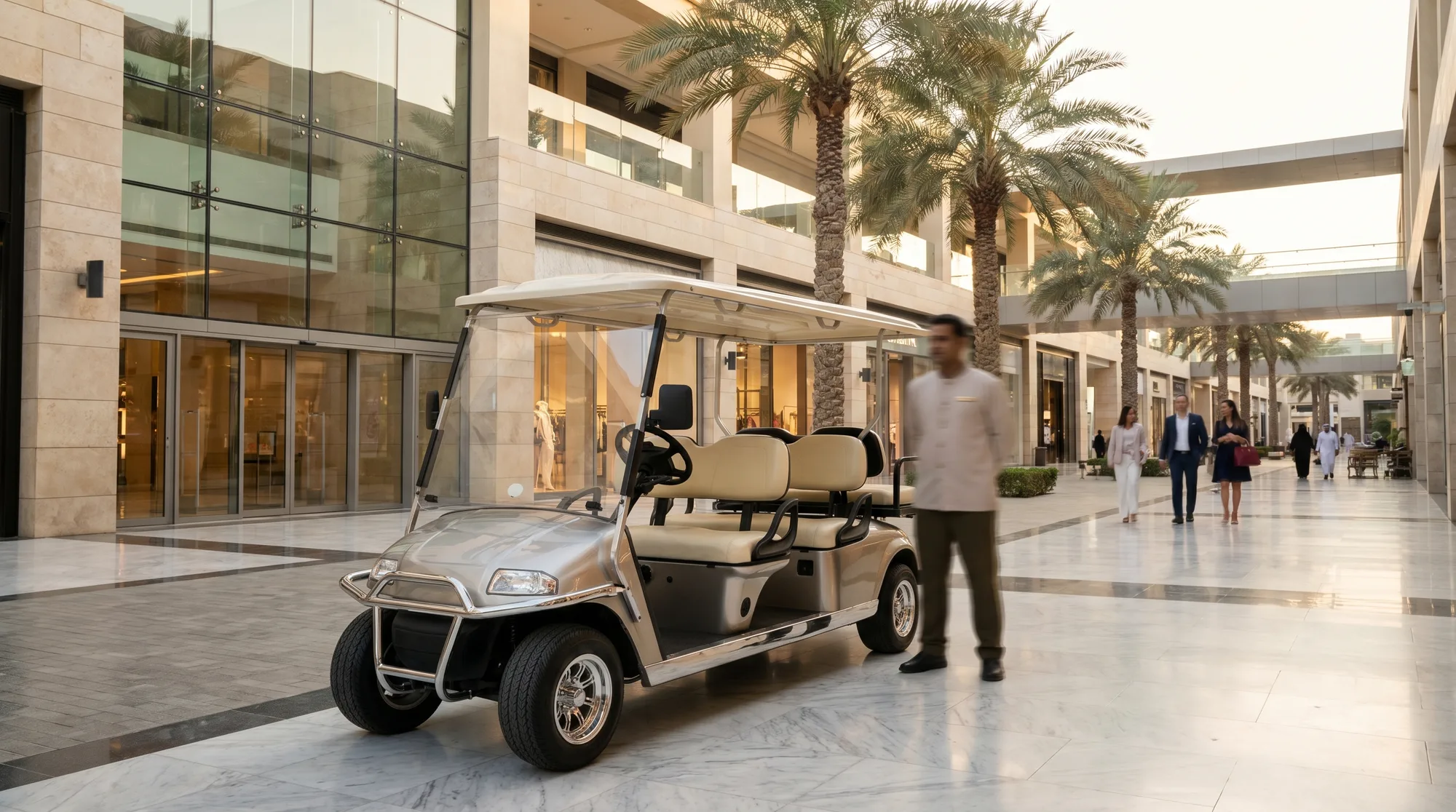
Multiply that across a day and a team and the cart pays for itself in recovered hours. That is why facilities operations across the Emirates standardise on golf carts, and why the conversation for a facilities manager is never whether to have them but how to specify and run a fleet that does not let the operation down. The same logic drives cart fleets at malls and retail destinations and on healthcare and education campuses.
Sizing the fleet
The most common and most expensive mistake is sizing a fleet to average use. Estates have peaks: morning shift starts, incident response, event setups, deliveries. If there are only enough golf carts for a quiet Tuesday, the busy hours create queues and idle technicians. Size to peak demand and to the property's geography, and account for the golf carts that will always be on charge or in for service.
- 01
Map the property and the journeys
Plot the routes, the distances and the chokepoints. A long, linear estate behaves very differently from a compact one.
- 02
Identify the peaks
Find the busiest hours and the worst-case days. Size to those, not to the average, so the operation never stalls.
- 03
Add a duty allowance
Some of the fleet is always charging or being serviced. Build that into the count so peak capacity is real, not theoretical.
- 04
Match cart type to task
Mix passenger and cargo golf carts according to the actual work, rather than buying one type for everything.
- 05
Plan for growth and events
Decide whether occasional spikes are met by owning extra golf carts or by hiring in, and size the core fleet accordingly.
Specifying a utility fleet
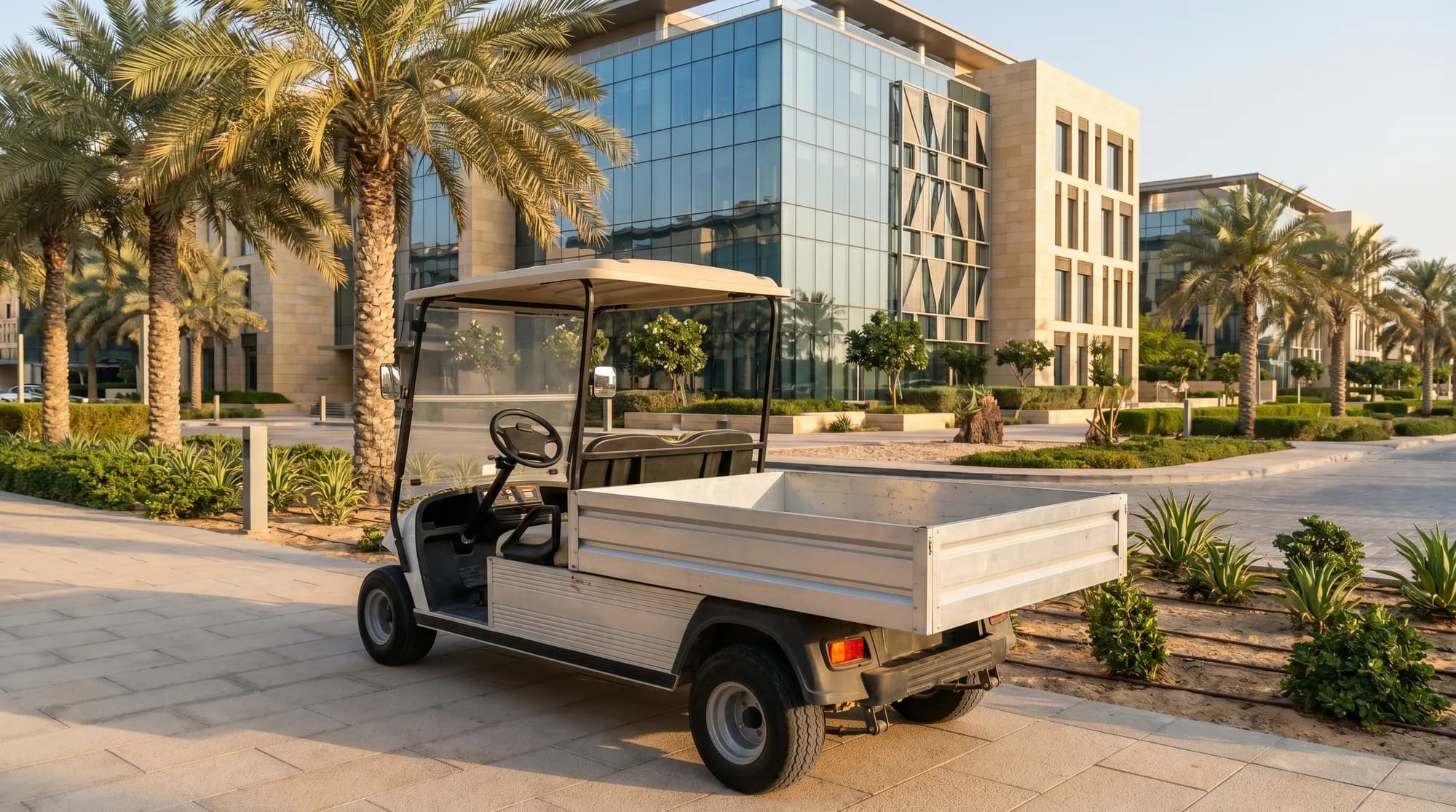
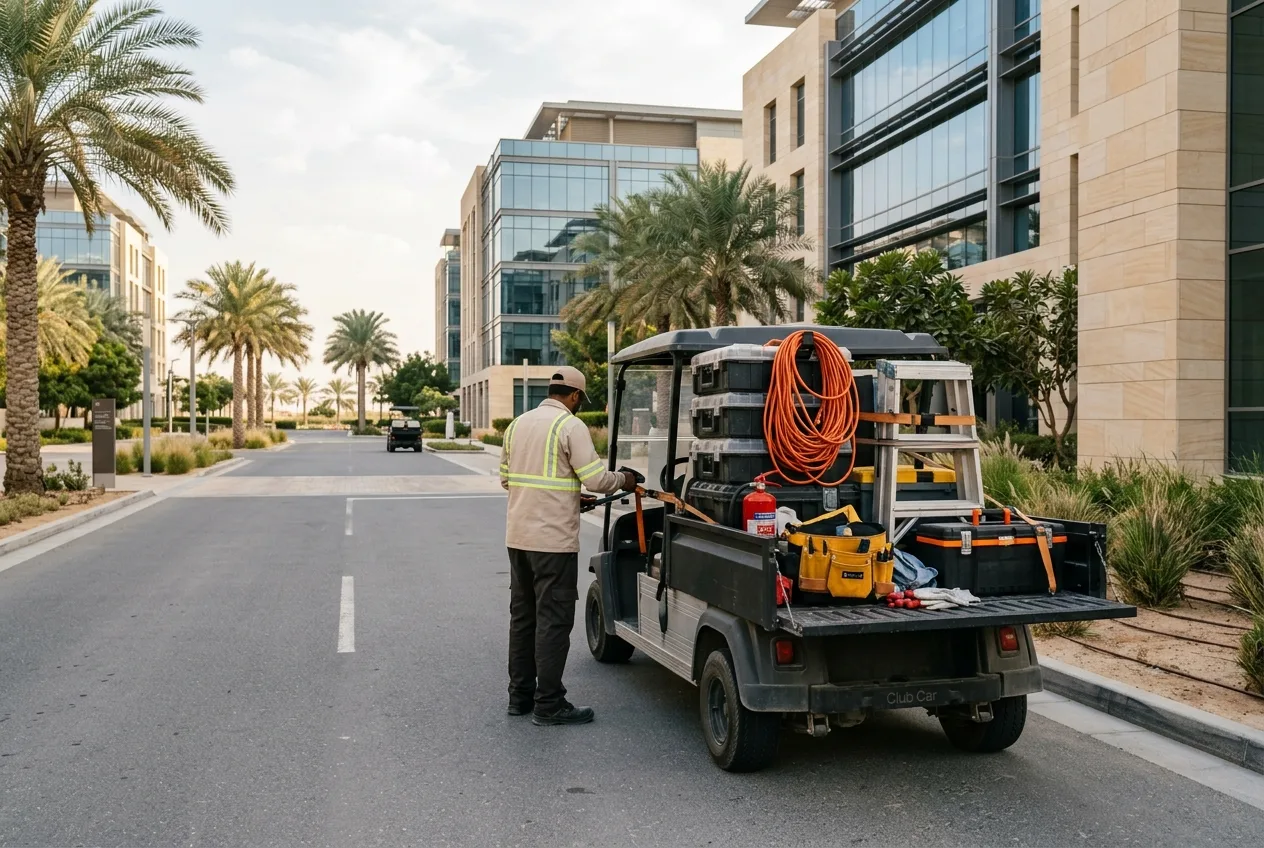
Facilities golf carts earn their keep through utility, so the specification looks different from a leisure cart. The priorities are carrying capacity, durability and the safety features the property and the developer require, not comfort or polish. Build the fleet around the work it does.
- Cargo beds and tow capacity for tools, parts, waste and grounds equipment.
- Durable, UV-stable trim that survives constant outdoor use and the sun.
- Lithium (LiFePO4) batteries for heat tolerance, fast charging and long cycle life under heavy daily use.
- Full lighting, indicators, brake lights and seatbelts to meet community and safety requirements.
- Sealed controllers and protected bearings to keep fine sand out of the parts that fail expensively.
- Clear estate or department livery so golf carts are accountable and easy to identify across the property.
Charging logistics at fleet scale
One cart charges from a normal socket and you never think about it. A fleet is a logistics problem. You need enough charging points, on circuits that can carry the load, located where golf carts naturally end the day, with a schedule that gets them all charged overnight without tripping anything. In the Gulf, the additional rule is to charge in shade and ideally in cooler hours, because heat is hard on both the pack and the charger.
Plan this before the golf carts arrive, not after. Retrofitting charging infrastructure into a facilities yard is far more disruptive than designing it in. Decide where the fleet parks, how many points you need to charge it overnight, and whether you want any opportunity charging during the day for the busiest golf carts.
Heat, dust and uptime
Everything a facilities cart faces in the UAE is harsher than the brochure assumes. Sustained heat ages batteries and trim, fine sand attacks bearings, controllers and connectors, and coastal humidity corrodes terminals. A fleet specified to a budget rather than to the climate will spend too much time off the road, and an out-of-service cart is a technician on foot in the sun. Durability is not a luxury here; it is uptime.
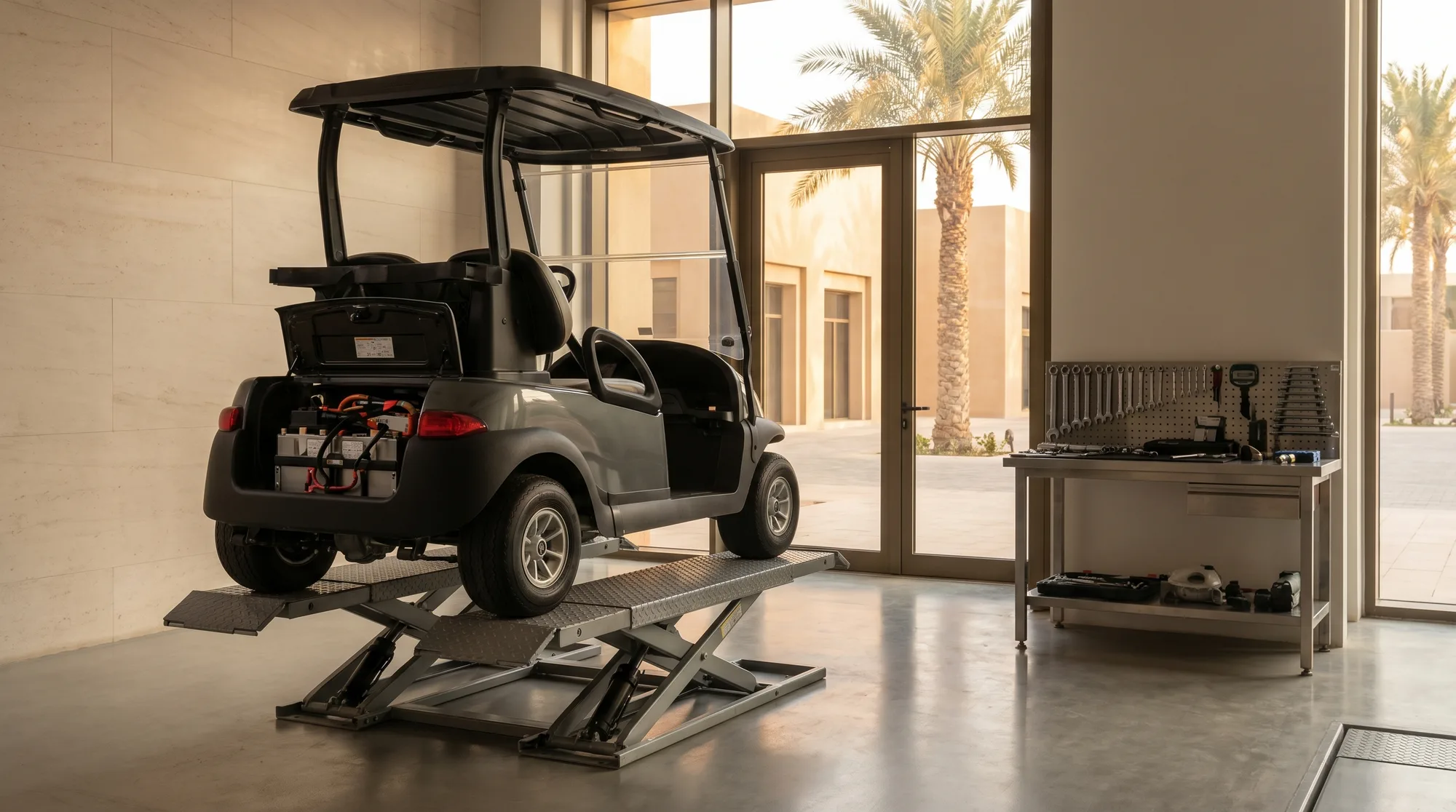
This is where a planned maintenance contract earns its place. Scheduled visits, common parts kept on hand and a spare battery or two keep the fleet available, which for a facilities operation is the entire point. Our guide to golf cart servicing and parts in the UAE covers the schedule and the climate-specific wear in detail.
- Cheapest cart
- Budget pack, heat-degraded fast
- Climate-ready fleet
- Lithium, long cycle life, summer-tolerant
- Cheapest cart
- Frequent, technicians on foot
- Climate-ready fleet
- Low, scheduled maintenance keeps golf carts running
- Cheapest cart
- Trim and parts fail early
- Climate-ready fleet
- Sealed, UV-stable, corrosion-resistant
- Cheapest cart
- Low to buy, high to run
- Climate-ready fleet
- Higher to buy, lower over its life
| Cheapest cart | Climate-ready fleet | |
|---|---|---|
| Battery | Budget pack, heat-degraded fast | Lithium, long cycle life, summer-tolerant |
| Downtime | Frequent, technicians on foot | Low, scheduled maintenance keeps golf carts running |
| Build | Trim and parts fail early | Sealed, UV-stable, corrosion-resistant |
| True cost | Low to buy, high to run | Higher to buy, lower over its life |
On an estate the question is never the sticker price of a cart. It is how many hours of a technician's day it saves and how few of them it costs you when it is off the road.
Buying for a facilities operation
For a fleet, price is set per cart and depends on specification and volume, so treat any figure as indicative and in AED only. The decision that matters is total cost of ownership: a slightly higher purchase price for lithium, durability and a maintenance plan almost always beats a cheap cart that lives in the workshop. The best starting point is to tell us your property, your peaks and the work the fleet must do, and let us scope it. For context on pricing, see our guide to how much a golf cart costs in the UAE.
Scope a facilities fleet that stays on the road
Tell us your property, your peak demand and the work your team does, and we will scope a utility fleet, charging plan and maintenance with current pricing.
Frequently asked questions
How many golf carts does a facilities team need?+
Size to peak demand and the property's geography, not to average use, and add an allowance for golf carts always on charge or in service. A linear estate needs more than a compact one. Mapping journeys and peaks gives the real number.
What specification suits a facilities or maintenance cart?+
Utility first: cargo beds and tow capacity, durable UV-stable trim, lithium batteries for heat, full lighting and seatbelts, and sealed components to keep sand out. Comfort and polish matter far less than carrying capacity and durability.
How do you handle charging for a cart fleet?+
Plan it as logistics: enough charging points on adequate circuits, located where golf carts park, with an overnight schedule that charges the whole fleet. In the Gulf, charge in shade and cooler hours to protect packs and chargers.
Is lithium worth it for a facilities fleet?+
Usually yes. Under heavy daily use in heat, lithium (LiFePO4) tolerates the climate, charges faster and lasts several times longer than lead-acid, which lowers downtime and the most expensive part of the running cost.
Should an estate own or hire its golf carts?+
Most facilities operations own a core fleet sized to peak demand and consider hiring for occasional spikes or events. A maintenance contract on the owned fleet protects the uptime the operation depends on.
Related solutions
Ready to explore what we build?
See the vehicles and the setting this applies to, or get a tailored quote built around your site.
Ready to find the right golf cart?
Tell us how and where it will work and we will specify a vehicle and a tailored quote built around you. Every build comes with a 3-year warranty and a 24-hour priority call-out.