South Carolina has some of the most specific golf cart rules in the country, and they catch newcomers out constantly. Unlike states that simply lean on the federal low-speed vehicle class, South Carolina created its own permitted golf cart with distance limits, a daylight rule and a registration step that is unique to the state. Get those details right and a cart is a genuinely useful way to get around coastal towns and island communities. Get them wrong and you are an easy ticket. This guide lays out the 2026 rules and the well-known local exceptions.
- South Carolina requires a golf cart permit and registration before you drive a cart on public roads.
- Permitted carts may generally drive within four miles of the registered address or the point of business.
- Driving is generally limited to daylight hours unless the cart is properly equipped and local rules allow more.
- You may use secondary roads with a speed limit of 35 mph or less, and cross higher-speed roads at an intersection.
- The driver must hold a valid license and the cart must carry liability insurance; confirm specifics with your county and the SC DMV.
The South Carolina golf cart permit
The single thing that defines South Carolina is the golf cart permit. Before a cart touches a public road, the owner registers it and obtains a permit decal, providing proof of ownership, a valid driver license and liability insurance. This is not the federal LSV titling process; it is a state-specific permit that turns an ordinary golf cart into a legally road-permitted one within set limits. The decal must be displayed, and you should carry the permit when driving.
This permit is why a plain cart bought elsewhere is not automatically road legal here. If you are weighing a permitted cart against a full low-speed vehicle, our guide on whether to buy a cart or an LSV is a useful companion, and the registration and titling overview explains how the paperwork differs from a car.
The four-mile rule and the daylight rule
Two rules define daily life with a permitted cart in South Carolina, and both surprise people. The first is distance: a permitted cart may generally be driven within a four-mile radius of the address or point of business shown on the registration. That is enough for the grocery store, the marina and the beach access in most coastal towns, but it is a real boundary.
The second is time of day. As a baseline, permitted carts are limited to daylight hours. Some areas extend this where the cart is properly equipped with lights, but you should never assume night driving is allowed without checking. These two rules together are the reason South Carolina carts feel like local-errand machines rather than all-purpose vehicles.
Where you can drive
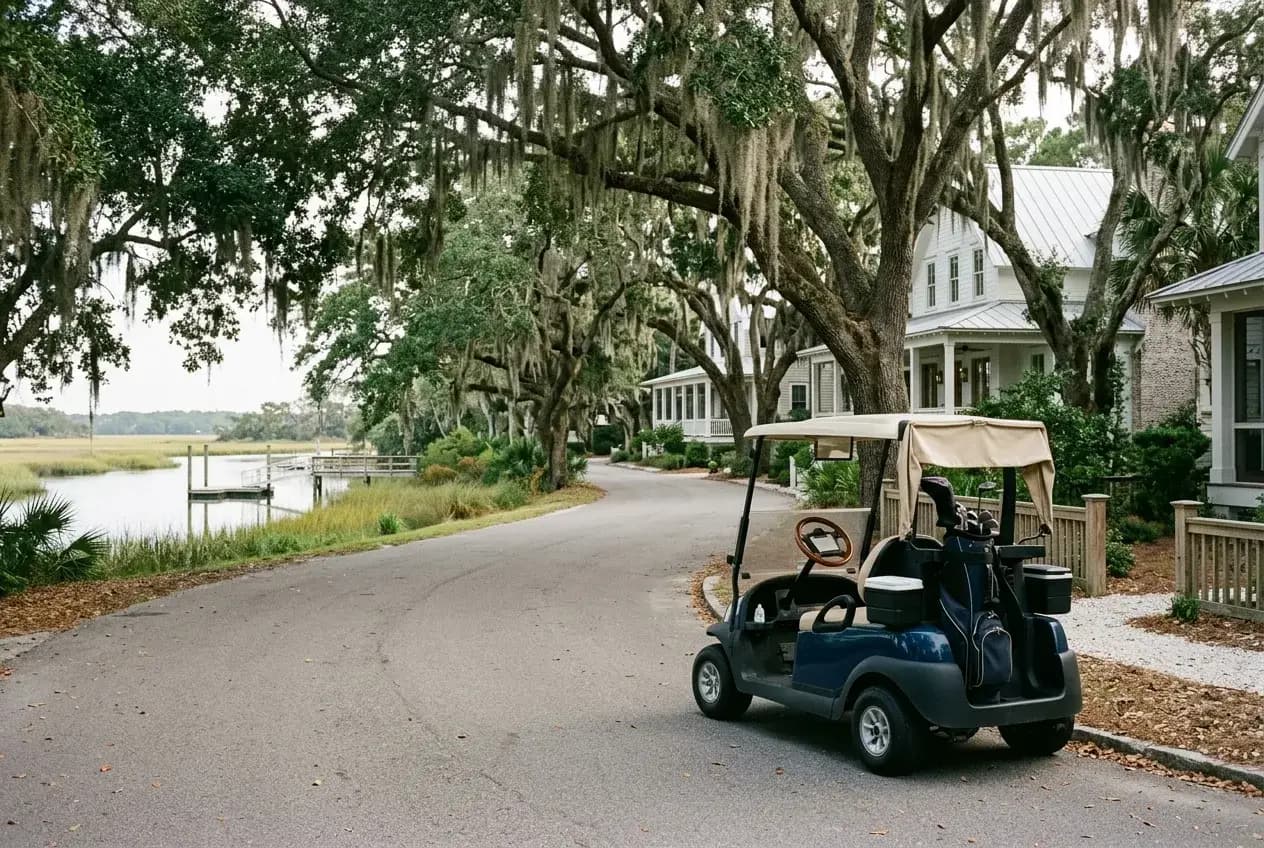
On the road itself, the rules echo the low-speed vehicle pattern, much like the LSV street-legal framework used elsewhere. A permitted cart may use secondary highways and streets where the posted limit is 35 mph or less, and may cross a road with a higher limit at an intersection. It should not travel along faster roads. Inside private communities and on island networks the local rules can be more generous on paths, but the public-road limits hold the moment you leave private land.
- Rule
- State golf cart permit and decal required
- What it means
- Register before road use
- Rule
- About four miles from the address
- What it means
- Errand radius, not open touring
- Rule
- Daylight as a baseline
- What it means
- Night only where allowed and equipped
- Rule
- 35 mph or less; cross higher at intersections
- What it means
- Stay off faster roads
- Rule
- Valid license and insurance
- What it means
- Same as any road vehicle
| Rule | What it means | |
|---|---|---|
| Permit | State golf cart permit and decal required | Register before road use |
| Distance | About four miles from the address | Errand radius, not open touring |
| Time of day | Daylight as a baseline | Night only where allowed and equipped |
| Roads | 35 mph or less; cross higher at intersections | Stay off faster roads |
| Driver | Valid license and insurance | Same as any road vehicle |
Island and beach-town exceptions
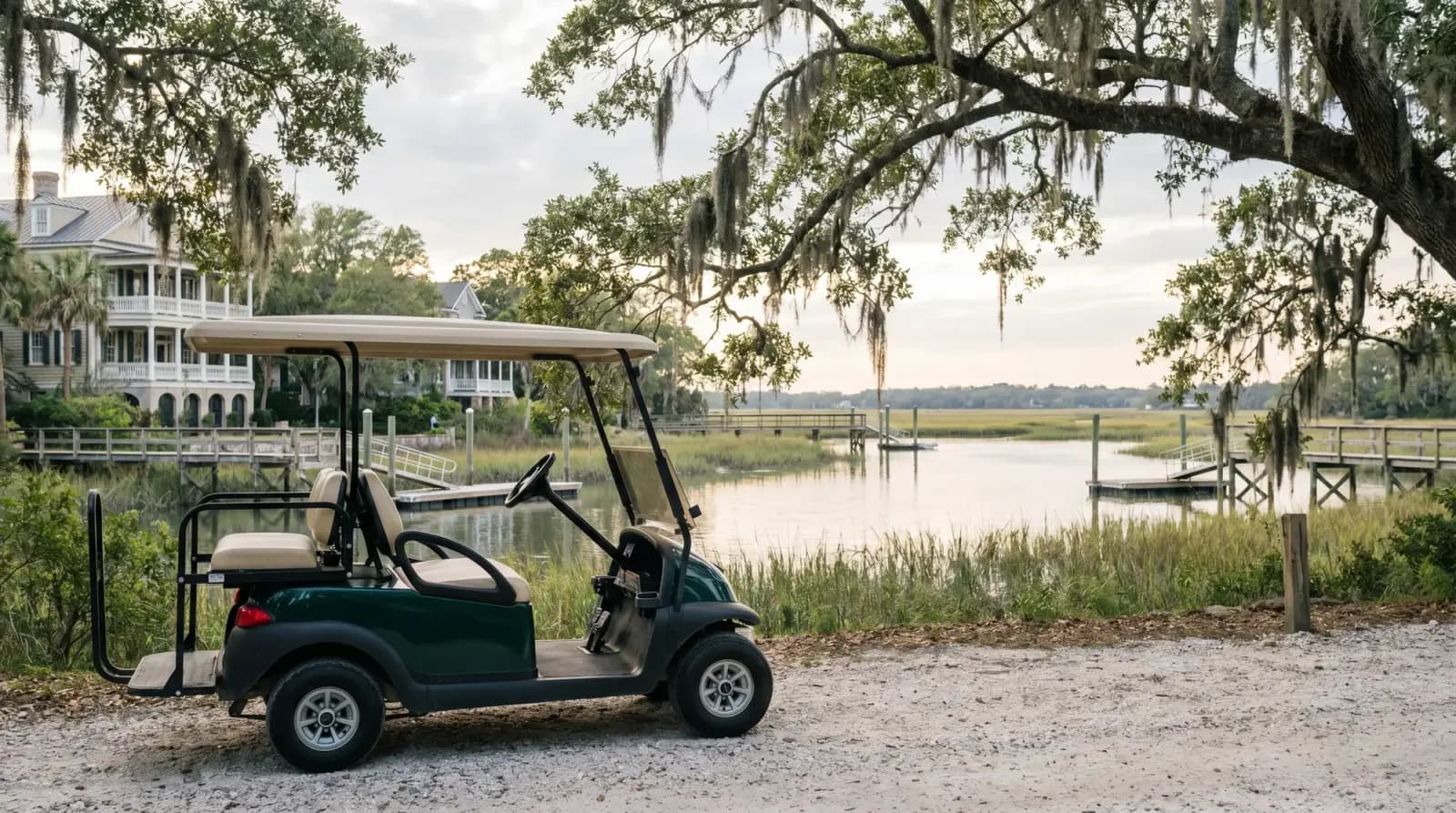
South Carolina's barrier islands and beach towns are where carts shine, and several have local ordinances that shape daily use. Communities on islands near Hilton Head, Beaufort and the Charleston area, and towns up the Grand Strand, each set their own rules on parking, beach access points and which streets are cart friendly. Some are stricter than the state baseline, a few are more permissive on paths. The pattern is the same everywhere: the state sets the floor and the town adds its own layer.
- Beach access parking for carts is often designated and limited, especially in peak season.
- Some towns require a local decal or sticker in addition to the state permit.
- Cart theft rises in summer; many islands recommend wheel locks and removable keys.
- Crossing the main highway is usually only legal at signed intersections, not mid-block.
License, age and insurance
The driver of a permitted cart on a public road must hold a valid driver license, and liability insurance is part of obtaining and keeping the permit. Inside a private community, the community's own age and conduct rules may apply, but on the public road it is a licensed-driver activity. Our insurance guide covers what coverage actually protects you, which matters more than the legal minimum if there is ever an incident.
So what should a South Carolina buyer do?
Plan around the permit, the four-mile radius and the daylight rule from the start. If those limits do not fit your life, look at a full low-speed vehicle instead, which carries broader road rights. Either route, confirm the rules with your county, your town and the SC DMV. If you would like a cart specified and equipped for South Carolina coastal use, we are happy to help with real numbers.
Get a coast-ready cart specified
Tell us your town and how far you drive, and we will spec a permit-ready cart with an honest price.
Frequently asked questions
Do I need a permit to drive a golf cart in South Carolina?+
Yes. South Carolina requires a golf cart permit and registration before driving on public roads. You provide proof of ownership, a valid driver license and liability insurance, and display the permit decal.
How far can I drive a golf cart in South Carolina?+
A permitted cart may generally be driven within about four miles of the address or point of business on its registration. Beyond that radius it is no longer covered by the permit.
Can I drive my golf cart at night?+
As a baseline, permitted carts are limited to daylight hours. Some areas allow more where the cart is properly equipped with lights, so confirm with your county and the SC DMV before driving after dark.
What roads can a golf cart use?+
Permitted carts may use secondary roads posted at 35 mph or less and may cross a higher-speed road at an intersection. They should not travel along faster roads.
Is insurance required for a South Carolina golf cart?+
Yes. Liability insurance is part of obtaining and keeping the golf cart permit, and the driver must hold a valid license. Confirm exact requirements with the South Carolina DMV.
Related solutions
Ready to explore what we build?
See the vehicles and the setting this applies to, or get a tailored quote built around your site.
Ready to find the right golf cart?
Tell us how and where it will work and we will specify a vehicle and a tailored quote built around you. Every build comes with a 3-year warranty and a 24-hour priority call-out.
Our guides are written and reviewed by the Hawke Electric Vehicles team, the people who specify, build, deliver and support the vehicles. We focus on honest, practical advice and flag where a figure depends on the build rather than guessing.
More guides by Hawke