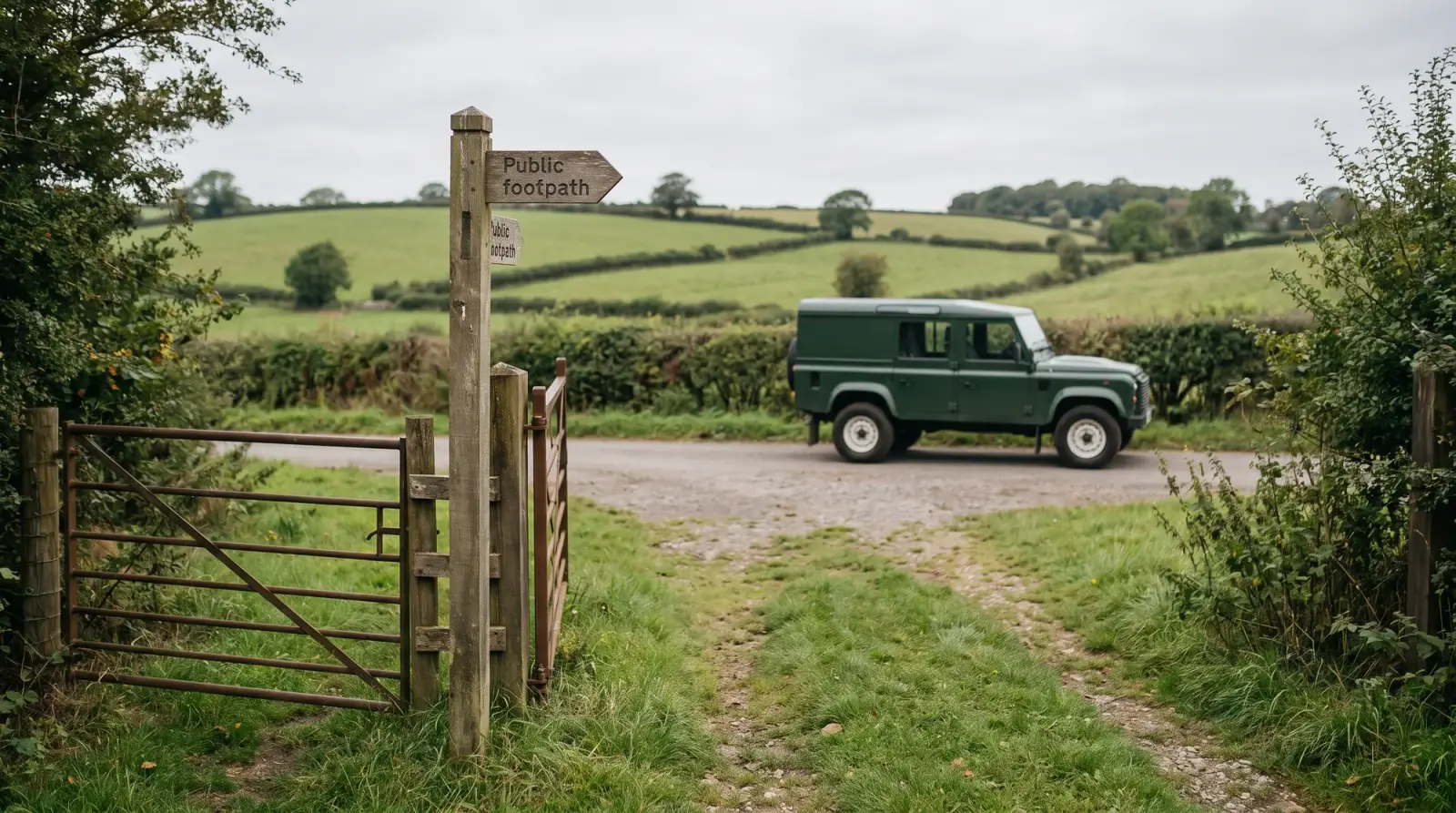
The moment a golf cart's wheels touch a public road, road traffic law applies to it in full, even if it's only crossing ten metres of quiet lane between the 9th green and the 10th tee. That means driver licensing rules, compulsory insurance under section 143 of the Road Traffic Act 1988, and vehicle standards the cart was never built to meet.
Plenty of UK courses live with this every day. A B-road or farm lane splits the front nine from the back, members trundle across between holes, and nothing bad ever seems to happen. We'll be straight with you: this is a grey, enforcement-light corner of the law, and prosecutions are rare. But the legal position is clear enough that clubs should understand it properly, because the day it matters is the day a cart and a car meet on that lane, and at that point every technicality becomes very real.
- A public road crossing puts a cart inside the full road traffic regime: licence, insurance (s.143 RTA 1988) and vehicle standards, however short the hop.
- An unregistered, untaxed, uninsured cart crossing a road is technically committing several offences, which is why some clubs build underpasses or reroute.
- The "public place" doctrine can extend road traffic law to car parks and other areas the public can access.
- Signage and marshalling manage the risk sensibly but don't remove the legal issue.
- Registering golf carts for limited road use is possible in principle but the type approval and registration route is heavy.
Why do ten metres of tarmac change everything?
Because the Road Traffic Act doesn't measure distance. Section 143 makes it an offence to use a motor vehicle on a road (or other public place) without insurance against third-party risks, full stop. Driving licence requirements, minimum age rules, and construction and use standards (lights, brakes, tires and the rest) attach the same way. A standard golf cart has no number plate, no vehicle registration, no type approval and usually no insurance certificate that covers road use, so a bare crossing ticks several offence boxes at once. Our guide to licensing, tax and MOT rules for golf carts walks through each requirement.
Would anyone actually be prosecuted for pottering across a lane? Usually not; police forces have better things to do, and many crossings have operated for decades without trouble. The scenario that bites is a collision. A driver swerves to avoid a cart, a cyclist comes round the bend too fast, a member is struck crossing back with the sun low. Now there's an injured party, an insurance claim, and an insurer on the other side pointing out that the cart had no business being on the road at all. That's when the grey area stops being comfortable.
The "public place" trap most clubs miss
Road traffic law doesn't stop at the white line. Key offences, including uninsured use, apply on a road "or other public place", and the courts have interpreted public place widely. A car park that the public can drive into, a venue open for an event, an access road used freely by visitors: all can count. So a club whose golf carts never touch the lane, but do cross the members' car park to reach the first tee, may still be inside the doctrine's reach. It's a point worth raising with your insurer explicitly, and our golf cart insurance guide explains what cover to ask about.
What do careful clubs actually do?
In practice, clubs bisected by a road pick from a short menu, and each option trades cost against how much legal exposure it removes. The gold standard is grade separation: an underpass or bridge, so golf carts never touch the highway. Several UK clubs have built exactly that, usually when a road got busier or a new hole layout forced the issue. It's expensive, and it's also the only option that removes the problem entirely.
- Does it fix the legal issue?
- No
- Cost and effort
- None
- Honest verdict
- Common, but all the risk sits unmanaged
- Does it fix the legal issue?
- No, but it manages the risk
- Cost and effort
- Low
- Honest verdict
- The sensible minimum for most clubs
- Does it fix the legal issue?
- Yes, where geography allows
- Cost and effort
- Medium
- Honest verdict
- Underrated; often just costs a few minutes per round
- Does it fix the legal issue?
- Yes, completely
- Cost and effort
- High (planning plus construction)
- Honest verdict
- The permanent fix if the road is busy
- Does it fix the legal issue?
- Yes, if achieved
- Cost and effort
- High (type approval, registration, insurance, driver rules)
- Honest verdict
- Heavy and rarely worth it for a crossing alone
| Does it fix the legal issue? | Cost and effort | Honest verdict | |
|---|---|---|---|
| Do nothing, golf carts cross freely | No | None | Common, but all the risk sits unmanaged |
| Designated crossing, signage, marshals on busy days | No, but it manages the risk | Low | The sensible minimum for most clubs |
| Reroute golf carts the long way on private land | Yes, where geography allows | Medium | Underrated; often just costs a few minutes per round |
| Underpass or bridge | Yes, completely | High (planning plus construction) | The permanent fix if the road is busy |
| Register golf carts for limited road use | Yes, if achieved | High (type approval, registration, insurance, driver rules) | Heavy and rarely worth it for a crossing alone |
The registration route deserves a word because members often assume it's simple. It isn't. Getting a cart onto the road lawfully means satisfying DVLA registration requirements, which lean on type approval or individual vehicle approval, plus lights, indicators and mirrors the machine wasn't designed with, road-rated insurance and a licensed driver every trip. Some specializt vehicles do make it through. For a single quiet crossing, most clubs conclude the underpass fund is a better use of the money. If road capability really matters to your operation, ask about it at specification stage rather than trying to convert a course cart later; can you drive a golf cart on the road covers what conversion involves.
What should a club crossing policy say?
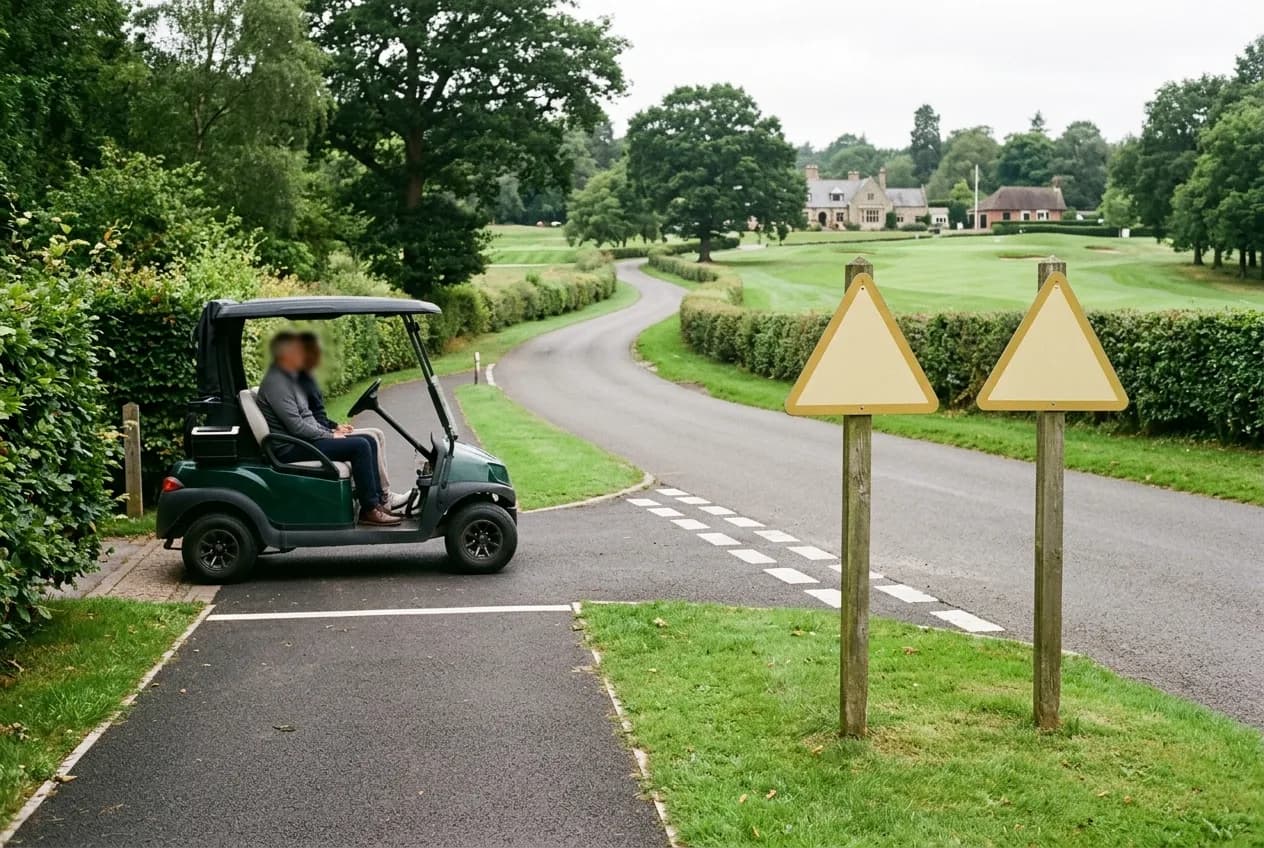
If your club decides, eyes open, to keep a surface crossing, write the policy down. Name the single permitted crossing point and ban crossing anywhere else. Require a full stop and look both ways, exactly like a junction. Set a marshal on competition days and during societies. Put reflective signage on both approaches for drivers, and cut back sightline vegetation twice a season. Record near-misses in the same incident log you use for everything else, because a pattern of near-misses is the evidence that gets an underpass past the committee. None of this makes the crossing legal. All of it makes an incident less likely, and shows a court or insurer that the club took the risk seriously.
Hire customers deserve a special mention. A member might know the lane; a visitor or society player hiring a cart doesn't. Brief the crossing at the hire desk, mark it on the course map, and say plainly that the cart must not be driven along the road itself. It takes thirty seconds and closes the most likely gap.
Frequently asked questions
Is it legal to cross a public road in a golf cart?+
Strictly, an unregistered and uninsured cart commits offences the moment it's driven on the road, even briefly. Enforcement is rare, but the legal position doesn't soften because a crossing is short or customary.
Does a cart need number plates to cross a road?+
To be on a road lawfully a vehicle needs to be registered (and so plated), roadworthy to the applicable standards, insured, and driven by someone with the right licence. A standard course cart meets none of these, which is the heart of the problem.
Does our insurance cover golf carts crossing the highway?+
Often not. Course-use policies frequently exclude the public highway, and sometimes publicly accessible car parks too. Ask your broker in writing, and don't assume the answer.
Is a car park a public place under the Road Traffic Act?+
It can be. Courts have treated car parks and similar areas that the public can access as "public places" for road traffic offences, including uninsured use, so cart routes through a visitor car park deserve the same scrutiny as a road crossing.
What should a club crossing policy include?+
One designated crossing point, a mandatory stop, marshalling on busy days, driver-facing signage on both approaches, maintained sightlines, hire-desk briefings for visitors and an incident log. It manages the risk rather than removing the legal issue, and it should say so honestly.
A club in this position should treat the marshalled, signed, single-point crossing as this season's job, cost the reroute and underpass options properly for the five-year plan, and get its insurance position confirmed in writing this month. That sequence costs almost nothing up front and turns an unmanaged legal grey area into a documented, defensible system. Take formal advice from a solicitor before relying on any of it; road traffic law is unforgiving of assumptions.
Speccing golf carts for a complicated site?
If your course or venue needs vehicles with road-capable specification, or you'd rather plan routes around a fleet that never needs the lane, talk to us. We'll quote the right configuration for the ground you actually have.
Related solutions
Ready to explore what we build?
See the vehicles and the setting this applies to, or get a tailored quote built around your site.

Ready to find the right golf cart?
Tell us how and where it will work and we will specify a vehicle and a tailored quote built around you. Every build comes with a 3-year warranty and a 24-hour priority call-out.
Our guides are written and reviewed by the Hawke Electric Vehicles team, the people who specify, build, deliver and support the vehicles. We focus on honest, practical advice and flag where a figure depends on the build rather than guessing.
More guides by Hawke