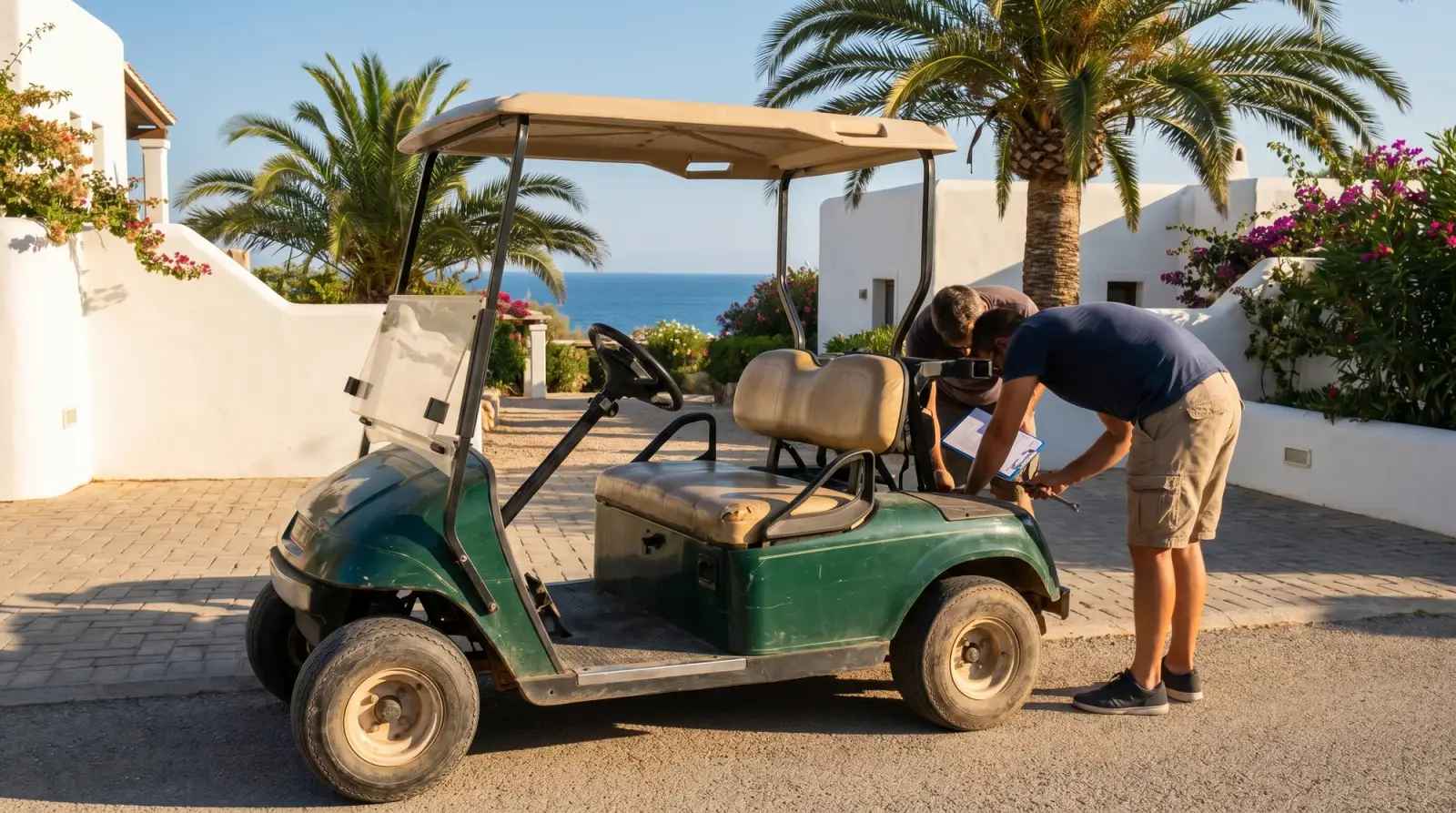
- A used golf buggy can be good value in Spain, but the battery is where hidden heat damage shows up, so check it first.
- Ask for the buggy's history: how it was stored, whether it was shaded, and how old the battery is.
- Inspect in daylight and test drive on a slope if you can, to reveal weak motors and brakes.
- Faded trim and a tired canopy are clues the buggy has lived in the sun without care.
- A new build gives the longest warranty, so weigh a used bargain against that honestly.
What should you check when buying a used golf buggy in Spain? Start with the battery, because that is where the Spanish heat does its quiet damage, and a tired battery is the most expensive thing to put right. After that, look at the motor, brakes, canopy and trim, ask honest questions about how the buggy was stored, and test drive it on a slope if you can. A good used buggy is a sound buy; a sun-baked, neglected one is a costly mistake. This checklist helps you tell them apart.
Start with the battery
In Spain, the battery is the part most affected by years of heat, and it is also the most expensive to replace. A buggy that looks smart can still hide a worn battery, so this is where to focus first.
- Ask how old the battery is and whether it is the original.
- Find out the battery type. Lithium handles heat better than older lead-acid.
- Ask how the buggy was charged and stored, especially in summer.
- Check the range on a test run against what the seller claims.
- Look for any signs of swelling, corrosion or poor connections.
Motor, brakes and drive
Many Spanish estates are hilly, so a buggy that feels fine on the flat may struggle where you actually need it. Test it properly.
- 01
Listen at start-up
Note any grinding, whining or hesitation when you pull away.
- 02
Test on a slope
Drive up an incline, loaded if possible, to reveal a weak motor.
- 03
Check the brakes
Brake on a descent and feel for confident, even stopping.
- 04
Watch the steering
Look for play, pulling to one side or uneven tyre wear.
- 05
Run it a while
A longer test shows whether range and performance hold up.
Bodywork, canopy and trim
The cosmetic condition tells a story about how the buggy lived. Heavy fading and a brittle canopy suggest years in the sun without shade or cover, which usually means the unseen parts had a hard life too.
- Faded, cracked seats and trim point to long sun exposure.
- A brittle or torn canopy may need replacing and hints at neglect.
- Corrosion on fittings is common near the coast; check it is only cosmetic.
- Check the canopy and frame are solid, not just present.
Paperwork and provenance
Ask for any service history, the original specification and proof of ownership. If the buggy was ever used on public roads, check what registration or paperwork exists, because that ties into the broader question covered in our guide to road rules for golf buggies in Spain. For private-estate buggies the paperwork is lighter, but provenance still matters.
Negotiating and walking away
Once you have inspected the buggy honestly, let what you found shape the conversation. A worn battery, a tired canopy or weak brakes are real future costs, and it is fair to factor them in. Just as important is the discipline to walk away if the picture does not add up, because a cheap buggy that needs a new battery is rarely cheap at all.
- Price in the cost of any battery, canopy or brake work the buggy clearly needs.
- Be wary of a seller who cannot or will not answer questions about age and storage.
- Compare the all-in cost, including likely repairs, against a new build with full warranty.
- Walk away if the heat history is unknown and the battery condition is uncertain.
A sound used buggy bought with eyes open is a fine purchase. The mistakes happen when buyers fall for the cosmetic shine and skip the battery and drive checks. Take your time, ask the awkward questions, and let the answers decide.
Prefer the certainty of new?
If a used buggy's history worries you, a built-to-order buggy gives you the exact spec and the full warranty. Request a tailored quote and compare honestly.
Used bargain or new build?
A sound used buggy, checked carefully, can be genuine value. But weigh it honestly against a new build, which gives you exactly the seats, canopy and finish you want plus a three-year warranty, all specified for the Spanish climate. If your usage justifies it, new may be the better long-run choice; our guide to hiring versus buying a golf buggy in Spain helps you frame that decision. You can see the configurations in the range and find more advice across our guides.
Frequently asked questions
What is the most important thing to check on a used buggy in Spain?+
The battery. Years of heat age it quietly, and it is the most expensive part to replace. Ask its age and type, check the range on a test run, and ask how the buggy was stored and charged.
How can I tell if a buggy has had a hard life in the sun?+
Look for badly faded seats and trim and a brittle canopy. These cosmetic clues usually mean the buggy was parked in full sun without care, which suggests the battery suffered too.
Should I test drive on a hill?+
Yes, if you can. Many Spanish estates are hilly, and a slope reveals a weak motor and tired brakes that feel fine on the flat. Test it loaded if possible.
What paperwork should I ask for?+
Service history, original spec and proof of ownership. If the buggy was ever used on public roads, check what registration exists, as that ties into national road rules.
Is used always cheaper than new in the long run?+
Not always. A sound used buggy can be good value, but a replacement battery or repairs can erode the saving. Weigh a checked used buy honestly against a new build with full warranty.
Related solutions
Ready to explore what we build?
See the vehicles and the setting this applies to, or get a tailored quote built around your site.
Ready to find the right buggy?
Tell us how and where it will work and we will specify a vehicle and a tailored quote built around you. Every build comes with a 3-year warranty and a 24-hour priority call-out.
Our guides are written and reviewed by the Hawke Electric Vehicles team, the people who specify, build, deliver and support the vehicles. We focus on honest, practical advice and flag where a figure depends on the build rather than guessing.
More guides by Hawke