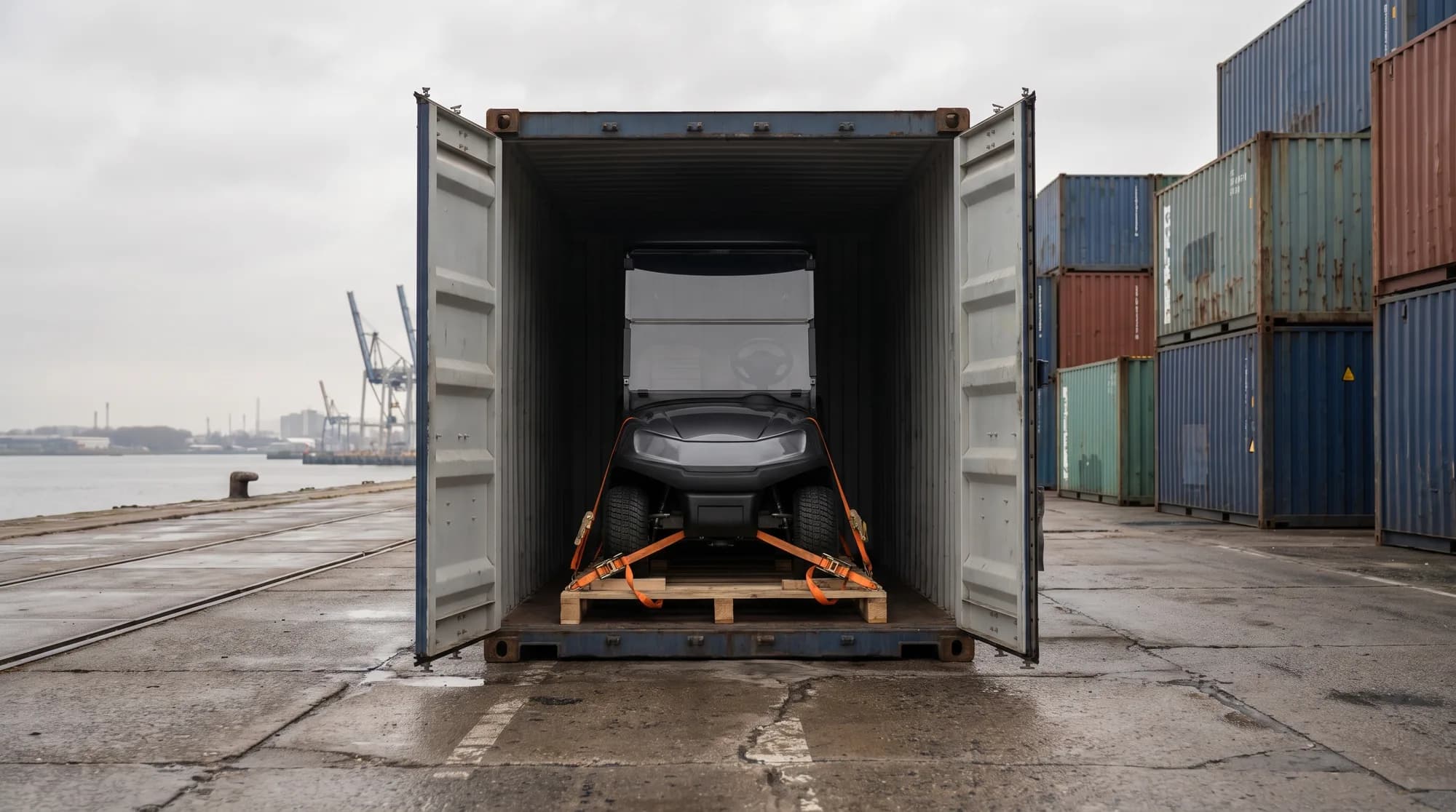
Importing a golf cart to the UK typically means paying around 10% import duty, then 20% VAT on the whole landed value, plus £1,000 to £2,500 in shipping from the US. Stack those up and a cheap American cart usually lands within touching distance of UK market prices, before you've dealt with the 110V charger it can't use here.
That's the short version. The longer version involves HS codes, VAT on shipping (yes, really), a charger swap, parts support that lives an ocean away, and the small matter of buying a used vehicle you've never seen. Some imports do make sense, usually rare models with no UK equivalent. For a standard cart, the maths rarely survives contact with the invoice. Here's the full picture, worked example included.
- Golf carts fall under HS code 8703.10, typically attracting around 10% duty on imports from the US, with 20% VAT then charged on price plus shipping plus duty.
- Shipping a cart from the US typically costs £1,000 to £2,500 depending on method and port.
- US carts ship with 110V chargers that need replacing for UK mains, and US-spec parts and warranty support don't travel.
- EU imports also attract duty and VAT post-Brexit unless rules-of-origin conditions are met. Cheap EU listings aren't automatically duty-free.
- A worked example on a $4,000 cart typically lands within range of simply buying in the UK, with none of the risk.
What do you actually pay at the border?
Three layers, calculated in a specific order. First, the customs value: the price you paid plus shipping and insurance to the UK. Second, import duty on that value. Golf carts are classified under HS code 8703.10 (vehicles specially designed for travelling on snow; golf cars and similar vehicles), and the UK tariff on that heading from the US is typically around 10%, though rates can change and trade arrangements shift, so check the UK Integrated Online Tariff on gov.uk for the current figure before committing. Third, VAT at 20%, and this is the step that stings: it's charged on the landed total, meaning price plus shipping plus the duty you just paid. You pay tax on the tax.
On top of that come the fees people forget: customs clearance and broker charges (often £100 to £300), port handling, and delivery from the port to your door, which for a vehicle that can't be driven on the road means transport on a trailer or truck. None of these is huge alone. Together they're rarely under a few hundred pounds.
The worked example: the $4,000 cart
Numbers make this concrete. Say you find a tidy used cart in Florida for $4,000, roughly £3,150 at a typical exchange rate. Here's how it lands, using mid-range typical costs.
- Typical amount
- £3,150
- Running total
- £3,150
- Typical amount
- £1,500
- Running total
- £4,650
- Typical amount
- £465
- Running total
- £5,115
- Typical amount
- £1,023
- Running total
- £6,138
- Typical amount
- £350
- Running total
- £6,488
- Typical amount
- £250
- Running total
- £6,738
| Typical amount | Running total | |
|---|---|---|
| Purchase price | £3,150 | £3,150 |
| Shipping and insurance to UK | £1,500 | £4,650 |
| Import duty (~10% of customs value) | £465 | £5,115 |
| VAT (20% on landed value) | £1,023 | £6,138 |
| Clearance, port and UK delivery | £350 | £6,488 |
| Replacement 230V charger | £250 | £6,738 |
So the $4,000 bargain lands at roughly £6,700, more than double the sticker price, for a used vehicle you've never sat in, with no warranty, no UK dealer behind it and US-spec parts. Compare that with what the same money buys on the UK used and new market (our guide to electric golf cart costs in the UK sets out the going rates) and the saving has mostly evaporated. Sometimes it goes negative.
The catches that don't show up on the invoice
The charger and the electrics
US carts are built for 110V mains. Plug that charger into a UK 230V socket and you'll destroy it, possibly dramatically. A step-down transformer is a clumsy workaround for a device that runs for hours at a time, so the practical answer is a new 230V charger matched to the battery pack, typically £150 to £400. Budget it from the start.
Parts, support and warranty
Any manufacturer warranty is unlikely to be honoured in the UK, and US-market variants can differ from their UK equivalents in controllers, chargers and trim, which turns simple part orders into detective work. When something fails, and on a used cart something will, you're either importing parts with the same duty-and-VAT treatment or adapting UK stock. Fine for a confident home mechanic. Expensive and slow for everyone else.
Compliance, registration and sight-unseen risk
A golf cart isn't road-legal in the UK by default, imported or not, so most imports never need DVLA registration; if a vehicle were ever to be registered, a NOVA (Notification of Vehicle Arrivals) declaration to HMRC would come into play, but for a private-land cart it's usually academic. Where compliance does bite is commercial use: put an imported cart to work at a business, and UKCA/CE conformity and workplace-equipment rules (PUWER) become your problem rather than a manufacturer's. And every one of these carts is bought sight-unseen, an ocean away, with photographs standing in for a battery load test. The rules on where you can legally drive any cart are covered in our guide to golf cart road legality.

What about importing from the EU?
Post-Brexit, an EU purchase is a real import too. The UK-EU trade deal only gives zero tariffs where rules of origin are met, meaning the cart must be sufficiently made in the EU. Many carts sold in Europe are manufactured elsewhere, so they don't qualify, and the roughly 10% duty applies just as it does from the US. VAT at 20% applies either way. Shipping is cheaper across the Channel than across the Atlantic, and EU models at least come with 230V chargers, so the maths is less brutal, but the warranty, support and sight-unseen problems remain. Check origin paperwork before assuming a Dutch or German listing is duty-free.
Import vs buy in the UK: the honest comparison
- Import from US
- Sticker price roughly doubles once landed
- Buy in the UK
- The price you're quoted is the price
- Import from US
- Usually none valid in the UK
- Buy in the UK
- Dealer warranty; 3 years on a new Hawke
- Import from US
- US-spec, ocean away, duty on every order
- Buy in the UK
- UK dealer support and call-out
- Import from US
- 110V unit needs replacing (£150-400)
- Buy in the UK
- 230V, ready to plug in
- Import from US
- Sight-unseen used vehicle, no recourse
- Buy in the UK
- Inspect, test drive, consumer rights apply
- Import from US
- Weeks at sea plus customs
- Buy in the UK
- Days
| Import from US | Buy in the UK | |
|---|---|---|
| All-in cost | Sticker price roughly doubles once landed | The price you're quoted is the price |
| Warranty | Usually none valid in the UK | Dealer warranty; 3 years on a new Hawke |
| Support and parts | US-spec, ocean away, duty on every order | UK dealer support and call-out |
| Charger | 110V unit needs replacing (£150-400) | 230V, ready to plug in |
| Risk | Sight-unseen used vehicle, no recourse | Inspect, test drive, consumer rights apply |
| Timescale | Weeks at sea plus customs | Days |
There is one honest case for importing: a specific model or configuration that simply isn't sold here, where you accept the premium as the price of getting exactly what you want. For a standard cart, the UK market already offers everything from budget used stock to premium new machines, and our electric golf cart buyer's guide will get you to the right one without a customs form in sight.
Frequently asked questions
How much is import duty on a golf cart?+
Typically around 10% for carts under HS code 8703.10 imported from the US, calculated on the price plus shipping and insurance. Rates can change with trade arrangements, so check the UK Integrated Online Tariff for the current figure.
Do you pay VAT on an imported golf cart?+
Yes, 20% VAT is charged on the landed value, which means the purchase price plus shipping plus the import duty. On a typical US cart that adds £1,000 or more to the bill.
Does an imported golf cart need DVLA registration?+
Not for private-land use, which is where golf carts legally belong in the UK anyway, as they aren't road-legal by default. NOVA notification only becomes relevant if a vehicle were ever to be registered, which a standard cart usually can't be.
Will a US golf cart charger work in the UK?+
No. US chargers are built for 110V mains and UK sockets supply 230V, so plugging one in will destroy it. Budget £150 to £400 for a replacement 230V charger matched to the battery pack.
Is importing a golf cart cheaper than buying in the UK?+
Rarely. Once duty, VAT, shipping, clearance and a new charger are added, a typical US cart lands at or above UK market prices, without a warranty or local support. Importing only tends to make sense for models unavailable here.
Run the landed-cost maths before you fall for the sticker price, and use real quotes for shipping rather than the optimistic figure in a forum post. In almost every case we've seen, the money that would have gone on freight and VAT buys a better vehicle from UK stock, seen, tested and warrantied. Save the importing for something UK stock simply can't supply.
Get the UK price before you gamble on freight
Tell us what you need and we'll quote a Hawke cart to your spec, with a 3-year warranty, UK support and 24-hour call-out. Compare it with your landed-cost maths and decide with real numbers.
Related solutions
Ready to explore what we build?
See the vehicles and the setting this applies to, or get a tailored quote built around your site.

Ready to find the right golf cart?
Tell us how and where it will work and we will specify a vehicle and a tailored quote built around you. Every build comes with a 3-year warranty and a 24-hour priority call-out.
Our guides are written and reviewed by the Hawke Electric Vehicles team, the people who specify, build, deliver and support the vehicles. We focus on honest, practical advice and flag where a figure depends on the build rather than guessing.
More guides by Hawke